

Article
Thomas Carothers
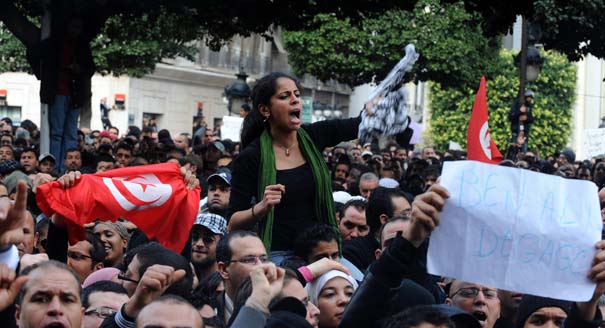
Source: Getty
While the departure of President Ben Ali does not necessarily signal a democratic transition, the international community can play a role in creating space for a genuine democracy to take root in Tunisia.
In the 1990s dictators fell by the dozen and we got used to receiving the startling news that another longtime strongman—seemingly entrenched in power indefinitely—was suddenly history. With democracy’s spread having slowed over the last decade we've gotten out of the habit of receiving such news and have forgotten some of the basic lessons of authoritarian collapse. The fall of President Zine El Abidine Ben Ali in Tunisia usefully reminds us of them.
First, sharp political change is often wholly unexpected and unpredicted. If you had asked the most knowledgeable team of experts on Arab politics five years ago, or even just one year ago, to predict the next Arab leader to leave office none of them would have named Ben Ali. I remember vividly in 1998 when demonstrations began to multiply in Indonesia and one of America's top Indonesia experts confidently told me that President Suharto was fully in control, in fact "at the top of his game" and would ride out the turmoil without problem. One month later Suharto was gone. Tipping points in political change are based on psychological thresholds, which are both difficult to predict and measure. Often the very people who know the country best are least able to foresee the change, rooted as they are in old assumptions of stability.
Second, if a leader is relying on "performance legitimacy” as justification of his place in power, the leash can snap with special quickness. Despite his grandiose rhetoric at times about his special role as protector of the nation, Ben Ali was able to stay in power without other forms of legitimacy—such as genuine elections, an appealing ideological vision, religious appeal, or ethnic identity—because of the country’s relative economic success. Once that success faded, and a large mass of citizens felt shut out, his legitimacy became a hollow trunk, ready to snap in the first hard wind.
Third, the power of citizen protest is extraordinary. No matter how well-armed and well-organized the regime, when large numbers of citizens are suddenly demonstrating in the streets of the capital and are willing to take bullets the regime is in serious trouble. Shortly after the fall of Nicolae Ceausescu in Romania in 1989, which also occurred just weeks after demonstrations broke out, a Romanian friend in Bucharest could not get over how little it ended up taking to drive the dictator out. All those years we put up with his horrors, he said, believing his apparatus to be invincible. And then we finally go into the streets, shout and throw some rocks, and the next thing we know he's on a helicopter in panic, flying away.
Fourth, although the international community often has little to do with sudden authoritarian collapse, it can play a critical role in the immediate aftermath. No Western government has pushed Tunisia hard on democracy and human rights in the past 10 years and none can take any credit for the end of the dictatorship. The United States and other Western governments can, however, play a vital role now.
The departure of Ben Ali does not necessarily signal a democratic transition. Some authoritarian systems offer up the ouster of a president in the hopes of keeping the rest of the repressive system in place. They promise elections that will be held but then quietly shut off the oxygen to the political transition process once the international attention fades. Washington and other Western capitals should press now to get specific commitments from the new Tunisian leadership that not only will elections be held, but that they will be meaningful—that there will be genuine space and time for political parties to organize and campaign; freedom of expression, association, and movement will be respected; the elections will be administered by independent authorities; and international observers will be allowed.
Washington largely missed the boat on helping Tunisians during their dark years of dictatorship; let's not miss the chance to make up for that now with meaningful pro-democratic engagement.

Harvey V. Fineberg Chair for Democracy Studies; Senior Fellow, Democracy, Conflict, and Governance Program
Thomas Carothers, a senior fellow in the Carnegie Endowment for International Peace’s Democracy, Conflict, and Governance Program, is a leading expert on comparative democratization and international support for democracy.
Recent Work
Thomas Carothers
Thomas Carothers
Carnegie does not take institutional positions on public policy issues; the views represented herein are those of the author(s) and do not necessarily reflect the views of Carnegie, its staff, or its trustees.

Ex-president Gurbanguly Berdimuhamedov remains interested in politics, but his son Serdar, Turkmenistan’s current president, is becoming increasingly independent and willing to break with his father’s legacy. If their covert rivalry goes too far, both risk losing power.

Galiya Ibragimova

Sergei Kiriyenko used Russia’s parliamentary vote to further hone his strategy of corporate mobilization that is designed to maximize votes for United Russia.

Andrey Pertsev

The European far right might fail to steer EU policy in the direction Russia wants, but they will create enough chaos inside Europe to benefit the Kremlin.

Dimitar Bechev

If the Russian-speaking community in Latvia cannot articulate their interests without being seen as disloyal, they could end up embracing a pro-Kremlin agenda.

Sergejs Potapkins

Russia’s ruling party would have benefited from Putin appearing as its distant patron, but as an active frontman imposing his views on the public, he has done nothing but harm both the party’s election campaign and the ruling system overall.
Andrey Pertsev