

Commentary
Geological complexity and years of mismanagement mean the Venezuelan oil industry is not the big prize officials in Moscow and Washington appear to believe.
Sergey Vakulenko
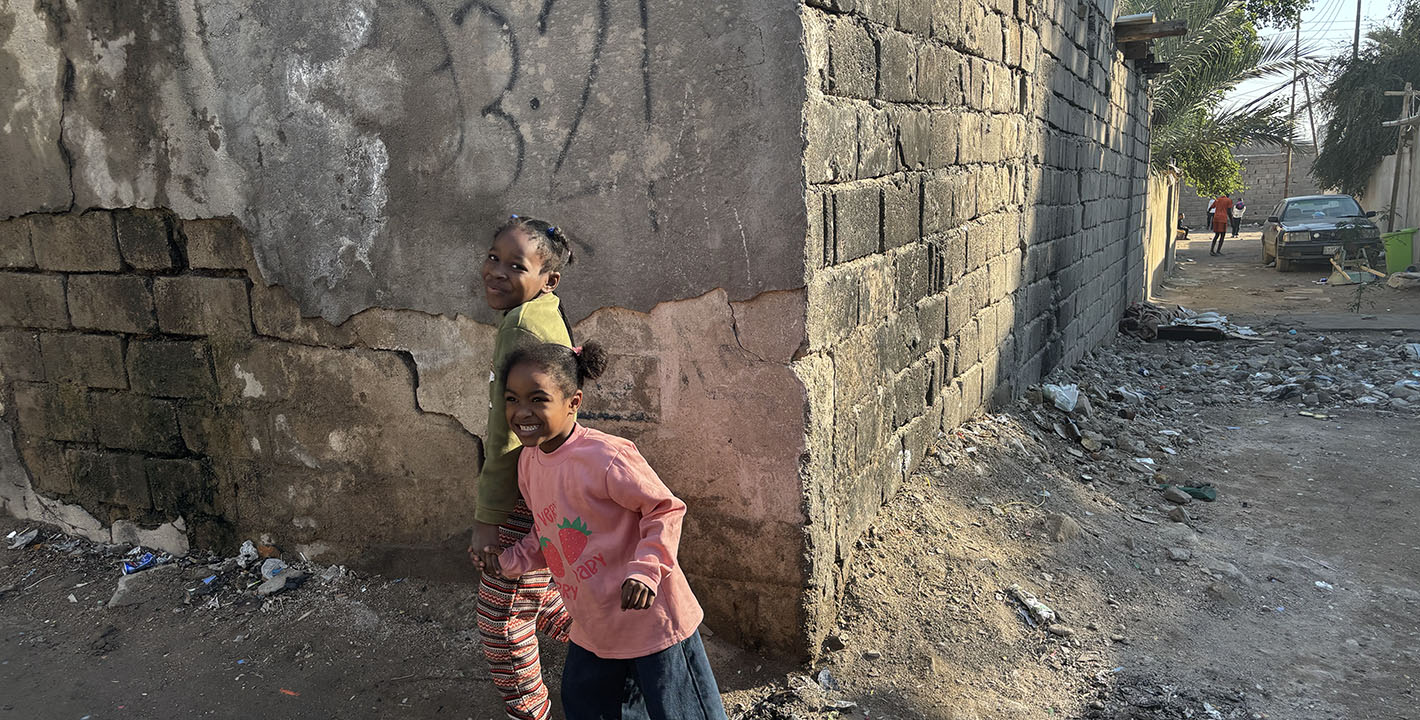
Two Afro-Iraqi children playing in the street in a Zubayr shantytown, Iraq. Source: Zeinab Shuker
Afro-Iraqis experience political, economic, and social marginalization and discrimination, which exposes the poorest members of the community to the harsh realities of the region’s climate disaster.
Iraq is among the countries in the world most vulnerable to climate change. The conditions there are expected to worsen if underlying factors such as state capacity and infrastructure are not improved. However, this vulnerability does not affect all regions or all social groups equally. Groups occupying a lower position in the socioeconomic and political hierarchies, especially those living in the most climate-sensitive parts of the country, are more likely to experience the worst of the climate crisis. One such group is the Afro-Iraqi community in Basra Governorate—estimated at between 400,000 and 2 million people—which is especially exposed to deteriorating climate conditions and environmental degradation, a situation exacerbated by the group’s vulnerable socioeconomic status.
Afro-Iraqis experience political, economic, and social marginalization and discrimination, which take several forms. These include a lack of access to resources, but also the use of derogatory terms to describe group members, which are the strongest indicators of disadvantage amid worsening environmental and climate conditions. Many community members suffer from high rates of poverty, illiteracy, and restricted social mobility. They are mainly engaged in manual labor or positions as entertainers, which decreases their economic and social status, as these roles are often looked down upon in Basra’s conservative society. These economic conditions expose the poorest members of the group to the harsh realities of the region’s climate disaster, which in recent years has led to significant increases in temperature and a decline in water quantity and quality. That is why the fate of the Afro-Iraqis is a good measurement of the suffering due to the extremes of climate change in Iraq.
The precarious conditions of Afro-Iraqis are being aggravated by Iraq’s climate crisis, especially in Basra, as well as by the community’s social challenges, deriving from its history and invisibility. The presence of people of African descent in Iraq dates back to the Abbasid era around the beginning of the ninth century, when large numbers of people from East Africa, especially from modern-day Kenya, Tanzania, Mozambique, Zanzibar, and Ethiopia, were enslaved and transported primarily to the city of Basra. They were forced into hard labor, such as draining salt marshes and mining salt, but also cultivating sugarcane and dates.
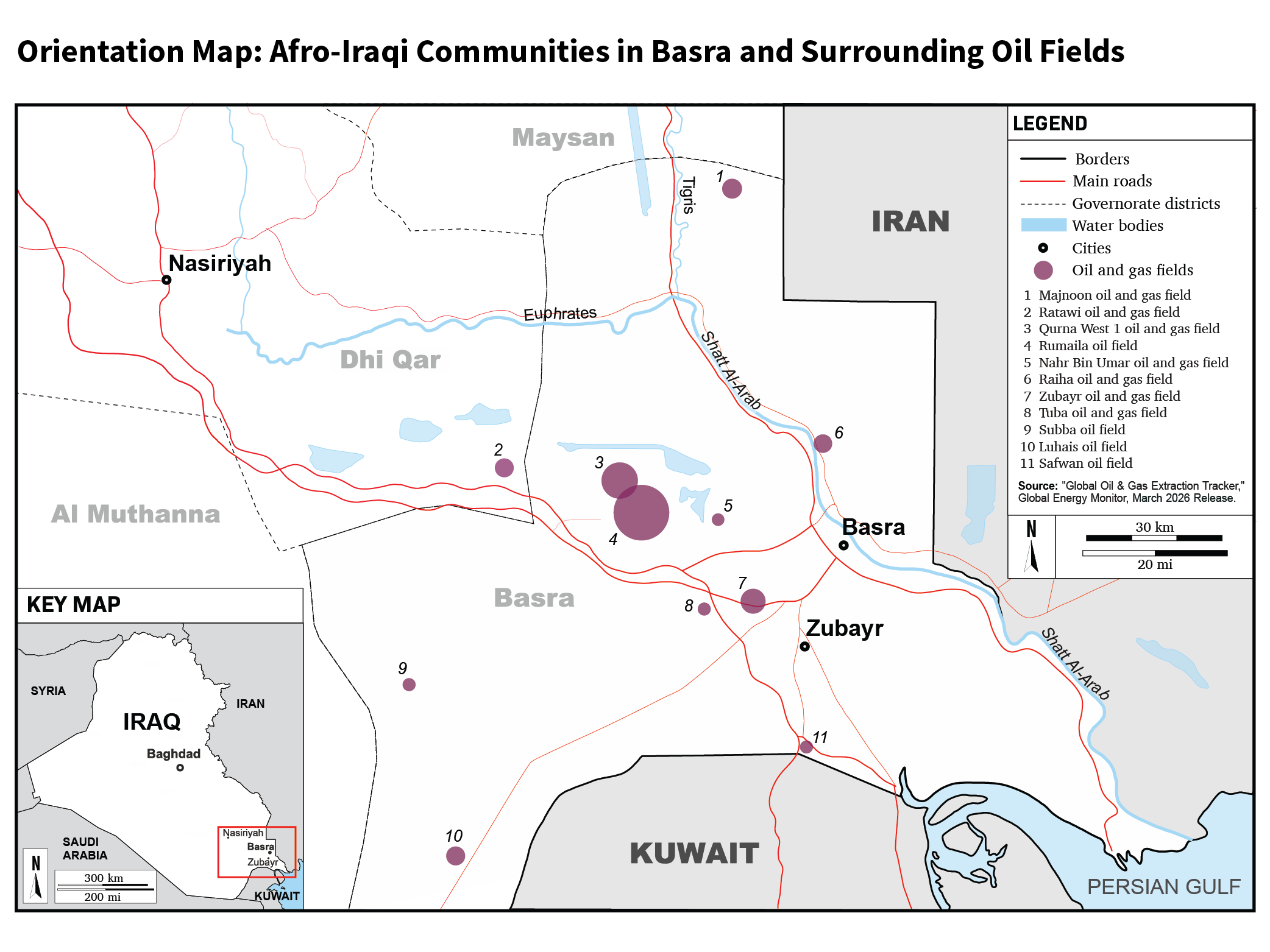
Racial prejudice became ingrained because of a labor market reliant on servitude, and later low-paying jobs. This was based on an ideological framework reinforcing the Afro-Iraqis’ social inferiority and marginalization. The situation persisted until modern times. A key moment in the community’s history was the Zanj Rebellion (869–883 CE), led by Ali ibn Mohammed, which was one of the most significant and longest slave revolts in history. Though ultimately suppressed, the revolt ended the large-scale use of enslaved labor in agriculture in southern Iraq. Under Ottoman rule, slavery remained legal until the early twentieth century. During the Arab and Ottoman empires, a distinct social stratification emerged among the slave populations, with so-called white slaves, such as the Mamelukes, able to reach senior military or administrative positions, while black slaves, referred to as abeed, were denied the option of advancement. Slavery was officially abolished in Iraq in 1924. Today, much of the Afro-Iraqi community resides in Zubayr, located some 28 kilometers from Basra. Others are scattered around Basra Governorate or in other southern governorates such as Amarah.
Afro-Iraqis have paid a heavy price as Iraq and the broader region’s environment has come under severe transformational pressures.
Afro-Iraqis have paid a heavy price as Iraq and the broader region’s environment has come under severe transformational pressures. Since winter 2020, large portions of West Asia, encompassing the Fertile Crescent around the Euphrates and Tigris Rivers, have experienced extreme drought conditions, and 2025 marked the worst drought on record in Iraq since 1933. Water quality in the country has also been steadily declining in recent years, as temperatures have been soaring, and the Iraqi political system has failed to act with urgency to address worsening climate and environmental conditions.
Increasing temperatures and decreasing precipitation have led to a decline in agricultural production, increased tension and conflict among groups over limited resources, and an impact on the quality of life of those affected. For instance, 92 percent of Iraq’s agricultural land is threatened by desertification due to climate-related events. A 2023 study found that 60 percent of farmers reported cultivating less land due to extreme drought, and that same year Iraq reported a decline in the harvest of eight of its top ten crops. This is an outcome of the country’s limited capacity to adapt to and mitigate the impact of climate change, poor infrastructure due to years of corruption, neglect, and conflict, which have increased the impact of climate-related events, and the suppression of civil society organizations involved in climate and environmental activism. These combined factors pushed the United Nations to label Iraq in 2022 as the fifth most vulnerable country to climate change.
Furthermore, given that many of the underlying conditions are systemic and political actors lack clear pathways to address poor institutional infrastructure, climate conditions will likely worsen. This leaves Iraq’s most vulnerable groups exposed to harsh conditions and their consequences—health risks, displacement, conflict, loss of income, and more. For instance, the country is expected to be the hottest in the region by 2050, and the gap between water demand and availability is projected to widen from around 5 billion cubic meters today to 11 billion cubic meters by 2035.
Iraq’s south, especially the city of Basra, is bearing the brunt of the climate crisis, despite significant oil resources. For instance, in 2018 water quality in Basra sharply declined, leading to waterborne diseases, the hospitalization of at least 118,000 people, and widespread protests against the local and federal government. The authorities responded with violence, quashing the protests. The water crisis in Basra is a long-term problem caused by several simultaneous factors, namely higher salinity, pollution, and infrastructure failure. For instance, reports indicate that untreated sewage flows directly into the Shatt al-Arab. Other key factors are declining water levels in the Tigris and Euphrates, before they merge into the Shatt al-Arab, along with poor infrastructure, unregulated water use, and reduced water flows from Türkiye and Iran. The marshlands in Nasiriyah and Amarah, which push water southward into the Shatt al-Arab and eventually the Persian Gulf, are also facing severe water shortages due to droughts and the drying up of wetlands caused by oil extraction projects. This has led to a significant drop in water levels in the Shatt al-Arab and an increase in salinity to over 30,000 parts per million, roughly half the salinity of seawater. Because Iraq still relies on an outdated flood irrigation system, saline water has severely damaged much of the farmland around Basra, particularly in areas such as Zubayr.
The combination of rising temperatures, environmental degradation, and poor resource management is making cities such as Basra unlivable during the summer months.
The loss of farmland and greenery has exacerbated the impact of high temperatures and pollution. Iraq has one of the highest carbon emissions per GDP rates in the region, mainly originating from the energy sector, including oil production and gas flaring. In fact, Iraq is responsible for the second highest percentage of gas flaring in the world after Russia. Consequently, cities and towns near oil refineries, such as Zubayr, suffer the worst impacts of oil- and gas-dependency and inadequate infrastructure. The combination of rising temperatures, environmental degradation, and poor resource management is making cities such as Basra unlivable during the summer months. Temperatures in Basra have frequently exceeded 53 degrees Celsius (127 degrees Fahrenheit), especially near oil fields. Groups with limited economic and political power are the ones most likely to live closer to such locations, due to the higher cost of living and competition for housing in Basra city, exposing them more to environmental and climate risks. The limited political power they enjoy curtails their ability and resources to advocate for solutions to their environmental challenges.
The legacy of slavery in Iraq, despite its abolition just over a century ago, can still be seen, especially in the invisibility of the Afro-Iraqi community in the national political and social discourse.1 To understand the group’s current marginalization and higher exposure to the risks of climate change and environmental degradation, we must understand its standing in the Iraqi political and economic system, especially after the U.S. invasion in 2003 and the downfall of Saddam Hussein.
With the Baath regime gone, Iraq entered a transition in which many components of the population received some form of political and social representation in the new order. The system created a hybrid form of rentierism, specifically the apportionment of quotas in the state to the country’s ethnosectarian groups. This provided access to economic opportunity and resources, strengthening patronage networks, and providing these groups with protection, while continuing Iraq’s dependency on oil production as a main source of income. However, Afro-Iraqis were not included in this carve-up, making them invisible in the political, economic, and social spheres. For example, in 2007, activist Jala Diab Thijeel founded the Free Iraqi Movement to advocate for Afro-Iraqi civil rights. The movement gained momentum after Barack Obama’s election in 2008, inspiring Afro-Iraqis to seek political representation. However, this was met with violence and Diab’s assassination in 2013.
This brutal response, among other factors, reinforced the idea that racial categorization was not welcomed in Iraq at the time, underlining that one’s race was not a significant aspect of one’s identity, history, and socioeconomic standing. Diab’s killing pushed many members of the Afro-Iraqi community (and the majority of those interviewed in the focus group for this article) to minimize the role of racial identity in their lives, whether out of fear of retaliation or out of a genuine belief that such an identity was not a primary characteristic of their lives.2 While members of the community tend to downplay their race in conversations, almost all of them, when pushed, justified such an attitude by saying that they didn’t want to attract attention or trouble to themselves, while citing examples of racial discrimination.
Many members of the Afro-Iraqi community live in Zubayr alongside people not from their community. The town’s main identifying feature is the residents’ socioeconomic status. A majority of Zubayr’s residents are lower-income individuals living in difficult conditions, characterized by limited infrastructure and resources.3 The main road connecting Basra to Zubayr is paved, as are some of the town’s key roads. This is a recent development, however, thanks to the initiative of Asaad Abdulamir al-Eidani, a politician and businessman who has been the governor of Basra since 2017.4 However, all of Zubayr’s side streets are unpaved, and many are inaccessible by car. When it rains, the side streets become muddy and very difficult for pedestrians, who have to use wooden planks and other means to avoid getting fully covered in mud.5 That is why the inhabitants will point out that the winter or rainy season, not the hot summer months, are the most challenging for them, as even light rain renders streets impassable and keeps children from attending school or adults from working.
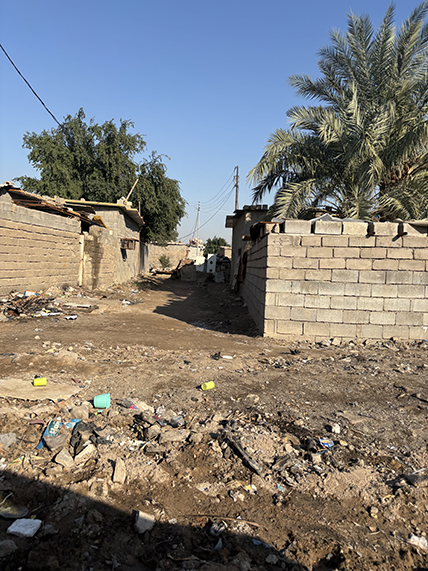
A side street after light rain in a Zubayr shantytown, Iraq. Source: Zeinab Shuker
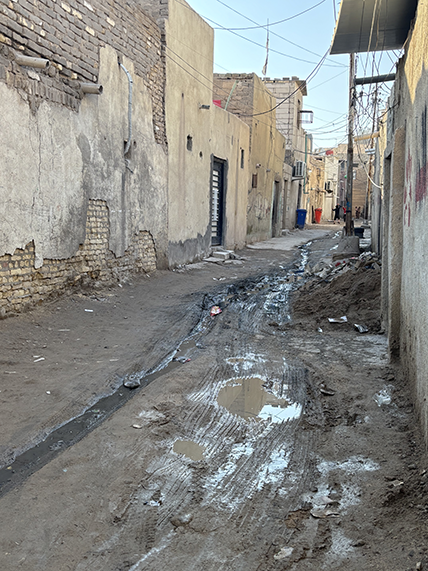
An unpaved side street after a light rain in Zubayr, Iraq. Source: Zeinab Shuker
Not only are many streets unpaved, but for decades the sewer infrastructure was either outdated or nonexistent, leading to sewage entering homes and flooding streets during the rainy season.6 Many residents pointed out that only in recent years has a new infrastructure been built, leading to a significant improvement in the quality of life. However, these improvements have not extended to the shantytowns around Zubayr. Certain neighborhoods are also close to oil refineries, and driving through them, one can smell flared gas filling the air, making breathing very difficult. Other residents who do not live near these refineries say that on windy days the smell of gas and burning oil products permeates the whole town.7 Beyond the polluted air and inaccessible side streets, garbage dumps are present alongside residential areas, with children frequently playing in these dangerous landfills. Additionally, surplus garbage is frequently set on fire, and because these sites are located near homes, the smoke spreads throughout inhabited areas, especially on windy days.8
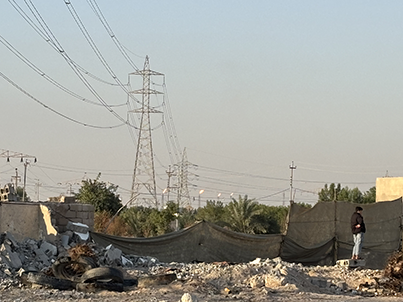
Oil refiners close to residential areas in Zubayr, Iraq. Source: Zeinab Shuker
There are three main categories of people living in the shantytowns around Zubayr who are the most vulnerable to climate change and environmental degradation. First, there are the poorest of the poor who do not have access to long-term housing or employment. This category includes not only members of the Afro-Iraqi community, but also those from the lowest socioeconomic classes in the city in general.9 Second, there are Afro-Iraqis whose parents are not Iraqi and therefore lack official documentation.10 Because of their ambiguous legal status, it is difficult for them to find employment, which affects their living conditions. In one case, three sisters born in Iraq, but whose father is Sudanese, found themselves in this situation and were forced to live in a house made of zinc-coated metal sheets, enduring extremely hot conditions in summer and very cold ones in winter.11 The sisters indicated that while the rainy season was difficult, the extreme summer heat was the most challenging, making breathing very difficult.12
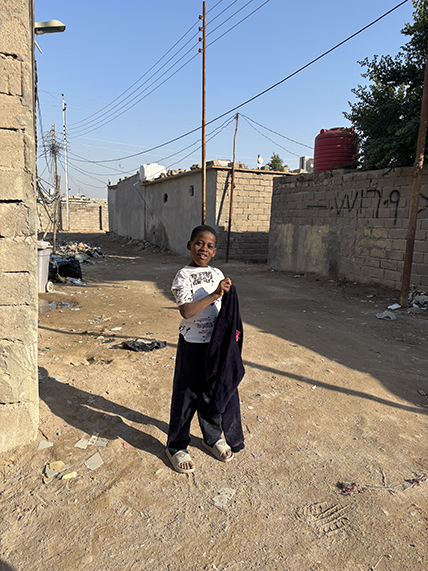
An Afro-Iraqi child in a Zubayr shantytown, Iraq. Source: Zeinab Shuker
The final category is made up of internally displaced families who come mostly from Nasiriyah, some 200 kilometers away. They are generally not Afro-Iraqis, and these families migrated because of tribal conflicts or environmental factors. Among the displaced are many people who worked in agriculture, therefore have suffered from the impact of drought, losing both land and a source of income. The climate-induced displacement of these families has had a negative impact on those living near the shantytowns. During interviews, this group of displaced families was often accused of provoking conflict and altering Zubayr’s social fabric.13 These claims were echoed by political actors in Basra and elsewhere, emphasizing the tensions and divisions between rural and urban communities in Iraq, as well as the unequal distribution of resources among them.14 This demonstrated that while the Afro-Iraqi community has not experienced climate-related displacement as have other communities in the area, climate-induced displacement still negatively affects the group’s social cohesion and stability in indirect ways. Many members interviewed also remarked that part of the tension resulted from increased competition over limited job opportunities in the area.15
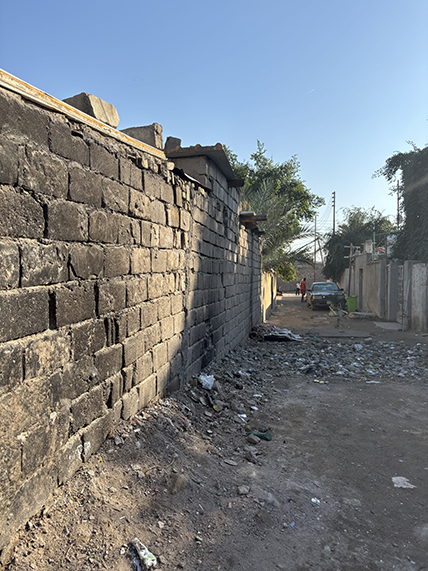
A side street covered with garbage in a Zubayr shantytown, Iraq. Source: Zeinab Shuker
These observations highlight several key points. First, racial identity is important in determining social and economic outcomes. As the population grows across Iraq, public-sector employment is becoming scarce, and private-sector employment is emerging as an important tool for economic mobility. However, members of the Afro-Iraqi community continue to struggle to access employment in the private sector due to preexisting racial hierarchies, which means that they are more likely to be left to compete over the limited openings in the public sector, or to work in sectors they have historically occupied, such as music, dance, or construction, all of which offer limited revenues.16 Construction, in particular, has become more dangerous and inadequate amid rising temperatures in the area, affecting the living standards of Afro-Iraqis in a highly deleterious way.
Climate change is a threat multiplier for Afro-Iraqis, adding to the discrimination they already face as a consequence of their socioeconomic status and racial identity.
The relentlessness of the heat came up time and again in conversations with members of Afro-Iraqi focus groups. One of them, a police officer, recounted how extremely high temperatures frequently forced him to seek shelter, or at times skip work altogether.17 Others in the same group pointed to counterparts who worked in construction, emphasizing that they were more likely to lose income and opportunities because of increasingly onerous working conditions.18 Climate change is a threat multiplier for Afro-Iraqis, adding to the discrimination they already face as a consequence of their socioeconomic status and racial identity. It is also important to highlight that not only does the group’s racial identity contribute to their marginalization, but so too does their sectarian identity. In an interview with one member, he emphasized that many group members belong to Sunni tribes in a part of the country controlled by Shia-dominated tribes.19 This identity further restricts their patronage networks, therefore their access to power, resources, good employment opportunities, and housing, which consequently reduces their climate resilience.
Second, while there have been significant improvements in recent years in many parts of Zubayr—from continuous electricity supply for most of the town’s residents to a new sewer network to some paved roads—the overall climate crisis remains unchanged and perhaps has even worsened. For instance, along the Shatt al-Arab in Basra there used to be numerous palm groves and agricultural fields that played an important role in regulating temperatures in the area. However, as saltwater levels rose and the government failed to intervene at critical moments to ameliorate the situation, many farmers sold their farms to businessmen, who redeveloped them for housing and commercial use.20 What had been the city’s lungs was turned into a concrete jungle, contributing to higher temperatures. While improved infrastructure can ease the burden of the scorching summer heat, those with limited resources, including residents of shantytowns, are forced to fend for themselves.
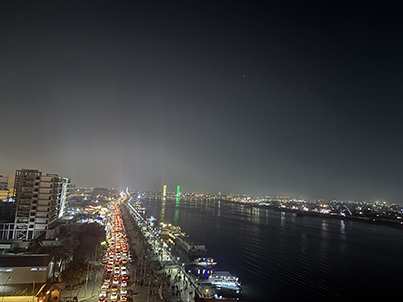
Picture taken at night from the Italian Bridge, demonstrating the disappearance of green space and the urbanization of al-Tannumah area on the right side of Shatt al-Arab in Basra, Iraq. Source: Zeinab Shuker
As a result, the Afro-Iraqi community is squarely facing the effects of ongoing socioeconomic discrimination, worsening climate conditions, and a limited government response. Most importantly, the community lacks political and social representation to effectively advocate for its needs.21 Therefore, to boost climate resilience among Afro-Iraqis, a comprehensive approach must be adopted that addresses not only climate and environmental crises in their neighborhoods but also considers issues such as racial and class marginalization. Frameworks such as the environmental justice approach are especially helpful in this regard. The environmental justice approach emphasizes that the benefits and burdens of climate change must be shared equally, with a focus on protecting low-income and minority communities, repairing past harms, and addressing the disproportionate, long-term environmental impacts experienced by marginalized groups.
Inclusive climate adaptation strategies also involve reckoning with existing social and economic inequalities affecting marginalized community members, since climate change at its core exacerbates threats and interacts with, and increases the harm of, economic and racial injustice and marginalization. This can include steps such as ensuring equal employment opportunities for community members in private-sector jobs, which can break cycles of poverty; implementing legislation that punishes the use of derogatory terms in school and work settings; providing financial support for residents of shantytowns and taking better steps to integrate them into local communities; revisiting the legal status of Afro-Iraqis who have no legal documents; and offering payment for past damages due to racial and environmental harm the group has endured for decades. In other words, class and racial justice cannot be separated from environmental justice.
The case of the Afro-Iraqi community in Basra illustrates how climate change does not occur in a social vacuum. Rather, it interacts with and intensifies preexisting inequalities rooted in history, race, class, and political exclusion. While Iraq faces mounting environmental pressures, the burdens of these changes are distributed unevenly. Communities such as the Afro-Iraqis, who already occupy marginalized positions within Iraq’s socioeconomic and political orders, are disproportionately exposed to environmental hazards and possess fewer resources to adapt to them. Addressing these vulnerabilities, therefore, requires more than technical solutions to environmental degradation. Policies aimed at improving water management, infrastructure, and climate adaptation must also be accompanied by steps to reduce social and political inequalities that shape exposure to climate risks. Without such an approach, climate policy in Iraq, when and if introduced, risks reproducing the same patterns of exclusion that have long shaped the lives of marginalized communities.
This work is licensed under a Creative Commons Attribution 4.0 International License.
For more details regarding the license deed, please visit: CC BY 4.0 Deed | Attribution 4.0 International | Creative Commons.
Zeinab Shuker
Zeinab Shuker is an assistant professor of sociology at Sam Houston State University, Texas. Her research interests revolve around comparative global political economy, democracy, climate change, and theory, with special emphasis on the Middle East in general and Iraq in particular.
Carnegie does not take institutional positions on public policy issues; the views represented herein are those of the author(s) and do not necessarily reflect the views of Carnegie, its staff, or its trustees.
Geological complexity and years of mismanagement mean the Venezuelan oil industry is not the big prize officials in Moscow and Washington appear to believe.

Sergey Vakulenko
Inflicting damage on oil infrastructure in Russia that is used by Kazakhstan and a whole series of Western oil majors risks backfiring on Kyiv.
Sergey Vakulenko
Mutual suspicion between Moscow and Ankara is growing as Türkiye cozies up to Washington and NATO while reducing its dependence on Russian energy.

Ruslan Suleymanov
Much depends on Washington’s appetite for enforcement when it comes to the effectiveness of the sanctions on oil majors Lukoil and Rosneft.
Sergey Vakulenko
Kyiv’s unprecedented strike campaign on Russian oil refineries has inflicted serious—but likely not critical—damage on the country’s ability to produce fuel.
Sergey Vakulenko