

Commentary
Ruslan Suleymanov
{
  "authors": [
    "Ruslan Suleymanov"
  ],
  "type": "commentary",
  "blog": "Carnegie Politika",
  "centerAffiliationAll": "",
  "centers": [
    "Carnegie Endowment for International Peace",
    "Carnegie Russia Eurasia Center"
  ],
  "collections": [
    "Politika: The Best of 2025"
  ],
  "englishNewsletterAll": "",
  "nonEnglishNewsletterAll": "",
  "primaryCenter": "Carnegie Russia Eurasia Center",
  "programAffiliation": "",
  "programs": [],
  "projects": [],
  "regions": [
    "Russia",
    "Türkiye"
  ],
  "topics": [
    "Foreign Policy",
    "Security",
    "Global Governance",
    "Nuclear Energy",
    "Climate Change"
  ]
}
Source: Getty
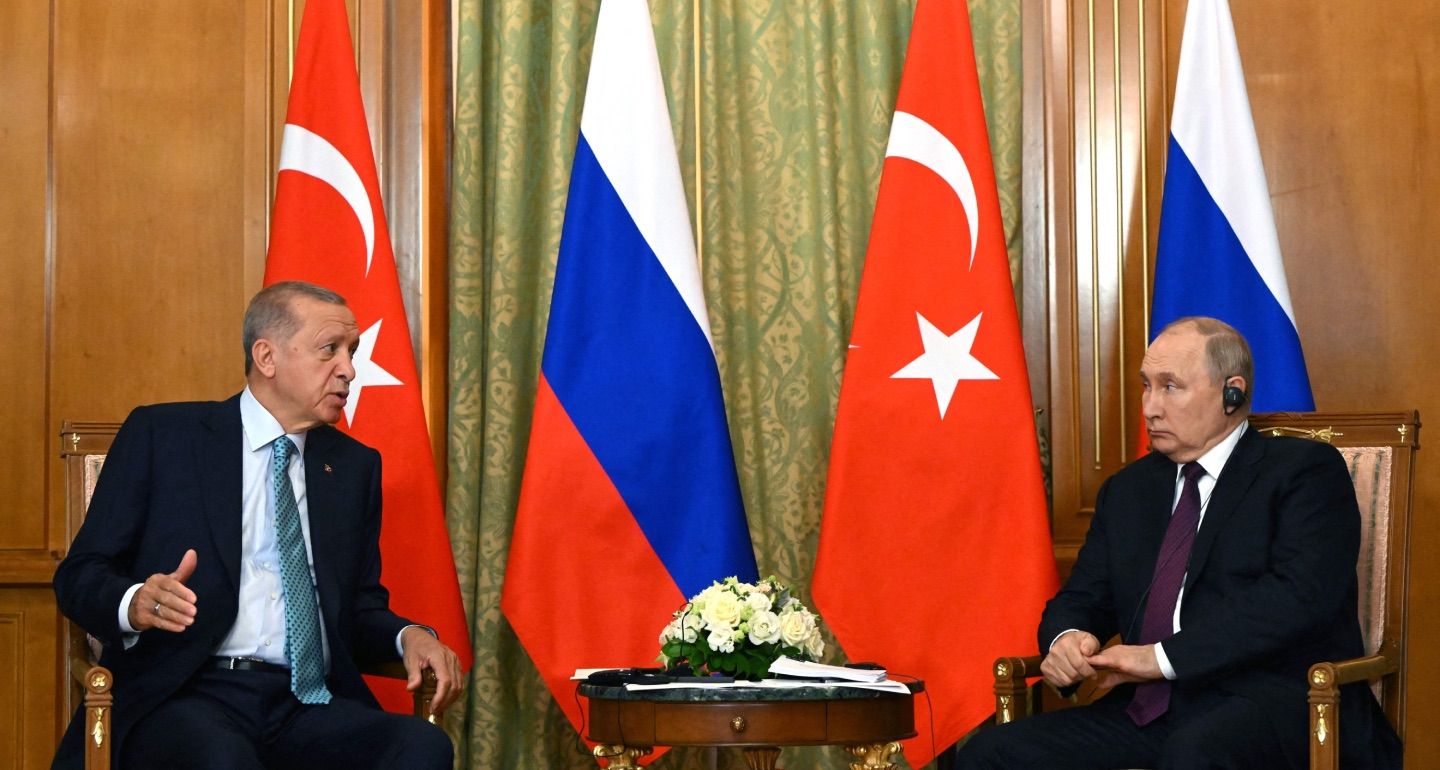
Mutual suspicion between Moscow and Ankara is growing as Türkiye cozies up to Washington and NATO while reducing its dependence on Russian energy.
It’s becoming increasingly difficult for Türkiye to successfully maneuver between Russia and the West. While trade between Russia and Türkiye nearly doubled in 2022 following Moscow’s full-scale invasion of Ukraine, relations have since cooled, particularly in the oil, natural gas, and atomic energy sectors. Distrust has been fueled by Turkish arms exports to Kyiv, the seizure of power by pro-Turkish rebels in Syria, Moscow’s declining influence in the South Caucasus, and a recalibration of Türkiye’s role within NATO.
Türkiye has been involved in several military incidents as part of the fighting in Ukraine. On November 17, Russia attacked a Turkish-flagged LNG tanker moored in Odesa; in August, Russian missiles struck a factory being built near Kyiv to produce Turkish Bayraktar drones; and in August 2023, Russia fired warning shots at the Turkish ship Şükrü Okan that was sailing under a Palau flag in the Black Sea.
Moscow has repeatedly expressed its objection to Türkiye supplying arms to Kyiv. Türkiye, for its part as a mediator between Russia and Ukraine, is irritated by Russia’s approach to peace negotiations—particularly its maximalist demands and the low-level delegation it sent to Istanbul talks. Türkiye supports Ukrainian sovereignty and territorial integrity, and backs Kyiv’s aspirations to join NATO. Ankara also insists Russian President Vladimir Putin must meet his Ukrainian counterpart, Volodymyr Zelensky, for peace talks to progress: something the Kremlin rejects.
Nevertheless, disagreements over Ukraine are only the tip of the iceberg. Despite repeated invitations, Putin has declined to visit Türkiye in recent years—likely because of the outstanding international arrest warrants in his name, the fact that Türkiye is a member of NATO, and a general mistrust of Ankara’s intentions.
In particular, mistrust has grown as calls grow for Türkiye to take a bigger role in European security, with many European officials pushing for greater defense cooperation. Both Germany and the United Kingdom recently approved the long-stalled sale of Eurofighter Typhoon jets to Türkiye, and, symbolically, the 2026 NATO summit will take place in Ankara.
In addition, the Kremlin is wary of warming ties between Washington and Ankara. Not only is Turkish President Recep Erdoğan hoping for further U.S. investment to help the country’s stuttering economy, he also wants U.S. assistance in the standoff with Syrian Kurds. Erdoğan would like the United States to either help Syria integrate the Kurds into the country’s new army—or greenlight a Turkish military operation against them inside Syria. Ankara is not particularly interested in the Kremlin’s opinion.
Such engagement with the United States means it’s increasingly difficult for Ankara to resist pressure to comply with Western sanctions against Russia. In other words, Ankara is increasingly opting for Washington instead of Moscow.
Under former U.S. president Joe Biden, Ankara blocked the Russian payment system Mir, stopped sanctioned EU goods reaching Russia, and Turkish banks halted financial transactions with their Russian counterparts. Now Biden’s successor, Donald Trump, is demanding that Türkiye wean itself off of Russian oil. As a result, Russian oil exports to Türkiye fell more than 60 percent in October to 26,000 tons a day. In the week beginning November 3, they stopped altogether. October also saw volumes of Russian diesel bound for Turkish ports drop by 19 percent.
Russian natural gas exports have also declined. Over the last four years, Russia’s share of the Turkish natural gas market has shrunk from 45 percent to 36 percent. Increasingly, Türkiye is replacing Russian gas with LNG. In 2024, LNG met 31 percent of Türkiye’s gas needs, rising to 44 percent in the first quarter of 2025. In September, Ankara signed a $43 billion contract with U.S. company Mercuria to supply LNG over twenty years—which will obviously help further reduce Russian imports. Finally, Türkiye is seeking to boost domestic gas production.
It’s unsurprising, therefore, that negotiations between Moscow and Ankara over creating a gas hub in Türkiye appear to have collapsed. Russia’s state gas giant Gazprom has reportedly given up on this idea, which was first proposed by Putin in 2022.
Russia-Türkiye atomic energy ties are also on the rocks. Türkiye’s Akkuyu nuclear power plant, which is being built by the Russian nuclear power company Rosatom, was due to be launched last year, but that still hasn’t happened. It’s currently being held up by the refusal of German company Siemens to supply turbines due to sanctions against Russia, but Turkish media have also reported that Rosatom failed to provide planned financing.
At the same time, Türkiye is negotiating with the United States over nuclear power cooperation. It’s possible that Ankara could hire a U.S. company to build the country’s second nuclear power plant, even though Rosatom said in 2024 that Erdoğan had offered it the project.
By courting Trump, Erdoğan is not only hoping for more U.S. investment and a new U.S. policy on Syria’s Kurds. He is also hoping Ankara will once again be involved in the production of the F-35 fighter (it was kicked out of the program in 2019 after buying Russia’s S-400 anti-aircraft system). While the Turkish military continues to operate S-400s, they appear to be of little practical use—if for no other reason than because they are incompatible with NATO standards.
Developments in other parts of the world have also fueled tensions. In the Middle East, it was the fall of the Moscow-backed regime of Bashar al-Assad in Syria and the seizure of power by rebels supported by Türkiye. In the South Caucasus, Trump’s involvement in a joint peace declaration by Armenia and Azerbaijan strengthened the position of both Washington and Ankara at the cost of Russia’s influence there.
Russia-Türkiye cooperation has weakened so significantly over the last three years because of Russia’s enormous expenditure of resources on the war in Ukraine, Ankara’s drift toward Washington, an end to the so-called Astana Format (made up of Russia, Türkiye, and Iran) set up to address the fighting in Syria, and the diversification of Türkiye’s foreign trade. The annual trade turnover between Russia and Türkiye increased 90 percent in 2022 to $65 billion. By 2024, it had fallen to $52.6 billion, and China had replaced Russia as Türkiye’s main source of imports.
Of course, Moscow and Ankara still have a significant economic relationship—from atomic energy to oil and gas. It would therefore be impossible for them to fully break with one another overnight, even if they wanted to. It’s the same when it comes to international affairs, where Russian and Turkish interests are entangled in the South Caucasus, Syria, and Libya. But the scale of their bilateral ties is shrinking—and fast.

Non-resident research fellow, the Institute for Development and Diplomacy (Azerbaijan)
Recent Work
Ruslan Suleymanov
Ruslan Suleymanov
Carnegie does not take institutional positions on public policy issues; the views represented herein are those of the author(s) and do not necessarily reflect the views of Carnegie, its staff, or its trustees.
Russia spent years building a “sovereign internet,” concentrating web infrastructure exclusively within Russian territory. Ukrainian drone attacks have shown how vulnerable that approach has left the Russian internet.

Maria Kolomychenko

Putin’s conservative staffing policies and search for ever greater control have cemented parliament’s transformation into a bureaucratic appendage of the executive branch.

Andrey Pertsev

Russia’s AI-driven propaganda campaigns operate in a fragmented, chaotic, and often illogical manner. That’s not necessarily a problem for the Kremlin, though: It’s much easier to mimic genuine public debate that way.

Ilya Klishin

Without a ceasefire with Ukraine on attacking each other’s energy infrastructure—to which the Kremlin is unlikely to agree—the diesel agreement between Putin and Trump is largely for show, rather than representing a genuine increase in the volumes of Russian diesel on the global market.

Sergey Vakulenko

Russian strikes are weakening the economy sustaining Ukraine’s war effort. Closing the growing funding gap will require more European support and politically contentious reforms in Kyiv.

Balázs Jarábik