

Report
To help expand and sustain America’s middle class, U.S. foreign policy makers need a new agenda that will rebuild trust at home and abroad.
At the heart of Biden’s approach to China was the consolidation of a framework for strategic competition with an eye toward coexistence.
In December 1966, NBC aired the Star Trek episode “Balance of Terror.” As the U.S.-Soviet arms race spiraled and the two superpowers vied for global influence, on the small screen Captain James T. Kirk and the crew of the USS Enterprise found themselves locked in a confrontation with their Romulan foes. Never meeting face-to-face, Captain Kirk and the unnamed Romulan commander largely communicated through patterns of behavior, feints, and restraint. Each side studied the other with incomplete information. Neither wanted a war. Both feared appearing weak. And the Neutral Zone between them––upheld by their mutual interest in maintaining a fragile peace even as the two powers compete––was both a nominal guardrail against catastrophe and a catalyst for tension.
Sixty years later, that fictional standoff—along with elements of its Cold War backdrop—holds lessons relevant to the evolving, competitive dynamic between the United States and China. In January 2021, Joe Biden’s administration inherited a relationship in free fall. Mutual trust had eroded, strategic communication had almost entirely broken down, and Beijing and Washington were facing material and growing risks that the relationship would further crater through miscalculation. In response, the administration set out to build a framework that paired vigorous competition—on technology, military posture, and economic resilience—with restraint. “Competition, not conflict” became its motif. But as the fictional Captain Kirk knew all too well, declarations alone rarely manage to prevent a slide from rivalry to war. What maintains or frays a fragile peace are decisions: executive judgments necessarily made with incomplete information or reached under uncertainty, by actors on both sides decoding ambiguous signals as much as they are sending them.
What this report examines is how that process played out during the crucial years of the recent Biden administration: how the White House translated its China strategy from stated policy into operational reality. In the process, the Biden team grappled—as every administration must—with the gap between the strategy sketched out in the halls of the White House and the imperfect reality of translating a vision into operational plans through a sprawling interagency apparatus, in coordination with allies, and in response to a Chinese government that was navigating internal pressures and its own strategic choices. The resulting story encompasses both achievement and missed opportunity.
Ultimately, the most meaningful challenge documented in this report is not one of tools or resources or even political goals, though all of these matter enormously. Instead, what looms largest is the enormous importance of institutional design and policy practice: How a democracy develops and sustains a long-term strategy toward a rival power across administrations, budget cycles, election years, and under the relentless pressure of unavoidable crises. Using the Biden administration as a concrete, consequential, empirical case study for designing and implementing a China-focused foreign policy, we can begin to address that broader topic to help structure a positive future for U.S.-China relations.
The crew of the Enterprise survived their encounter with the Romulans without triggering a wider war. Captain Kirk prevailed not because he was more powerful, but because he understood his competitor and kept attention firmly trained on his larger objective. So too must the United States navigate a reality of competition with Beijing and continuing entanglement with China that will play an outsized role in defining the international order for decades or longer.
I thank Christopher Chivvis, Senkai Hsia, and the American Statecraft Program for preparing this report. I also extend my gratitude to the many interviewees and reviewers who contributed.
Mariano-Florentino (Tino) Cuéllar
President
Carnegie Endowment for International Peace
March 2026
When Joe Biden’s administration took office in January 2021, U.S.-China relations were in free fall. The era of presumed convergence had ended, mutual trust had collapsed, and the risk of escalation was real. The COVID-19 pandemic was raging. The central question was whether the relationship would harden into open and dangerous hostility or settle into a more durable form of rivalry. Biden officials viewed the inheritance of the first Trump administration to be a sharpened awareness of the China challenge but an underdeveloped national strategy and limited institutional capacity for that challenge. They set out to impose greater coherence, discipline, and durability on the U.S. approach to this crucial problem of American statecraft.
At the heart of Biden’s approach was the consolidation of a framework for strategic competition with an eye toward coexistence. These officials accepted that China and the Chinese Communist Party are permanent features of the geopolitical landscape and that neither America nor China could meaningfully defeat the other without catastrophic cost. Their objective was therefore not dominance, but competitive coexistence—preserving U.S. advantages while avoiding war. That framing now shapes Washington’s statecraft and has endured even in the second Trump administration, albeit with some adjustments.
The Biden team looked to technology as the center of gravity of their strategy. Building on but systematizing earlier efforts, they deployed export controls, industrial policy, and alliance coordination to protect U.S. leadership in semiconductors, artificial intelligence, and advanced manufacturing. For the first time in decades, technological advantage was treated as the decisive arena of great-power rivalry. This shift represents one of their most consequential legacies.
The Biden administration also paired competition with sustained diplomacy—especially in the second half of its term. Rather than treating dialogue as a concession, the White House aimed to use it to reduce misperception and manage risk. Strategic communications channels were restored and military-to-military contacts resumed. This produced tangible gains, including improved crisis management and renewed Chinese cooperation on fentanyl enforcement. Biden’s diplomats did not aim to eliminate rivalry, only to stabilize it by convincing Beijing that strategic competition was the appropriate framing for the U.S.-China relationship. Without this diplomatic track, the competitive strategy would have been more dangerous.
The administration also emphasized U.S. alliances, particularly in the Indo-Pacific. Security ties with Japan, Australia, India, and the Philippines deepened, and the administration worked to improve military coordination. At the same time, the administration was cautious about market opening, judging the domestic costs to outweigh the alliance building benefits. The alliance network thus grew stronger on defense but less integrated economically than long-term competition may require.
On military strategy, the administration took a maximalist approach that bolstered deterrence, but they did so without fully resolving a fundamental question: how much is enough? Investments in regional posture and advanced capabilities were substantial, yet the strategy leaned toward maximizing capability rather than defining sufficiency from a strategic perspective. A competition framework does not require primacy at all costs. Future administrations will need to determine how to balance deterrence with flexibility, fiscal sustainability, and escalation risk—especially as the depth of U.S. support for conflict with China can be questioned.
Biden’s China policy was calibrated realism—neither naive nor warlike. It recognized that long-term competition will be decided more by American domestic vitality than by military deployments. The strategy’s enduring insight is that diplomacy is an important complement to sustaining technological leadership, economic resilience, political stability, and capable alliances. These ultimately matter more than rhetorical confrontation and maximizing military advantage. The U.S.-China relationship remains fraught and unsettled, but Biden established a structured rivalry that avoided collapse and created a baseline from which future leaders—of either party—can operate.
When Joe Biden entered the White House on January 20, 2021, he inherited a U.S.-China relationship that had undergone profound shifts over the last decade and was in an accelerating slide toward crisis. China had gained newfound economic and military strength and reoriented its diplomatic and national security posture worldwide. Additionally, the COVID-19 pandemic and Beijing’s early success at controlling its spread had intensified Beijing’s confidence that China would soon overtake the United States as the world’s paramount superpower, further exacerbating tensions. Consequently, China had become more problematic for the United States than any major power since the collapse of the Soviet Union. The Biden administration’s achievement, over its four years, was to arrest the free fall in bilateral relations and put the relationship on firmer diplomatic ground—and to do this while accelerating and institutionalizing the shift in America’s strategic posture toward China and ensuring that the United States maintained an edge economically, technologically, and politically.
The first Donald Trump administration had rightly identified China as a challenger and developed an initial strategy, but it struggled to implement a comprehensive or consistent approach. The Biden administration thus sought to be steadier in leveraging a combination of economic, diplomatic, technological, and military tools to strengthen America’s geopolitical position and build up the internal bureaucratic structures needed to manage U.S.-China competition. The administration also sought to avoid inadvertent military escalation and put the diplomatic relationship in a stronger place. It largely succeeded in these aims despite the frictions created by a global pandemic, the full-scale Russian invasion of Ukraine, Speaker Nancy Pelosi’s visit to Taiwan, an errant Chinese spy balloon that floated above U.S. territory for days, the war between Israel and Hamas, and sometimes overconfident Chinese leaders who believed they were on a path to replace the United States as the global hegemon.
China was the most strategic foreign policy challenge that the Biden administration faced, and managing the relationship effectively was thus the most significant foreign policy achievement of the presidency. But the administration’s record is not without flaws. In the first two years of the term, the diplomatic track foundered. Biden often cast the relationship in stark us-versus-them terms, especially early on when he emphasized global competition between democratic and authoritarian systems. This framing hindered the leader-to-leader diplomacy that was needed to set expectations, reassure Beijing about U.S. intentions, and safely defend U.S. interests. The administration reformed key foreign policy agencies to better focus resources on China, but these reforms remain rudimentary in many cases. Further, some military decisions—for example, on force posture—while logical, may have added as much cost as benefit. And despite some steps later in the administration to improve American economic competitiveness and secure supply chains, the United States remains vulnerable to long-standing dependencies on China.
Fulfilling the Biden administration’s goals on China required a deft mix of strategy, art, and organizational skill.
Fulfilling the Biden administration’s goals on China required a deft mix of strategy, art, and organizational skill. Fortune sometimes threw up hurdles—especially in 2022, when Russia invaded Ukraine and U.S. speaker of the House Nancy Pelosi visited Taiwan. At other times, however, fortune favored stability—as, for example, when Beijing overstepped in its own diplomacy and alienated its neighbors. The economic headwinds that China faced in the second half of the Biden term also favored the U.S. administration’s effort to stabilize the relationship through diplomacy.
This report has two main aims. First, to provide an account of how the administration understood and implemented its approach to China. Second, it draws lessons from this chapter in American statecraft and explores implications for the future. More needs to be done to implement and sustain a long-term strategy that maintains the United States’ edge without sacrificing stability or needlessly risking war. Preserving space for adjustments in U.S. posture and commitments and resisting Washington’s exceptionalist impulses will remain as crucial as realism about the challenge posed by China’s rise. The latter is especially true given uncertainty about whether the American people will support a heavy cost for strategic competition. Most Americans already believe that China will surpass the United States at some point and yet also see this as having no impact on their lives.1
At the time of this writing, it is unclear what the current Trump administration’s strategy for China is and whether it will also manage to balance the imperatives of diplomacy and war prevention with the need to protect U.S. security and other interests. The Biden administration has left it a good foundation to do so.
The political, economic, and military rise of China is the single most impactful geopolitical development of the first half of the twenty-first century. By the time Biden entered office, the United States and China were engaged in an intense competition that spanned economics, technology, regional security, and ideology. This contest will continue to define the operating environment for American statecraft for at least a decade and probably longer. Whether competition is managed through diplomatic and political means or war will profoundly impact America, China, and the world. The 2021–2024 period offers the best empirical window the United States has into the management of strategic competition with China across multiple domains—diplomacy, military posture, intelligence, technology, economics, soft power, and crisis management. The Biden administration’s experience is an important case study for what it takes to implement a China-focused grand strategy under real-world conditions.
Biden’s presidency was the first full presidential term in which the United States treated China as the central organizing focus of national strategy and, as such, it set the United States on a general course. This report builds on Carnegie’s past work on China strategy,2 with the aim of extracting lessons from the Biden administration for future policy. The administration had to articulate a framework, build bureaucratic machinery, engage skeptical allies, manage multiple crises, and adjust course when it encountered serious problems at the outset. Absent war or some other catastrophe, several aspects of the Biden experience are likely to recur. Exogenous events will complicate diplomacy and conspire to derail long-term strategy. Domestic politics—especially polarization—will constrain the White House’s options. Beijing will seek advantages of its own, engage in adversarial and counterproductive rhetoric, stonewall mutually beneficial U.S. initiatives, and build up its military, even while remaining open to diplomacy and sensitive to U.S. and global pressure. Mutual vulnerability will also persist: Technology and economic interdependence will give the U.S. leverage but also make it vulnerable. And allies—especially in Asia and Europe—will augment and amplify U.S. power but cannot be expected to view their interests and values as automatically aligning with America’s and compelling them to cooperate with Washington.
This is thus not a study of the People’s Liberation Army, the internal decisionmaking of the Chinese Communist Party, or the intricacies of the One China Policy. Nor is it a partisan political study. Biden’s term provides rich empirical material, but underlying questions endure—about strategy, crisis management, and the complex balance between competition and stability. Administrations may change, but the structural pressures underlying the relationship will not—at least not anytime soon. The Biden administration’s experience simply offers the chance to learn from a first full-term test of competitive coexistence with China in order to better navigate the challenges ahead.
This report draws on interviews with thirty-three former Biden administration officials, as well as an extensive reading of available primary statements by U.S. and Chinese officials, contemporary reporting, and other secondary sources. The primary goal was to record for posterity how the administration understood the China problem and what they believed they were doing at the heart of American foreign policy during this period. While the utmost effort was made to fact-check and ground the opinions, self-descriptions, and perhaps self-aggrandizements of the interviewees within the wider context of contemporaneous reporting and secondary sources—the approach still had its limitations. We have tried to be clear throughout when a judgment is our own and when it is an administration official’s. These limitations also applied to making judgments on how Beijing reacted to U.S. policies. Clearly, Beijing was not simply reacting to Washington during this period, but also to structural and, almost certainly, domestic political constraints that shaped its policy responses—some of these constraints are discussed throughout the report, but the focus is on what the Biden administration was doing. Someday, scholars may get access to internal Chinese records that will provide the definitive view from Beijing during this crucial period, and it will be interesting to compare these with the account provided herein. With these caveats, the assessments in this report—which appear mainly in the concluding chapter—are informed by but independent of the perspectives of the interviewees.
The report begins with the development of Biden’s China strategy during the 2020 presidential campaign and early months in the White House. It then describes the bureaucratic reforms that followed from this strategy, and explains how the team initially struggled to find its footing diplomatically, especially after a contentious initial high-level meeting of U.S. and Chinese officials in Anchorage, Alaska, in March 2021.
The following section turns to the logic and practice of these officials’ efforts to build alliances for competition with China and compete with China in the Global South. Such efforts were ongoing throughout the administration, including during the turbulence in 2022, which is examined in the following section of the report. In that year a series of exogenous shocks and the introduction of major new measures to restrict China’s access to high-end U.S. technologies created further headwinds to diplomatic stabilization.
In the second half of Biden’s term, the relationship gradually began to stabilize, as described in subsequent sections of the report. The White House redoubled its diplomatic efforts, restoring the so-called strategic channel that permitted intense diplomacy between the U.S. national security adviser, Jake Sullivan, and the Chinese director of the Office of the Foreign Affairs Commission, Wang Yi, and sending a host of top-level U.S. officials to Beijing for meetings. This diplomatic effort helped set the stage for an important summit between Biden and President Xi Jinping near San Francisco, California, in November 2023. The final section of the report describes the Biden administration’s efforts to keep the diplomatic track alive while taking steps to strengthen America’s competitive edge at China’s expense.
The conclusions of the report assess the accomplishments, shortcomings, and lessons of the Biden years. Despite the ups and downs of the strategy’s implementation from 2021–2024, it was positive overall and offers valuable lessons for current and future policymakers, including on the value of diplomacy, the limits of deterrence, and the importance of allies and the reality of technology competition.
This section explains how the Biden administration diagnosed the challenge from China as it entered office and then translated that diagnosis into a strategic framework. It traces three steps: first, how the team assessed the scale of the problem in early 2021; second, how that assessment crystallized into the Invest, Align, Compete strategy; and third, how the White House institutionalized that strategy across the bureaucracy.
Early thinking about the new reality in U.S.-China relations began in the later years of Barack Obama’s administration,3 but Trump decisively shifted the U.S. approach toward great power competition during his first term in office. Trump’s administration declared an end to the strategy of convergence, according to which the United States would support China’s integration as a “responsible stakeholder” into the liberal international order.4 It instead cast China as a “revisionist power” seeking to “shape a world antithetical to U.S. interests and values.”5 Trump’s 2017 National Security Strategy claimed that China had achieved its economic gains through corruption and espionage and was building up its military to “displace the United States in the Indo-Pacific region, expand the reaches of its state-driven economic model, and reorder the region in its favor.”6 In response, the United States would “raise [its] competitive game to meet that challenge.”7 An escalating trade war ensued,8 in which the United States labeled China a currency manipulator and added Chinese telecommunications giant Huawei to its foreign entity blacklist. The Trump administration also sanctioned Chinese officials involved in repressing human rights in Hong Kong, a move that brought reprisals from Beijing.9
Any hope for a U.S.-China détente was sunk by the near simultaneous outbreak of the COVID-19 pandemic.
As Trump’s first term entered its final year, however, optimism was growing for a recovery in the bilateral relationship. Trump and Chinese vice premier Liu He signed the Phase One Trade Agreement that reduced the tariffs somewhat and increased China’s purchases of American goods.10 But any hope for a détente was sunk by the near simultaneous outbreak of the COVID-19 pandemic. As the virus spread around the world, American and Chinese leaders blamed each other. Stumbling with his initial domestic response, Trump tried to deflect blame by calling COVID-19 the “China virus” and accusing Beijing of orchestrating a “cover-up.”11 Chinese officials meanwhile claimed without evidence that it was the U.S. military who brought the virus to China, and China’s official news agency, Xinhua, labeled Trump’s language “racist and xenophobic.”12 Tensions soared, with expulsions of journalists, further sanctions, investment restrictions, the closure of consulates, and an escalating war of words on both sides.13 China’s “wolf warrior” diplomats were everywhere—confrontational, nationalist, and critical of the United States. In July 2020, U.S. secretary of state Mike Pompeo declared engagement with China a failure, and later in December, U.S. director of national intelligence John Ratcliffe called China “the greatest threat to America today.”14
Amid this dramatic spike in tension, the American public was growing skeptical, even hostile, toward China. The Pew Research Center’s polling showed that the percentage of Americans who held unfavorable views toward China rose from 48 percent to 79 percent between 2017 and 2020.15 Attitudes worsened the most among Republicans, but surveys also revealed a hardening among Independents and Democrats.16 By 2020, most of the American public had aligned themselves with the Trump administration’s framing that the United States and China were rivals rather than partners and increasingly viewed China’s rise as a threat.17 These public trends were in turn marked with a sixfold increase in China-related bills introduced in Congress between 2013 and 2021.18 Reports of discrimination and violence against Asian Americans in the United States increased.19
As future Biden administration officials began to flesh out their policy views in the second half of 2020, bilateral relations were in free fall, with a growing number of Americans viewing China negatively. During the 2020 presidential race, candidate Biden reacted accordingly, depicting the United States and China as being in confrontation with each other and saying that America “need[ed] to get tough with China.”20
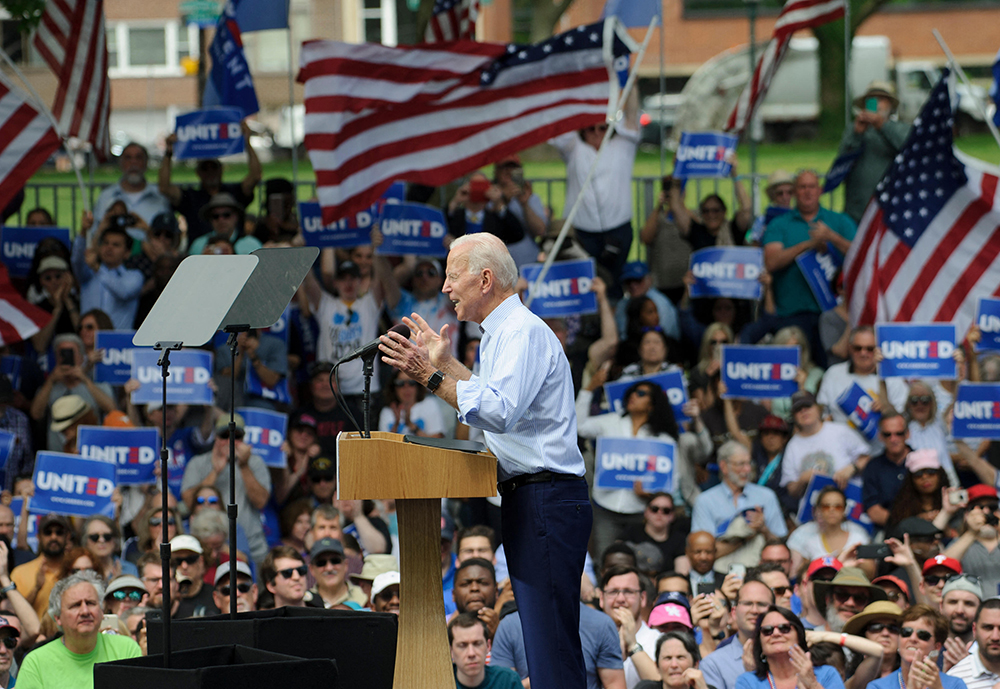
It would be too easy to overlook how deeply the trauma of the pandemic impacted the 2020 presidential election and the first year of Biden’s term. In the first quarter of 2020, the U.S. unemployment rate tripled, leaving 21 million Americans unemployed.21 By the end of the year, the U.S. gross domestic product (GDP) contracted by 3.5 percent as consumer and retail activity dwindled, with over 700,000 businesses closing.22 Stay-at-home orders, school closures, and mask mandates placed restrictions on everyday social interactions. The human cost was severe—by May 2020, there were over a million confirmed COVID-19 cases in the United States, and by September, over 200,000 Americans had died from the virus.23
In contrast to the United States’ halting response and recovery in the face of the pandemic, China had comparative success in containing the disease with its Zero COVID policy that imposed aggressive isolation, containment measures, and quarantines. Although China would ultimately pay a heavy economic cost for this approach, for the first eighteen months it purportedly recorded only two deaths from the virus and claimed to be the only major economy that posted positive economic growth that year.24 China’s apparent success and America’s troubles intensified the impression that China was rising and America was collapsing.
The situation also gave the impression that China’s rise and America’s decline were inevitable. Chinese leaders had already been referring to “great changes unseen in a century”—a claim that America was in decline due to rising economic inequality, hollowed-out American industrial capacity, and political instability.25 Xi encouraged this view, arguing that China now had the opportunity to challenge American leadership and achieve “national rejuvenation”; in late 2020, possibly during the Fifth Plenary Session of the Nineteenth Central Committee, Xi reportedly started using the expression “the East is rising and the West is declining.”26 By March 2021, “the ascendancy of China and fall of the United States” was being openly promoted by Chinese officials, using the pandemic to demonstrate that China’s rise was “unstoppable” because of a “striking contrast of the order in the East and chaos in the West.”27
When the Biden administration entered the White House in January 2021 and took stock of this situation, they made five key observations. The first was that Beijing intended to challenge the United States and probably sought to supplant it globally. It was clear to nearly everyone in the incoming administration, and importantly everyone at the White House, that China had undergone profound changes under Xi. The confident rhetoric from Chinese elites and wolf warriors had not gone unnoticed by Biden’s foreign policy team, who assessed that Beijing had convinced itself that the United States was in “terminal decline” as a world power.28
This sense of mounting conflict only deepened after the Biden administration received their initial intelligence briefings in their early weeks in office.29 According to several officials, China was working to “make the world more dependent on [it] while reducing its own dependence on the world.”30 In stark terms, the United States risked becoming economically dependent and falling behind China technologically by 2030; what’s more, there was a real risk that America might be defeated by China militarily before the end of the decade.31 The realization that China was capable of launching pre-positioned cyber attacks against critical infrastructure used by millions of Americans was, as a former senior Biden official stated, “an extraordinary vulnerability on some level and was obviously really concerning.”32 To make matters worse, officials believed, China was planning military bases in the Americas and aiming to ramp up detentions of U.S. citizens as part of a bilateral dispute.33 The Chinese Ministry of State Security’s intelligence and surveillance capabilities were expanding.34 Time was thus short, they concluded: The 2020s would be the “decisive decade” of competition with China.35
A sense of heightened tension with China sat well with Biden himself, who was born of the Cold War and was comfortable with its binary framing.
This sense of heightened tension with China sat well with Biden himself, who was born of the Cold War and was comfortable with its binary framing. As one senior official put it, “Biden in his nature believed that we were in a bipolar world and that America had to stand up and fight against other countries—that’s who he was, he grew up in the Cold War and came about in the post-Vietnam era.”36 The president’s tendency to frame the historical moment in stark ideological terms was not always conducive to coexistence—as discussed below—but his Cold War background does help to explain why the administration was quick to accept the sharply competitive nature of the relationship.
The second observation was that China was rapidly gaining ground on the United States across several measures of national power. The United States was emerging from the pandemic standing but badly battered. Past predictions that it would be at least a decade before China surpassed the United States now looked too optimistic. One widely cited report, for example, predicted that China would overtake the United States economically by 2028—the very year the Biden administration hoped to be wrapping up.37 Militarily, China had produced weapons that allowed it to threaten U.S. and allied forces throughout much of the western Pacific, and the situation was worsening, with the U.S. military falling behind China by the day, especially in the Indo-Pacific.
Unease about America’s comparative economic and military backsliding was intensified by the conclusion that the United States was also losing ground to China technologically—especially in advanced technologies such as telecommunications, artificial intelligence (AI), and quantum computing. During Trump’s first term, China had begun producing some advanced technologies at scale and was threatening to put the United States at a global commercial disadvantage. Huawei was the leading example of how China’s high-tech, large-scale, low-cost technologies were being embraced by governments and consumers worldwide. The Trump administration took sharp action to curtail China’s efforts to dominate global telecommunications, but it was clear by 2021 that technological competition with China would have commercial, economic, and national security dimensions.
Layered on top of the observation that Beijing was becoming increasingly aggressive and the United States was trailing behind in key areas was a third concern: The United States had become dangerously dependent on China economically and technologically. During the bygone era when China was a developing country and docile trading partner, dependencies had been given little thought. Now that Xi was championing China’s regional and global power, and challenging the United States directly, reliance on China for critical inputs suddenly appeared to be a major U.S. vulnerability—one that extended to several key U.S. allies.
The problems of conflict, decline, and dependency were further compounded in the administration’s view by a fourth observation: the perception that America’s image with key allies and partners had been dealt a severe blow by the first Trump administration and had opened the door for China to expand its influence with nations worldwide. As a former senior White House official put it, “Countries will look at the United States wondering somewhat warily, how much has the United States changed in the age of Trump? … [He] will be one of the most influential presidents in American history, in ways that we may not welcome.”38 And just as Washington’s response to the pandemic reinforced Beijing’s sense of the inevitability of American decline, it had shaken confidence in other important capitals like New Delhi, India.39
Finally, the fifth observation, proffered by Biden himself, was that this was a global historical moment, centered on an epic contest between authoritarian and democratic forces, and he was determined to lead the democratic world in this struggle. This conceptual framing was undoubtedly influenced by domestic U.S. politics and deep concern with more authoritarian elements of the Republican Party under Trump. It is unclear to what extent it was shared by his national security team, who tended to lean in a more realist direction than the president. But Biden’s view was paramount and, in this case, further intensified tensions with China’s autocratic leaders.
With this threat assessment in the foreground, the Biden administration developed a three-part China strategy in its first year in office. That strategy was built on three interlocking pillars: invest at home, align with allies, and compete responsibly with China. The intention was not to defeat China, but rather to manage the long-term rivalry from a position of renewed American strength.
The invest pillar reflected the conviction that the United States urgently needed to focus on strengthening itself for a much more competitive and dangerous international environment, in which China’s power was an enduring reality. National rejuvenation would involve a whole-of-government approach, bringing together political, economic, military, technological, and diplomatic tools to make America stronger. Industrial policy would hone the U.S. edge in leading technologies, as well as build a domestic economy that was less vulnerable to COVID-19–era shocks and China’s economic chokeholds. By rebounding from the pandemic and showing national resolve and unity of purpose, Biden’s America would defeat Beijing’s narrative that America was in inexorable decline.40
Biden’s America would defeat Beijing’s narrative that America was in inexorable decline.
The decision to center the Biden strategy on domestic rejuvenation had practical and political advantages that went beyond foreign policy. For one, China’s apparent success in handling the pandemic was a vector to attack Trump and a reason for Biden to talk up the problem during his presidential campaign. Raising the issue of China was also a way of pointing to Trump’s admiration for Xi and other autocratic leaders.41 The Biden campaign wanted to contrast what they saw as the “chaos and corruption” of the Trump presidency with an “affirmative agenda” for the nation and the world.42 More broadly, the administration arrived in office aiming to focus its foreign policy on the needs of the American middle class—a philosophy outlined in 2020 by some soon-to-be top officials in a report by the Carnegie Endowment for International Peace.43 The emphasis on rejuvenation aligned Biden’s China strategy with related domestic objectives, such as building out infrastructure, enhancing social programs, and creating jobs. The China strategy was thus bound deeply with the administration’s domestic political agenda—the slogan for which had been “Build Back Better.” This dimension eventually became known as the invest pillar of the strategy.
To help expand and sustain America’s middle class, U.S. foreign policy makers need a new agenda that will rebuild trust at home and abroad.
The second pillar was aimed at building a broad international coalition to resist China’s ascendancy. As secretary of state Antony Blinken later explained, America needed to “shape the strategic environment around Beijing.”44 This meant strengthening allies and partners, especially in East Asia, to check China’s regional ambitions—a strategy that some (especially Beijing) would later liken to the U.S. Cold War strategy of “containment.”45 As one of the leads on the Biden-Harris transition team stated, “We all recognized that the sort of power of partners and allies was fundamental to our capacity to manage China’s trajectory and to do so more effectively.”46 Biden himself increased this emphasis on allies and partners. Speaking at the 2021 Munich Security Conference in his first address to a global audience, Biden promised that “America is back. The transatlantic alliance is back. And we are not looking backward; we are looking forward, together.”47 It also fit with his administration’s effort to “restore” America’s image in the world after what Democrats claimed were self-interested and unpredictable policies of the first Trump administration.48
This pillar of the strategy was initially conceived as “uniting” other nations behind the United States, but experts objected that this framing was unlikely to be appealing to many countries that were hesitant to pick sides in a Cold War–esque struggle between the United States and China. They were wary of China’s trajectory under Xi, but this did not mean that they would hew to a strict U.S. line. Many were keen to deepen economic relations with China, were suspicious of the United States after the experience of the first Trump administration, and were wary of the possibility of a deteriorating conflict.49 This dimension was thus reconceptualized as the align pillar in order to accommodate a broader coalition.
The third core idea was that the situation would be characterized as a competition rather than a conflict. This idea stemmed from an understanding that despite the very serious problems that China posed for the United States, China’s rise as a major power was an incontrovertible reality that was not going to change in the foreseeable future. Defeating China or replacing the Beijing government were not serious options, according to former U.S. officials interviewed. The compete pillar was thus conceived as finding a middle ground between the more confrontational approach of the first Trump administration and congressional hawks and the approach of previous administrations who had viewed China as a partner and stakeholder in the U.S.-dominated world order.
This competition framing also implicitly reflected that war with China would be catastrophic. China had not only become a military peer of the United States in the Indo-Pacific, but also had amassed more nuclear weapons, space and counter-space systems, and advanced cyber capabilities and was developing other dangerous weapons. For the first time in seventy-five years, the United States faced an adversary other than Russia who could reach out and damage the U.S. homeland directly in a war. But competition would not mean ignoring the role of deterrence, especially as a means of preventing unwanted military conflict in the western Pacific. The framing moreover reflected Democrats’ continued hope that the United States and China might cooperate on common issues of global concern, including counternarcotics, nonproliferation, global food scarcity, pandemic response, and, above all, climate change. Theoretically, competition afforded more space for doing so. As former undersecretary of defense Colin Kahl described, “The prospect of conflict was real, but it would be disastrous if we got into a war with China, and therefore, we needed to build guardrails around that competition to avoid sliding into a war. But also, we needed to carve out at least narrow lanes for cooperation.”50 These nuances would prove somewhat confusing for Beijing, however, as discussed below.
“The prospect of conflict was real, but it would be disastrous if we got into a war with China.”
The administration did not, therefore, see this as a competition in which one side would defeat the other. Good strategy normally points at specific desired outcomes, but in the context of China policy, Biden’s advisers understood that the success of the strategy would not lead to a decisive endgame where, as Sullivan described in an interview, “someone’s going to win, and someone’s going to lose and walk off the field.”51 Instead, U.S.-China competition was conceived as an enduring feature of international politics in which both sides agreed to accept coexistence. The end state was thus not victory, but a steady state in which the relationship was “managed responsibly” by both sides so that it did not tip over into conflict.
For senior Biden officials, their conception of “steady state” competition would eventually require intensive direct diplomacy with Beijing that was carefully coordinated and sequenced.52 The goal was to generate greater mutual transparency and predictability in the U.S.-China relationship by clarifying misperceptions.53 In contrast to the first Trump administration’s approach, which Sullivan later described as “at times more confrontational than competitive,” the Biden approach centered on direct diplomacy with Beijing as an essential tool to manage the relationship.54 As Nicholas Burns, who served as U.S. ambassador to China for most of the Biden administration, stated in an interview, “The end goal was to compete with China on many levels of competition—military, technological, economic, human rights—to defend American interests but also to live in peace with China and not end up in a catastrophic war.”55
The Invest, Align, Compete strategy on China sought not only to reorient U.S. policy toward China, but also to convince Beijing that a different approach to the relationship was necessary. Attempts by American policymakers “to move the Chinese” side toward a mutual acknowledgment of the realities of a competitive U.S.-China relationship would be a continuing theme in direct diplomacy with Beijing throughout the Biden administration.56 This aim was one of the more innovative aspects of the strategy. It also proved one of the more difficult.
The administration’s strategy was finalized in late 2021, but many of the central ideas had been put forward by key officials before Biden entered office. For example, Sullivan and his top Asia adviser, Kurt Campbell, published an article in Foreign Affairs in August 2019 that laid out the idea of a “competition without catastrophe.”57 Comparing U.S.-Soviet relations during the Cold War to current U.S.-China relations, they noted that China “represents a far more challenging competitor” because its “economy is more diversified, flexible, and sophisticated than the Soviet Union’s ever was.”58 Future assistant secretary of defense for the Indo-Pacific, Ely Ratner, also wrote in 2019 that the United States would need “ambitious U.S. investments in scientific, technological, and financial innovation” along with an effort to sustain “ties with China where commercial exchange benefits the U.S. economy while at the same time developing more powerful safeguards to protect and advance vital U.S. technological advantages.”59 In the early months of the administration, the National Security Council’s (NSC) future China director, Rush Doshi, published a book on competition with China, titled The Long Game: China’s Grand Strategy to Displace American Order.
Starting in January 2021, strategy development was formally centralized in the NSC, with both an internal and an interagency effort.60 Written strategies are often maligned as exercises in futility by bureaucrats who believe they have no effect on how policy turns out. In this case, however, senior administration officials thought that the massive changes in U.S.-China relations called for a clear internal statement of strategic goals and objectives and a common terminology. They also intended the strategy to answer “very specific questions about prioritization” on how to manage the complexities of a competitive relationship.61 The goal was therefore to agree to an internally facing strategy document that would give instruction to the interagency on the direction of China policy. (Senior White House officials considered a public document but ultimately concluded that it “would be too stark.”62)
The new China and Taiwan directorate at the NSC took the lead in drafting and coordinating the strategy, working closely with Sullivan and other directorates for specific issues such as the vitally important technology competition portfolio.63 Early on, Sullivan set a weekly China strategy meeting for senior directors from all the NSC directorates with China-related portfolios. These meetings aimed to create a regular touchpoint and venue where all the relevant NSC officials could participate in policy development while supporting Sullivan’s desire to personally keep track of the complicated set of intersecting China efforts getting underway.64 Importantly, the intention was to consider economic issues alongside, rather than separate from, strategic decisions.65 This aim reflected the administration’s view that economic and technological competition had become a national security issue and therefore could no longer be treated in isolation.
The U.S. intention was to consider economic issues alongside, rather than separate from, strategic decisions.
As federal agencies began to staff up through 2021, the NSC set up regular China-focused interagency policy committees, including ones dedicated to China and Taiwan policy, technology competition, and international economics.66 NSC Deputies Committee meetings on China were also held regularly, although with greater frequency earlier in the term before the Afghanistan, Ukraine, and Israel-Gaza crises.67 In the early period, the NSC’s work also included reviews of the previous administration’s tariff, technology, and other China-related policies, such as Trump’s executive order to ban TikTok.68 The Biden administration’s internal China meetings largely continued despite the many crises in other areas, thereby demonstrating its recognition that China should remain a priority and its dedication to ensuring that strategy and policy be coherently developed and successfully implemented.
Some agencies grumbled that too much of the process was being centralized in the White House, and some former senior White House officials admit that things were definitely “NSC-heavy.”69 But top-heaviness seemed unavoidable given that across the U.S. government White House senior officials were in place far faster than their interagency counterparts, who required Senate confirmation.70 Some degree of centralization was also needed to prevent this crucial piece of Biden’s foreign policy from becoming an incoherent and meaningless free-for-all that reflected the varied parochial desires of the U.S. national security bureaucracy—a risk to which many “country strategies” of this kind regularly fall prey.
If there was centralization at the NSC, however, several officials noted that top figures such as Sullivan did not have an authoritarian, top-down intellectual style. An accomplished debater, accustomed to testing his own theories, Sullivan was widely viewed by his team as being “discursive” and “Socratic” in his approach, regularly soliciting views on China strategy and willing to see his views challenged and debated by officials from across the government.71
Other officials thought too much debate—or at least too many meetings—slowed things down, but ultimately, the process produced results. By the end of 2021, a still-classified twenty-seven-page China strategy was circulated to the Principals Committee and edited by the president.72 Some of the experts developing the strategy may have had mixed feelings about the involvement from the highest level, because it risked upending the cohesiveness of the strategy at the last minute, but the level of interest was a plus and another clear sign of the level of importance that the president and administration placed on getting the relationship right. The China strategy was later supplemented by classified implementation guidance sent to all departments and agencies in early 2022.73
The China strategy built on the March 2021 interim National Security Strategic Guidance, which described China as “the only competitor potentially capable of combining its economic, diplomatic, military, and technological power to mount a sustained challenge to a stable and open international system.”74 The interim guidance also laid out the vision for what the Biden administration’s strategy to “out-compete” China would entail: strengthening “enduring” American advantages through investments at home, while defending allies and partners abroad to deter Chinese aggression.
The strategy itself remained classified, but the NSC was keen to explain the key elements of its approach to the public—or at least the Washington expert community—and settled on a speech by Blinken as the best way to do so. Although the internal strategy was finished by December 2021, the outbreak of the Russia-Ukraine war in February 2022 delayed the public release until May 26, 2022, when Blinken finally was able to speak at George Washington University.75 The 2022 National Security Strategy, whose release was also delayed due to the Ukraine war, further reinforced some key ideas, including the prioritization of China because it was “the only competitor with both the intent to reshape the international order and increasingly, the economic, diplomatic, military, and technological power to advance that objective.”76
Blinken’s speech aimed to frame the bounds of competition for the United States and China, and in this sense it was a proposal on the rules of the game to Beijing. But Blinken also sought to telegraph to allies and domestic audiences that the Biden administration was committed to standing up for U.S. interests—and theirs. Perhaps unsurprisingly, therefore, Beijing voiced strong objections, describing Blinken as seeking to “spread disinformation . . . interfere in China’s affairs and smear China’s domestic and foreign policy.”77 This was more evidence, Beijing claimed, that Washington sought to “contain and suppress China’s development and maintain the U.S. hegemony.”78
The domestic response was mixed. Some critics argued that the strategy was too aggressive. Writing for the Council on Foreign Relations, for example, China scholar Ian Johnson called the strategy “eloquent but inadequate” and faulted Blinken for failing to leave enough room for bilateral cooperation on major issues of global concern.79 Similarly, Brookings Institution scholar Ryan Hass, who served as a China director in the Obama NSC, emphasized that Washington needed to do more “to give Beijing cause to respond favorably to its efforts to keep China embedded in the international system”—in other words to signal that the United States was not hostile to China’s rise.80 Separately, Jessica Chen Weiss, another China scholar, went further, claiming that the administration was complicit in an escalating dynamic and had failed to do enough to halt the slide in relations. Weiss, who served for a time early in the administration at the State Department, charged that the Biden administration’s focus on ideological competition risked a downward spiral of zero-sum competition that would provoke China and increase racism toward Asian Americans.81 She was particularly vocal about the need to avoid a “fatalistic approach” that presumed conflict was inevitable. In her view, deeper engagement could avert this risk and Washington needed to be more willing to offer clearer rewards for better Chinese behavior.82
As of 2022, such criticisms were fair given the extent to which the U.S. political atmosphere had grown heated over China, especially in Congress, which was seized with the issue and producing a flood of anti-China legislation.83 The administration, however, was operating in a political context where many experts were pushing it toward an even more aggressive approach. For these experts, strategic competition did not go far enough. Former Trump administration officials such as Matt Pottinger and Randy Schriver accused the Biden approach as being too weak on China and called for policies to match what they now framed as a “Cold War.”84 Others advocated “winning” the competition with China by seeking to expressly weaken the Chinese Communist Party, a position that one former Biden official described as “reckless.”85
Despite the strategy not being universally embraced, Biden officials saw their approach as a coherent middle ground between these different points of view. The strategy sought to respond to China’s increasingly aggressive actions and intent to displace the United States, while recognizing the reality that “China was here to stay.”86 Combining domestic investments and export restrictions aimed at improving American competitiveness, Biden officials sought to use intensive diplomacy to stabilize the U.S.-China relationship “at a higher competitive equilibrium.”87
When the Biden administration entered the White House, there was already a clear—albeit shallow—bipartisan consensus on the importance of China and the challenge it posed. Despite generalized expectations that Biden would attempt to strike a contrast with Trump on most foreign policy issues, the initial instructions given at early interagency meetings were that “all the work on China should continue as it had been.”88 However, even though there were few immediate changes, the Biden approach differed from the Trump administration in important ways.
To begin with the similarities, both administrations gave high priority to the relationship with China. From the start, the first Trump administration moved sharply away from the partnership model that had long defined the U.S.-China relationship and toward much more tension and adversity. Biden was expected to immediately work to reduce that tension but did not do so. The Trump administration also tried to shift U.S. defense posture away from counterterrorism and toward great power competition, an effort that would only deepen under the Biden strategy. The first Trump administration furthermore also emphasized the technological dimension of the challenge that China posed and sought to curtail China’s technological expansion around the world, for example by preventing Chinese telecommunications firms from making inroads into key markets worldwide.89 Trump also began stiffening up monitoring and control of the use of Chinese technology in the United States through a process under the Committee on Foreign Investment in the United States.90 This technological focus only deepened under the Biden presidency, with the relevant team sometimes replacing the haphazard Trump-era approach to technology with a more organized and deliberate one. Lastly, despite Biden criticizing Trump’s tariffs on the campaign trail, the new administration continued them after entering office.
But there were also major differences between the new Biden strategy and Trump’s strategy. For one, Biden’s decision to frame U.S. foreign policy in terms of autocracy versus democracy added a more explicit ideological dimension to the conflict that had been mostly absent from Trump’s approach (he had no qualms about dealing with autocrats). Biden also placed enormous emphasis on the positive role of allies and partners in strengthening the U.S. competitive position, whereas Trump had largely deemphasized allies.
Another key difference was Trump’s heavy focus on the trade relationship. Trump’s primary concern in the bilateral relationship was always with America’s massive trade deficit with China—even though some of his advisers, such as John Bolton and Pompeo, viewed competition with China through a more traditional national security lens. In contrast, the Biden strategy was more holistic. It brought together the key economic, technological, military, and diplomatic dimensions of the relationship into a coordinated, whole-of-government approach aimed at strategic rejuvenation of the nation in the face of intensified competition with China.
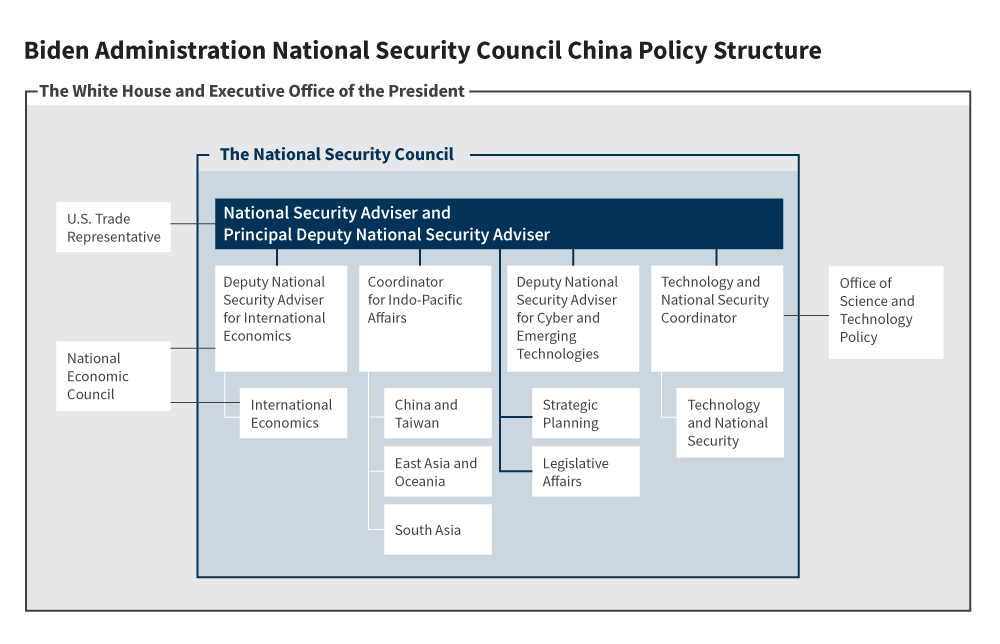
Strategic rejuvenation called for a major effort to strengthen the focus on China and improve coordination across the national security bureaucracy on China policy. As the strategy for China was being developed in the early months of the Biden administration, the NSC was also reorganized. The complex, whole-of-government nature of the challenge imposed a far-reaching coordination problem that the administration sought to address by centralizing the strategy’s coordination squarely in the council. This entailed structural changes to the NSC that increased the importance of China and signaled the broad-based regional and global approach of the strategy.91
The main innovation was to create a single entity for the entire Indo-Pacific, in which several senior directors and their directorates would be situated. Kurt Campbell, a former assistant secretary for East Asian and Pacific Affairs (EAP) in the Obama administration, was named the coordinator for Indo-Pacific affairs.92 Campbell had also been a deputy assistant secretary of defense back in president Bill Clinton’s administration and was known as a friend of Taiwan. As such, he was among the more hawkish senior voices on China and strongly emphasized the key role of U.S. regional allies and partners. Campbell was also close with Blinken.93 Campbell later moved from the White House to become the deputy secretary of state in February 2024. “Kurt never tried to do the work of the senior directors, but in his role as coordinator [for the Indo-Pacific], with his seniority and work style, he was able to bring a lot of things to the forefront,” said a senior official who worked with him.94 These things included the early meeting of the Quadrilateral Dialogue (Quad) with Australia, Japan, and India, which he personally convinced the president to prioritize.95
Campbell’s new domain at the NSC encompassed three newly created directorates, each headed by a senior director. What had previously been the NSC Asia Directorate thus became the China and Taiwan Directorate, the East Asia and Oceania Directorate, and the South Asia Directorate. The new NSC China and Taiwan Directorate was tasked with coordinating China policy “as the quarterback” across the interagency and as the White House’s lead for direct diplomacy with Beijing.96 Former Obama official Laura Rosenberger became the senior director, and Rush Doshi and Julian Gewirtz were among those who joined as China directors early in the administration.
While the new Indo-Pacific coordinator position sometimes created confusion (regarding where exactly it sat in the NSC bureaucratic hierarchy), the intended effect of Campbell’s role and new directorates was to elevate their influence and signal to the wider interagency that the region was of paramount importance to the Biden administration’s foreign policy.97 This meant that coordination on regional issues became more intensified; as one former senior director indicated, the structure meant they had much more contact with Rosenberger and her team relative to the Obama NSC.98
In addition, a new Technology and National Security Directorate was created at the NSC to coordinate policy on U.S.-China technology competition, with staffers dual-hatted at the White House Office of Science and Technology Policy.99 Tarun Chhabra brought in-depth knowledge of technology and foreign policy as NSC’s senior director for technology and national security. The directorate’s portfolio was distinct from the International Economics Directorate, shared between the NSC and the National Economic Council, which would continue to coordinate economic sanctions, oversee investment screening through the Committee on Foreign Investment in the United States, and lead on engagements in multilateral forums including the G7, G20, and Asia-Pacific Economic Cooperation (APEC). The latter was more important than usual because the United States would host APEC in 2023, creating a valuable opportunity that the administration would later leverage to stabilize relations with Beijing.100
Finally, the NSC’s Strategic Planning Directorate was led initially by Sasha Baker and then by Thomas Wright. The office took the lead in drafting the administration’s 2022 National Security Strategy, which underscored the refocus on China. The Legislative Affairs Directorate meanwhile coordinated China-related policy objectives with Congress.101 These efforts were especially important in the first two years of the administration when the key China-oriented legislation was passed.
The NSC managed the core of the development and implementation of Biden’s China strategy. The intensified focus on China and sound process also led to the creation of China-focused centers within several key national security agencies. As discussed in greater detail later in this report, the State Department eventually introduced “China House,” various elements of the intelligence community created new structures including the Central Intelligence Agency’s (CIA) China Mission Center, and the Department of Defense conducted a department-wide process review.
These White House reforms were only the beginning. Across the government, agencies soon undertook their own restructuring to support strategic competition. By the end of 2021, the Biden administration had moved from diagnosis to doctrine to implementation. The strategy of strategic renewal—Invest, Align, Compete—was not merely rhetorical; it had been embedded in institutional processes and classified guidance. The harder question would be whether it could withstand the shocks that followed. The next section explains the subsequent institutional shifts the strategy prompted and then moves on to the story of how the administration’s initial diplomacy foundered.
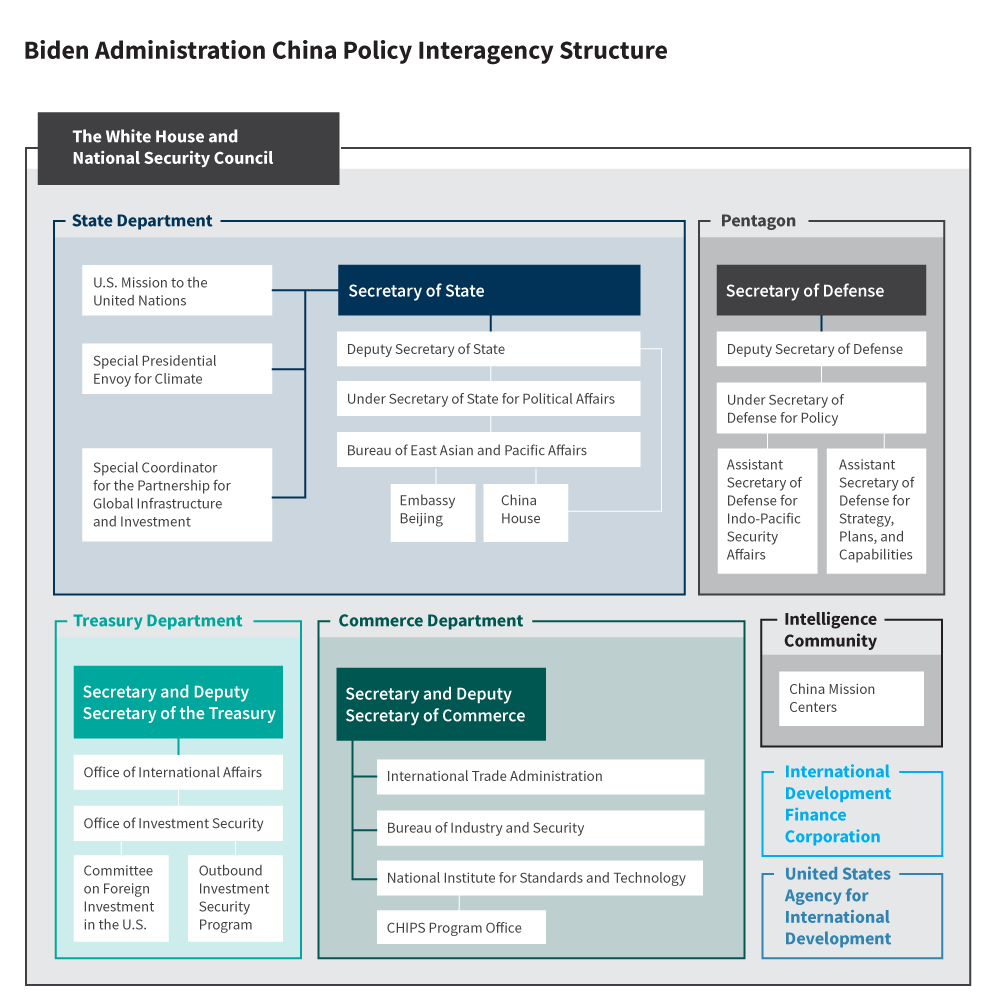
As the administration worked to implement its Invest, Align, Compete framework, it recognized that strategy called for institutional change. Implementing a truly whole-of-government approach to competition with China required restructuring key agencies and clarifying lines of coordination. Agency implementation guidance was designed to create what a senior official described as a “common approach that everyone understood and was executing against.”102 New bureaucratic structures were thus built at multiple federal agencies to align diplomatic, intelligence, economic, and military tools behind what the Biden administration viewed as its central foreign policy challenge. This section explains these innovations—from the creation of China House at the State Department and new China-focused structures in the intelligence community to changes inside the Pentagon, including both administrative reforms and shifts in U.S. regional force posture.
One of the more important innovations was the creation of China House at the State Department. Its dedicated function was to coordinate China-related diplomatic activities globally. The Office of China and Mongolia Affairs within the State Department’s EAP usually oversaw the U.S.-China relationship from Washington. But Biden officials recognized that the global breadth and scale of competing with China across regions and domains vastly outstripped the capabilities of the existing office, which largely focused on bilateral relations.103 The result was the creation of the Office of China Coordination, otherwise known as China House. The new unit was given a mandate to coordinate “a whole-of-enterprise approach to strategic competition and diplomatic relations with the PRC [People’s Republic of China].”104
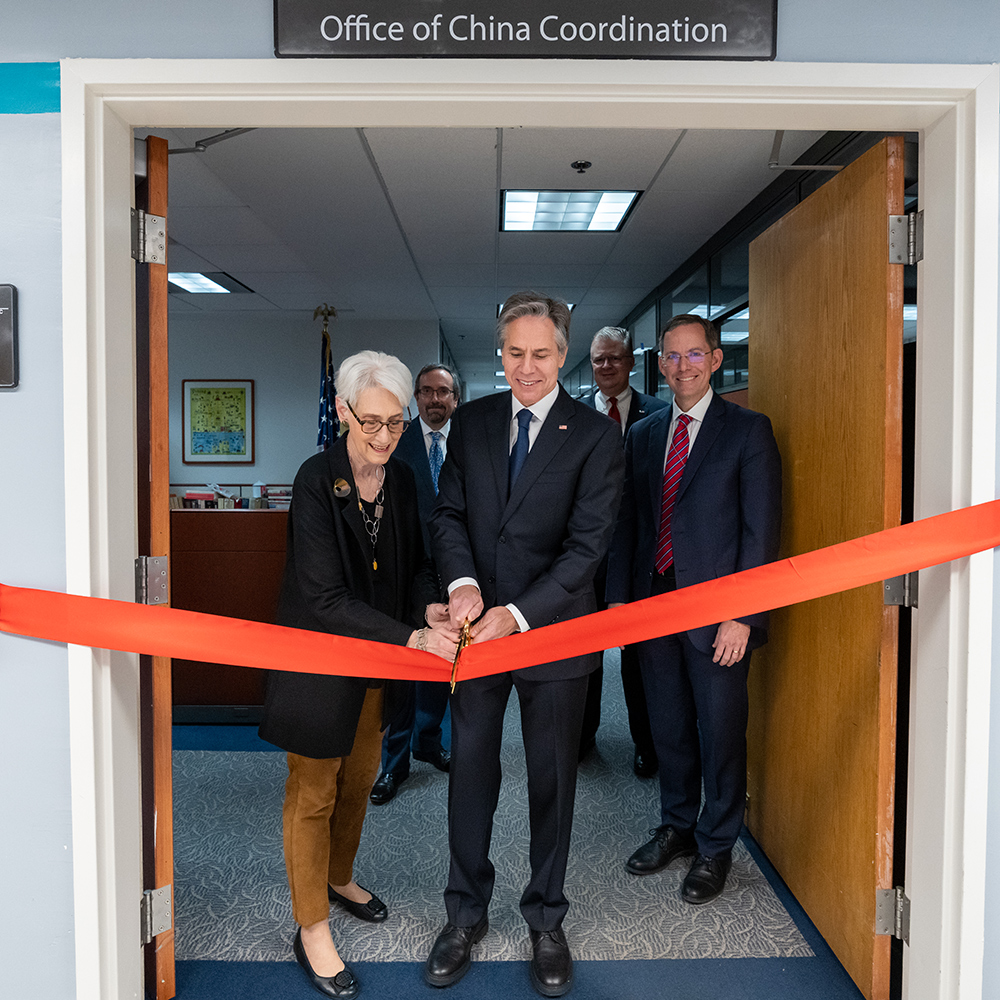
Reporting directly to then deputy secretary of state Wendy Sherman and situated on the Truman Building’s seventh floor near the department’s leadership, China House took on a unique structure.105 The aim was to raise the profile of China across the department while integrating efforts to compete with China both functionally and geographically.106 The roughly sixty to seventy staffers were split into three teams, including a core group based at China House, a group dual-hatted with other regional and functional bureaus, and an overseas group of Mandarin speakers strategically positioned at U.S. embassies worldwide.
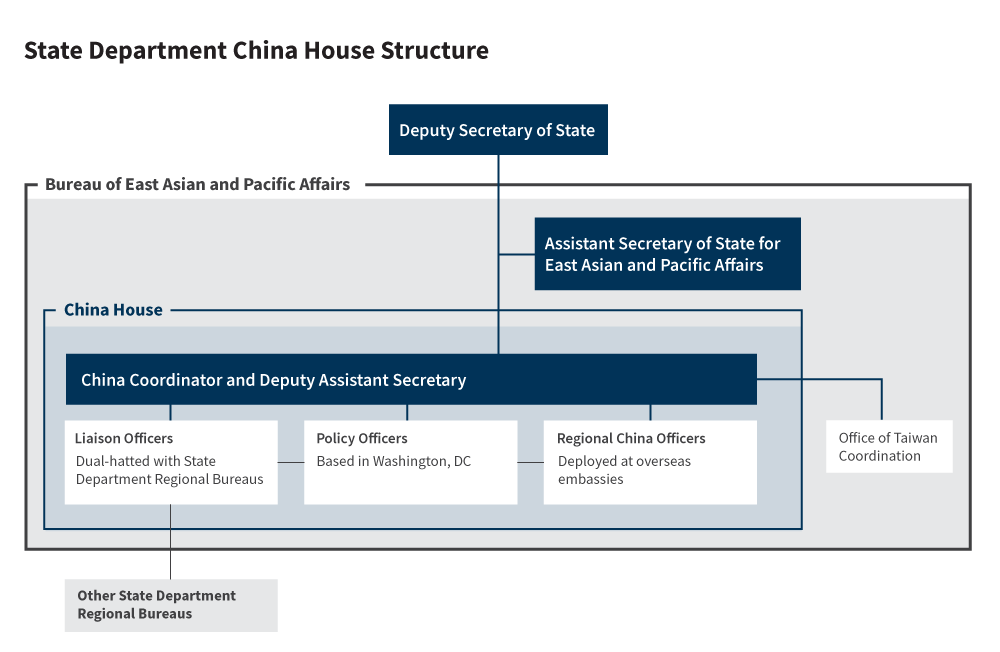
Some Republicans criticized the creation of the new unit as a bureaucratic power grab,107 but most former career and Biden officials saw it as a meaningful improvement given that regional bureaus had traditionally been siloed and ill-suited for a coordinated global effort.108
One former official interviewed noted the China House’s value, stating that for the first time the State Department was “able to get ahead” of the Chinese foreign minister’s annual visit to Africa, a tradition dating back to Chinese premier Zhou Enlai.109 China House also helped identify opportunities to advance U.S.-China–related interests when State Department officials met with their counterparts from third countries. For example, if the secretary of state was meeting with a foreign counterpart from a country outside of EAP’s traditional purview, China House was better placed to coordinate with the relevant regional bureau to add China-related priorities (for example, its global 5G ambitions) to the meeting agenda.110
One of the more important innovations was the creation of China House at the State Department.
China House was strengthened with $325 million from Congress in 2023—funds that were available for China-related objectives worldwide.111 Its creation signaled that competition with Beijing was no longer confined to the bilateral relationship but had become a global organizing principle for U.S. diplomacy. It is noteworthy that the structure has survived the current Trump administration’s State Department reforms.
To meet the scale of the effort going into a China-focused foreign policy, the intelligence community collectively undertook significant reforms to pivot from decades of prioritizing counterterrorism. Despite the first Trump administration’s reorientation toward great power competition, the Biden administration inherited a budget for the intelligence community that allocated over three times as much for counterterrorism as for China.112 The Office of the Director of National Intelligence (ODNI) therefore led an effort to reallocate resources toward China-related intelligence, including counting key resources differently to provide a more accurate picture of how much was being spent on what. Director of national intelligence Avril Haines then led a monthly meeting on “China Metrics” to keep track of the progress of long-term projects, such as new collection platforms, and to inform decisions on further budget allocations.113
With the increase in funds devoted to China, CIA director William (Bill) Burns launched the China Mission Center (CMC) at the agency. Mission centers are roughly akin to assistant secretary–level bureaus at the State Department, and the creation of the China-focused center added new resources and elevated the level and visibility of the intelligence officers working on China. Under Burns’s tenure, the CIA doubled its overall budget focused on China and hired more Mandarin speakers.114 The publicly stated aim of the center was to “address the global challenge posed by the People’s Republic of China that cuts across all of the Agency’s mission areas.”115 Like its counterpart at State, the new mission center would “bring a whole-of-agency approach” to unify intelligence work to counter “China’s global ambitions, and growing involvement in countries across the world.”116
Burns met with CMC experts weekly and sent more China experts overseas to increase monitoring and reporting on Chinese activities in third countries.117 Effort was also made to quietly strengthen intelligence channels with Beijing as part of the administration’s endeavor to improve dialogues between the two countries’ bureaucracies.118 However, the CMC’s intelligence diplomacy efforts with allies and partners were sometimes stymied by other mission centers seeking to retain bureaucratic ownership over regional channels.119
Other intelligence community members meanwhile implemented their own reforms. Soon after the launch of the CMC at the CIA, the National Security Agency (NSA) launched its own China Center. To strengthen it, NSA director Paul Nakasone gave the China Center some discretion over how the agency allocated and applied its resources toward China. The Defense Intelligence Agency (DIA) and National Geospatial-Intelligence Agency also stood up China-focused teams. According to a former senior intelligence official, reforms at the DIA proved controversial since it reallocated substantial resources away from counterterrorism toward China.120
The ODNI did not create its own China-focused center, however. Given the capabilities of the National Intelligence Council and National Intelligence Management Council, ODNI’s Mission Integration Directorate was judged to already have the capability of coordinating China-related intelligence across the intelligence community.121 Instead, the ODNI launched the Office of Economic Security and Emerging Technologies “to lead the [intelligence community’s] shift toward addressing techno-economic competition” and strengthen intelligence coordination on supply chain resilience, emerging technologies, and economic statecraft.122 The ODNI’s Counterintelligence and Security Center also worked with the Federal Bureau of Investigation and the Department of Homeland Security to step up counterintelligence action with state and local authorities, while engaging universities, the private sector, and Congress on Chinese intelligence collection efforts.
As allied leaders witnessed the effect of American intelligence on Ukraine’s capacity to defend itself, they acquired new appreciation for the intelligence community’s power.
While it is impossible to judge from the outside the impact of these reforms on China-related capabilities—some former officials interviewed whose purview was outside of China noted that what was really needed were more collection assets to track China’s global reach, rather than more Mandarin speakers123—the administration’s ability to share intelligence was likely important to shifting thinking in allied and partner capitals in Washington’s direction. In addition, as allied leaders witnessed the effect of American intelligence on Ukraine’s capacity to defend itself, they acquired new appreciation for the intelligence community’s power. The same effect may have been felt in Beijing, adding an additional deterrent effect for Taiwan. Finally, intelligence sharing—and intelligence in general—was especially at a premium during crises given how difficult communication with China has proven historically. Across the board, the U.S. intelligence community’s objective analysis was fundamental to helping policymakers avoid mistakes that could lead to a catastrophic conflict. As Haines said in an interview with the authors,
It is critical to have people in the discussion who play the role that we play as intelligence services, which is to say that we are not focused on a particular policy that we’re trying to justify to the President of the United States, but rather trying to give whoever is making the decision the best possible information that they can have in order to make that decision. That sort of evidence-driven, honest, unbiased analysis based on the extraordinary expertise that resides in our intelligence community gives our leaders a fundamental advantage.124
In contrast to the intelligence community’s outward focus, to support the invest pillar of the China strategy, the Department of Commerce established the CHIPS Program Office to coordinate the implementation of semiconductor manufacturing from over $50 billion allocated from the CHIPS and Science Act.125 Together with the Bureau of Industry and Security’s implementation of technology export controls, the changes to the Department of Commerce allowed it to become “very much a national security focused agency,” as noted by secretary of commerce Gina Raimondo.126
Lastly, the (re-)elevation of the U.S. permanent representative to the United Nations (UN) to a cabinet-level position under the Biden administration led the U.S. Mission to the UN to play a larger role in the development and implementation of the administration’s China strategy.127 Coordinating with its Washington office, the mission led on China-related objectives at the UN, including “getting ahead” of China to encourage the General Assembly to adopt a U.S.-led resolution (A/78/L.49) on sustainable AI development, the first-ever stand-alone resolution to establish a global consensus approach to AI governance.128
Given the centrality of deterrence in the Indo-Pacific to U.S. strategic objectives, the Pentagon was bound to play a critical role in implementing the Biden administration’s China strategy. Powerful elements within the building had been pushing for greater focus on China since at least Trump’s first administration, if not before that. During the transition, incoming Pentagon officials had therefore already identified several priority areas where they hoped to reorient U.S. defense strategy to focus even more on China.
There was “relatively little debate on the need to focus on China,” a former senior Pentagon official said.129 The administration was especially concerned that the rapid pace of China’s military modernization had undermined U.S. deterrence across the region.130 Former officials interviewed recalled “massive” Chinese investments into the People’s Liberation Army (PLA) Navy, cyber and space capabilities, air defense and missile capabilities, that already made it dangerous for U.S. forces to operate around the first and even the second island chains.131 This was before even counting China’s planned expansion of its nuclear forces. As they would put it in the 2022 National Defense Strategy, China was the Defense Department’s (DOD) “pacing challenge.”132
Moreover, while the Biden administration agreed that Trump had correctly identified great power competition as the underlying dynamic in the contemporary international system, it saw the 2017 National Security Strategy and 2018 National Defense Strategy as insufficient in several respects when it came to China. They were critical of Trump-era defense strategy as not distinguishing enough between the different nature of the challenges that Russia and China posed. Put simply by Colin Kahl in an interview, “Unlike China, Russia does not have the ability to dominate the world, but Russia does have the ability to blow up the world.”133 Biden officials were also critical of Trump for not having built a “holistic competitive strategy” toward China that “made clear how defense fit in with other instruments of national power.”134 In other words, Trump’s first administration had identified a heavy DOD role but never developed a comprehensive and coordinated approach.135
Biden’s defense team—all seasoned experts—were also cognizant that the Pentagon is notoriously resistant to change . A world unto itself, the “building” operates according to its own logic and priorities—and these are sometimes heavily shaped by the interests of the service branches and other institutional forces that outlive any presidential administration or strategy. Biden’s team knew that they needed leadership from the very top if they were to reorient the DOD’s million-strong workforce meaningfully away from the building’s many legacy efforts and toward competition with China.136 Without that leadership, Pentagon cadres would likely “just take whatever slide deck they were using and just put on a new title” with the words “China competition”—but no other changes.137
To kick off the process, the Biden administration embarked on a major policy review almost immediately after entering office. Announced by the president and led through secretary of defense Lloyd Austin’s office by Ratner, who would later become assistant secretary of defense for Indo-Pacific security affairs, a fifteen-member task force sprinted to assess how the department could increase its focus on China, deploying standardized questions for a Pentagon-wide data call, carrying out hundreds of interviews, and analyzing thousands of pages of existing policy and intelligence.138 The very existence of the task force was an important signal to the building that China was a top priority for Austin—even though he was associated with counterterrorism and America’s long wars in the Middle East.139
The task force was a successful signaling exercise, but a downside was that it established a bureaucratic precedent that prioritized maximizing China-related defense activity rather than assessing strategic needs. By framing China as a “pacing challenge,” the administration implicitly tied U.S. defense requirements to the rate of Chinese modernization. This created a logic that if the PLA expanded, the United States must outpace it. The question of what would constitute a sufficient level of force—independent of PLA growth—was thus largely sidelined in favor of maximizing the speed of the military pivot—as discussed in the conclusions in this report.
By framing China as a “pacing challenge,” the Biden administration implicitly tied U.S. defense requirements to the rate of Chinese modernization.
In April 2021, the task force delivered its initial assessments to Austin, and in June, the secretary announced several new China initiatives aimed at implementing a China-focused defense strategy. The assistant secretary of defense for strategy, plans, and capabilities, Mara Karlin, briefed the strategy extensively over the course of the second half of 2021, including to Congress, all the combatant commands, service heads, and other parts of the Defense Department.140 Pentagon leaders also realized the risk that the daily pressures of U.S. military operations worldwide would strip resources away from the China strategy and the strong need to prevent “micro-level decisions made in response to immediate needs from salami-slicing the strategy to bits.”141 A regular secretary-level forum known as “The China Brief” was thus established to hammer out China problems with the Pentagon’s senior-most leaders and ensure a long-term, strategic focus on China that otherwise might have been lost amid the daily crush of managing America’s global military posture.142 That meeting was backed by a three-star level meeting run by Karlin’s office. These meetings continued throughout the administration despite pressing crises in Afghanistan, Ukraine, and the Middle East, further underscoring to the sprawling bureaucracy that China really was a priority.143 The Pentagon also implemented changes to the budget process to ensure that budget requests were linked to the China-focused strategy and changes to the force allocation process to protect the strategic focus on China from more immediate, but less important, demands on the global force.144 These implementation efforts were viewed as crucial to success. “It’s all well and good to have a smart strategy—but if you don’t obsessively shape everything in line with it, your strategy will grow increasingly irrelevant,” one former senior official explained.145
The Pentagon also adopted the concept of integrated deterrence as a cornerstone of its China strategy. The concept was poorly defined from the start and gave rise to external critiques and internal confusion. The concept originated in a speech by Austin at Indo-Pacific Command on April 30, 2021, in which he said that “deterrence now demands far more coordination, innovation, and cooperation” and “integrated deterrence” is where “the U.S. military isn’t meant to stand apart, but to buttress U.S. diplomacy and advance a foreign policy that employs all instruments of our national power.”146
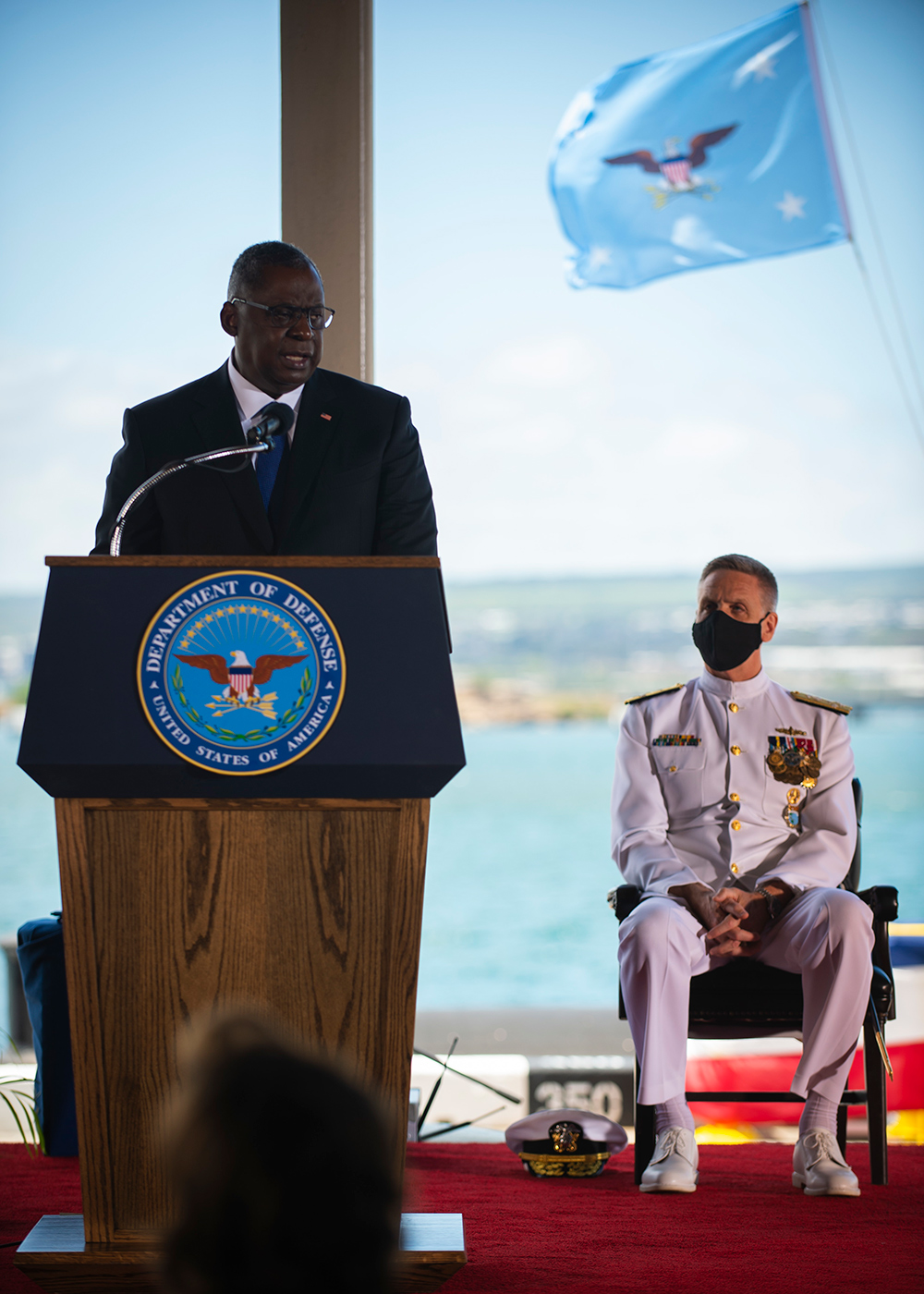
It fell to the Office of the Undersecretary of Defense for Policy to translate the concept Austin first described into a strategic framework through the administration’s National Defense Strategy. Integrating deterrence was a complex task—and the concept was open to different interpretations.147 In one interpretation, it meant cross-domain deterrence—in other words, the combination of conventional, nuclear, space, and information weapons to threaten a would-be attacker with unacceptable destruction. In another broader interpretation, it meant integration across the spectrum of conflict to span scenarios from minor gray zone incursions to full-scale nuclear war. Yet a third interpretation of the concept involved integration across all instruments of national power, including the threat of punishment through economic, diplomatic, and information instruments located in other areas of the government. A final interpretation of the concept meant integration across allies and partners because the United States would not fight a war alone.148
In short, integrated deterrence was a concept with something for everyone.
In short, this was a concept with something for everyone. As such, it also reflected a maximizing approach, rather than one based on an assessment of what amount of deterrence might be sufficient to reduce risk to acceptable levels. The breadth of ambition raised eyebrows and caused some degree of confusion. Did the Pentagon, for example, expect to also control the nonmilitary means of deterrence or was this simply recognition that there was more to the puzzle than military force? At least one official noted the consternation it created elsewhere in the government, where it was viewed as “an effort to have DOD own everything.”149 Republicans meanwhile balked at what they saw as an invented and ineffective concept.150
Critiques notwithstanding, Austin continued to refer to integrated deterrence as a cornerstone for how the United States would ensure that “conflict is neither imminent nor inevitable” in the Indo-Pacific.151 The concept was principally articulated through the classified version of the National Defense Strategy in spring 2022 and was also called out in the public National Security Strategy released later that year.152 In practice, it was operationalized mainly for gray zone scenarios such as a blockade of Taiwan and for testing resilience inference in U.S. trans-Pacific force flows in the run-up to a war.153
The Pentagon also worked to build a “more durable and lethal” force posture across the Indo-Pacific.154 Although the full scope of military acquisitions under Biden was vast, the core adjustments focused on dispersing vulnerable U.S. forces, expanding access agreements with allies, increasing operational tempo, and developing new autonomous capabilities under initiatives such as Replicator.155
These changes were driven by the reality that U.S. forces were highly vulnerable to China’s short- and medium-range strike systems. Dispersal and mobility were intended to reduce this vulnerability, enhance resilience, and thereby strengthen the credibility of the U.S. deterrent. This logic underpinned the eventual establishment of four new Enhanced Defense Cooperation Agreement sites in the Philippines and the forward deployment of long-range precision fires in joint exercises there.156
In Japan, the United States forward stationed a Marine Littoral Regiment and began restructuring U.S. forces there into a more operationally integrated headquarters to improve interoperability with Japanese forces.157 One official described these enhancements as enabling U.S. forces to provide “our own long-range precision fires and be highly mobile to avoid being pinned down by a potential Chinese attack.”158 Elsewhere in the region, the Pentagon increased high-end rotations of air, naval, and strategic assets to Australia and the Korean Peninsula, signaling both commitment and readiness.159
The efforts to strengthen U.S. force posture were accompanied by intensified military diplomacy with regional allies and partners, as well as investments through the Partnership for Global Infrastructure and Investment and other means. Biden officials wanted to move beyond what they saw as the Trump administration’s overly narrow focus on allied defense spending to a focus on enhancing allied defense capabilities through U.S. weapons sales and co-developing new indigenous capabilities.160 The jet engine deal with India was a key example of this (and will be discussed later), but the administration also pursued related initiatives with other countries, such as coproducing artillery shells and guided missiles with Australia to boost U.S. manufacturing.161
In the waning days of the Biden administration, deputy secretary of defense Kathleen Hicks said in a speech at the Johns Hopkins School of Advanced International Studies that “Strategic competition is a team sport, and more is more at home and abroad. Internationally, our allies and partners are a force-multiplier that makes us stronger.”162 In addition to describing changes in force posture, investments, and engagements in the Indo-Pacific as “historic, transformational improvements . . . fortifying our position from Northeast Asia down to Australia and the Pacific Islands,”163 Hicks stated that the DOD and Austin’s personal prioritization of competing with China had led to “seeing in classified wargames that these approaches are paying off” and that the Biden administration’s reforms would be an “enduring legacy.”164
The administration had set its regional strategy for allies and partners on a new trajectory, one in which they would be expected to do much more for the United States.
In reality, what was accomplished was more modest than Hicks made it out to be, but the administration had set its regional strategy for allies and partners on a new trajectory, one in which they would be expected to do much more for the United States. Overall, the success of Pentagon reforms in reorienting toward the Pacific was clear. By defining success primarily through the lens of outpacing a peer competitor, however, the administration deferred the harder debate over what level of military power would actually be sufficient to achieve its goals.
As the administration solidified its China strategy and agency implementation guidance over the course of 2021, it also began direct diplomacy with Beijing to stabilize the diplomatic relationship. It was a rocky start. Pandemic conditions, Biden’s domestic priorities, Beijing’s unrealistic expectations about where the United States was headed, and the NSC’s focus on other aspects of the strategy such as building up allied support all made for rough going. The cacophonous high-level meeting between U.S. and Chinese officials in Anchorage, Alaska, in March 2021 displayed underlying tensions for the whole world and set back subsequent efforts at diplomacy for several months—just as the chaotic U.S. withdrawal from Afghanistan sucked up the attention of the most senior U.S. officials. The result was over a year of competition without effective diplomacy or much effort to get there.
Some officials interviewed argued that the slow pace of diplomacy was intentionally aimed at avoiding meetings that were purely ceremonial and did not move U.S. goals forward.165 It would have been better, in their view, to borrow from China’s own book and bide time while rolling out the economic, technological, military, and alliance dimensions of the strategy to more convincingly confront China from a position of strength in diplomatic negotiations. There is a clear logic to this approach, although it may be largely an ex post rationalization for the faltering diplomacy of 2021. It was one thing to claim in theory that Washington would approach China as an equal, and quite another to overcome the practice of decades of U.S. primacy.
Officials interviewed who participated in the transition argued that their Chinese counterparts seemed to be anticipating that Biden would “reset” the relationship from the Trump interlude.166 This would have meant, for example, opening and reconstituting the U.S.-China Strategic and Economic Dialogue that dated from 2006.167 This anticipation, however, reflected a very inaccurate understanding of how far Democrat thinking in the White House had evolved since Obama.168 The new Biden administration considered forums like this to be “talking shops” of a bygone era and instead sought bilateral dialogue focused on substantive deliverables.169
Pandemic restrictions in the early months of 2021 made restoring diplomatic channels challenging, however. Capacity for in-person meetings in Washington was extremely limited, as the Alpha variant of the COVID-19 virus infected millions of Americans in the early weeks of January.170 Beijing meanwhile was under strict Zero COVID lockdowns and multiweek quarantines for foreigners arriving in China.171 As a former White House official recalled, the mechanics of engaging diplomatically with China in the depths of the pandemic were “unbelievably hard.”172
As a former White House official recalled, the mechanics of engaging diplomatically with China in the depths of the pandemic were “unbelievably hard.”
A further challenge, which was described by multiple former officials as a historic and persistent source of friction in the relationship, was navigating sensitivities in diplomatic protocol and access with Chinese interlocutors. Doing so required lengthy negotiations on the appropriate “parallelism” of officials, which was not straightforward given the structural differences between the American and Chinese governments. For American policymakers, the opaqueness of the Chinese system also made it difficult to ascertain who would be the most effective counterpart to establish a strong channel of communication between Washington and Beijing.
The result was a laborious back and forth between American and Chinese officials in the first weeks of the administration. A compromise was finally reached for a two-by-two meeting, with Blinken and Sullivan meeting Wang and the then director of the Office of the Foreign Affairs Commission, Yang Jiechi, for talks in Anchorage, Alaska, on March 18–19. Anchorage was meant to represent the midpoint between the countries, while hosted “on U.S. terms” on American soil.173
To give diplomacy a better chance of success, the administration early on decided to soften their language. They viewed Trump-era rhetoric as needlessly confrontational and were especially critical of Pompeo for his attacks on China and its leadership. From the Biden administration’s perspective, managing competition required language that reflected the reality that China was not going anywhere.174 And it was especially important to avoid the kind of “pejorative” language that could be viewed by Beijing as signaling a “desire for regime change.”175 Softening the language also responded to the criticism that the Trump administration’s aggressive language had spurred anti-Asian sentiment during the pandemic.176
As a result, official State Department language shifted from referring to the “Chinese Communist Party” and “Chinese government” to “the People’s Republic of China” and “Beijing.” The updated language guidance was visible from the start of the Biden administration, with a January 23 State Department press statement on “PRC Military Pressure Against Taiwan” noting “with concern . . . PRC attempts to intimidate its neighbors”—a mere four days after Pompeo had declared that “the Chinese Communist Party” was “commit[ting] genocide and crimes against humanity against its own people.”177
At the same time as the administration aimed to tone down the language, however, it also stuck with a tough line on human rights—thus somewhat undermining the effect. For example, Blinken, during his Senate confirmation hearing in January 2021, said he agreed with the outgoing Trump administration’s determination that China’s treatment of the Uyghurs was genocide.178 Biden, during his campaign trail in August 2020, also said China’s treatment of Uyghur Muslims was genocide.179
Signs of how frosty U.S.-China relations had become started appearing in the run-up to the Anchorage meeting.
Perhaps because of this, softening the language had no immediate effect on Beijing’s approach to the relationship. Signs of how frosty bilateral relations had become started appearing in the run-up to the Anchorage meeting. Washington and Beijing publicly disagreed over what to call the meeting in the first place: U.S. officials described it as a “one-off event” to address Beijing “from a position of strength,” while Chinese officials described it as a “high-level strategic dialogue” with an opportunity for a “reset.”180 Virtual engagements beforehand highlighted deep divisions, with separate phone calls between Biden and Xi and Blinken and Yang emphasizing U.S. concerns for Chinese human rights violations and Xi warning of a disastrous confrontation.181 The timing of the Anchorage meeting had also been carefully sequenced to follow U.S. consultations with its Indo-Pacific allies, including a virtual leaders’ summit of the Quad and also Blinken’s and Austin’s visits to Japan and South Korea in the days before the Anchorage meeting.182 The signal to both the Chinese delegation and American public was that the United States, with the backing of Indo-Pacific allies and partners, intended to confront China bluntly—in short that Biden’s approach was not that different than Trump’s.
Even with managed expectations going into the meeting amid a pandemic, the outcome proved worse than anticipated.183 Stepping off the plane in Anchorage, the Chinese side bristled at what they saw as a lack of respect for protocol by their American hosts—specifically the failure to offer a meal. According to former U.S. officials, this breach was the product of strict pandemic related regulations, but it was an inauspicious start to an important meeting between the world’s two most powerful countries.184
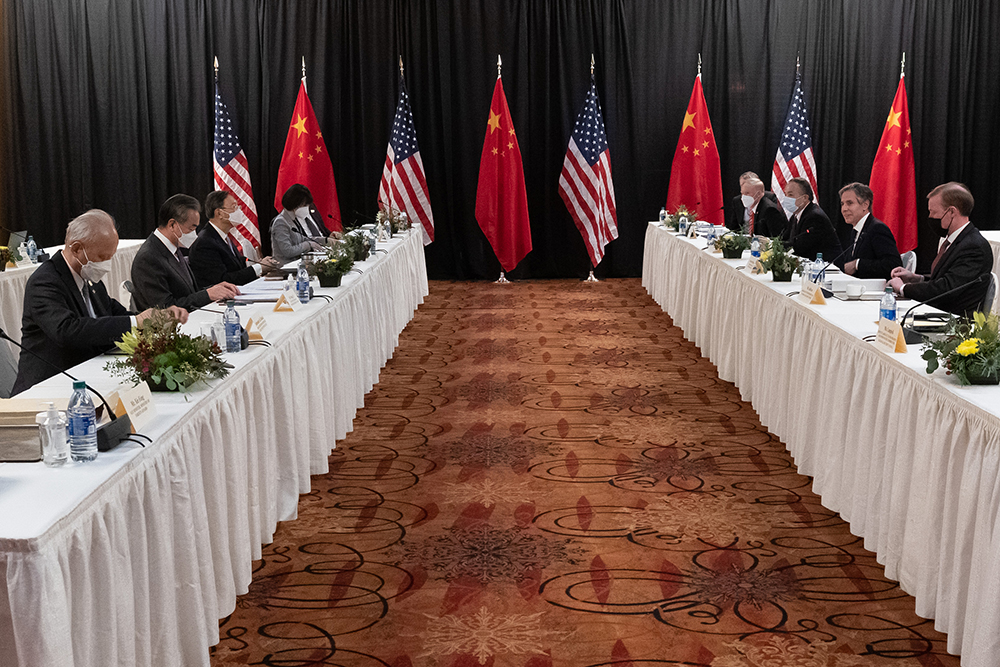
Things only got worse from there. In opening remarks televised to a global audience, Blinken, sitting across from his Chinese counterparts, underscored his sympathies for U.S. Indo-Pacific allies and criticized China’s human rights record.185 Perhaps Blinken felt this was necessary given the anti-China sentiment at home, but it came across as confrontational—not the meeting of equals that Beijing had expected. Blinken’s remarks put issues long considered by China to be internal affairs front and center and took Yang by surprise. It was hardly a triumph of diplomacy.
Clearly aggravated, Yang then launched into a sixteen-minute tirade against the United States, accusing it of being “condescending” and charging the United States with hypocrisy on human rights given its history of racism. Taken aback at Yang’s address, which badly breached a prior agreement for allocated speaking time, Blinken motioned for the press to stay for his own reply, saying, “It was never a good bet, to bet against America.”186 Yang then turned directly to the press and called, in English, for them to wait again.187 He then produced another long critique, angrily condemning U.S. breaches in diplomatic protocol and charging their hosts with treating “the Chinese people” with disrespect. The United States “did not have the qualifications to speak to China from a position of strength,” he said, clearly still heated and by now also thinking of how the standoff would play back in China.188
According to U.S. and Chinese officials present at the meeting, the subsequent closed-door discussions proved to be much more substantive and professional, with the temperature turned down outside of the media spotlight.189 Nevertheless, this was a public display of rancor, and the mood proved hard to shake. The next day, the Chinese delegation departed without a joint statement or public comment. Blinken and Sullivan attempted to downplay the spat, framing the opportunity for “clear-eyed” dialogue as valuable in and of itself.190 But it was hardly a step in the direction of a more stable and predictable relationship. Despite the opportunity for substantive dialogue on issues such as Iran and nonproliferation, the public spectacle led to “bruised feelings on both sides” and cast a shadow over the bilateral relationship.191
In the months following, Beijing stonewalled most attempts to arrange senior-level follow-ups, including delaying calls between Biden and Xi.192 Meanwhile, back in Washington, the Anchorage meeting made it even harder to justify the case for diplomatic engagement and managed competition, particularly among the Republican China hawks in Congress.193 This was also the period in which the administration was responding to the collapse of Afghanistan in the wake of the U.S. withdrawal—a crisis that required high levels of attention from all the top foreign policy officials in the administration from August through October 2021. The early inklings of Russia’s designs on Ukraine further complicated efforts to stay the course on China.
The overall result was a further cooling of the relationship post-Anchorage. It would be half a year until a second call between Biden and Xi and seven months until a meeting between Sullivan and Yang in Zurich, Switzerland.194 For one senior administration official interviewed, the worry post-Anchorage was whether it was even possible to “get onto a kind of a track that would allow our key seniors to have good effective relations with their counterparts.”195
Why did the Anchorage meeting go so visibly off the rails? U.S. officials on background accused the Chinese side of “grandstanding” and being “focused on public theatrics and dramatics.”196 Some concluded that Yang’s remarks had been pre-planned for a domestic audience, with the Chinese delegation going “back to business as usual” on agenda items after the cameras stopped rolling.197 At the time, Yang was Xi’s premier America-hand, having spent considerable parts of his career in the United States, including serving as Chinese ambassador to Washington from 2001 to 2005. As such, it is plausible that he was in part motivated by a desire to look tough to prevent any internal accusations of being co-opted by his American counterparts. Meanwhile, the Chinese foreign ministry blamed the Americans for showing a lack of “good host manners or proper diplomatic etiquette” since they “exceeded severely the set time limit” with “fiery and theatrical” statements.198
One U.S. official reflected that the two-by-two format with open press had proven a poor choice, observing that having two Chinese and two American officials together in a single meeting “created dynamics that were not helpful for a constructive conversation, since each official had to prove themselves to be more hawkish than the other.”199 This official also noted the relative inexperience and challenges faced by the U.S. protocol team in Anchorage and expressed regret for logistical constraints and missteps failing to provide for “the trappings of what respect looks like for Chinese guests,” which “set things off on the wrong foot.”200 How much of what occurred can be chalked up to the unusual environment created by the pandemic is impossible to say, but it clearly played an unhelpful role.
Whatever the prevailing headwinds, opening the first high-level meeting between senior officials of a tense bilateral relationship by inviting press into the room was flawed. Given the publicly documented record of how each side was framing the encounter—a meeting to show a position of strength versus a meeting of equals—more caution and care should have been exercised in the preparations. As evident from subsequent exchanges, there were ways the Anchorage meeting could have been handled more adeptly, such as inviting press in at the end of the meeting to summarize outcomes, releasing a still photo of the start of the meeting, or agreeing on a photo and handshake with no comments to press. While the Biden administration would apply the hard-learned lessons to subsequent engagements, Anchorage was a real setback.
As early efforts in high-level diplomacy foundered, Washington’s China posture in 2021 was defined less by new diplomatic bargains than by the pressure tools inherited from the Trump administration, Biden’s democracy versus autocracy framing, and domestic politics. What resulted was a strategy with a more aggressive edge than was initially intended as the United States took steps to address the competitive deficit that it claimed had developed during the Trump years.201
One of the first big issues the administration had to tackle was what to do about the Trump-era tariffs on China. Trump had imposed tariffs on more than $350 billion worth of Chinese goods, and China was resentful.202 Biden had campaigned against the economic impacts of tariffs, and his campaign claimed that America’s farmers “have paid a heavy price for President Trump’s tariffs” and that Trump was “pursuing a damaging and erratic trade war without any real strategy.”203 After entering office, however, Cabinet officials disagreed over what to do.204
Treasury secretary Janet Yellen took the orthodox view that a broad lowering of tariffs was in the U.S. economic interest because it would benefit American consumers.205 Blinken and U.S. trade representative Katherine Tai, however, wanted to keep them in place.206 For them, tariffs offered leverage that might be used in the future to extract other economic concessions from China. Lifting tariffs without getting something in return from Beijing also risked making the new administration look weak. Other key members of the administration, including Sullivan, had previously been skeptical of excessive reliance on free trade, especially when it serves geopolitical rather than domestic objectives.
Most of all, Biden’s political advisers judged that the tariffs were popular domestically and keeping them in place was important for maintaining support from organized labor and politically important states.207 Biden thus ultimately opted to keep Trump’s tariffs in place—not only in 2021, but for most of his term.208
Notably, part of the reason may relate to the old Washington joke that Republican administrations decide without deliberating, while Democratic administrations deliberate without deciding; a comparison of the first Trump administration and Biden administration also lends credence to this caricature. Biden officials consciously conceived of their measured process as the antidote to the speed and “chaos” of the Trump era, including on tariffs, and while this had the benefit of increasing buy-in across the bureaucracy, it did result in some important decisions “moving quite slowly,” as one senior NSC official noted.209 In fairness, in 2021, the pandemic was still gumming up the internal processes of the U.S. government: Many workers remained at home, and in-person meetings were limited.
Perhaps even more tension-inducing than tariffs in the first year was Biden’s framing of the world historical moment as a struggle between authoritarianism and democracy.
Perhaps even more tension-inducing than tariffs in the first year was Biden’s framing of the world historical moment as a struggle between authoritarianism and democracy. This was a view that he ultimately laid out most clearly in the 2022 National Security Strategy. That strategy was developed internally over the course of 2021, but there were external glimmers early on in the administration. For example, in Biden’s Munich Security Conference speech in February 2021, he declared the world at an “inflection point” between democracy and autocracy.210 This framing was clearly aimed at Russia, China, and also U.S. domestic audiences—but it cannot have done much to ease tensions with China.
In addition to adding a sharp ideological frame to the relationship, the view of a titanic standoff reinforced Biden’s early emphasis on human rights, even though not all national security officials deemed it useful in building a more constructive relationship with Beijing. In his first call with Xi on February 1, Biden spoke unscripted for over ten minutes on the topic, adding his concerns about aggression against Taiwan and China’s clampdown on freedoms in Hong Kong.211 In December, the White House announced that it would diplomatically boycott the 2022 Beijing Winter Olympics as a response to Beijing’s mistreatment of Uyghur minorities.212 At the same time, Biden signed the Uyghur Forced Labor Prevention Act, penalizing most U.S. companies that imported goods from the Xinjiang autonomous region.213
Both the ideological framing and the emphasis on human rights did, however, fit the public mood of the moment, which remained very anti-Chinese throughout 2021. The human rights emphasis would at least diminish as Biden’s term wore on. Although the National Security Strategy said the administration would “hold Beijing accountable for abuses—genocide and crimes against humanity in Xinjiang, human rights violations in Tibet, and the dismantling of Hong Kong’s autonomy and freedoms,”214 this language likely dated from 2021. In the next three years of the administration, there were no major actions on human rights directed at China.215
Therefore, as 2022 began, the U.S.-China bilateral relationship was in a similar place to the year before, when the Trump administration left office. Direct diplomacy between the two countries was fraught, and most of the existing tariffs and export restrictions were retained. Biden did, however, implement high-level structural and procedural changes in how China policy was developed and coordinated through the government and worked through a deliberative and slow-moving process to implement key parts of the Invest, Align, Compete framework. While competition continued under a steady-as-she-goes approach, going into 2022, Biden officials recognized there would be much work to do in establishing stability in the bilateral relationship while also rebuilding trust and cooperation with U.S. allies. It was not easy, as exogenous events continued to impede diplomacy while Washington introduced a raft of competitive measures centered on technology protection and alliance building.
The Biden administration recognized that the China strategy’s success or failure would rest not only on domestic renewal, but also on the ability to shape the environment in which competition was unfolding. In the first two years in office, this shaping required both consolidating ties with treaty allies and competing for influence beyond them. Senior Biden officials believed that China would only respond to diplomacy if confronted with a strong countervailing coalition. They therefore sought to overlay existing alliance relationships in the Indo-Pacific with a latticework that brought partners more closely into alignment with the United States and each other. Minilaterals—ad hoc groups of nations brought together around specific issue sets—were important parts of the lattice. The administration also prodded allies in Europe to take a more critical approach toward Beijing.
At the same time, shaping the strategic environment required engagement with countries that did not want to align formally with Washington. In the Global South, the administration’s objective was not to assemble a coalition against China, but rather to compete with Beijing’s growing economic and political influence—offering alternatives where possible while not going so far as to demand that these countries pick sides. This section therefore begins by examining the administration’s effort to build an Indo-Pacific latticework of allies and partners and then assesses the attempt to compete with China for influence in the Global South through initiatives such as the Partnership for Global Infrastructure and Investment.
These officials saw their project as, in part, restoring alliances damaged during the first Trump administration, but also, in part, building on some initiatives that had started under Trump. China’s assertive diplomatic posture in 2020 and 2021 facilitated their push, which by many measures was successful. The approach did require tradeoffs, however. For example, it risked reinforcing Beijing’s narrative that the United States sought to contain its rise and in some cases risked overstretching U.S. resources for marginal gain. Moreover, Biden’s reengagement had limits—most notably in the economic sphere, where domestic political constraints prevented the administration from offering expanded market access that some partners desired.
The Biden administration’s criticism of Trump’s destructive approach to allies was not wholly accurate: The first Trump administration made some effort, including at the Cabinet level, to focus allies more on the China problem, but it was certainly true that Trump had upset allies on several occasions and invested more limited presidential time in bringing them along with his China policy. It was also true that key allies, especially in Europe, had not moved very far in Washington’s direction on China by the time Biden entered office. Germany, France, and the United Kingdom, for example, all sought to build up their economic relationship with China—especially in a context where the future of U.S. trade policy was uncertain and their relationships with Russia were fraught. The trend in Asia was more aligned with Washington, but some treaty allies such as the Philippines and South Korea were—due to their own internal politics—in a more friendly mood toward Beijing.
In their 2019 Foreign Affairs article, Sullivan and Campbell emphasized that one of the United States’ “greatest strengths” in its competition with China was its allies and partnerships. From deterrence in the Indo-Pacific to international trade and global common goods, Sullivan and Campbell rightly emphasized how the “combined weight of U.S. allies and partners can shape China’s choices across all domains.”216 Washington therefore needed to “embed its China strategy in a dense network of relationships and institutions in Asia and the rest of the world.”217
The approach to allies recognized, in theory at least, that each country has its own distinctive history and relationship with China.218 This meant every potential partner, and even long-standing allies, would approach China differently from America.219 The aim was thus not to wholly unify, but instead to bring partners “into maximum alignment” in order to intensify their combined impact on China’s behavior.220 This meant that across the domains of economic, technological, and military competition, the United States would help develop a common concept for what “de-risking” from China would entail and coordinate collective steps on investments, sanctions, and military operations.221
To create multiple touchpoints for competition with China, Sullivan and Campbell devised the concept of a latticework of partnerships “so that everyone would be connected to everybody in a greater way.”222 They insisted that this was not a return to the Cold War strategy of containment. Instead, Campbell argued in a later interview that it was a means of engaging “China through the strength of groupings, both formal and informal in the Indo-Pacific.”223 The network included a wide range of overlapping arrangements, including “ad-hoc coalitions of likeminded partners, some big, some small, layered on top of each other” rather than a more formal international order composed of “proper-noun institutions with full-time secretariats.”224 This ad hoc approach gave the network a flexible and organic character that reflected the interests and outlooks of the various different nations that comprised it. At the same time, by strengthening regional contact, it created a superstructure that aimed to contribute to regional stability.
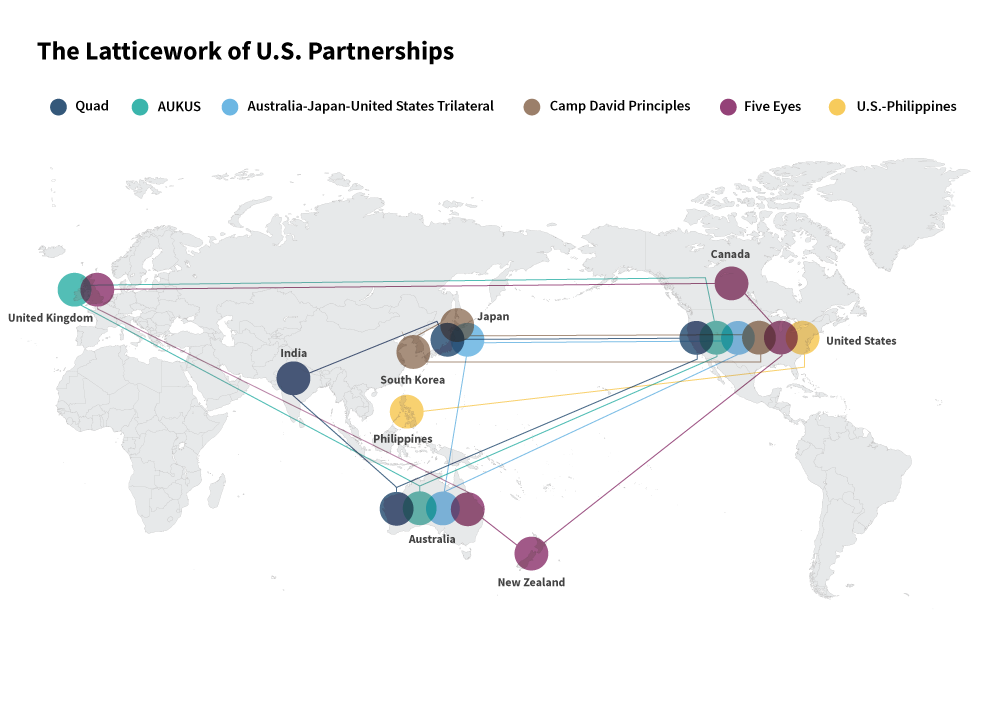
The Biden administration assessed from its early consultations that allies and partners welcomed U.S. diplomatic reengagement in the region. China’s lack of transparency and cooperation on the origins of the pandemic, as well as its wolf warrior diplomats’ destructive approach to many bilateral relationships, opened the door to a reassertion of U.S. alliance ties.225 Individual allied concerns about Beijing ranged from China’s maritime aggressions in the South and East China seas, border conflicts between China and India, and Beijing’s punitive, and ultimately self-defeating, economic coercion of Australia during the pandemic.226 Outside the region, European allies were starting to grow more concerned about their vulnerabilities to Chinese economic pressure, especially after China imposed a trade boycott against Lithuania in 2021.227 In this context, the Biden administration saw an opportunity for American support and coordination to foster a common alignment.
To articulate its approach to allies and partners, the NSC built on its transition planning memos to write an Indo-Pacific Strategy.228 In contrast to the classified China strategy, this was public-facing and intended to detail U.S. intentions to allies and partners. Some of these partners were wary of aligning closely with the United States, both because they wanted to continue beneficial economic relations with China and because they feared Chinese retaliation. The strategy therefore needed to de-emphasize competition with China in favor of a positive, “affirmative” vision for the region. According to an official familiar with its drafting, the aim was to help “persuade the rest of the region and in particular countries in Southeast Asia that the U.S. had something to offer to which they could also sign up to.”229 Hence, although the strategy noted “the PRC’s aggression and coercion” in the introduction, the main thrust was broad goals such as advancing a free and open Indo-Pacific—a concept first outlined by Japanese prime minister Shinzo Abe in 2016—and the importance of traditionally nonaligned countries.230 Accompanied by classified implementation guidance to agencies, the Indo-Pacific Strategy complemented the more narrowly focused China strategy as part of the broader Invest, Align, Compete agenda.231 Over the Biden administration’s four years in office, many U.S. allies, including Australia, Japan, Korea, and the European Union, each produced their own versions of an Indo-Pacific strategy with similar goals.232
Despite the emphasis on an affirmative vision, the administration considered market access off the table, but this was the one thing regional partners—from Vietnam to Indonesia—most wanted.
A challenge to this approach was that despite the emphasis on an affirmative vision, the administration considered market access off the table, but this was the one thing regional partners—from Vietnam to Indonesia—most wanted. The administration’s primary economic vehicle, the Indo-Pacific Economic Framework, explicitly avoided the traditional trade deal components of tariff reduction or market opening. The decision was grounded in the imperative of ensuring that foreign policy, including foreign economic policy, directly served Americans—along the lines of the Foreign Policy for the Middle Class concept that key players in the administration had laid out before coming into office. Although sound from a domestic perspective, putting market access off limits meant asking allies to take security risks against China without providing the economic gravitational pull necessary to decouple their commercial interests from Beijing.
A first step in implementing the Biden administration’s vision for the Indo-Pacific was to reengage and strengthen the Quad. The Trump administration had revived this forum in 2017, but Biden elevated it to the leaders’ level for the first time, convening a virtual summit on March 12, 2021.233 The meeting aimed to signal early “the administration’s commitment to the region and thinking about China in a newly strategic way alongside allies and partners.”234 The leaders issued a joint statement to “strive for a region that is free, open, [and] inclusive unconstrained by coercion,” as well as, without mentioning China by name, to seek “a free, open, rules-based order, rooted in international law” and to defend “democratic values, and territorial integrity.”235
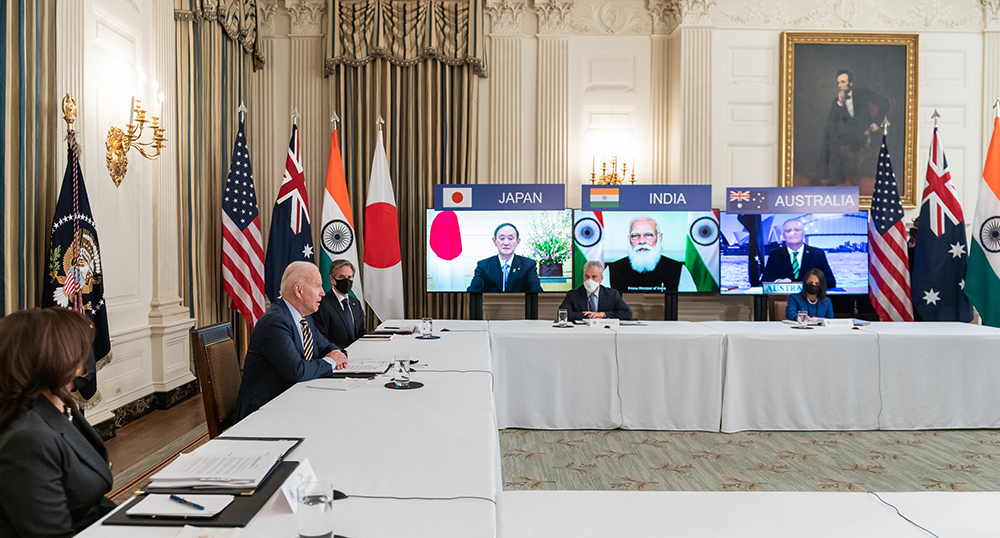
The United States already had treaty alliances with Japan and Australia, but what made the Quad unique was India’s participation, which created the optic of a major power concert concerned with China’s rise. The price of that participation, however, was a more limited purview for this minilateral. Even though India has long-standing security concerns about China, its equally long-standing tradition of nonalignment ruled out a Quad discussion of regional security. The Quad’s main focus thus became global health, infrastructure development, cyber security, and technology—also important regional issues.236
Beijing was not happy. Xi denounced the revival of the Quad as “multilateralism as a pretext to form small cliques or stir up ideological confrontation,” predicting (incorrectly) that it would be short lived.237 Over the course of the administration, there were regular annual Quad leader-level summits, including in-person meetings in Washington and Hiroshima, Japan, along with extensive foreign minister convenings.238
Meanwhile, the process of exploring a trilateral defense agreement between the United States, United Kingdom, and Australia—which had origins in the later part of the Trump era—was gathering steam. The impetus came from the Australians, whose relations with China had been deteriorating severely, leading to calls for a revival of Australia’s “forward defence” policy from the Cold War, which aimed to keep the “threat” from Asia as far away from Australia’s shores as possible.239 Australian military circles were meanwhile also concerned that the new diesel-electric successors for their aging Collins-class submarines—under construction by the French firm DCNS (now called Naval Group)—were no longer sufficient.240 Delays, cost overruns, and as one U.S. official termed it, “concerns over the technical viability and usefulness” of the French submarines, led Australian defense officials to conclude that nuclear-powered, conventionally armed submarines with long-range strike capabilities were a better solution for regional subsea power.241 Australia does not have a civil-nuclear industry that could produce or service its own nuclear reactors, however, which meant that the acquisition of this weapon required the development of a complex working relationship with the United States and the United Kingdom.242
Washington and Canberra’s discussions about potential nuclear cooperation dated from the first Trump administration, but moved more quickly when Biden came into office. In April 2021, Andrew Shearer, Australia’s director-general of national intelligence, traveled to Washington and convinced Sullivan to launch an intensive study into the feasibility of nuclear submarine cooperation.243 A two-week-long “group negotiating session” between roughly 200 Australian, British, and American officials worked through the basic conditions for an unprecedented trilateral nuclear collaboration and laid the foundation for Biden, Australian prime minister Scott Morrison, and British prime minister Boris Johnson to announce the Australia-UK-U.S.(AUKUS) trilateral security partnership on September 21.244 For the Biden administration, the willingness to share nuclear submarine technology—which one official interviewed called the “crown-jewel” of American defense capabilities—for only the second time in U.S. history was a visible demonstration of the value that the United States placed on allies and partners in the Indo-Pacific.245
For the Biden administration, the willingness to share nuclear submarine technology for only the second time in U.S. history was a visible demonstration of the value it placed on allies and partners in the Indo-Pacific.
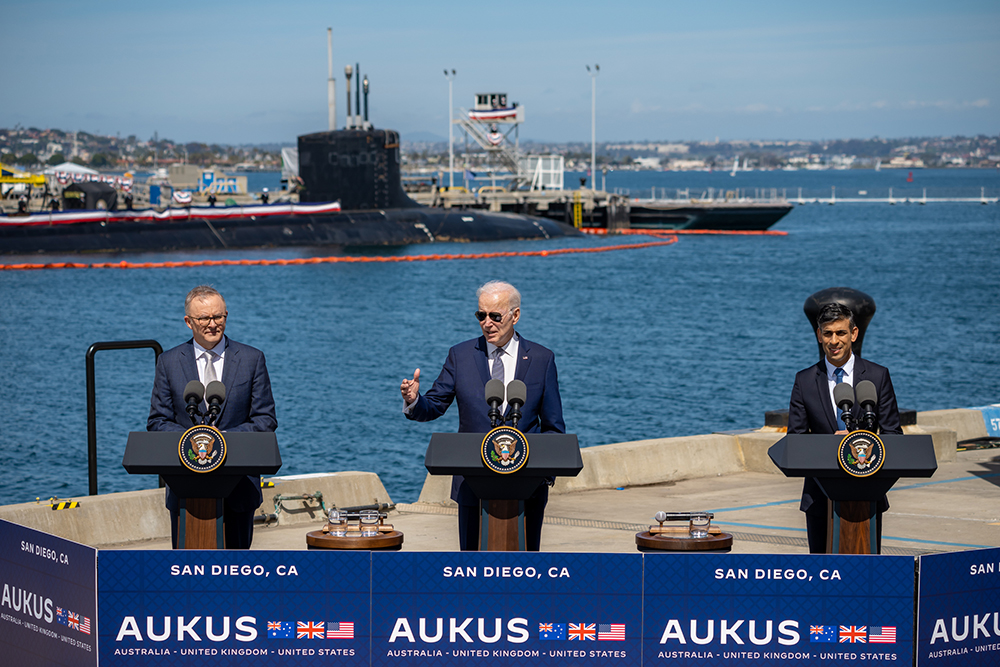
The creation of AUKUS was a bold step. The partnership aimed to strengthen allies in the region so that they could better manage their own defense, thereby offering strategic upsides to all parties. For example, the United States gained a new base for visiting American nuclear submarines at the Royal Australian Navy base HMAS Stirling, just south of Perth in Western Australia, providing new power projection capabilities in the Indian Ocean and in Northeast Asia.246 In revealing comments that caused some consternation in Australia, Campbell was quoted as saying, “When submarines are provided from the United States to Australia, it’s not like they’re lost.”247
Unfortunately, AUKUS’ implementation was plagued with challenges. To begin with, the French government, which had not been informed of the change in Australia’s plans until the eleventh hour, was understandably furious. The failure to inform the French was primarily Australia’s own responsibility according to U.S. officials, but French ire was also directed at Washington.248 French President Emmanuel Macron felt so betrayed and humiliated that he recalled the French ambassador to Washington for the first time in history, while French-Australian relations also broke down completely at the leaders’ level.249 According to one U.S. official interviewed, Macron’s and French officials’ public complaints that Biden had “acted like Trump” to sink the deal hurt Biden deeply and personally.250 Key U.S. officials involved in negotiating AUKUS proffered their resignations to the president (but he refused to accept them). Biden later reconciled with Macron, saying that the United States had been “clumsy” in its approach.251 Australia too had alienated a key European ally in the Indo-Pacific.
Subsequent progress in the partnership was also rocky; as the realities of shortfalls in U.S. shipbuilding capacity became clear, the program ran into challenges with technology sharing and export restrictions and was criticized for its proliferation effects. It took another year and a half for the three countries to develop a clear technical plan for delivering the submarines, and the plan did not have the SSN-AUKUS going to sea until at least the 2040s. There were also increasing concerns about the British element of the partnership given challenges with its own submarine force.252 As a result of the likely delay in producing the submarines, a stopgap agreement was arranged to provide Australia with U.S.-built Virginia-class nuclear submarines for the interim, but this remains in question even today.253 Thus, despite the billions Australia has invested in upgrading U.S. shipyards, Australia risks being left without any submarine capability for an extended period in the 2030s—although the United States will still get access to HMAS Stirling.254
Meanwhile, by the end of the Biden administration, AUKUS had been broadened to include more than submarines, with the addition of “Pillar 2,” an initiative to codevelop advanced defense capabilities such as quantum technologies, artificial intelligence, and hypersonics.255 The Biden administration also ramped up defense collaboration with Australia beyond AUKUS, adding Australia to Title III of the U.S. Defense Production Act and launching efforts to coproduce weapons, including artillery shells, long-range strike missiles, and missile defense systems in Australia.256
In addition to its work with the Quad, the Biden administration also invested considerable energy in deepening its partnership with India, which aspires to be a global power and has an active diaspora community in the United States. India also has its own competition and tensions with China; their relationship soured significantly after violence between the two sides in the disputed Galwan river valley in June 2020 resulted in the deaths of Chinese and at least twenty Indian soldiers.257 As a former senior White House official described, the Biden administration recognized that these ongoing tensions meant India “trusted us more on the China file,” which opened the conversation to expanding its partnership with the United States.258
Thus, strengthening defense ties took center stage, and the United States took the important step of allowing sensitive fighter jet technology to be transferred to India in order to coproduce General Electric F414 fighter jet engines.259 Getting to yes on this deal required overcoming deep reservations from the nonproliferation community across the interagency, as well as concerns about India’s long-standing defense ties to Russia, who for decades had been India’s main source of high-end weapons systems. As one White House official who worked on the deal put it, “You had to dig so deep into different bureaucracies to overcome long-standing resistance” to giving away such sensitive technology.260 But in the end, it was a sign of deepening trust and Washington’s readiness to support other nations in their own efforts to balance against China.
In keeping with its focus on technology as a core area of strategic competition, the administration put technology cooperation at the center of its effort to deepen ties to New Delhi. One significant outcome was the U.S.-India initiative on Critical and Emerging Technology in January 2023.261 The initiative helped create new partnerships in biotechnology, semiconductors, space, radio access networks, and 6G technologies.262 India also contributed to the Biden administration’s global climate policy through the U.S.-India Strategic Clean Energy Partnership, which aimed to mobilize finance to scale climate technologies and deploy clean energy technologies in India.263
Biden welcomed Indian Prime Minister Narendra Modi to the White House on September 24, 2021, and hosted him for a State visit on June 23, 2023.264 To be sure, keeping the relationship with India from going off the rails was sometimes a feat in itself, and U.S. officials struggled to avoid a collapse after Indian operatives assassinated a Sikh dissident on Canadian soil in June 2024.265 But in the end, the Biden administration left the relationship in a strong position—one that would be tested in 2025 under Trump.
Japan is America’s most crucial ally when it comes to strategic competition with China, yet its role in regional security has historically been hemmed in by the legal limits of its constitution. As Japan expanded its definition of collective self-defense, the Biden administration put great effort into strengthening the U.S.-Japan Alliance.
When the administration entered office, China’s aggressive military buildup was already making Tokyo reconsider its traditionally low defense spending and limited military role. And after Russia invaded Ukraine in February 2022, domestic momentum began for building an entirely new strategic concept. A few months later when China fired missiles over Japanese-controlled territories in response to Pelosi’s visit, Japan’s Fumio Kishida government pledged to increase defense spending from 1 percent of GDP to 2 percent by 2027 and announced plans to acquire a powerful offensive missile capability based on the U.S. Tomahawk system.266
The United States meanwhile upgraded its command-and-control frameworks in Japan, including the development of a joint forces headquarters to “enable seamless integration of operations and capabilities.”267 Weapons codevelopment initiatives were also strengthened through a new bilateral Forum on Defense Industrial Cooperation, Acquisition, and Sustainment, as the United States agreed to support Japan’s January 2024 purchase of 400 Tomahawks and conduct joint research on hypersonic weapons.268 The launch of a joint science-and-tech partnership on AI, quantum computing, semiconductors, and biotechnology was among over seventy initiatives announced as part of the Japanese prime minister’s state visit to Washington in what the White House described as an effort to “transform [the] bilateral relationship into a truly global partnership.”269 The Biden administration also sought to better integrate Japan with other U.S. regional partners, especially Australia and South Korea, but also the Philippines.270 For example, a new U.S.-Japan-Australia trilateral engagement led to the deployment of Japanese F-35s to Australia in August 2023.271
One wrinkle in the U.S.-Japan alliance was Biden’s decision to block Nippon Steel’s acquisition of U.S. Steel in the final days of the administration. The Japanese government called the decision “incomprehensible,” and the second Trump administration would later approve the deal.272 Nevertheless, by the end of the Biden administration, the U.S.-Japan alliance had strengthened overall.
The Biden administration also sought to break new ground with other groupings and minilateral partnerships in the region. One of the most difficult problems for the United States has long been the tense relationship between Japan and South Korea, which still suffers effects from Japan’s brutal occupation of South Korea from 1910 to 1945. Biden administration officials, however, wanted to see closer coordination between these two important allies, especially on military issues, and therefore tried to narrow their differences by pushing a trilateral arrangement.273
Biden took a personal interest in this relationship. In his first two meetings with world leaders in Washington, Biden hosted Suga on April 15, 2021, and South Korean president Moon Jae-in shortly after on May 21, underscoring for Asian audiences that the administration was focused on working with them on common regional issues.274
Yet, it was not until the election of South Korean president Yoon Suk Yeol in May 2022 that conditions ripened for an entente between Tokyo and Seoul.275 Following the G7 Hiroshima summit in May 2023, where Kishida met Yoon in person for the first time, Biden invited both leaders to a trilateral summit at Camp David.276 On August 23, 2023, the Camp David Principles security pact was signed, and the three countries committed to “expand our cooperation trilaterally and raise our shared ambition to a new horizon, across domains and across the Indo-Pacific.”277
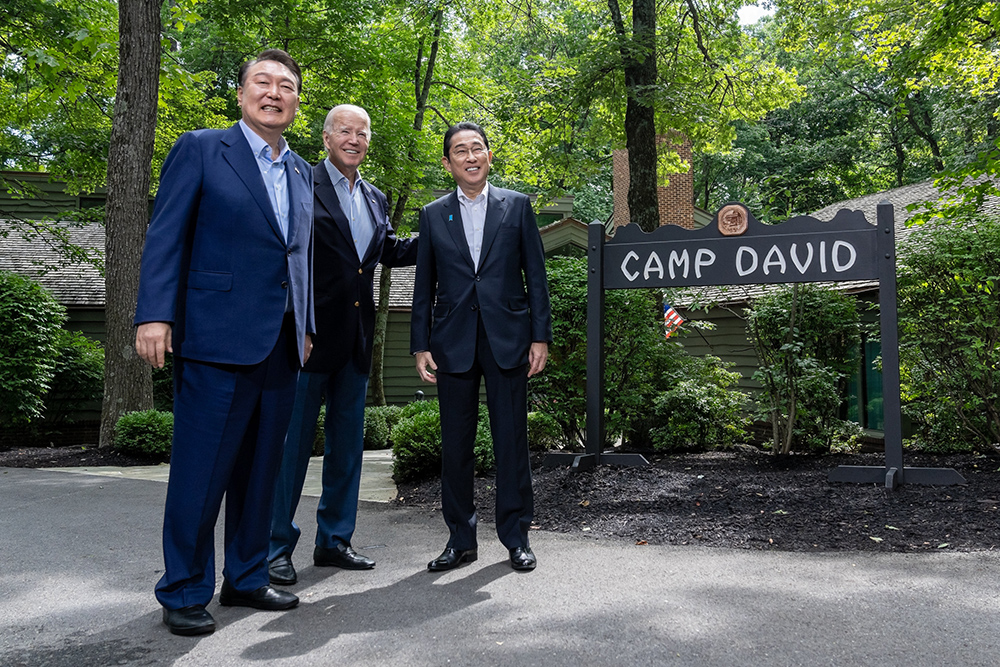
The diplomatic breakthrough between the Japanese and Koreans also built on other Biden administration investments into the U.S.-Philippines alliance.278 Since 2016, the Philippines had leaned heavily toward China under president Rodrigo Duterte, but the election of Bongbong Marcos in 2022 opened a window for change. Marcos hoped reviving relations with the United States would help the Philippines push back against Chinese efforts to dominate the South China Sea.279 Deepening the alliance with the Philippines was especially appealing to the Pentagon, which saw the opportunity to deploy ground-based missile systems closer to China and Taiwan, thus increasing the resilience of the U.S. force posture in the region. The process was slow, but by 2024, the United States was investing $500 million to support badly needed reforms in the Filipino military and deploying U.S. missile systems that could strike across the Luzon Strait and into mainland China.280
This rapid expansion of the U.S. footprint in the Philippines was hailed by the Pentagon, but even as the number of Enhanced Defense Cooperation Agreement sites grew and missile systems were deployed, the administration avoided defining the strategic ceiling of this buildup. How far should it go? By focusing on the lethality and resilience of the posture in response to PLA actions, the administration omitted a clear metric for sufficiency—how much was enough? This left open the question of whether deterrence was being strengthened through such moves or whether the United States was simply entering an open-ended arms race in the South China Sea.
The Pacific Island Countries also received attention, especially after China conducted a charm offensive aimed at deepening its relations with these remote islands; the approach resulted in a 2022 Solomon Islands security agreement with Beijing.281 This development caught Washington’s eye, as well as Australia’s, given that China’s presence so close by was especially unwelcome. To challenge China’s inroads, Biden hosted the first-ever U.S.-Pacific Island Country Summit on September 28, 2022.
The Biden administration’s allies and partners approach also extended to traditionally nonaligned nations such as Vietnam, which upgraded its relationship with the United States to the level of “comprehensive strategic partnership” after Biden visited the capital Hanoi on September 10, 2023.282 The upgrade did not stop Vietnam from continuing to hedge between the United States and China, however.283 Nevertheless, to Biden officials, even modest success with a traditionally nonaligned nation such as Vietnam (also a one-time adversary) was proof that its Indo-Pacific Strategy was yielding valuable results.284
A final major element of the Indo-Pacific Strategy was the additional push on multilateral diplomacy with the Association of Southeast Asian Nations (ASEAN), the Asia-Pacific Economic Cooperation (APEC) forum, and the G7. The White House organized a U.S.-ASEAN Special Summit for May 12, 2022, and hosted APEC throughout 2023.285 Both of these endeavors helped reinforce the align dimension of the strategy. So did cooperation with the G7, to which the administration looked to help coordinate sanctions and export controls.286 In an important signal of the G7’s growing alignment on China, leaders met in Hiroshima in May 2023 and opposed changes to the territorial status-quo in the region, raised human rights concerns, and called on China to press Russia to end its war in Ukraine.287 The Hiroshima meeting built on Biden’s earlier efforts to focus European leaders on how China’s actions could threaten their collective interests; the communique of the 2021 North Atlantic Treaty Organization (NATO) Summit included unprecedented language, stating that “China’s stated ambitions and assertive behavior present systemic challenges to the rules-based international order and to areas relevant to Alliance security.”288
In Europe, most allies had been reluctant to give the first Trump administration’s tough approach to China their full endorsement—a tendency that continued in the first year of Biden’s term. Europe has almost no military capabilities relevant to Indo-Pacific warfighting. Instead, Europe’s potential, when it comes to strategic competition with China, is in its economic strength, advanced technologies, and diplomatic power in the Global South and in multilateral institutions. Biden thus built on a Trump-era initiative in 2021 to establish a forum for coordinating industrial policy, especially as it related to supply chain diversification. The new U.S.-EU Trade and Technology Council produced modest results at best but was a step toward much-needed economic cooperation in an era when industrial policy was deepening in the United States.289
Europe’s potential, when it comes to strategic competition with China, is in its economic strength, advanced technologies, and diplomatic power.
When Russia attacked Ukraine in February 2022, European views began to shift away from China, whose “no-limits” partnership with Russia and subsequent support for its war effort handed U.S. diplomats in Europe a key talking point. Within NATO, U.S. officials stressed the threat from China, and it became possible to negotiate language reflecting this in the 2022 NATO Strategic Concept.290 NATO also established a mechanism for Australia, Japan, New Zealand, and South Korea—called the Indo-Pacific Four, or IP4—to participate regularly in NATO summits. This mechanism linked the lattice of the Indo-Pacific to the European continent—a logical move, although perhaps a less consequential one given limited European military capabilities in the region.291
To support its engagements with allies and partners, particularly as it became clear Russia intended to invade Ukraine, the Biden administration accelerated the pace of U.S. intelligence diplomacy. According to a former senior intelligence official, Biden thought the key institutions to lead an international pushback against Russia were NATO and the EU. Moving these institutions to act required bringing on board the other four members of the Quint coalition, including France, Germany, Italy, and the United Kingdom.292 This started a coordinated process at the foreign minister and intelligence chief levels to engage officials from these countries.
What emerged were new mechanisms of sharing intelligence with allies and partners. Haines focused on multilateral spaces, while Burns engaged in bilateral efforts.293 Analysts from across the intelligence community—including from the CIA, ODNI, Defense Intelligence Agency, and Treasury Department’s Office of Intelligence and Analysis—met every fortnight with Quint counterparts. According to a former senior intelligence official, these new channels created a “virtuous cycle,” where intelligence was shared to reinforce American diplomatic efforts at other levels of the Quint.294
As Chinese collaboration with Russia deepened, Biden directed the intelligence community to set up a similar system for Indo-Pacific allies and partners with influence in regional institutions like ASEAN. The intention was to complement existing intelligence channels supporting other elements of Indo-Pacific policy, including an “intel quad” with India, Australia, and Japan; an “intel trilateral” with South Korea and Japan; and the Five Eyes alliance with the United Kingdom, Canada, Australia, and New Zealand—particularly with AUKUS partners the United Kingdom and Australia. “If we have a crisis in Taiwan,” one former senior intelligence official explained, “we’re going to need to have different partners and allies understand what’s happening and have as good information as possible.”295
According to the former official, products shared through these channels included analysis of topics such as the People’s Liberation Navy, Chinese coast guard and militia boats, median line crossings, incursions into Taiwanese territorial waters, and changes in Chinese domestic law expanding coast guard authorities.296 Because some partners had shallower relationships and less-developed intelligence capabilities compared with European allies, American intelligence officials were judicious in sharing intelligence with those “who would have access to the leader who could set the table” in supporting diplomatic and policy objectives.297
Through intensive diplomacy across all levels of the latticework of allies and partners, the Biden administration made real progress to strengthen its partnerships throughout the Indo-Pacific by the end of its term. But was this intensification of regional ties a return to the Cold War strategy of containment? That strategy involved a worldwide effort to deter Soviet military advances in Europe and Asia while pushing back against Soviet efforts to strengthen communist forces globally.
Beijing complained loudly that it was the same strategy, while administration officials were keen to show that it was not. As one former senior White House official put it:
I don’t know how it’s possible that anyone can see this [as containment]. China is the dominant trading partner with all the countries involved. It is, you know, playing a dominant role in technology and trade globally. So, the idea that somehow we’re fencing in China is inaccurate. What I think is a better way to see this is the United States working in partnership with other countries to secure certain areas of common purpose from, frankly, quite carnivorous actions on the part of China that are in trade or technology or investments that are really designed not for positive sum outcomes, but to put competitors out of business to basically dominate both economic and strategic arenas.298
Biden administration officials were correct in the sense that they were not trying to cut off China’s economic, diplomatic, or even security ties with other countries in the Indo-Pacific—an effort that would have been futile anyway. Building up the U.S. network of regional alliances, however, was clearly intended to confront Beijing in a broad-based pushback, with the obvious aim of containing Beijing’s power and preventing the continued erosion of America’s own. In this sense, the Indo-Pacific strategy was a containment strategy and did intensify tension with China. Some administration officials were more forthright about this later—pointing out that if the strategy irritated Beijing, this was the point.299 And they were not wrong; soft containment through allies makes sense, provided there is a degree of flexibility and a realistic level of ambition that does not commit the United States to defending nations that are ultimately peripheral to its core interests.
Building up the U.S. network of regional alliances, however, was clearly intended to confront Beijing in a broad-based pushback.
Even if the latticework fell short of classic containment, it sharpened the competitive character of U.S. regional diplomacy—most visibly among countries already inclined to work closely with Washington. The harder test was whether the United States could compete for influence beyond that, in countries keen not to choose sides. That challenge was most apparent in the Global South.
During the first Trump administration, China’s Belt and Road Initiative (BRI), which offered countries massive capital infrastructure financing and development, was recognized as a central tool of China’s foreign policy and a challenge to U.S. relations with developing countries around the world.300 The Biden administration understood that it therefore needed to revitalize the U.S. approach to these nations if it was going to truly “compete” with China. As in the case of the Indo-Pacific Strategy, it judged that the key to competing with China would be an “affirmative vision and offer” that focused on “priorities that they care about, not just our list of interests in those countries.”301
Competing with the BRI, however, was a challenge that Washington was not well equipped to meet, given the slowness of its existing development assistance process, the limited funding available compared with China, and the fact that U.S. development assistance was run by a hodgepodge of agencies across the government that had never been oriented toward geopolitical objectives, only development objectives. As one senior official put it, the United States’ approach to development had been all about “ideals and telling countries what to do with their societies” rather than geopolitics.302 The advent of the BRI made clear that China had tools that the United States did not, and this was a disadvantage that left America at risk of being outcompeted not just for influence but for physical, financial, and political control over important critical minerals and other supply chains.
The advent of the BRI made clear that China had tools that the United States did not.
Biden officials assessed that as a command-and-control economy, China also had the ability to structure investments to undercut competitors and absorb financial losses, all while remaining unbound by Western rules preventing foreign corruption. This meant China was offering large upfront investments in the Global South at a speed unmatched by Western competitors. BRI’s efforts to support the Made in China 2025 industrial policy were growing China’s dominance in the upstream supply chains of strategic sectors such as batteries, electric vehicles, and solar panels. Repeatedly, around the world, Washington watched as BRI funds flowed into these strategic investments, and the United States had no tool to make a counteroffer.
The Biden administration’s main response to this challenge was the Partnership for Global Infrastructure and Investment (PGII). In 2021, PGII was originally conceived as Build Back Better World, but the Build Back Better theme was closely linked to Biden’s political platform, and this proved confusing for international partners and an impediment to getting funding out of Congress.303 The name was thus changed to PGII, and Biden launched the initiative at the G7 meeting in June 2022.304 A special coordinator position for PGII was established to support international coordination of development assistance through the G7 and drive the U.S. domestic development assistance toward strategic objectives. PGII essentially marked the beginning of an effort to compete with the BRI, although it could not match it in terms of sheer scope or scale. As Amos Hochstein, who served as the special coordinator for most of the Biden administration, explained in an interview with the authors, the purpose was not to match the BRI dollar for dollar, but the United States needed something to work with: “My zero dollars are not worth more than [China’s] money, but if I come in with a billion dollars, it’s worth more than 10 or 15 billion because I can get private sector and allies onboard also.”305 He found it easier to get buy-in from the intelligence committees on the Hill than other relevant committees, who he described as “stuck in the weeds.”306
As conceived within the Biden administration, the domestic side of PGII had “two prongs”: development and strategic competition.307 The development work focused on clean energy and climate, digital connectivity, health issues, and gender (which was “more of a lens than a particular investment category”308), as well as transportation and other connective infrastructure. According to one official who helped build the project from the ground up, “These were areas where we thought there was legitimate development need as well as areas where we could see strategic benefit vis-à-vis strategic competition with China.”309 The broader aim was to support U.S. industrial policy by ensuring that the green tech objectives of Biden’s policy could be sustained without dependence on China. Former officials interviewed were keen, however, to stress that this was “not an extractive play,” and they emphasized that unlike BRI, Biden’s PGII focused on the broader economic well-being of partner nations.
PGII effectively operated as a development finance agency, using U.S. government capital to de-risk and “crowd in” private finance for development projects PGII deemed strategically desirable. U.S. government investment reduced the risk for the private sector and showed that the United States “had skin in the game.”310 Advocates believed the latter was an important signal to encourage private sector investment—for example, because it signaled that the United States would pay extra attention to pushing back against bribes, handouts, and other corrupt practices that can make it hard for private sector firms to compete with China in Global South contexts.
To coordinate the initiative’s development agenda, the NSC set up a dedicated PGII Interagency Process Committee to bring together diplomacy and financing tools from across myriad U.S. development agencies, including the State Department, U.S. Agency for International Development (USAID), U.S. International Development Finance Corporation (DFC), Millennium Challenge Corporation, United States Trade and Development Agency, and Export-Import Bank of the United States.311 In an effort led by Amos Hochstein, first as senior adviser to Blinken for energy security and later as special presidential coordinator for global infrastructure and energy security, information was collated from across the development interagency to identify the most promising locations for potential investments. According to members of his team, Hochstein’s close relationship with Biden meant PGII received his personal investment and elevation on the U.S. agenda for G7 and G20 meetings.312
Ultimately, projects were selected organically as opportunities presented themselves, rather than through a comprehensive strategic needs analysis, which the administration feared would be too time consuming and lead to dithering as important opportunities to compete with China in the here and now were left on the table. It was important to be able to “jump quickly.” As one official described it, the question of project selection was “the question . . . [because] you want to have a consistent approach with tons of strategic analysis . . . but you also want to be able to move quickly when something pops up—especially where there are tenders out and Chinese companies are the only ones that have bid.”313
This preference for agility over exhaustive planning manifested in May 2023 with the Lobito Corridor initiative in Africa. State Department officials recognized the opportunity fortuitously during vice president Kamala Harris’s trip to meet with Zambian President Hakainde Hichilema. That meeting led the PGII team to the conclusion that China, which had bought the rights to the port of Lobito, was aiming to purchase the associated regional rail infrastructure to create a closed system that would offer Beijing a tight grip on the region’s critical minerals. Hochstein convinced the Zambian side to keep the tender open while he worked on European allies to place a competitive bid on the project.314 In the end, he succeeded and the rail project was awarded to a European consortium.315
The resulting Lobito Corridor aimed to build a new greenfield 800-kilometer rail line linking Angola and Zambia for the first time. By the end of 2024, U.S. investment in the project had reached more than $4 billion, and with contributions from G7 partners and regional development banks, total international investment had exceeded $6 billion.316 The investment covered not just the rail line itself, but also projects to support access to high-speed internet and clean electricity and to connect farmers to global markets.
Strengthening this rail infrastructure offered the chance to push back against China’s chokehold on global cobalt production by developing the DRC’s cobalt resources and bringing this critical mineral to the western side of Africa, rather than to Dar es Salaam on the eastern coast. It also aimed to exemplify the benefits of working with the United States rather than China by creating value for the countries involved, moving them up the value chain and strengthening their energy production and connectivity.317
A conjuncture of favorable political factors made the project possible. Angolan President João Lourenço was in the midst of an aggressive push to develop closer ties with the United States after describing past Chinese debt-based infrastructure investments as “disadvantageous” to Angola.318 Meanwhile, Zambia was also courting U.S. support while it negotiated a debt-restructuring program with China. When Harris visited Zambia on March 31, 2023, Hichilema indicated being open to the idea of American investment in regional rail corridors. The DFC was meanwhile already evaluating a project to support a Western consortium on the Benguela rail line in Angola.319 These opportunities combined to enable PGII to commit to a large-scale development effort that became its marquee project.320 Biden’s only trip to Africa was to Angola in December 2024 to visit the Lobito Corridor construction project, an effort publicly seen as specifically related to China and the race to secure critical mineral exports.321
PGII later expanded to support the Luzon Economic Corridor in the Philippines, the partnership’s first corridor in the Indo-Pacific. Announced late in the Biden administration’s term in April 2024, the Luzon Corridor was intended to support connectivity between the Port of Subic, Clark International Airport, the Port of Manila, and the Port of Batangas in the Philippines through modernizing rail and port infrastructure and building clean energy and semiconductor supply chains.322 This effort dovetailed with the Pentagon’s focus, led by Ratner, on building up the Philippines into a more capable ally through force posture enhancements and investments.323
The Biden administration’s approach to PGII was operational in the sense that it prioritized speed and near-term execution. Given the extent of China’s inroads across the Global South, this urgency was understandable, and in the case of the Lobito Corridor, it produced a genuine proof of concept—demonstrating that the United States could mount infrastructure initiatives intended to compete with the BRI. Yet this operational success obscured deeper strategic ambiguities. The impact of the corridor, and of PGII more broadly, on competition with China can be overstated. As one official observed, the BRI “is China’s foreign policy in the Global South.”324 PGII, by contrast, never fully confronted the scale of what meaningful pushback would entail, nor the trade-offs involved in attempting it. PGII officials recognized that the aim was not to compete everywhere with China, but the question of where, how, and to what end the United States should compete was never really answered. The Lobito Corridor demonstrated that Washington could leverage its development tools for specific geoeconomic ends, namely, securing critical mineral routes outside of Chinese control. Yet Lobito remained a tactical success.
Insofar as it was successful, Joe Biden’s own involvement was key. These projects appealed to his political sensibilities. “Biden’s the Amtrak guy. He loved infrastructure. These things connect for him,” Hochstein told us. This was a president who understood that building U.S. political influence meant providing concrete value for citizens, and was thus drawn to the idea of building critical infrastructure for citizens overseas—especially when the geopolitical stakes were high.
Joe Biden’s involvement in infrastructure projects was key. “Biden’s the Amtrak guy. He loved infrastructure. These things connect for him.”
The Biden administration also eventually attempted to link its international development efforts to U.S. national security interests at home. For example, at a speech late in the administration’s term, USAID administrator Samantha Power framed her agency’s role as advancing U.S. economic statecraft to guard against China’s economic influence. One tool available was the Economic Resiliency Initiative, which Congress appropriated for USAID to deploy nearly $100 million on projects across three core pillars: stabilizing economies, supporting partner job and wage creation efforts, and connecting U.S. partners to critical supply chains for in-demand goods along the Lobito Corridor.325 Similarly, a Countering PRC Malign Influence Fund (CPIF) was strategically allocated by the State Department and USAID. Among the many USAID projects were efforts to support building resilient undersea cables around the island nation of Palau, outcompeting Chinese bids on ports in the Dominican Republic, and combatting Chinese disinformation campaigns in Southeast Asia.326
The Biden administration also employed the DFC to counter China. The DFC was originally created in October 2018, largely to respond to the BRI and to modernize U.S. foreign economic assistance. DFC’s chief executive officer at the time, Scott Nathan, said in a 2024 testimony to Congress that the goal was for its funding to “successfully differentiate itself from the predatory practices of the PRC and other competitors.”327 By the end of 2024, DFC had made $12 billion in commitments across 181 projects, providing an alternative to Chinese investment in the areas of infrastructure, critical minerals, and clean energy manufacturing.328 DFC also invested in the Indo-Pacific, tripling its portfolio in the region during the Biden administration to over $4 billion in commitments in India, Indonesia, Nepal, and Sri Lanka, among others.329 It also developed partnerships with the development finance institutions of other U.S. allies, including those of Japan, South Korea, and Taiwan.330 DFC’s coordination with USAID tried to amplify the effects of these efforts, with the two agencies collaborating on 116 transactions in over forty countries in order to help support the crowding in of private capital and the opening of markets for American businesses.331
Going into 2022, U.S.-China relations were on a rocky footing. Biden and Xi had only spoken twice on the telephone and met once virtually (in November 2021).332 Both sides’ readouts of the November virtual meeting referenced an agreed need to strengthen communication, but a former White House official described the meeting as having been “largely unproductive.”333
Xi’s Zero COVID policy had insulated China from the pandemic in 2021, but it was becoming more and more costly as the virus mutated.
Economic developments were meanwhile trending in Washington’s favor and would continue to do so throughout 2022. Xi’s Zero COVID policy had insulated China from the pandemic in 2021, but it was becoming more and more costly as the virus mutated, forcing more lockdowns of greater severity and scale.334 In March 2022, for example, the effort to uphold the Zero COVID policy in Shanghai led to a two-month lockdown of 25 million residents, with widespread public frustration amid reports of food shortages.335 Chinese GDP growth in 2022 slowed to 3 percent, far below the government’s 5.5 percent target and among the lowest in decades.336 In response to the lockdowns, in late 2022, “White Paper Protests” erupted across China in a rare display of widespread public dissent against Xi and the Chinese Communist Party’s (CCP) leadership.337
Recognizing that the Zero COVID policy had become untenable, the government lifted most restrictions in early December 2022 and ended mass testing and tracking in the months that followed.338 According to one estimate, China experienced an almost 4 percent loss in GDP in 2022 because of the Zero COVID policy.339 China’s post-pandemic economic recovery remained fragile, however, due to a sector-wide real estate crisis, reduced consumer spending, rising public debt, and high youth unemployment.340 In contrast to the confident rhetoric espoused by wolf warrior diplomats in 2020, surveys showed increasing pessimism among ordinary citizens on the state of the Chinese economy.341
This changing economic context eventually encouraged a somewhat more cooperative approach from Beijing, but 2022 was a turbulent year—starting with Russia’s attack on Ukraine—and, ultimately, the U.S.-China relationship further deteriorated.
By late 2021, ominous clouds were gathering in Eastern Europe. Russia had built up massive forces along Ukraine’s border, and by early 2022, the CIA was warning publicly of an imminent invasion.342 China was hosting the Winter Olympics in February, and the administration hoped to convince Xi to use its influence with Russian President Vladimir Putin to help avert the invasion. Between late 2021 and February 2022, White House officials thus held a half dozen meetings beseeching Chinese officials to urge Russia not to invade.343 These meetings included long discussions in Washington with Chinese ambassador Qin Gang, while Blinken raised the issue with Wang. Unfortunately, Chinese officials were skeptical about the U.S. intelligence and repeatedly rejected the NSC’s claims that it was in China’s own interest to stop Russia from attacking. Qin, for example, cited Russia’s “legitimate security concerns” in Europe—a position that implicitly supported Russia’s long-standing claim that it was being backed into the use of force by Ukraine, the United States, and its allies.344
The real blow to these efforts came on February 4, 2022, when Xi welcomed Putin to the opening ceremony of the Beijing Winter Olympics with open arms.345 Standing side by side, Xi and Putin issued a 5,000-word joint statement declaring a “no-limits” partnership. For the first time, China explicitly opposed NATO enlargement (a core Russian grievance against the West). Both countries also denounced AUKUS and the “negative impact of the United States’ Indo-Pacific Strategy.”346 In retrospect, this was a watershed moment in Russia’s relations with China, an important shift that set the stage for China’s crucial support to Russia’s war effort.347
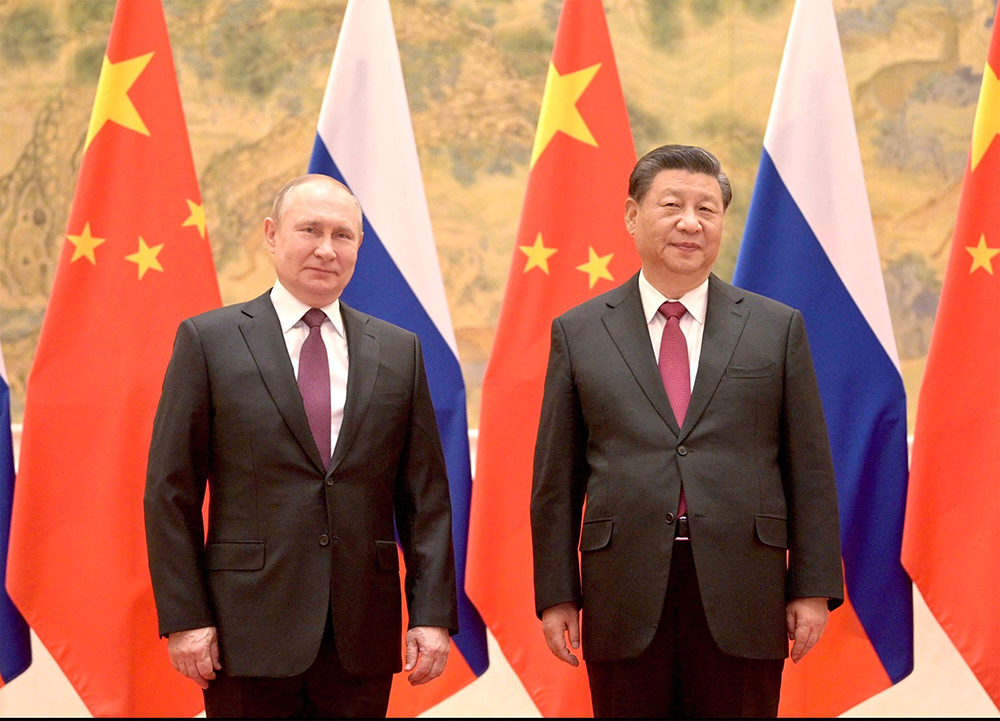
But the material deepening of the relationship was still to come. Xi actually may have been caught off guard by the immediacy of Russia’s full-scale invasion of Ukraine on February 24, 2022. Chinese intelligence services perhaps underestimated the magnitude of the Russian assault, putting Xi in an awkward position.348 On the one hand, Chinese leadership saw a strategic upside to Russia’s attack on Ukraine.349 A major war in Europe would inevitably distract the Biden administration from its objectives in Asia, forcing Washington to expend precious resources to overcome a “test of American influence and resolve.”350 At the same time, however, Russia was in deep trouble on the battlefield and would only become needier as the war went on—Putin would have no choice but to look to Beijing for support against Western economic sanctions and diplomatic isolation.351
Despite these strategic upsides, backing Russia presented challenges for Beijing. For example, it complicated Chinese efforts to divide Europe from the United States. The Chinese leadership appeared surprised by the degree to which the democracies of the world in Europe and Asia rallied behind Ukraine to coordinate on sanctions and to isolate Russia diplomatically.352 Amid a global outcry against the war, backing Russia also threatened to tarnish China’s reputation, just as it sought to project itself as a responsible great power.
Shortly after the invasion when Washington started to recognize that Russia’s military failures were leading to a protracted conflict, U.S. intelligence learned that Russia had asked Beijing for military assistance, including armed drones.353 This was an ominous sign for the future. Sullivan and Yang met in Rome on March 14 for a previously scheduled meeting that turned into a “substantial discussion of Russia’s war against Ukraine,” according to one of the U.S. officials present.354 In Rome, on a follow-up phone call on March 18, and during an almost five-hour discussion with Yang in Luxembourg in June, Sullivan pressed his Chinese interlocutor hard not to provide lethal assistance to Russia, making clear that doing so would result in “very direct and severe” consequences for China.355 Biden also spoke with Xi by phone on March 18 to reinforce this message from the top.356 The exact content was not specified, but presumably it included the threat of major sanctions on Beijing—something that by 2022, Beijing was less inclined to risk, given the difficulties emerging in its economic outlook.
China’s assistance to Russia became a central point of friction in the U.S.-China bilateral relationship.
China’s assistance to Russia became a central point of friction in the U.S.-China bilateral relationship, and the war was one of the main exogenous blows to the administration’s efforts to stabilize bilateral ties. The potential for Chinese lethal arms assistance to Russia was of particular concern to U.S. allies and partners in Europe, who saw the Russian invasion of Ukraine as the greatest threat to their security in three decades.357
Yet for several Biden administration officials, there was a silver lining to this unfortunate turn of events in relations with China. Beijing’s growing support for the Kremlin gave U.S. diplomats a valuable talking point in European capitals and alienated European leaders from Beijing, thus helping to encourage a much more skeptical and realistic approach to China overall.358 On April 1, 2022, at the Twenty-Third EU-China summit, senior EU leaders—including the European Council’s president, Charles Michel, the European Commission’s president, Ursula von der Leyen, and the EU’s top diplomat, Josep Borrell—warned Xi and premier Li Keqiang directly that “any circumvention of the effects of the sanctions or any aid provided to Russia” would be of deep concern to the EU.359
U.S. and European objections to China’s support for Russia’s war would become a constant in the relationship. For example, a year into the war at the February 2023 Munich Security Conference, China’s newly appointed top diplomat Wang got a frosty welcome from the Europeans, many of whom publicly called China out for supporting Russia.360 Europe’s negative view of China’s support for Russia also helped to dispel Beijing’s misconception that Europe was only supporting Ukraine because the United States was forcing it to do so.361 U.S. officials described Beijing’s fear that “the bottom would drop out” of its relationship with Europe as something “quite alarming and meaningful” that played an important role in China’s decision not to provide Russia with lethal weapons.362
Overall, however, U.S. efforts to slow China’s support to Russia had mixed results at best. Although China did not provide lethal support to Russia, it did eventually provide valuable dual-use technologies, such as semiconductors, optics, and nitrocellulose—all of which were key to Russia’s war effort.363 One former White House official expressed regret that the Biden administration had not managed to curtail Chinese support for reconstituting Russia’s military, which “arguably may be even more significant than lethal [assistance] in the long term.”364 U.S. officials did, however, credit China for its efforts alongside other nations to dissuade Russia from using tactical nuclear weapons in Ukraine, which had also been discussed between U.S. and Chinese officials.365
Russia’s invasion of Ukraine provoked a debate over whether China would view an alleged Western lack of support for Ukraine as a green light to invade Taiwan.366 But this argument was always far-fetched. One former U.S. defense official, for example, said that the way Russia’s military “got smashed” by Ukrainian resistance in a land war meant that China became even more cautious about invading Taiwan—a much riskier and more ambitious seaborne operation than Russia’s costly Ukraine invasion.367 The same U.S. defense official noted that the Russian military’s initial defeats in Ukraine had likely reinforced Xi’s lack of trust in his own military, pointing to how the war had led to “many see[ing] Russia’s military as the second-strongest in Ukraine” despite years of investments and an extensive operational history in Syria and Georgia.368
The Pentagon and U.S. government more widely believed that the combined diplomatic, economic, informational, and intelligence capabilities used by the United States and its allies in warning and responding to the Russian invasion had unnerved the Chinese leadership, who were left blindsided by their own intelligence agencies. While former Biden officials conceded that it was less clear whether these lessons would hold over the long term since China could have advantages in a protracted war over Taiwan, they believed that the allied response to Ukraine had made China more likely to weigh the costs of aggressive action. Just as the shadow of nuclear war hanging over the Ukraine war compelled both the United States and Russia toward caution, China “should think twice about putting an American ship at the bottom of the ocean” in response to indirect support for Taiwan, as Colin Kahl explained in an interview.369
When the Biden administration entered office, relations across the Taiwan Strait were as tense and problematic as ever. Long the most difficult problem in the region for Washington to manage, the difficulty had increased substantially by 2021 due to China’s military modernization, which drew into question the U.S. military’s capacity to defeat a Chinese attack on Taiwan. Xi’s repression of the 2019–2020 Hong Kong protests, generalized American hostility toward China over COVID-19, and the Biden administration’s framing of the world historical moment as a contest between authoritarianism and democracy were encouraging many parts of the Washington establishment to move toward a warmer embrace of Taiwan.370 To complicate matters, the administration took some early risks, such as inviting Taiwan’s representative to the United States, Hsiao Bi-Khim, to Biden’s inauguration. Actions such as these were symbolic—they gave Taiwan symbols of sovereignty and thus inflamed Beijing—but did nothing to improve Taiwan’s military or diplomatic position to defend itself.371
Against this backdrop, NSC officials had a highly restricted meeting in early 2022 in which they concluded that Washington should do more to reassure China about U.S. intentions toward Taiwan. According to some former White House officials, there were signs that Beijing had serious misconceptions about U.S. policy toward Taiwan and clearing these up might lead to greater cross-strait stability.372 Top administration officials recognized the need to reassure Beijing that U.S. policy on Taiwan was not shifting away from the long-standing “One China” approach. In practice, this meant communicating to Beijing that the United States was not actively seeking Taiwan’s independence. Doing this convincingly in 2022, however, proved difficult.
The first challenge was Biden’s repeated statements to the press that departed from Washington’s long-standing One China policy. Biden explicitly and repeatedly committed to using military force to defend Taiwan—commitments that came without qualification. Traditionally, Washington has sought “strategic ambiguity” as to whether it would intervene in the event of a war. This policy has helped prevent Taiwan from declaring independence, while also making it clear to Beijing that U.S. intervention needs to be part of their war planning if they were to carry out an unprovoked attack on the island. At least four times during his presidency, Biden made statements that appeared to strengthen the U.S. commitment into something resembling a firm security guarantee to Taipei.373 On each occasion, the White House would hastily issue a walk-back, clarifying that “our policy has not changed” on Taiwan.374
Many analysts in Washington, however, observed that Beijing could easily interpret these repeated statements by the commander-in-chief as signaling major changes in U.S. policy—regardless of what the White House said afterward.375 That Beijing would be so willing to dismiss the repeated words of a U.S. president seems questionable, given Beijing’s top-heavy presidential system and tendency to mirror-image. Chinese officials reacted angrily, saying, for example, that Biden’s remarks “severely violate the important commitment the U.S. made not to support Taiwan independence.”376
Biden’s administration, however, maintained that Beijing was posturing and in fact was unperturbed by Biden’s statements.377 Most also claimed that the president’s gaffes did not disrupt the working relationship with Beijing,378 with one noting that president George W. Bush had made similar statements,379 and another judging the impact minimal because “Beijing already assumes we’re coming” to Taiwan’s defense.380 Others noted that Biden himself was quick to clarify that he remained committed to the One China policy and did not support Taiwanese independence.381 These statements were “idiosyncratic to Joe Biden” and the president’s communication style, which eschewed diplomatic niceties.382
The most dangerous crisis in the U.S.-China relationship during the whole Biden administration was caused by Nancy Pelosi’s visit to Taiwan.
Whatever the impact of the president’s statements about Taiwan, the most dangerous crisis in the U.S.-China relationship during the whole administration was caused by the visit of Pelosi to Taiwan on August 2, 2022. Pelosi was a longtime defender of Taiwan and a fervent critic of the CCP’s human rights record.383 When she was invited in early 2022 to visit the island as part of a tour of U.S. allies in Asia, Pelosi was determined to go. This came as an unwelcome surprise for the White House, which by then was starting to look for ways to stabilize the relationship.
White House officials leaked Pelosi’s preparations to the Financial Times in July, perhaps hoping to forestall the trip.384 Chinese officials issued stark warnings in public and in private to alarmed NSC officials.385 According to multiple U.S. officials, the U.S. intelligence community assessed that Beijing would react furiously to the visit, likely with military force.386 The planned timing of Pelosi’s visit was especially provocative from Beijing’s perspective because it would occur just a day after the anniversary of the PLA’s founding and a few months before the CCP’s Twentieth Party Congress where Xi was expected to secure an unprecedented third term.387
Given the risks, the Biden administration went to great lengths to avert the visit. Sullivan, Bill Burns, Campbell, and several top U.S. military officials paraded up to Capitol Hill to brief Pelosi and her staff to try to dissuade them from making the trip.388 Pelosi was briefed on the intelligence assessments that anticipated a dangerous Chinese reaction. Administration officials explained why her visit would only serve to weaken Taiwan’s security and enable the PRC to establish a new more aggressive baseline on its military threats around the strait. The White House grew so concerned about losing control of the delicate situation that they even tried to persuade the Taiwanese to withdraw Pelosi’s invitation.389
But these warnings fell on deaf ears. Pelosi was determined to go. She viewed the White House as unacceptably tolerant of the CCP’s human rights record and wanted to make a statement.390 And she would later express irritation at White House pushback against “the first branch of government.”391 She also said it was unacceptable that “President Xi Jinping decide where I, a Speaker of the House, could go.”392
Ultimately, whether Pelosi visited Taiwan was up to Biden. In theory, the White House could have withdrawn her transportation aircraft and refused to sanction the military support covering her travel.393 Pelosi made clear that she would hear the senior White House officials on the case, but otherwise dismissed them as just staff, making clear that unless Biden himself called her, she would not budge. But Biden refused to go this far.394 As a longtime senator, he was deeply committed to the separation of executive and legislative powers but also fearful of opening himself up to personal criticism of being weak on China.395 For Pelosi, Biden’s deference and his past statements committing to defend Taiwan were an effective green light for the trip.396
When it became clear that Pelosi was not persuadable, the Pentagon launched a massive effort to minimize the risk of a disaster. One major concern was internal assessments that the PLA might attempt to intercept and challenge her plane as it approached Taiwan.397 Since the most direct routing to Taipei was over disputed airspace in the South China Sea, the Pentagon feared that U.S. aircraft might be forced to respond to a PLA Air Force interception.398 To avoid this, they rerouted Pelosi’s plane on an extended three-hour detour around the Philippines, which made use of the Philippines’ geography as a barrier to maximize the distance to mainland China.399 U.S. military aircraft also did “large loops” 50 to 100 miles away from her plane so that Beijing could not as easily claim that the U.S. military was “escorting” her to Taiwan. The hope was that this performance would at least reduce the symbolism of the event and with it the chances of a PLA response.400 The Pentagon went to a 24/7 operational footing with around-the-clock interagency coordination with Indo-Pacific Command, the NSC, and the State Department to synchronize messaging to Beijing, Taipei, and allies and partners.401 In the process, the Taiwan team in the Office of the Undersecretary of Defense for Policy was moved from the East Asia office to the China office in what would become a permanent reorganization that mirrored other federal agencies and the NSC.402
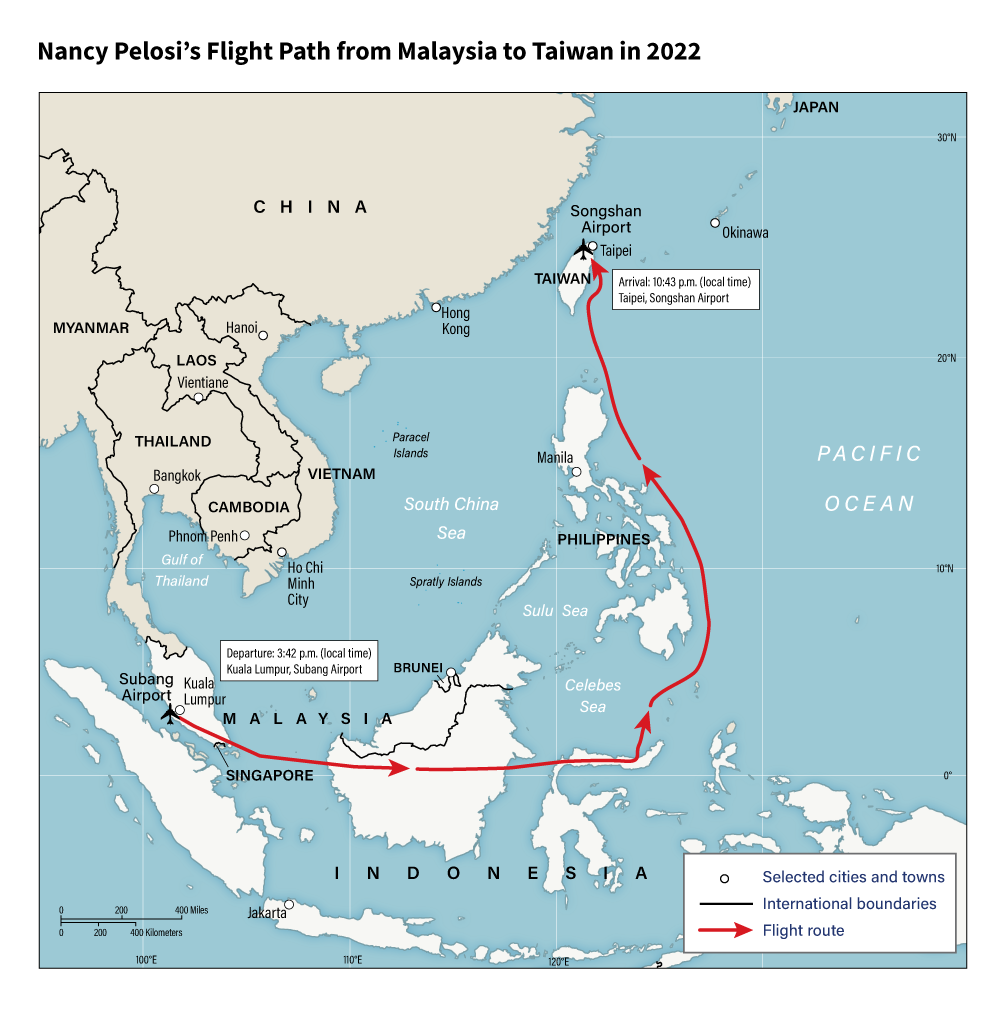
Pelosi landed in Taipei on the evening of August 2, 2022. She met with president Tsai Ing-wen the next day, saying that her visit made it “unequivocally clear we will not abandon our commitment to Taiwan.”403 As expected, the reaction from Beijing was immediate and harsh. As Pelosi touched down, twenty Chinese military aircraft entered Taiwan’s air defense zone, and within an hour of her arrival, the PLA announced live-fire drills around Taiwan.404 The PLA then began a weeklong series of exercises around the island in what more than one U.S. official described as a “temper tantrum.”405 They conducted elaborate maneuvers encircling Taiwan and for the first time fired ballistic missiles over Taiwan’s main island and around its northeast and southwest coasts—some of which landed in Japanese territorial waters.406 China then froze the diplomatic relationship with Washington—severing military-to-military communications; suspending talks on climate, counternarcotics, and illegal trafficking; and subjecting U.S. ambassador to China Nicholas Burns to multiple hours-long lectures from vice foreign minister Xie Feng.407 Following Pelosi’s visit, Chinese military incursions around Taiwan continued at a greater frequency and scale—the baseline threat the island faced had been raised.408
Multiple former Biden administration officials thought Pelosi’s visit was nothing short of a “fiasco.”409 Chinese officials viewed Pelosi, of the same political party as Biden, as seeking to maximize Beijing’s embarrassment during a sensitive period for the Chinese leadership.410 Meanwhile, officials regretted that her visit gave Beijing the opportunity to further erode the status quo norms by establishing a new baseline of activity around Taiwan that was higher in intensity than before.411 Over the long term, Washington feared that greater Chinese intimidation focused on “grinding down” Taiwan’s military readiness—for example, by forcing it to constantly scramble aircraft—could undermine cross-strait deterrence.412
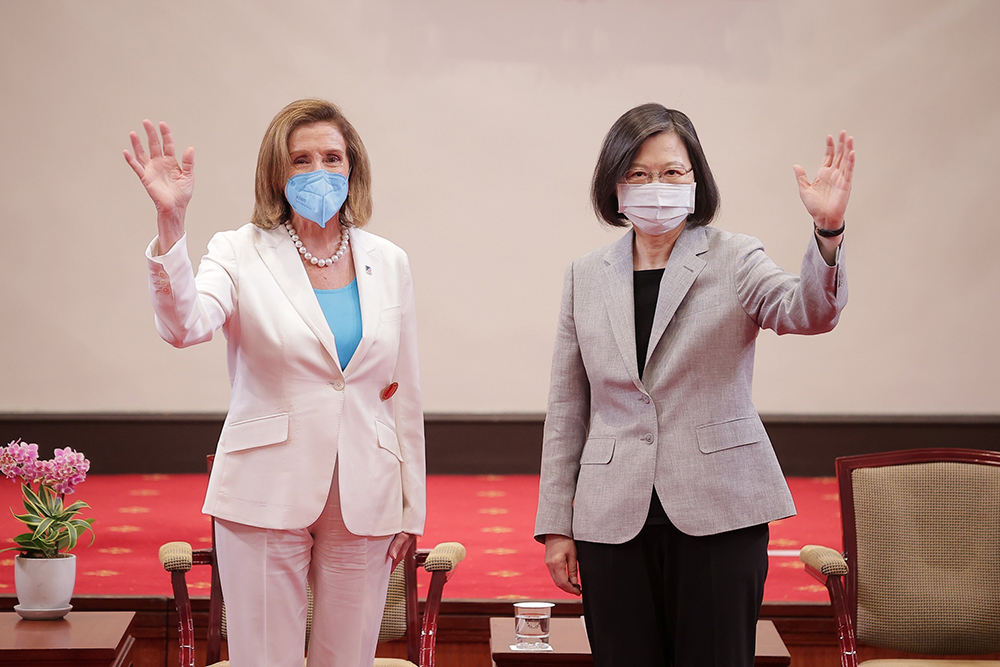
There were, however, a few silver linings in the episode from the administration’s perspective. For one, Beijing’s military outburst helped push Japan to double its defense budget and move forward with its “so-called counter-strike” capability.413 Taiwan meanwhile invested more heavily in some of the asymmetric capabilities that the United States had long pressed it to acquire, such as mobile coastal defense missiles and domestic civil defense and resilience programs.414 The following year, U.S. officials convinced Speaker Kevin McCarthy not to make a similar trip to Taiwan and instead meet Tsai on U.S. soil—a development that they could later argue demonstrated that the White House was ready to exercise restraint on this inflammatory issue.415
After the Pelosi visit, the administration increased its efforts to reassure Beijing that it was not seeking to change the status quo with Taiwan. Most of this “reassurance play” to Beijing was conducted through the “strategic channel” established between Sullivan and Wang in 2023.416 Even before that, however, officials were concerned that rising tensions might unleash a war, especially if Beijing felt that its hand was being forced by moves toward independence by Taiwan’s political leadership.417 White House officials repeatedly claimed that they were quick to pressure Taiwan not to move in this direction—especially later in the administration when Tsai was replaced by the more pro-independence Lai Ching-te. As Campbell said in an interview with the authors, “Taiwan’s status is very much like the movie A Beautiful Mind, in which [John] Nash understands that sometimes the best equilibrium is when two complex actors agree to take their second-best option.”418
These Biden officials were very reluctant, however, to disclose specifics about what they were actually saying behind closed doors to Taipei.419 Most claimed that they used the “special channel” with Taipei to have “direct and often hard conversations” to support long-term peace and stability across the Taiwan Strait.420 As a top U.S. official put it, “Our main effort was basically to say we will come down hard on China for their efforts to unilaterally change the status quo, but equally Taiwan should not be taking steps to do so.”421
U.S. officials also warned Taipei to be careful about statements that could undermine Taiwan’s long-term security.422 The White House was keen not to give the appearance of policing the public language of the Taiwanese leadership, but did emphasize the importance of keeping “formulations around sovereignty, peace, and stability” consistent, especially during the Taiwanese presidential transition from Tsai to Lai in May 2024.423
But the United States was obviously not neglecting its relationship with Taipei. Far from it, reassurance to Beijing took place alongside efforts to increase U.S. trade and economic investment in Taiwan, as well as major arms sales to Taipei.424 Despite delays caused by the war in Ukraine, which created bottlenecks in America’s ability to supply certain weapons to Taiwan, the administration pursued an arms sales policy that was broadly similar to the first Trump administration’s policy. Foreign military sales to Taiwan totaled over $5 billion during Biden’s term and included anti-aircraft missiles, advanced missile defense systems, ammunition, and other weapons.425 Washington also regularly expressed strong concern to Beijing that it was eroding norms around Taiwan with incursions into Taiwan’s contiguous zone, across the Taiwan Strait’s median line, by harassing Taiwanese maritime vessels, and with its disinformation campaigns. These, the administration said repeatedly, were the primary factors contributing to increased instability in the region.426
The third objective of the Biden administration’s Taiwan strategy was to raise awareness with allies and partners about why the island mattered to global security and prosperity. This included extensive conversations with European and Indo-Pacific allies to show that they too had a stake in maintaining cross-strait peace and stability. Due to international dependence on semiconductors produced by TSMC and the magnitude of regional trade flowing through the Taiwan Strait, a potential conflict around Taiwan would cost the global economy trillions of dollars.427 After Russia invaded Ukraine, European and Asian allies were described by former officials as becoming increasingly receptive to the idea that “today it’s Ukraine, tomorrow it could be Taiwan.”428 Creating a common understanding of Taiwan’s importance and vulnerability contributed to bringing allies and partners into alignment on the administration’s China and Indo-Pacific strategies. The United States also worked to shore up the support of Taiwan’s few remaining official diplomatic relationships, including dispatching the State Department’s China Coordinator Mark Baxter Lambert to Saint Kitts and Nevis and Saint Lucia to push against PRC pressure in the Caribbean.429 The Biden administration’s outreach to European and Asian regional partners demonstrated how instability across the Taiwan Strait “was not just a China problem, but important to everyone.”430
When asked about whether her visit made Taiwan more secure, Pelosi unapologetically said, “We don’t know how much more secure somebody is or not. It depends on the attitude of President Xi.”431 But in the aftermath of the visit, U.S.-China relations sunk to even deeper depths than after the showdown at the Anchorage meeting the year before. Virtually all communication between American and Chinese officials ceased. NSC officials had started envisaging proposals for an in-person meeting between presidents Biden and Xi in early 2022, but a “trifecta of serious disagreements”—including Russia’s invasion of Ukraine, the Taiwan-Pelosi “fiasco,” and October U.S. export controls on semiconductors—had created a deepening crisis in the bilateral relationship.432 This accelerated the impetus for the White House to push for an in-person Biden-Xi meeting at the G20 summit in Bali, Indonesia, in November 2022.
For NSC officials, the purpose of the Bali meeting was to “put a floor under the relationship” that was verging on a free fall.433 Some in the NSC and interagency predictably thought the president would “look soft” if he met with Xi, but Biden was open to the idea.434 The theory, former deputy senior director Rush Doshi said in an interview, was that “if you have instability because of a difference in interests, then the place you need to go is to manage the difference in perceptions.”435 An in-person meeting, executed well, would help Biden explain the rationale of U.S. actions to Xi and assure him personally that the United States was not out to destroy the Chinese Communist Party. Putting a floor under the relationship also might create political space for cooperation in the narrow areas where it remained possible, for example on military crisis management.
Blinken and Wang met on the sidelines of the UN General Assembly on September 24, 2022, and explored the possibility of a summit at the G20.436 China was reluctant to commit, likely because they believed not doing so would give them leverage.437 Having learned from the missteps of Anchorage the year before, White House officials held extensive virtual meetings and discussions with their counterparts to establish trust and set the agenda for the presidents’ meeting.438 NSC staff thought an extra effort to “exercise strategic empathy” was needed in order to set the conditions for a meeting that delivered “actual outcomes.”439 Sarah Beran, who would succeed Laura Rosenberger as NSC senior director for China and Taiwan in March 2023, later described the White House’s aim as establishing “predictability in the engagements at senior levels, but also at working levels.”440
U.S. officials also understood that Beijing mainly saw the meeting as a way to bolster Xi’s image on the international stage for a domestic audience now suffering from the Zero COVID policy and the economic downturn it had caused. Summit outcomes and atmosphere would also shape perceptions about the direction of the relationship for domestic and foreign audiences.441 U.S. officials also understood Beijing’s need for the optics of the meeting to demonstrate that the United States and China were meeting as equals who could sustain a productive relationship.442 This resulted in detailed arrangements for photo-ops and many hours of careful choreography.443 In October in Beijing, Burns met with Wang, who later called Blinken to set the final conditions for the meeting.444
Biden and Xi met in Bali on November 14, 2022. Although Biden and Xi had met several times, this was their first meeting as leaders of their nations. Biden described his aim as finding out “what each of our red lines are” and “how to resolve it and how to work it out” if they conflicted.445 The White House approached the meeting in two parts: The first half was dedicated to “managing perception, giving face, showing respect and clearing up misperception,” and the second half discussed a “cooperative agenda.”446
The meeting lasted over three hours, and readouts on both sides emphasized a “candid” and “constructive” exchange of views.447 They agreed that Blinken would visit China; established working groups on global macroeconomic stability; agreed to new talks on climate, public health, agriculture, and food security; and planned to expand people-to-people exchanges.448 The most important development, however, was the birth of a high-level channel between Sullivan and Wang. This channel proved critical to stabilizing the relationship, as turbulence continued over the next two years.449
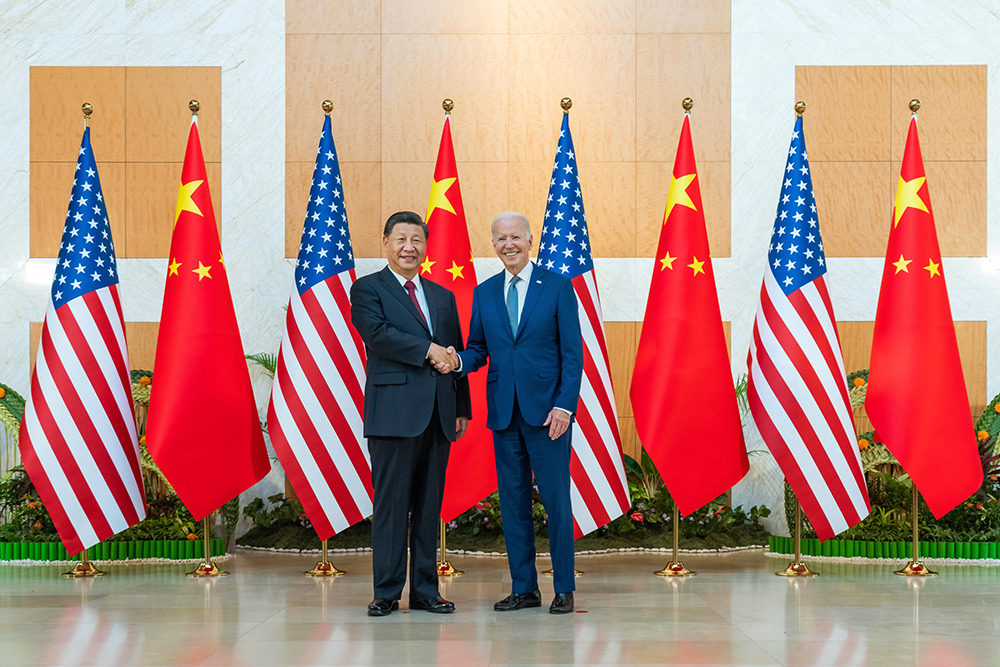
Chinese officials later termed the cooperative atmosphere of the summit as the “Bali spirit.”450 Whereas Yang had told Sullivan in Luxembourg in June that China “firmly opposes the definition of China-U.S. relations by competition,”451 the Chinese readout from Bali noted that “there is always competition in the world, but competition should be about learning from each other.”452 Significant differences remained between the two sides, but Biden officials saw Bali as a “mini-inflection point” and a positive one. 453 Going into 2023, there was hope the relationship might evolve into the managed strategic competition the Biden administration had envisaged. Unfortunately, exogenous events in the first months of the new year again shook and nearly erased the momentum that Bali had put in place.
The “floor” established in Bali was a diplomatic achievement, but it was also a fragile one. Beneath the diplomatic stability, structural drivers of the relationship remained fundamentally antagonistic. While the presidents discussed stabilization in Indonesia, the administrative and legislative gears in Washington had been grinding toward a far more confrontational reality in the realms of high technology and industrial policy. To understand why the “Bali floor” was so quickly tested, one must look past the summits and into the “small yard” of export controls and halls of a restive Congress, where the tools of a new economic statecraft were being forged.
Even as Washington was grappling with the diplomatic crises of 2022, the administration was pursuing a second track of competition aimed at preserving U.S. technological advantages and strengthening the domestic foundations of the long-term rivalry. These efforts were central to the strategy. They spread across all four years of the administration, but their center of gravity was 2022–2023. This section begins by explaining how technology export controls and related restrictions became the administration’s most consequential tool of technology competition, despite interagency tension, industry pressure, and the accelerating AI race. The section then turns to the administration’s “build” agenda in Congress, especially CHIPS and related legislation that aimed to strengthen the United States for sustained technological and economic competition with China.
One assessment underpinning Biden’s China strategy was that the U.S.-China relationship had entered a “decisive decade.” This belief arose in large part from the conclusion that certain advanced technologies—above all AI, quantum computing, and advanced biotech—were on the cusp of revolutions that would be transformational for societies and offer disproportionate gains to nations that acquired them first.454 Being a first-mover in one, let alone all of these technologies, promised far-reaching economic and military advantages. The Biden administration saw America’s long-standing leadership in technology as a key strength in strategic competition. While there was no guarantee that the United States would win the race, losing would be disastrous, and the sooner the United States leveraged advances in emerging technologies, the easier it would be for America to retain its global leadership in power projection, military capabilities, and economic competitiveness.455
At the center of the technology competition were semiconductor microchips that were vastly increasing the computational power used in training AI models. According to Biden officials, restrictions on technology would be an essential tool for the United States to win the race to artificial general intelligence and its profound power to reshape global economics, politics, warfare, and society.456 Many of Biden’s top technology advisers had developed their thinking on this prior to entering office at institutes such as Georgetown’s Center for Security and Emerging Technology (CSET).457 Since the Trump era, institutes such as CSET had been working up proposals for export controls to staunch the flow of U.S. and allied semiconductors and chip-making equipment to China’s military.458 Several CSET alumni joined the Biden administration from the start. Jason Matheny, who was the director of CSET, became deputy assistant to the president on technology and national security—a role dual-hatted between the NSC and the White House Office of Science and Technology Policy to oversee all aspects of technology policy development across foreign and domestic issue areas. Tarun Chhabra—whose role as NSC senior director for technology and national security made him a key player on export controls and the technology dimension of the strategy in general—was also from CSET. Chris McGuire also joined the NSC technology team after serving on detail from the State Department as director of research for the National Security Commission on Artificial Intelligence, an independent commission reporting to Congress on how AI would impact U.S. national security. McGuire, with Chhabra and the NSC international economics team, led assessments to identify the effective chokepoints in the semiconductor supply chain and legal mechanisms to implement export controls.459
Once in government, the NSC Technology Directorate became a central driver of the push to place limits on exports of U.S. chips and semiconductor fabrication equipment to China. Working with the Pentagon and the Office of Science and Technology Policy, and leveraging informal channels to leading frontier AI labs, the NSC assessed the risks and came down in favor of a fairly aggressive set of restrictions.460 The team was driven by the assumption that there was an exponential correlation between computing power and AI capabilities over time.461 This meant small policy actions impacting “the start of the scaling curve” would have large, long-run impacts.462 In other words, moving fast was crucial—and this included restricting China’s access to high-end U.S. chips. Moreover, the Pentagon was concerned that the PLA’s capabilities were catching up, making it even more urgent to deny China the most advanced microprocessors.463
There was no doubting that cutting off exports of these chips to China would be another blow to the bilateral relationship, but for NSC officials, the urgent national security need to slow China’s technological progress outweighed likely diplomatic costs.
There was no doubting that cutting off exports of these chips to China would be another blow to the bilateral relationship, but for NSC officials, the urgent national security need to slow China’s technological progress outweighed likely diplomatic costs.464 By the summer of 2021, the NSC Technology Directorate therefore settled on their approach in an internal technology strategy paper approved by the NSC Principals Committee.465
Even though a core group of officials entered the White House with a strong sense that restrictions would be necessary, implementation took over a year and a half. Much of the development of these export controls was conducted in relative secrecy to keep “the magnitude of what [U.S. officials] were doing” under wraps from China.466 Within the administration, there was interagency agreement on the need for controls, but much disagreement on how far to go in practice and on how effective the controls would be in achieving the identified objectives.467
An initial plan for the first round of controls was ready by late 2021, but high-level deliberation delayed the implementation until October 2022.468 This internal debate pitched national security-oriented agencies, including the NSC, Pentagon, State Department, and the Department of Energy, against more economically oriented agencies, including the Department of Commerce, U.S. Trade Representative, and most vocally, the Treasury Department.469
According to a senior Treasury official, the disagreement over “where to draw the line” on export controls stemmed from fundamental differences in worldviews.470 The Treasury’s perspective, supported by Yellen and deputy secretary Wally Adeyemo, was that it would be better to keep China dependent on U.S. technology infrastructure for longer.471 In general, Treasury officials were more skeptical of the feasibility of slowing down China’s technological development, because they thought China would catch up regardless and that having American technology embedded in Chinese capabilities would increase U.S. leverage when it came to negotiations over AI and other emerging technologies.472 In contrast, cutting off China’s access to high-end chips would encourage Beijing to develop their domestic chip manufacturing ecosystem, and this might end with China being less dependent on the United States and yet equally capable—or close to it—in this all-important area. Treasury distrusted China, given its record of intellectual property theft and the number of times Beijing “had said one thing and done something different,” but Treasury officials placed more value on maintaining economic interdependence between the United States and China.473 Raimondo also shared this more liberal view on export controls.474
Outside the government, NSC proponents of export controls faced a “withering” pushback from industry, which wanted to maximize sales to China.475 Microchip equipment manufacturers and automakers were generally more supportive of the restrictions because they had less exposure to the Chinese market, but chipmakers were especially concerned about the impact the restrictions would have on their profits. One NSC official depicted corporate lobbying by firms such as Nvidia as a “scorched-earth campaign,” in which they painted a dire picture of the damage these restrictions would do to the U.S. industry.476 These warnings were dubious, however, given burgeoning global and allied demand for advanced semiconductors and limited global chip-making capacity. Furthermore, Biden’s team argued that Xi’s efforts to indigenously develop China’s chip-making capabilities and replace U.S. software undermined the case for dependency and merely helped the PLA and PRC cyber actors develop AI models more quickly.477 McGuire later described the strategy of engagement in an op-ed as “handing [China] global industrial dominance and helping to build up Chinese firms that proceeded to toss the foreign competitors out on their rears.”478
Biden ultimately supported the view of the NSC hard-liners, concluding that it was common sense that the United States should not be giving technology to China that could pose a danger to American lives.479 Nevertheless, the intense interagency debate and industry lobbying slowed a final decision on export controls and led to a more cautious rollout overall. Rather than set static restrictions, Biden officials decided to update controls gradually and annually to reflect advances in semiconductor capabilities.480
The timing was also shaped by China’s outburst at Pelosi’s visit to Taiwan, which one official said “enabled us to pull the trigger” on the controls on October 7, 2022.481 These controls targeted China’s ability to purchase and manufacture advanced chips as well as develop and maintain its supercomputers.482 (Prior to this announcement, on August 26, 2022, the Biden administration had privately informed Nvidia that it had imposed export controls on its flagship A100 and H100 chips to China and Russia.483) The following year, on October 17, 2023, the Commerce Department’s Bureau of Industry and Security (BIS) tightened these controls to limit China’s ability to use large-scale AI systems and to develop weapons of mass destruction and advanced conventional weapons.484 Under these new controls, BIS restricted chips based on their total performance, performance density, and whether the chip was “designed or marketed” for use in a data center. This vastly expanded the number of chip types under export restrictions to include high-performing gaming chips and lower-performing data center chips.485 These controls were further tightened and extended in subsequent moves in September and December.486
Across three speeches in September and October 2022 and April 2023, Sullivan detailed the administration’s strategy for technological and economic competition.487 Using the metaphor of building a “small yard and high fence,” the United States sought to keep chokepoints for critical technologies within U.S. control, with high barriers to prevent strategic competitors (in other words, China) from “exploit[ing] American and allied technologies to undermine American and allied security.”488
One of the most controversial innovations of the administration’s export control strategy was replacing the goal of maintaining a sufficient technological lead with a goal of maximizing the absolute U.S. advantage.
One of the most controversial innovations of the administration’s export control strategy was that it replaced the goal of maintaining a sufficient lead in the technology with a goal of maximizing the absolute U.S. advantage. Instead of merely staying “n-2” generations ahead, the administration decided that the United States had to create as large of a lead as possible.489 This was because aggregations of past generations of semiconductors would soon be able to produce the equivalent computational power of advanced chips for training AI models—especially if they were produced without the energy and cost constraints that most assumed China would manage to circumvent.490
The strategy also required the United States to prevent the “diffusion” of semiconductors and large data centers outside U.S. or allied control. Described by a former official as akin to building “a nonproliferation regime for supercomputers,” restricting large clusters of advanced semiconductors to operate only in trusted countries by U.S. companies would prevent China circumventing the restrictions.491
In practice, the new standards were challenging to implement because of the tension between avoiding giving China an unacceptable military advantage, and at the same time, allowing for the potential for continued robust trade. As another former senior official described, the small yard, high fence concept remained ambiguous, meaning “too many things to too many people, even within the administration. It was hard to define it in a very clear way.”492 With the rapid pace of technological advancements requiring new restrictions, the approach on global export controls was not an easy sell to industry, allies, and partners.
The use of export controls for military technology was not new. The United States has always sought to protect its most sensitive technologies from falling into foreign hands. Cutting off access to chips, however, appeared to broaden the scope of such restrictions because advanced chips could also have civilian uses. Some critics thus viewed the policy as excessively sweeping.493 Other critics viewed it as a stopgap measure that would be ineffective in the longer term.494 For these critics, China would simply adjust to the controls and manufacture its own chips—as the Treasury Department believed. But CSET and the National Security Commission on Artificial Intelligence’s research showed that this would be very hard for China to do, first and foremost because it lacked the expertise to build the necessary equipment, which itself relied on American-made technologies.495 This meant that cutting off access to both chips and essential manufacturing inputs would seriously set back China’s ability to develop technology comparable to America’s.
A complementary outbound investment screening regime was put in place later in the administration that aimed to restrict U.S. investments in China’s AI ecosystem, quantum technologies, and the supply chain for the PLA’s military-industrial complex.496 According to a former Treasury official, these “narrow but deep restrictions” on the ability of U.S. persons to invest in certain sectors in China had less to do with reducing China’s access to capital, which was already plentiful.497 Instead, the restrictions targeted China’s access to technology expertise, particularly the scientific and engineering support that often accompanies foreign investments.498 The restrictions aimed to send a clear message to industry about the costs of excessive cooperation with Chinese firms on advanced technologies, while minimizing the negative impacts for U.S. firms.499
On August 9, 2023, Biden issued an executive order directing the Treasury Department to prohibit certain outbound investments by U.S. persons into China (including Hong Kong and Macau) in semiconductors, quantum technologies, and AI capabilities.500 These outbound investments covered acquisition of equity stakes, debt financing, greenfield investments, and joint ventures.501 A year later, on October 28, 2024, the Treasury Department issued its final ruling on these investment restrictions, creating the Outbound Security Investment Program.502
The administration’s strategy for technology competition with China meanwhile elevated the role of the Department of Commerce in U.S. national security. In contrast to previous eras where Commerce had taken a back seat on major foreign policy decisions, Raimondo recognized from early on that she would need to “build up her department’s muscles” so that it could play a leading role in U.S. economic statecraft.503 Commerce’s wide-ranging responsibilities and statutory authorities across its thirteen bureaus were ultimately used to great effect to implement the Biden administration’s China policy.
The department’s importance to the Invest, Align, Compete pillars fell mainly in two areas. First, Commerce played a central role in crafting the CHIPS and Science Act, which gave the department $52 billion for projects increasing the domestic manufacturing of advanced semiconductors to shift their production away from China and Taiwan.504 Second, as described earlier in the report, the Bureau of Industry and Security’s extensive authorities through the Entity List and Foreign Direct Product Rule export control enforcement put Commerce on the front line of stemming the export of advanced technologies to China—above all, chips for AI. Alan Estevez, handpicked by Raimondo to head BIS as undersecretary of commerce for industry and security, described the department and BIS’s role as “its impediment over here and run faster over there. And the CHIPS Act . . . is the oil and machinery to make us run faster.”505 Commerce’s International Trade Administration also had a role in crafting the administration’s tariff policies and outbound investment rules.
Across two speeches in November 2022 and February 2023, Raimondo described her approach to using the levers of the Commerce Department to implement a “long-term vision for America’s technological leadership” as part of the administration’s China strategy and domestic policy.506 China’s leadership, she said, was increasing the role of the state in its economy and society and thus “forcing us to defend our businesses and workers.” This called for a strategy to ensure the United States “builds the talent, technologies, and manufacturing capabilities necessary to lead the global economy in the 21st century.”507 China was convinced that the West was in terminal decline, she said, and to counter this, the United States needed a strategy that focused first and foremost on strengthening the U.S. domestic economy.508 Winning the global competition with China required a strong partnership with the private sector, which she urged to leverage the $50 billion of public investment the administration was offering to boost overall U.S. investment in manufacturing and research and development by ten times that amount.509 The approach also emphasized the value of allies and partners to create diverse and resilient supply chains and shared technology standards. Finally, Commerce played a key role in direct diplomacy between Washington and Beijing in the later years of the administration.510
Overall, these restrictions amounted to a major change in the nature of the U.S.-China relationship, reversing what had been a very open-ended exchange of technology for decades and replacing it with a more protective approach underpinned by core national security concerns. In an interview summing up the legacy of the Biden administration’s work on technology competition, Chhabra offered his take: “For the first time, we were pushing back in the tech war that China had been waging against us for decades.”511
“For the first time, we were pushing back in the tech war that China had been waging against us for decades.”
Taken together, these measures marked an important qualitative shift in U.S. policy. The aim was no longer simply to prevent China from acquiring military technologies, but to preserve an outsized U.S. advantage in general-purpose technological capabilities—especially advanced computing—on the theory that superiority would compound over time. That premise was strategically coherent, but not the whole picture. Restrictions would buy time, but not strengthen the U.S. economy itself. The administration therefore paired its denial strategy with a domestic “build” agenda, centered in Congress, that sought to restore American industrial capacity and anchor emerging technologies within the United States and trusted allies.
One of the most important parts of the Biden administration’s competitive strategy was the belief that economic power was at the very core of the competition with China. As of 2021, the United States was suffering from a pandemic-induced recession, and Beijing assessed that the country was in terminal decline. The Biden administration wanted to take dramatic steps to reinvigorate the American economy and set it on a trajectory for future economic dynamism. It therefore invested heavily in a series of major legislative acts that passed Congress in 2021 and 2022. This legislation was far-reaching in ambition and a good deal of it was focused on domestic and social initiatives that lie beyond the scope of this account of Biden’s China strategy. But the effort was central to the strategy implementation—one the administration invested heavily in seeing through.
With the Biden administration’s support, Congress passed four major legislative packages in 2021 and 2022 that were germane to industrial competitiveness and economic recovery from the pandemic: the American Rescue Plan and the Bipartisan Infrastructure Law in 2021 and the Inflation Reduction Act and the CHIPS and Science Act in 2022. All of these were justified in whole or part by the need to compete with China, and they all supported the Biden strategy’s aim of strengthening America at home. CHIPS, however, was the most directly related to strategic competition because of its technology focus.
CHIPS actually began in 2021 as the Endless Frontier Act, introduced by senators Chuck Schumer (D) and Todd Young (R) as a proposal to strengthen basic science and research on emerging technologies.512 Biden officials then sought to combine Endless Frontier with funding already authorized for semiconductor manufacturing in the 2021 National Defense Authorization Act.513 Over time, the combined bill grew to encompass not only $52.7 billion in mandatory appropriations for semiconductor manufacturing in the United States but also provisions for funding related workforce training and regional technology hubs and $500 million to strengthen global semiconductor and telecommunications supply chains.514
Knitting together the final legislative package—and getting the sixty votes required to pass the bill in the Senate through regular order, while also negotiating the bill’s mandatory appropriations with the relevant committees and “four corners”—required a major investment of time from senior White House staff, and Raimondo, who became the administration’s lead for the bill.515
In the prevailing partisan environment, it is notable that the China framing of the legislation allowed the White House to bring some mainstream Republicans along, such as senators Todd Young, Bill Hagerty, and Lindsey Graham and representative Jim Banks.516 Focusing on China was not enough to overcome all Republican objections, however. Republican Senator Tom Cotton attacked the legislation on the grounds that it was a distraction from the urgent need for more military spending.517 Ultimately, though, several Republicans, including even Mitch McConnell, voted for the bill after a last-minute briefing by Biden administration officials, Raimondo, and a few former Trump administration officials.518 Biden signed the final version of the CHIPS and Science Act into law on August 9, 2022.
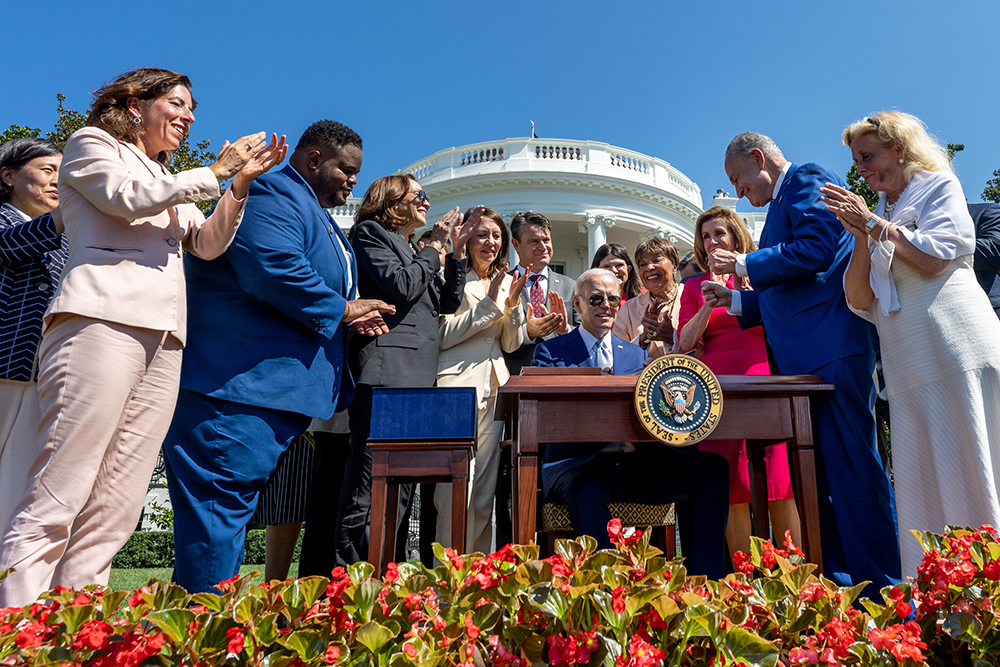
The administration also had unusually strong congressional support for AUKUS and other aspects of the align pillar of its strategy. The 2024 National Defense Authorization Act, which passed in December 2023, authorized the transfer of three Virginia-class submarines under AUKUS, notably exempting Australia from most U.S. export licensing requirements.519 In March 2024, the Compacts of Free Association with the freely associated states of the Federated States of Micronesia, the Republic of the Marshall Islands, and the Republic of Palau was also renewed in an effort to compete with Chinese influence in the subregion.520 White House officials also saw the House Select Committee on Strategic Competition between the United States and the CCP as largely helpful, because it helped drive congressional support for the administration’s competitive actions.521
Beyond its role in passing the administration’s landmark legislation, Congress also supported the administration’s direct diplomacy with China in at least one important moment. Schumer led a bipartisan congressional delegation to meet with Xi in Beijing on October 9, 2023. The delegation was able to reinforce the administration’s messaging on key U.S. priorities such as fentanyl, thus underscoring that it was a bipartisan concern and China needed to take action.522 This in turn helped set the stage for Xi and Biden’s agreement on fentanyl a few weeks later at their summit at Woodside.523
Even if winds in both political parties were blowing in favor of a tougher line on China, “playing the China card” ultimately did not overcome ideological polarization to most of the Biden administration’s domestic or economic initiatives.524 A senior Biden official stated that a part of the challenge lay in managing elected officials and public figures “who wanted to outdo each other on how much they hated China.”525 Some in the administration and Congress were tempted to inflate the China threat to justify higher budgets, even as others wanted to tone down the rhetoric to advance diplomatic or economic goals.
Meanwhile, senior congressional staffers criticized the administration for paying insufficient attention to their views and some charged the White House with excessive secrecy, for example, in the development of the NSC China strategy.526 More importantly, Republican support for the Development Finance Corporation and other international economic initiatives to compete with China’s BRI was less than the administration had hoped it would be. An effort to secure supply chains through a sovereign wealth fund was also shelved due to a lack of bipartisan support from Congress.527 Moreover, in 2025, under the second Trump administration, key provisions of the Inflation Reduction Act and the CHIPS and Science Act—large parts of which were penned by congressional Republicans—were slashed, while Commerce’s CHIPS Program Office was beset by layoffs.528 In the end, therefore, as one high-level White House official noted, aside from the CHIPS and Science Act, “the argument about China competition didn’t tend to move people that much.”529
The Biden administration’s effort to manage strategic competition also included a pursuit of guardrails—formal and informal mechanisms aiming to prevent the relationship from descending into accidental conflict or global catastrophe. Two key efforts focused on military-to-military communication and climate change. AI safety was also important, but only entered the discussion late in the administration. Whereas the invest and compete pillars of the China strategy required either unilateral American action or alliance management, the guardrails required a degree of Chinese cooperation that Beijing was often reluctant to provide. To China, these channels were often viewed as rewards for American good behavior; to Washington, they were the baseline requirements for responsible statecraft.
To China, communication channels were often viewed as rewards for American good behavior; to Washington, they were the baseline requirements for responsible statecraft.
Strengthening the United States and its allies and partners for war with China was the central focus of the Pentagon’s work under Biden, but there were also efforts to build a more stable bilateral relationship with China. One long-standing concern of security policy experts in Washington is the possibility that an accidental clash between U.S. and PLA forces might spark an all-out war. During the Cold War, the United States and the Soviet Union developed crisis-management channels and procedures to minimize this possibility. China, however, has traditionally resisted such measures. To make matters worse, most of the military-to-military communication channels had broken down during the COVID-19 pandemic and were never repaired, making it unlikely that messages could be usefully passed and heard in the event of an accident.530 The Pentagon thus also worked to restart military-to-military dialogues with counterparts in the PLA and Chinese defense officials.
The Biden administration “struggled pretty hard” to “restore something resembling a normal defense relationship.”
It was not easy going. As a senior defense official recalled, “We struggled pretty hard” to “restore something resembling a normal defense relationship” after inheriting frozen communication channels.531 Like at the NSC, pandemic conditions made any face-to-face interaction with their Chinese counterparts impossible. This made early video conferences with the Chinese side “just an exchange of talking points” in which it seemed to U.S. officials as though their PLA counterparts became “even more focused on performing for a domestic audience” because “it was on screen and being taped.”532 The stilted format also left little flexibility for off-camera and spontaneous exchanges that would normally present themselves during an in-person meeting.
The challenge of engaging with Chinese defense counterparts also extended to arranging higher-level exchanges. The issue of negotiating the appropriate “parallelism” between officials resurfaced as a source of friction, with the PRC and PLA “just unwilling to accept” the American position that the secretary of defense should be able to meet with both the PRC minister of national defense and the senior (first-ranked) vice chair of the Central Military Commission (CMC).533 For U.S. officials, the rationale was that the secretary of defense’s set of responsibilities more closely matched those of the senior vice chair of the CMC rather than just the PRC minister for national defense, who sits outside the PLA military chain of command and leads a ministry with little independent institutional influence.534
Meanwhile, it appeared to U.S. officials that the PRC “saw little upside in talking” and saw opportunities for any communication “as essentially gifts” or “rewards for good behavior.”535 One U.S. official described how the closest the two sides got to achieving a breakthrough at the secretary level was a proposal to meet with senior CMC vice chair General Zhang Youxia, but only in the unlikely event that secretary Austin would go to Beijing.536
Further complicating negotiations was the very short tenure of PRC defense ministers—with the position changing hands three times in 2023—including Chinese minister General Li Shangfu, who was under U.S. sanctions and thus refused to meet with Austin.537 Frustration that “the Chinese just wouldn’t answer the phone” continued, including during periods of escalated military tension.538 Given these challenges at the top, the main communications took place at the working-group level through the Office of the U.S. Defense Attaché at Embassy Beijing with the CMC’s Office of International Military Cooperation, and between the Pentagon and the PRC defense attaché at the Chinese Embassy in Washington.539
What explains the apparent lack of interest on the Chinese side to engage in military diplomacy? From China’s perspective, these efforts at military diplomacy were occurring just as the Pentagon was intensifying its presence along China’s shores, including with a capacity to strike into China from the Philippines. It is easy to imagine how this military pressure discouraged PLA engagement with the Pentagon. This is not the only explanation, however.
According to those involved in the talks, the official line from the PRC was to reject measures to lower risk on the grounds that better communication and crisis management channels would embolden the United States to take more aggressive actions against China.540 According to Beijing, the best way for the United States to reduce the risk of a crisis was to withdraw its forces from the region.541 Another theory about China’s reluctance to engage, which is not mutually exclusive of risk tolerance, was that Chinese officers feared that engaging with the United States might risk making senior leaders look weak or ineffective if their efforts at diplomacy fell on deaf ears in Washington.542 In other words, should the United States continue to take actions unfavorable to China regardless, the relevant Chinese officials could be perceived as having failed to deliver their message strongly enough.543
Whatever the reasons for the difficulties in military-to-military communication, some dialogue was possible later in the Biden administration after Biden and Xi’s summit at Woodside in November 2023. Austin met with PRC Minister of National Defense Dong Jun in May 2024 on the margins of the Shangri-La Dialogue in Singapore, and the commander of Indo-Pacific Command met virtually with his counterpart at the PLA’s Southern Theater Command in September 2024.544 According to U.S. officials, meetings with Chinese military counterparts were meaningful opportunities to raise concerns about a variety of issues, including confronting problematic operational behavior by Chinese forces, unsafe intercepts of U.S. military aircraft where inexperienced PLA Air Force pilots had raised the risk of accidents, and aggressive maritime actions viewed as unprofessional and dangerous in the South China Sea against the Philippines.545 Meetings also included efforts to dispel Chinese misconceptions about U.S. intentions, including a belief that the United States was seeking to provoke China into a conflict over Taiwan rather than action seeking to deter China from using coercion or force.546 These meetings also helped to restart pre-pandemic efforts to repatriate the remains of U.S. service members from China to the United States.547
Despite the often episodic and difficult nature of military-to-military communication, officials described it as serving a “tactical” utility, particularly at the working level to have some channel of communication open during times of crisis and heightened tension.548 However, it was clear that efforts to communicate with China stood far from the “strategic stability” envisaged by the Biden administration.549
China is the world’s largest emitter of greenhouse gases, and its cooperation is thus crucial to any global action on reducing emissions. In 2015, China signed the Paris Agreement, which included the promise to limit global temperature increases to well below 2 degrees Celsius above pre-industrial levels.550 The first Trump administration, however, withdrew from the agreement and ended climate diplomacy with China and other countries.551 Entering office, therefore, the Biden administration hoped to restart the Obama-era initiatives, and it made negotiating new climate agreements with China a high priority.552 This proved a challenge.
The Biden administration hoped to restart Obama-era initiatives. This proved a challenge.
To manage the diplomacy of climate change, the administration established the Office of the Special Presidential Envoy for Climate (SPEC) at the State Department. Former secretary of state John Kerry was appointed to head the office and given cabinet-level status in what was intended to be a sign of major commitment to the challenge.553 Kerry became the first high-level Biden administration official to visit China in April 2021.554 Progress was slow, however, given the pandemic and other frictions in the bilateral relationship.
SPEC’s work with China finally came to a head in a four-day negotiation at the Sunnylands estate in California from November 4 to 7, 2023, about a week before Biden and Xi would meet at Woodside. The resulting Sunnylands statement issued by Kerry and China’s special envoy for climate change Xie Zhenhua promised to further reduce coal, oil, and gas generation.555 In addition to reopening working-group climate dialogues, for the first time, China agreed to include all sectors of the economy and all greenhouse gases in its next Paris targets and to consider “post-peaking” absolute emission reductions for its power sector in the 2020s.556
The impact of the administration’s efforts to pursue climate change initiatives with China was ultimately quite modest, however. The Sunnylands meeting signaled a willingness to continue climate diplomacy between the world’s two most important players but did little concretely to move China closer to acting on its 2015 Paris pledge. The following year, China in fact moved in the opposite direction.557 Meanwhile, Trump’s return to the White House in 2025 cut off any possibility of further diplomatic action on emissions reductions.
A final guardrail of the Biden term was established in the final weeks of the administration. During their final meeting at the APEC summit in Lima, Peru, in November 2024, Biden and Xi reached a milestone agreement that neither country would ever allow artificial intelligence to seize control of nuclear weapons launch decisions; by affirming that human beings must remain “in the loop” for nuclear employment, both leaders acknowledged, implicitly at least, that while they were locked in a persistent quest to outdo each other’s military capabilities, certain risks were too high.558 It was a modest victory for strategic stability, but it underscored the administration’s belief that competition required guardrails—in this case to ensure that human judgment remained the ultimate arbiter of great power war.
By 2023, the landscape of economic competition between the United States and China was shifting as the world emerged from the pandemic. Contrary to the bold pronouncements by Chinese elites, the American economy rebounded strongly from the pandemic-induced recession, posting growth that outpaced other G7 economies.559 By June 2023, real U.S. GDP rose 5.4 percent from the level at the end of 2019, and the unemployment rate fell from a pandemic peak of over 14 percent to under 4 percent.560 Meanwhile, the Chinese economy was weakening. This likely reduced some of the confidence Beijing had conveyed in the early months of the Biden term.
Yet, if the economic indicators suggested a moment of U.S. strength, the structural drivers of the relationship remained fundamentally fraught. As detailed in the previous section, the small yard, high fence was now being built, creating a new baseline of friction. Bilateral tensions were also still strong for other reasons. China’s support for Russia’s war on Ukraine had not ended and, in some ways, had deepened over the course of the year since the war’s start. The Pelosi visit and China’s military reaction were not far in the rearview mirror. Washington remained deeply concerned about the risks of a Chinese attack on Taiwan. In testimony to Congress on February 3, Burns warned that “our assessment at the CIA is that I wouldn’t underestimate President Xi’s ambitions with regard to Taiwan.”561
The Biden administration thus found itself in the difficult position of simultaneously attempting to build a technological “fence” around China’s military-industrial complex while seeking a strategic channel to manage the diplomatic fallout of doing so. As the year began, both parties still seemed ready to continue the diplomatic efforts to stabilize the relationship, beginning with a visit by Blinken to Beijing in early February 2023. Unfortunately, exogenous events again knocked the diplomatic effort off course. This time, the culprit was an errant Chinese balloon that drifted into U.S. territory, creating a weeklong, slow motion, mini-crisis that came to be known in Washington as “balloon-gate.”
The U.S. military first detected the Chinese balloon on Saturday, January 28, when it drifted into U.S. airspace over Alaska. For a time, the balloon floated over Canada, but it reentered U.S. airspace over northern Idaho on Tuesday, January 31. On February 1, it was spotted by civilians in a commercial airliner over Montana and the press furor began.562 The next day, the Pentagon issued a statement that it had been tracking the balloon for several days and it was confident that it was a Chinese high-altitude surveillance balloon intended to gather intelligence while flying over sensitive U.S. national security sites.563 Amid increasing national attention, the American public became transfixed with alarm and intrigue over the so-called spy balloon. A media frenzy ensued, as an outpouring of debate, memes, and conspiracy theories flooded social media and as members of the American public gathered outside to catch glimpses of the balloon as it slowly journeyed across the country.564
When the Chinese Foreign Ministry professed this was a “civilian meteorological airship” that had accidently wandered off course, interest only deepened.565 Politics soon followed the brouhaha; Trump emailed and posted to his followers to “SHOOT DOWN THE BALLOON,” as Republicans pressured the White House for a swift and decisive military response and accused Biden of weakness in the face of an obvious and visible violation of American sovereignty.566

Behind the scenes, Biden administration officials had long known about the Chinese intelligence balloon program.567 For several years, similar balloons had been observed on intelligence, surveillance, and reconnaissance missions over U.S. Indo-Pacific bases, including at Guam and the Indo-Pacific Command headquarters in Hawaii.568 According to former defense officials, these balloons were not very sophisticated but could be difficult to detect while operating above commercial air traffic at near-space altitudes in a “dead zone” away from where most air-defense radars were directed.569
It quickly became apparent to Pentagon officials that the balloon’s erratic course was accidental.
Launched from Hainan Island, this particular balloon had likely been directed to fly over Guam but was taken by an unseasonable northerly jet stream into Alaskan airspace, where strong winds then pushed it south into the continental United States.570 Having tracked its departure from China, it quickly became apparent to Pentagon officials that the balloon’s erratic course was accidental.571 Notwithstanding, PLA operators elected to continue the mission and were ready to take advantage of the opportunity to gather intelligence from nuclear missile sites in Montana.572
At working-level channels, Chinese officials insisted to U.S. counterparts that the balloon had no relationship to the PLA or any kind of intelligence purpose.573 The balloon’s course had been accidental, Beijing said, imploring U.S. officials to “not overreact” by shooting it down.574 Repeated requests from chairman of the joint chief of staff General Mark Milley and Austin to speak with their Chinese counterparts were declined on the grounds that “the atmosphere wasn’t conducive,” according to a former official familiar with the outreach.575 Here was a good example of the inability of China’s military leaders to speak on issues of high political sensitivity—and a prime example of the problems that this hesitancy creates in military-to-military communication.576
Concerned about the unprecedented nature of the flight path and intrusion into the continental United States, Biden was informed of the balloon’s presence by Milley on January 31.577 Biden’s team faced a dilemma: Should they give in to pressure to shoot it down and risk harming not only the relationship with Beijing, but also civilians on the ground, or should they let it float across the continental United States and risk looking cavalier about American sovereignty?
Biden and Austin were inclined to act immediately over Montana amid undisputed consensus that the balloon needed to be shot down.578 In addition to the optics, officials were concerned that someone might try to take matters into their own hands and down the balloon themselves. Nevertheless, while it was obvious the balloon posed some level of intelligence threat from its signals-gathering and imaging equipment, it presented no physical threat to American lives as long as it remained in the air.579 There was a narrow window of opportunity to down the balloon over Montana, but Milley and U.S. Northern Command warned that a “school bus worth of metal” falling from the sky could potentially injure someone on the ground.580
The president thus agreed to let the balloon continue its course until it could be shot down over water, where its capabilities would be more likely to survive in an intact-enough condition to be collected and analyzed.581 Meanwhile, appropriate measures were taken on the ground to lock down overflown military sites to mitigate the balloon’s intelligence collection capabilities.582 This was a safe choice, but it meant another three days of news coverage while the balloon drifted slowly above U.S. territory creating an eerie sense of haplessness.
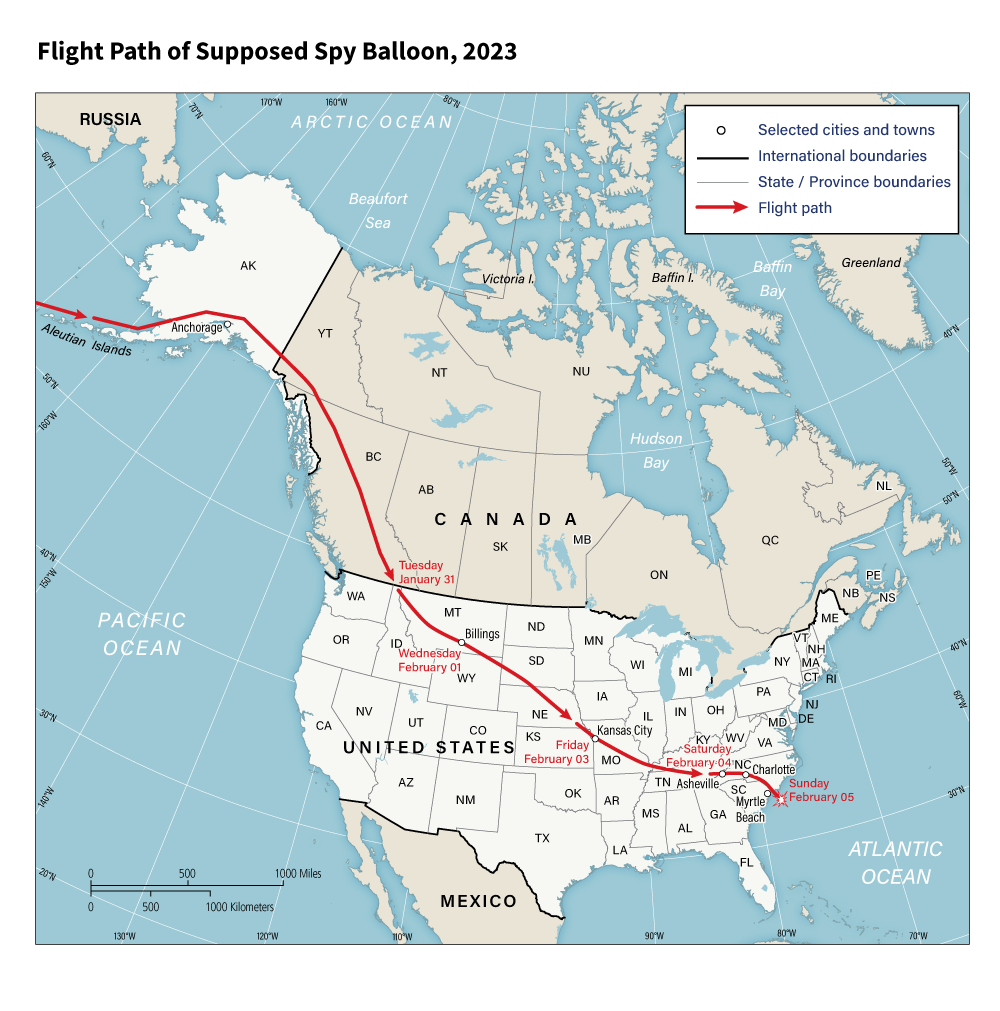
Inside the government, the incident was meanwhile becoming a big political headache for the White House. From “an informational perspective, it was a nightmare,” said one senior official, “since it made it look like we were spending a week not defending our airspace.”583 According to another official, the event “threw the whole top off in terms of the public attention and anxiety in the media,” which treated the incident like a Hollywood movie script.584 The Pentagon had to spend the weeks after chasing other alleged spy balloons across North America—and on three occasions, had to shoot them down with Sidewinder missiles.585 Haines later said that the situation was “so crazy,” it was “like an episode of Veep on some level.”586

Finally, on February 4, the balloon reached a safe distance off the coast of Myrtle Beach, South Carolina, and the U.S. Air Force deployed an F-22 to shoot it down. Whether it was truly necessary to use the world’s most advanced aircraft to down a slow-flying balloon or whether it was simply a muscle-flexing exercise after a week of painful waiting is uncertain, but according to a former official, this was one of the few aircraft able to “reliably produce kinetic effects” at altitudes over 60,000 feet.587
As the former official recalled, the military dimension of the episode “was not a physical threat or a huge intelligence threat because we saw it coming and could get out of the way.”588 The diplomatic damage was real, however, at least in the near term. The bilateral relationship was yet again “thrown into a tailspin” as China’s leadership suspended bilateral communication channels and froze out Burns in Beijing.589 Throughout the week, Beijing had maintained that it was just a weather balloon that had gone off course. The U.S. government insisted Beijing was dissimulating, even though some outside experts pointed out that Beijing’s claim was plausible and the Pentagon told the public that they did not believe that the balloon had actually collected any intelligence.590
Obviously, it was impossible for Beijing to acknowledge that it was an intelligence collection platform—especially in light of its own history of complaints about U.S. intelligence collection along its borders. The Chinese government thus attempted to shift the narrative by accusing the United States of hysterically “smearing” China and using the incident to distract from a train derailment of toxic materials in Ohio.591
Despite strenuous “attempts on [the American] side to make clear that this was a problem,” through messages of concern delivered through the embassy channels in Beijing and Washington, U.S. officials described their Chinese counterparts as “pretty perturbed” when the balloon was shot down.592 The Chinese Foreign Ministry said the United States “obviously overreacted,” and Feng lodged a formal complaint to the U.S. Embassy in Beijing, accusing the United States of violating international law and “dealing a serious blow” to stabilizing bilateral relations.593 As then U.S. ambassador to China Nicholas Burns said about China’s reaction, “After the balloon, they isolated us again. Three months later, Qin Gang called me and said, ‘Let’s have lunch.’ This is a pattern: China turns access on and off as punishment or reward. All my predecessors had this, too.”594
Blinken was supposed to be heading to China to follow up on the Bali meeting just days after the balloon drifted into U.S. territory, but this now carried greater political risks. Blinken wanted to continue with the trip,595 but when it came to light that he could end up landing in Beijing to toast Wang at the very moment the balloon floated over Washington—potentially the day of Biden’s much anticipated State of the Union—it was clear the trip needed to be called off.596 On February 3, Blinken therefore announced that he was postponing his trip, charging that China had committed “an irresponsible act” that was “detrimental to the substantive discussions that we were prepared to have.”597 Since plans for the trip had previously been announced, the Chinese side took affront, and the Foreign Ministry attempted to save face, retorting that “in actuality, the U.S. and China have never announced any visit.”598
Two weeks later, Wang spoke from the main stage of the Munich Security Conference and portrayed the U.S. decision to shoot down the balloon as “absurd and hysterical,” again reiterating that it was a “civilian” airship that had unalterably “veered off course.”599 A diplomatic cliff-hanger ensued when it was left unclear whether Blinken and Wang would meet, or whether the conference would end with the relationship in even worse shape. At the eleventh hour, however, the world’s two top diplomats sat down for a brief meeting, resolving the impasse and leaving space for the relationship to return to a steadier course in the months that followed.600
The foundation established when Biden met with Xi in Bali had been badly shaken—but the crisis had some silver linings.
The foundation established when Biden met with Xi in Bali had been badly shaken—but the crisis had some silver linings. According to multiple U.S. officials, the incident and panicked response had caused considerable embarrassment to Beijing.601 Xi himself was likely caught unaware.602 According to a former senior intelligence official, the incident “forced [the Chinese side] to look into their own system and figure out what was going on.”603 Furthermore, the extent to which China perceived the American response as an overreaction could help deterrence against “a very effective system that [was] relatively cheap.”604
That an “unpredictable and fundamentally non-kinetically threatening” slow-moving balloon could metastasize into an international crisis so severe as to “ground relations between the two most powerful countries to a halt” served as a wake-up call.605 It brought home how quickly the relationship could deteriorate and showed how hawkish pressures on both sides could cause even small disagreements to spiral out of control. This helped to clarify that there were upsides in exchanging information, even if severe disagreements remained.606
The aftermath of the balloon incident also presented the United States with leverage to pressure China on its support for Russia. White House officials warned Beijing that lethal military assistance to Russia to aid in its invasion of Ukraine would be especially detrimental to the relationship in the aftermath of the balloon incident.607 Saying later on CNN in February that China could face “real costs,” Sullivan made clear that the American public and Congress would demand the Biden administration be more aggressive against China if they did not pull back from providing Russia with lethal aid.608
From the start of its term, the Biden administration had sought a trustworthy, high-level communication channel with Beijing.609 Since national security adviser Henry Kissinger’s secret trip in 1971 to meet with Zhou Enlai in Beijing before president Richard Nixon’s groundbreaking trip to China that normalized bilateral relations, the channel between the U.S. national security advisers and their Chinese counterparts has often been an important component in managing U.S.-China relations.610
The dialogue between senior officials who each reported directly to their presidents—and thus commanded visibility and influence across each country’s national security establishments—enabled a holistic discussion of strategic issues and perceptions. The channel’s quiet and low-profile nature allowed for candor and discretion when discussing the most sensitive friction points and the sharing of perspectives on global issues. It also served its traditional role in the relationship as an agenda-setting mechanism for leader-level engagements and a forum to negotiate presidential-level deliverables.611 The Biden administration sought a return to using this channel, a practice that was already well grooved in the George H. W. Bush, Bill Clinton, George W. Bush, and Obama administrations but had fallen apart during Trump’s first administration.
Amid the tensions of Trump’s first term, with a higher turnover in national security advisers, the strategic channel atrophied. The Biden administration therefore needed to reestablish the channel and do so in an atmosphere of deepening mutual distrust. As Beran described in an interview, “The Biden administration spent the first two years focused on partners and allies and investing in U.S. sources of strength. With those efforts well established, we turned to reestablishing a strategic channel of communication. As we did so, we were clear publicly that the U.S.-China bilateral relationship was a difficult, tough relationship, but that didn’t mean that meetings should be off the table. In fact, these challenges made it even more important to meet and be honest about the sources of frictions and the potential for escalation.”612
After Pelosi’s visit to Taiwan, U.S. allies started warning the administration behind the scenes that they feared the United States and China were on a collision course over Taiwan.613 This provided the impetus for Biden to push to announce a strategic channel at the Bali summit.614 Xi agreed provisionally, but progress stalled due to the balloon incident and lingering friction over U.S. arms sales to Taiwan and technology export controls.615 By the spring of 2023, however, U.S. officials were able to get some traction with Beijing on a “serious, quiet, and no profile channel.”616 Because a national security adviser can travel more discreetly and flexibly than a secretary of state, Sullivan was chosen as the U.S. lead.617
On the Chinese side, Sullivan’s closest analogue was Wang, then director of the Office of the Foreign Affairs Commission.618 Wang was not a member of the CCP’s Politburo Standing Committee—a clique of Xi’s closest confidants—but was far more than a mere messenger.619 His deep foreign policy experience, including a decade-long stint as foreign minister and five years leading the Taiwan Affairs Office, had helped earn Xi’s trust.620 Unlike his predecessor Yang, whose style tended toward performative point-scoring, Wang was viewed by Washington as a “critical interlocutor” who could speak on a range of issues beyond foreign affairs.621 Crucially, with Yang and eventually Qin out of the picture, Wang was seen as “unusually influential for someone in his job” —an “outstanding interlocutor” and a “really critical interlocutor for [White House officials] who could speak on more than just foreign affairs issues.”622
The White House started by employing a back channel with former Chinese ambassador to the United States Cui Tiankai, who was sent by Beijing on a fact-finding mission to Washington and New York after official bilateral communications were cut off.623 As these careful conversations developed, subsequent discussions were held between White House and Chinese officials at the Chinese Embassy in Washington and during Burns’s meeting with Qin.624 Given the sensitivities, this work was known to only a very small circle in the administration.625
Former U.S. officials familiar with the negotiations described intense coordination on what issues the channel could discuss, agenda items, protocols to keep the meetings under wraps, and arrangements on public statements following the meetings.626 After months of sweating the details, a meeting was fixed for May 10 to 11, 2023, between Sullivan and Wang in Vienna, Austria, a location out of the spotlight and equidistant for both parties.627 This meeting would be a stark contrast to 2021’s collapse at Anchorage—a sign of how far both Beijing and Washington had evolved.
The core purpose of this iteration of the strategic channel from the NSC’s perspective was to operationalize the administration’s theory of how to sustainably manage a competitive relationship with China.628 Beran later described the administration’s meticulous approach to setting up the channel as “creating predictability . . . to help build in something to stand in for trust.”629 As a top White House official put it, the channel was aimed at those issues where “deep diplomacy is going to be necessary to clarify misperceptions and misconceptions, to try to generate some degree of transparency and predictability, and where we can to manage what could become crises and head them off before they get there.”630
In this vein, the channel allowed senior U.S. officials to guide Beijing toward a common framing of the U.S.-China relationship as a managed competition. Beijing had been reluctant to accept the reality that the United States and China were competing, but according to Sullivan, Washington thought China’s leaders needed to accept “that we were each going to do things the other didn’t like and that, nonetheless, we had to have space for intensive diplomacy.”631 Likewise, Beran stated that “of course, there would be no long list of deliverables, or even positive, cooperative joint statements after meetings—that’s the wrong metric for success in meetings between the U.S. and China. The often adversarial nature of the relationship made diplomacy even more important, not less.”632
“There would be no long list of deliverables, or even positive, cooperative joint statements after meetings—that’s the wrong metric for success in meetings between the U.S. and China. The often adversarial nature of the relationship made diplomacy even more important, not less.”
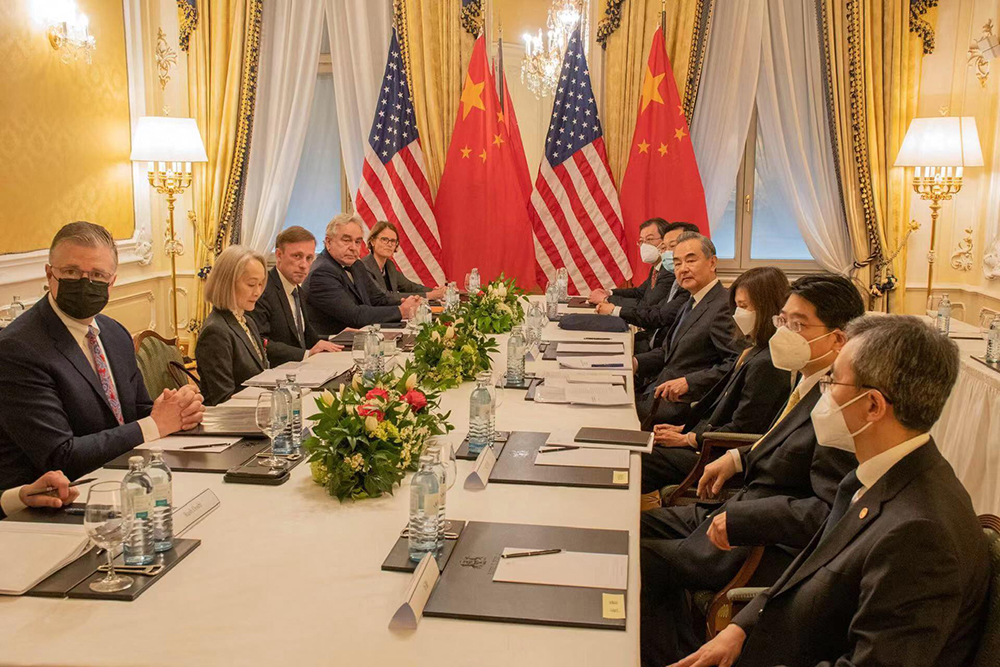
The channel also aimed to attend to the “huge amount of gardening” that needed to be done on three thorny issue areas: Taiwan and cross-strait relations, technology competition, and the Russia-Ukraine War.633 Biden officials were clear-eyed that China would never fully accept the U.S. position on these issues, but hoped to reduce misperceptions by clarifying questions such as, “What are we trying to do? What are you trying to do?”634 For them, the “very fact of a meeting and a press statement afterward indicates that at least the two sides are talking and . . . steadies everything on both sides.”635
The channel operated through quiet rendezvous across the world. The protocol on both sides was “you fly in, you drive to the hotel, you go into the room, you sit there for hours and hours.”636 Substantial U.S. interagency coordination before each meeting prioritized and sequenced messages—determining what should go through the strategic channel with Wang and what could be handled through other Cabinet or lower-level channels.637
The approach was first tested in Vienna at an intimate dinner where Sullivan, Campbell, and Beran joined Wang and two Chinese counterparts for an unstructured conversation aimed at building rapport. One former official estimated that the conversations in Vienna with Wang lasted over fifteen hours across two days.638
Each meeting typically had three sessions: one dedicated to bilateral issues, another on global issues, and a third on cross-strait issues.639 In Vienna, Wang emphasized that Beijing viewed U.S. policy on Taiwan as the biggest risk in the relationship.640 Sullivan sought to refute Chinese misconceptions that the United States was trying to provoke China into a war over the island. While Wang still refused to accept the U.S. framing of the relationship as a “competition,” the Vienna meeting did unlock a series of important visits from U.S. Cabinet officials to Beijing.641
Four meetings followed. From September 17 to 19, 2023, Sullivan and Wang met in Malta, in a key meeting that paved the way for the Woodside summit two months later.642 Malta also marked the first time Wang met U.S. officials in a dual capacity as director of the Office of the Foreign Affairs Commission and as minister for foreign affairs—a position he had re-acquired in June 2023 when Qin suddenly and inexplicably disappeared from public view (potentially due to having been compromised by British intelligence).643 The third meeting was on October 27, 2023, when Wang traveled to Washington to meet with Biden and separately with Sullivan at Blair House to finalize preparations for Woodside.644 The fourth meeting was in Bangkok, Thailand, January 26–27, 2024. This discussion lasted over twelve hours across two days and focused on Taiwan and North Korea.645 The final meeting was August 27–29, when Sullivan traveled to Beijing—his only such trip as national security adviser.646 In Beijing, Sullivan also met with Xi and Zhang.647 Sullivan’s meeting with Zhang, which included discussions on Taiwan and Chinese actions in the South China Sea and assistance to Russia, was notable because it was the only meeting between the senior CMC vice chairman and a senior U.S. official during the Biden administration.648
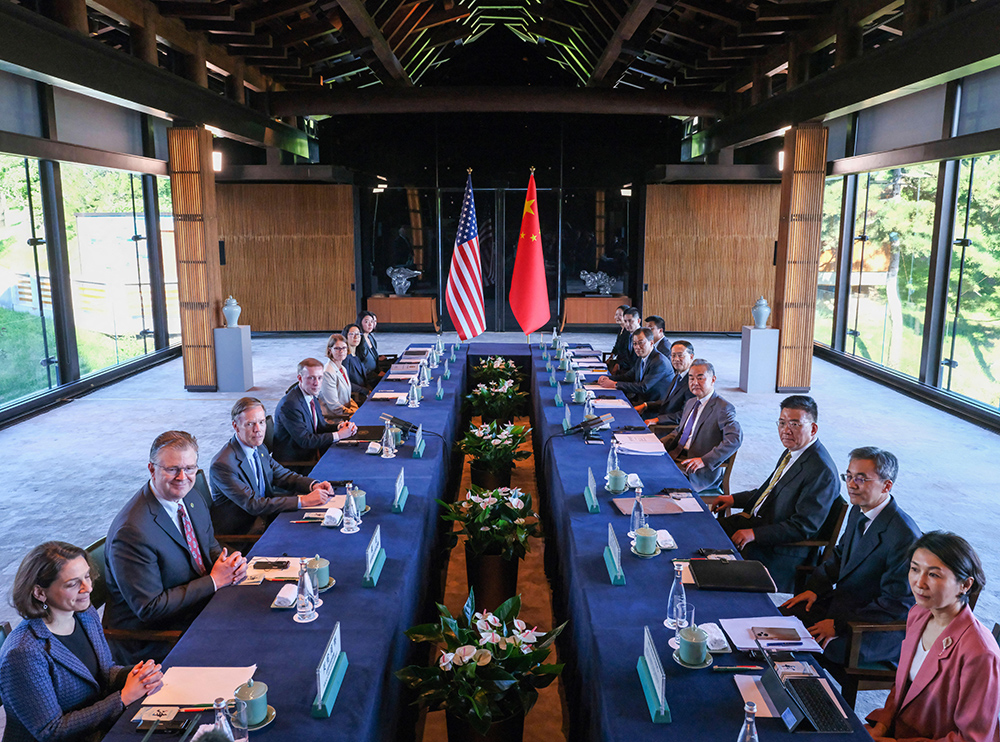
Because Beijing treated these engagements seriously, U.S. officials believed the channel helped China’s leadership to “energize their entire system.”649 As one official noted, putting an “empowered and authoritative” top-level U.S. diplomat face-to-face with a Chinese counterpart was an effective way to “convey our resolve and make clear” which actions the United States would and would not brook.650 The centralization of authority under Xi made it harder for the Chinese interagency to “leverage centralized power to get the other ministries to take action,” so the escalating of tailored U.S. asks to the presidential level had the “power to get things done outside the normal foreign ministry channels.”651 Counternarcotics and law enforcement issues, for example, fell outside the Chinese Foreign Ministry’s portfolio and required cooperation from the Ministry of Public Security under Minister Wang Xiaohong.652 By coordinating presidential-level deliverables, the strategic channel helped advance U.S. objectives throughout an otherwise resistant PRC bureaucracy.
Several former U.S. officials said a key reason for progress was the productive rapport between Sullivan and Wang. On the Chinese side, Sullivan was seen as tough but less dramatic than Blinken, whose exchanges with Wang in Anchorage and Munich had been particularly heated.653
China’s leadership had interpreted the concept of a managed competition in zero-sum terms, where “I win, you lose and that is a harsh kind of formula.”
Through the philosophical discussions the channel facilitated, U.S. officials learned how China’s leadership had interpreted the concept of a managed competition in zero-sum terms, where “I win, you lose and that is a harsh kind of formula.”654 As Sullivan stated, the channel offered the opportunity for him to explain to Wang that in American society the idea of competition was “an admirable kind of concept. Our whole system is built on competition. We have political competition, economic competition. That is what our democracy is built on.”655 From this perspective, the framing left space for U.S. restraint and even collaboration with China.
Pushing beyond a binary of the two countries as partners or adversaries was nevertheless “a really hard jump for the Chinese” side, according to one participant.656 Beijing would not publicly deviate from its formula that the relationship should be rooted in “mutual respect, peaceful coexistence and win-win cooperation.”657 But while it stuck largely to these talking points, Beijing had mostly accepted that more communication was needed to manage key issues across a fundamentally competitive relationship.658
The channel was also successful at reducing the temperature over Taiwan, which remained the most sensitive friction point in the relationship—especially after the Pelosi visit, U.S. military buildup in the region, and open debate in Washington about stepping away from the long-standing policy of strategic ambiguity into a posture of clear-cut support for Taiwan. Sullivan was able to speak candidly with Wang and dispel misconceptions about U.S. intentions, including by describing what Washington was doing behind the scenes to restrain Taipei and forestall any moves toward independence.659
The need for candid diplomacy about Taiwan only increased when Lai was elected president on January 13, 2024. In contrast to Tsai, who was described by multiple former U.S. officials as having a pragmatic and firm grounding in cross-strait issues, Lai lacked foreign policy experience and had no history of dealing with Beijing.660 He was mainly a domestically oriented politician—a former physician—who did not speak English well and lacked connections in Washington.661 While Lai’s selection of former representative to the U.S. Hsiao as his running mate helped improve the working relationship with Washington, he had a history of statements about Taiwanese independence that particularly infuriated Beijing.
The White House sought to use the channel to provide Wang with reason to believe that the United States was genuinely seeking to moderate Taipei’s position and steer clear of a crisis.662 They tried to demonstrate their seriousness of intent by prepping the Taiwan portion of the meeting in great detail, while also restricting that conversation to the bare minimum of participants.663 One White House official involved described how the room would “shrink down to just Jake [Sullivan] plus one or two people” for these sessions.664
Many of those in the White House would later credit Beijing’s restrained reaction to Lai’s election as being informed by the strategic channel’s discussions on Taiwan.665 The Kuomintang political party’s success in gaining the largest number of seats in Taiwan’s legislature in January 2024 clearly also played a role in moderating Beijing’s reaction.666 But while these officials may exaggerate the impact of their efforts to some degree, Taiwan-related diplomacy probably helped to dissuade Beijing from its more aggressive options.
Beyond Taiwan, the strategic channel helped the Biden administration clear up some of Beijing’s most misguided misconceptions about what the United States was trying to do in the Indo-Pacific in general. The first of these misconceptions was Beijing’s belief that the United States wanted to provoke China into a conflict. Beijing had convinced itself that the administration was adopting an all-out campaign to undercut China’s economic development through its technology export controls and economic sanctions, while also containing it militarily.667 Sullivan used his meetings with Wang to explain that from the U.S. perspective, these actions were a response to China’s aggressive behavior around Taiwan and the South China Sea—and emphasized the extent to which these cases were a root cause of the broad-based turn against China in the United States.668 To underscore Washington’s concerns about Russia in particular, U.S. officials showed Wang downgraded intelligence analysis that demonstrated how closely they were tracking Beijing’s support to the Kremlin.669 Washington’s aim was to deter China from actions that could undermine the cross-strait status quo or the security of allies, not to contain its rise or goad it into conflict.670
It is impossible for anyone outside the innermost corridors of the CCP’s compound at Zhongnanhai to know with confidence the extent to which the channel led Beijing toward a more constructive approach to its relations with Washington, but once the channel was in place, the relationship did move into calmer waters.
For example, when the United States put additional investment and technology restrictions in place in 2023 and 2024, Beijing’s response was comparatively subdued.671 Beijing also seemed less concerned about deepening U.S.-South Korea nuclear cooperation in April 2023—cooperation they rightly viewed as aimed at deterring North Korea and dampening Seoul’s own discussions under Yoon about acquiring nuclear weapons.672 The strategic channel offered the chance to give China’s top officials forewarning of what Washington was planning, to clarify Washington’s strategic rationale for deepening its nuclear cooperation with Seoul, and to illuminate the areas where the United States had purposefully not gone further.673
The strategic channel offered the chance for senior leaders to speak calmly and candidly behind closed doors and without the risk of the public grandstanding that had poisoned the Anchorage meeting. This opened the door to deeper conversations about the fundamentals of the relationship and how each side’s intentions were shaped by the other’s actions. U.S. officials, for example, found it helpful to hear how China’s leadership defined their own interests in the Indo-Pacific and how they were interpreting U.S. policies.674 Neither Beijing nor Washington were going to abandon core assumptions, of course, but the restoration of the strategic channel nonetheless became one of the Biden administration’s most important achievements in advancing its China strategy.
After Anchorage, the Russia-Ukraine war, the Pelosi visit, and the balloon incident conspired to send U.S.-China relations into a historic nadir, the strategic channel began the slow process of restoring some basis for mutual trust and respect on both sides. It also helped pave the way for other high-level visits.
As of 2023, no U.S. state governor, member of Congress, or Cabinet official had visited China in five years.675 While the pandemic raged in 2021 and 2022, very few Americans visited China and many American citizens returned home rather than face China’s strict lockdowns. Connectivity between the United States and China had not been lower since “reform and opening up” under PRC leader Deng Xiaoping in the late 1970s.676 Amid rising tensions and serious policy disagreements, senior U.S. officials and diplomats in Embassy Beijing worried the lack of connectivity would make it harder to defuse a potential crisis between the two countries.677
After agreeing to restart high-level communication in Bali, the first meeting of the strategic channel in Vienna in May 2023 unlocked a series of regular ministerial-level dialogues and a goal of working toward a second in-person meeting between Biden and Xi on the sidelines of the APEC Economic Leaders’ Meeting in San Francisco in November 2023.
The administration wanted to be sure that its top diplomat visited Beijing before other Cabinet officials, and Blinken thus became the first U.S. Cabinet official to visit Beijing in several years when he finally made his postponed trip, from June 18–19, 2023. Blinken met Xi, Wang, and Qin. The optics left something to be desired—Xi appeared to talk down to Blinken from the head of a boardroom table in a public appearance clearly staged for domestic Chinese audiences. Washington took this as a reminder that deep disagreements remained in the relationship, notwithstanding the recent Sullivan-Wang meeting in Vienna.678 Blinken’s trip did, however, help reestablish broad Cabinet-level dialogues. He was followed soon after by a parade of Cabinet colleagues.
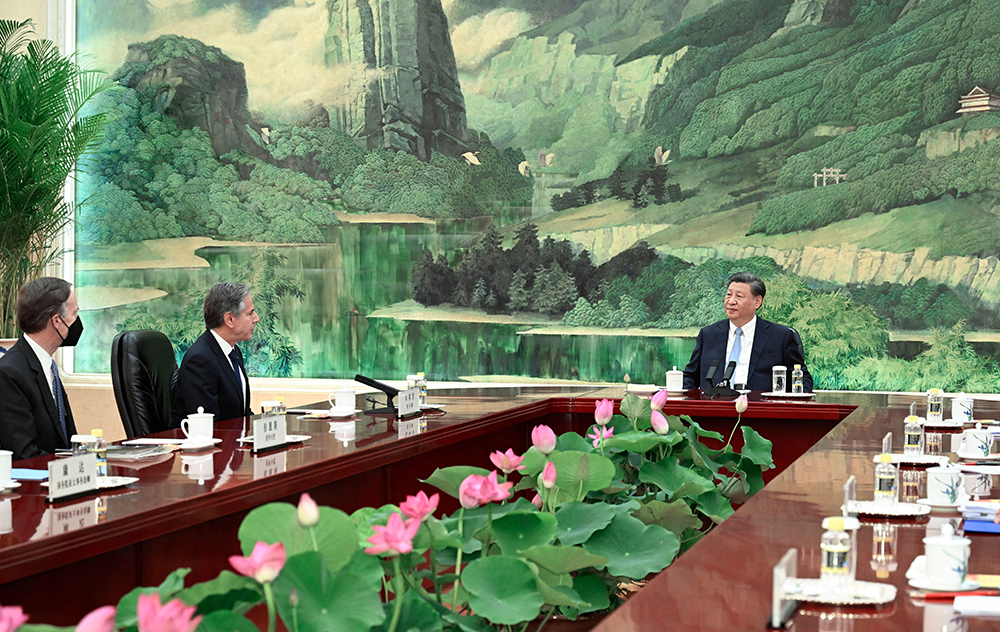
From July 6 to 9, 2023, Yellen visited Beijing and met Chinese Premier Li Qiang and officials from the Ministry of Finance. This was less than a year after the first round of technology export controls had been put in place and just a few months before a second round would be announced. It was important to the administration to reinforce to Beijing that these controls were not intended to destroy China’s economic growth or put an end to the mutually beneficial economic relationship. The aim was instead to avoid a negative spiral of recrimination and economic retaliation—in Yellen’s own words, to prevent “unintended escalatory actions that will be harmful to our overall economic relationship.”679 Chinese officials welcomed Yellen’s visit since they viewed her as more closely aligned with the financial sector’s view of China and therefore among the less hawkish senior members of the Biden administration. Beijing hoped the visit would help revive business confidence in China’s slowing economy and that Yellen, who had been a proponent of “responsible economic relations” with China,680 might help pare back U.S. investment restrictions and tariffs.681
Kerry also visited Beijing in July, meeting with Li and Wang and conducting extensive climate negotiations with his counterpart Xie.682 Kerry was followed by Raimondo, who visited Beijing and Shanghai from August 27 to 30, meeting with Li and her counterpart, Minister of Commerce Wang Wentao. Raimondo’s trip importantly established a dialogue on commercial issues at the vice-ministerial level, also adding a lower-level dialogue on export controls, which were by then a major irritant in the relationship.683 Raimondo characterized her visit as about increasing transparency and stability in the economic relationship between the two countries.684
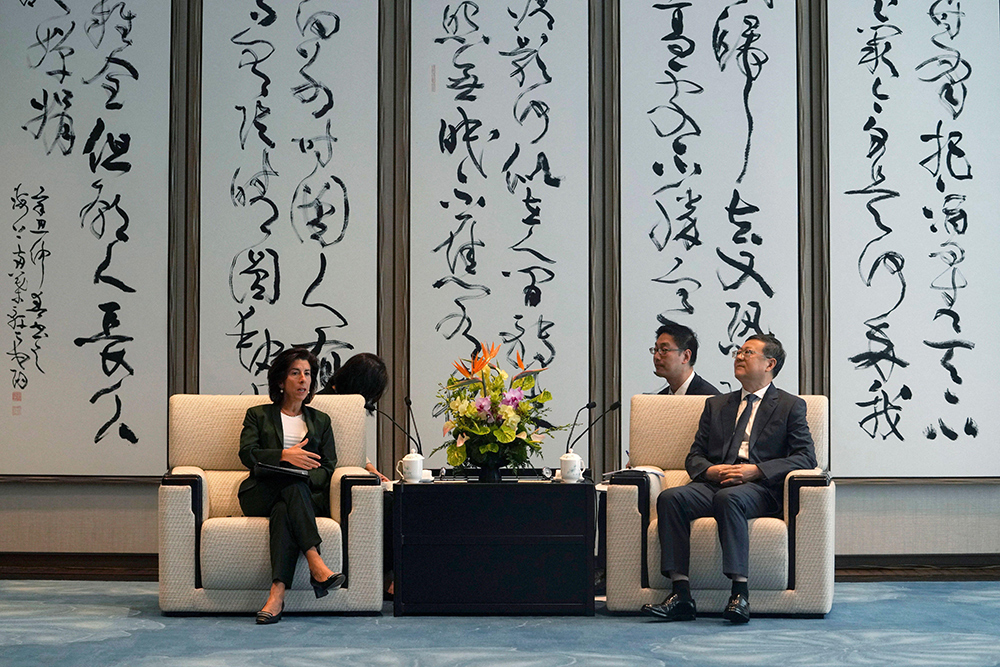
Amid these Cabinet-level visits, Kissinger also made a special trip to China on July 20, 2023. Then 100 years old, Kissinger held special significance to both sides. Xi described Kissinger as “an old friend of China” who had made “historic contributions to promoting the growth of China-U.S. relations and enhancing the friendship between the Chinese and American people.”685 Xi warmly received Kissinger with Wang.686 Kissinger also met with Chinese defense minister Li Shangfu, who had been under U.S. sanctions since 2018 and was therefore unwilling to meet his U.S. counterparts.687 By rolling out the red carpet for Kissinger, Beijing was clearly trying to appeal to nostalgia for a warmer period in U.S.-China relations.688
Some critics charged that the Cabinet-level visits were largely unidirectional (U.S. officials visiting Beijing) and that it was good optics for Xi’s domestic audience to have the Americans playing a role of a suitor seeking his audience. Nevertheless, along with the Sullivan-Wang channel, these high-level visits helped stabilize relations after four years of repeated crisis. Lower-level diplomacy was energized by them, as Chinese officials visited Washington and more regular phone calls were held between senior leaders.689 Narrowly tailored working groups were established as regular formal channels for dialogue, including a vice minister–level Economic Working Group and a Financial Working Group for financial policy matters between the U.S. Department of the Treasury and China’s Ministry of Finance and the People’s Bank of China, respectively.690
The diplomacy did not, of course, solve the fundamental structural problems of competition between the United States and China.
The diplomacy did not, of course, solve the fundamental structural problems of competition between the United States and China. U.S. Cabinet officials continued to stress that their export restrictions were narrowly targeted and to emphasize the small yard, high fence concept. But this was not how Beijing saw the issue. From China’s perspective, the export controls required China to develop “technological deterrence” with which it could make countervailing threats to the United States and its allies in order to prevent such restrictions.691 Nevertheless, stabilizing the relationship—not creating a new one—was the aim of the diplomatic offensive, and in this, it was successful.
The steady flow of Cabinet officials and the strategic channel dialogues also paved the way for a second in-person summit between Biden and Xi. Using Xi’s planned visit to San Francisco for the APEC Economic Leaders’ Meeting in November 2023 as a springboard, U.S. and Chinese officials began an intense series of negotiations over the meeting in the late summer. At the top of the American agenda was persuading China to help shut down the fentanyl supply chain, starting with the chemical precursors flowing out of Chinese labs. Former U.S. officials described the fentanyl challenge as an “ever-evolving problem” that required constant engagement and attention, since chemical manufacturers in China and drug dealers around the world steadily adapted their recipes and supply routes in response to Chinese and U.S. government crackdowns.692
The key compromise teed up for the summit was for Chinese law enforcement cooperation on fentanyl in exchange for the United States quietly removing sanctions on the Chinese Ministry of Public Security’s Institute of Forensic Science, which the United States had placed on the Entity List in June 2020 over its role in surveillance and repression in Xinjiang.693 The U.S. team thought their Chinese counterparts needed a trade like this to show “up their chain that China had received something in return” for agreeing to take action on what was seen in China as a U.S. drug problem.694 Lifting the sanctions also made sense given the institute’s role in law enforcement, which might require the United States to cooperate with it in the counter-drug effort. Before agreeing, however, the Biden team requested an intelligence assessment on whether taking it off the Entity List would have any concrete impact on Chinese human rights abuses, and the analysts came back with the conclusion that the effect was purely symbolic. Giving up a symbolic designation for “actual action to save American lives” seemed like a good trade.695
Biden thus warmly welcomed Xi outside the Filoli Estate’s historic Georgian mansion in Woodside on November 15, 2023. The seriousness of the stakes and wide-ranging nature of the talks were underscored by the heavy entourage that trailed behind Biden, including Blinken, Yellen, Raimondo, Kerry, Nick Burns, Sullivan, and various other senior NSC officials.696 Biden and Xi then spoke for over four hours, covering challenges ranging from fentanyl, military-to-military communication, AI safety, climate negotiations, Iran, and Taiwan.697
This was a more candid and substantive conversation than had occurred in Bali.698 Biden was direct about U.S. views on China’s support for Russia. For his part, Xi made clear that he found U.S. attitudes toward the CCP and fears that China would move imminently on Taiwan to be overwrought and unfair.699 Xi acknowledged that discussions on cross-strait issues had brought stability and de-escalation to a key flashpoint.700 Following the meeting, the presidents lunched over roast chicken with a small group and took a stroll together around Filoli’s grounds before the summit ended.701
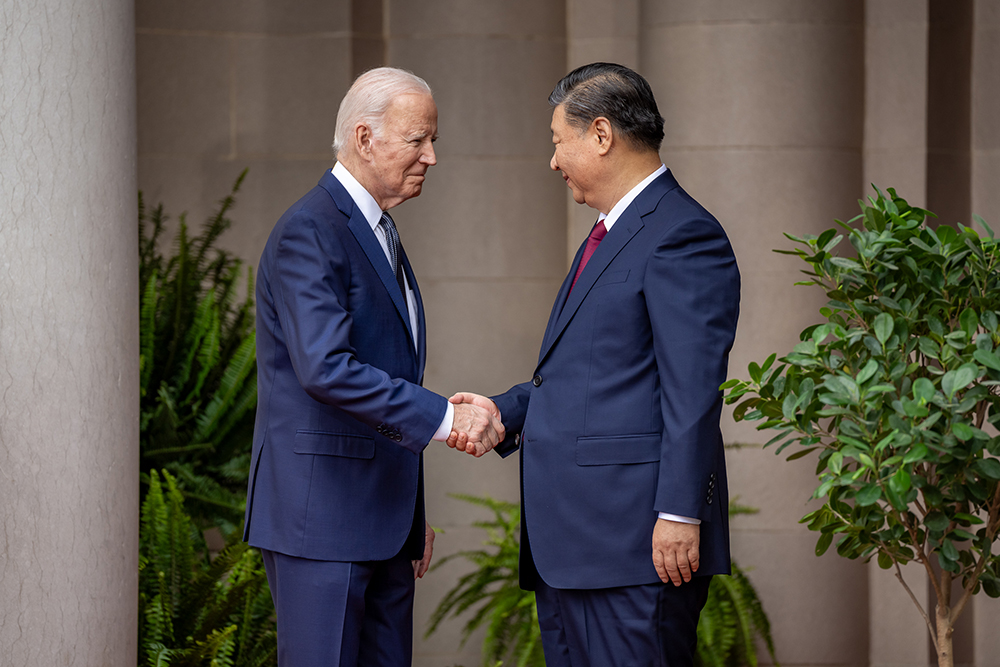
Woodside turned out to be the first Biden-Xi summit that produced tangible deliverables. Bilateral cooperation on counternarcotics resumed, and a working group was established to coordinate law enforcement actions.702 China agreed to ramp up law enforcement and issued a notice to industry, warning Chinese companies against engaging in this illicit trade.703 A noticeable decrease in the volume of precursors followed, and American fentanyl deaths slowed.704 China also finally agreed to reinstate military-to-military communication. Austin met with the next Chinese defense minister, and theater commanders later met with their counterparts.705 No less important was an agreement to start early-stage bilateral dialogues on the risks of advanced AI systems and need for improved AI safety.706
One reason for the positive outcome at Woodside—compared to the standoff at Anchorage earlier in the administration—was careful preparation of the diplomatic details.
One reason for the positive outcome—especially compared to the standoff at Anchorage in the early months of the administration—was careful preparation of the diplomatic details. For example, the NSC researched Xi’s first visit to the United States in 1985 and found a picture of a young Xi in front of the Golden Gate Bridge.707 During the summit at Woodside, Biden showed the photo to Xi on his phone, saying “Do you know this young man?” Xi’s smile and reply, “Yes, that was me thirty-eight years ago,” helped make the moment go viral on Chinese media.708 Biden also referenced Xi’s previous quotations of Lao Tzu and other classical Chinese philosophers, reminded Xi that his wife shared a birthday with the U.S. president,709 and invited Xi’s “old friends” from Iowa, who hosted him on his 1985 visit to join him for dinner at APEC.710 In an unscripted moment at the close of the summit, Biden shared his love of cars by complimenting Xi’s “beautiful” vehicle, which made the Chinese president chuckle and give Biden a brief look inside.711
These niceties served a diplomatic purpose at little cost to the United States. First, “giving face” by exercising cultural empathy was important for Xi’s Chinese audience. Second, the niceties recognized what a former U.S. official familiar with the preparations described as Xi’s position “as an autocrat in an unstable Leninist system.”712 These gestures aimed to make Xi feel respected as an equal on the world stage. As one member of Biden’s team’s put it, “Respect is as useful a commodity in bilateral diplomacy as the negotiation over the deliverable itself.”713 After the meeting, some may have criticized Biden’s approach as excessively warm, given Xi’s autocratic nature, but it reflected basic respect for the negotiation’s human element.
After the summit, both sides released statements that signaled that the relationship was on firmer footing. For the White House, it was “a candid and constructive discussion . . . including areas of potential cooperation.”714 For the Chinese Ministry of Foreign Affairs, it was “positive, comprehensive, and constructive” and “a new starting point for stabilizing China-U.S. relations.”715
For the first time during the Biden administration, the American and Chinese meeting readouts included very similar language on key issues such as climate change, people-to-people exchanges, and shared goals on “preventing conflict, maintaining open lines of communication, cooperating on areas of shared interest, upholding the UN Charter, and all countries treating each other with respect and finding a way to live alongside each other peacefully.”716
These were important demonstrations that both parties wanted to move beyond the acrimony of the last few years—signals to the world as well as to their own bureaucracies. At last, the relationship had turned a corner.
The one wrinkle was Biden’s gaffe doubling down at a press conference on calling Xi a “dictator,” which made Blinken visibly wince.717 As expected, the Chinese Foreign Ministry later denounced Biden’s remark as “extremely wrong” and “irresponsible political manipulation,” but U.S. officials were not overly concerned given the progress the meeting had secured.718
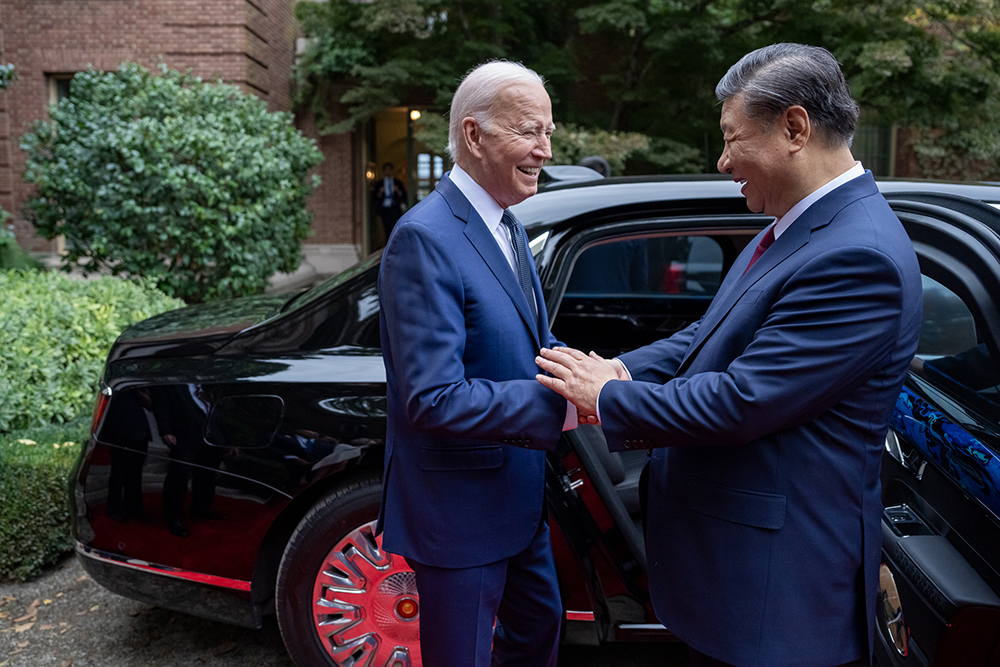
The last year of Biden’s term was more stable, thanks to the diplomatic efforts of 2023. The flow of U.S. Cabinet officials to Beijing continued. Blinken made a second trip to Beijing and Shanghai from April 24 to 26, 2024, meeting with Xi, Wang, and Wang Xiaohong. Fentanyl remained a top priority.719 Sullivan again met Wang in Bangkok from January 26 to 27, 2024, to lay the groundwork for a dialogue on AI and, in August, made his first trip to Beijing as national security adviser.720 John Podesta, who succeeded Kerry as Biden’s senior climate adviser, visited Beijing in early September.721
Sustained diplomacy was key to managing what continued to be a contentious relationship overall.
Sustained diplomacy was key to managing what continued to be a contentious relationship overall. Throughout 2024, Washington rolled out further tech and economic restrictions. New tariffs were introduced on Chinese steel, aluminum, solar panels, and electric vehicles.722 Sanctions on Chinese companies supplying Russia’s military-industrial base were expanded.723 New restrictions on outbound investment, quantum computing, and AI were also introduced.724 Despite these competitive actions, some Republicans such as future Secretary of State Marco Rubio called for further measures, including a blanket ban on all Chinese cars entering the U.S. market.725
Even after Kamala Harris lost the November 2024 presidential election, the Biden administration continued to press ahead. In fact, some officials described feeling somewhat more liberated, now that the chances of retaliation by Beijing were more limited as it readied itself for a potential trade war with the incoming Trump administration. It was a little “like a child pushing buttons in the elevator,” one official said.726 Meanwhile, China retaliated with restrictions on critical mineral exports—likely intended as a warning to the incoming administration.727
Other areas of friction in the bilateral relationship also did not go away. In the South China Sea, Chinese coast guard forces armed with knives and an axe boarded a Philippines boat near the Second Thomas Shoal on June 17, 2024.728 Nuclear arms talks restarted briefly, but the Chinese Foreign Ministry suspended them in July in protest of continued U.S. arms sales to Taiwan.729 Austin was able to meet his new counterpart Chinese Admiral Dong Jun in April and May 2024, but the Pentagon still thought this fell short of Xi’s promise to restart military-to-military ties.730
Biden and Xi met for a final time on November 16, 2024, on the sidelines of the APEC summit in Lima. For U.S. officials, the most important deliverable from this final meeting was securing Chinese agreement to affirm the crucial importance of keeping human control over the decision to use nuclear weapons and addressing the military risks of AI systems.731 This was the first time China agreed to shared language on AI and bilateral nuclear arms control.732 A final bright spot appeared on November 27, 2024, when Beijing released three U.S. citizens in a prisoner swap.733
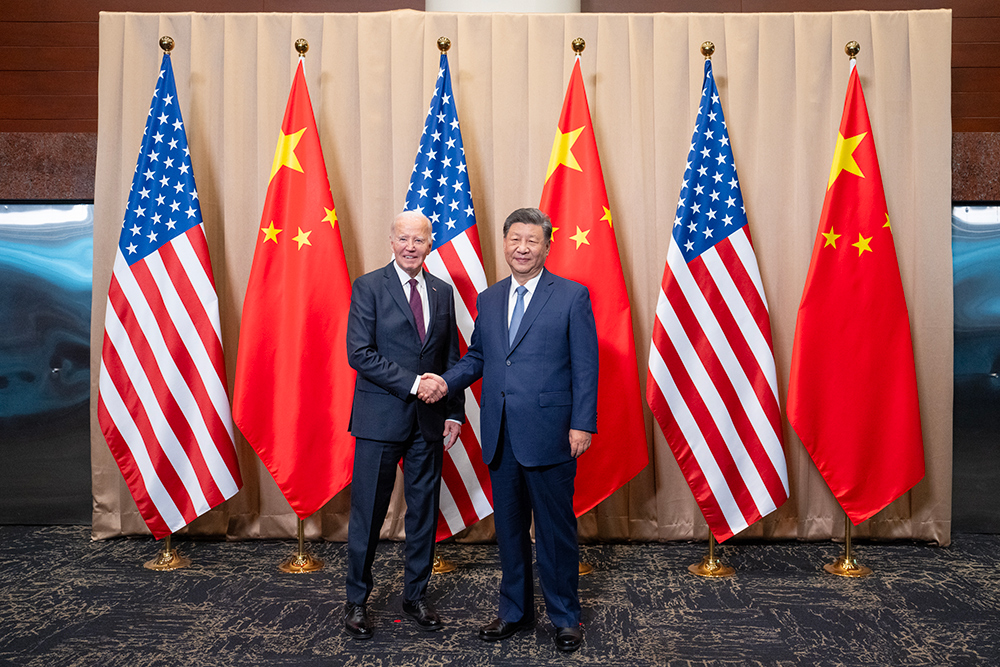
“The overall insight is that you can compete intensely, manage competition, and stabilize [the U.S.-China relationship] at a higher competitive equilibrium.”
While the Lima meeting was a somewhat anticlimactic culmination of the Biden administration’s four years of effort, it built upon work at Bali and Woodside to stabilize a relationship that had experienced significant crises since 2021. By the end of the administration, achieving some modest progress on counternarcotics cooperation, AI, and military-to-military communication, while engaging in significant competitive actions, was evidence for Biden officials that using intensive diplomacy to manage China’s threat perception had paid off. As a former White House official put it, “The overall insight is that you can compete intensely, manage competition, and stabilize [the U.S.-China relationship] at a higher competitive equilibrium.”734
What did the Biden administration’s China strategy ultimately achieve, and what does this mean for the future? When they walked into their offices at noon on January 20, 2021, the administration faced a U.S.-China relationship that was in free fall. China’s rise as a major power had surprised a foreign policy community focused on counterterrorism for almost twenty years. They were convinced that the convergence theory, according to which China was going to liberalize and become a natural partner of America, was dead.735 The central uncertainty was whether the relationship would settle into a managed rivalry or escalate into open hostility. The first Trump administration had rightly raised concern about China but the strategy they handed the Biden administration was rudimentary, and the capacity to implement it was limited.
Managing the rise of a major power such as China imposes conflicting moral imperatives on U.S. leaders, who must avoid a slide toward great power war while also protecting the vital interests of the American people. The Biden administration met this challenge with a long-term, whole-of-government strategy that institutionalized a stable strategic competition within rational bounds. Biden officials stressed the need for America to sustain a competitive edge over China but also recognized that China is a major power and, as such, a nation that cannot be defeated in any meaningful sense and with whom war would be catastrophic. They thus accepted that China and the CCP were permanent features of the geopolitical landscape and sought coexistence in a competitive framework. Their approach, which combined domestic renewal, technological protection, alliance coordination, and sustained diplomacy, now shapes the terrain on which subsequent administrations will likely operate. Even where the second Trump administration has modified specific policies on China, it has not fundamentally rejected the competitive framing that Biden consolidated. If anything, it has leaned even more into coexistence, avoiding the escalating rhetoric of Trump’s first term. Judged a year on, the shift that Biden accomplished thus represents a durable change in American statecraft.
The technological dimension of their competitive strategy was the newest. In his first term, Trump was right to focus on the technology challenge, but he approached the challenge inconsistently, damaging relations with key allies. In contrast, Biden introduced a developed framework for technology competition and used technology controls more aggressively than at any time in recent memory.
The Biden administration’s consistent diplomacy dampened the blowback from such controls and from the inevitable crises that occurred. Quiet diplomacy, well prepared and focused on communicating intentions as opposed to major deals, was effective and pursued in parallel with competitive measures. Biden did not fall into the trap of viewing diplomacy as a “give” that Beijing had to earn, but instead demonstrated the value of talking to adversaries.736 And this was not diplomacy for appearances only. The logic of the strategic channel was to communicate U.S. intentions and thereby reduce misperceptions that have historically been a source of damaging escalation in world politics.737 Without this diplomatic effort, the competitive strategy would have been riskier. The diplomacy also paid concrete benefits in improving military crisis management (post-Woodside) and inducing more serious Chinese efforts to reduce fentanyl flows to the United States—as reflected in dropping fentanyl deaths the following year.738 These are important indicators that Beijing is responsive to diplomacy, even though it is engaged in a multilevel, multiplayer game in which structural and domestic considerations also shape its foreign policy.
The logic of the strategic channel was to communicate U.S. intentions and thereby reduce misperceptions that have historically been a source of damaging escalation in world politics.
Another hallmark of the Biden approach to China was the emphasis on developing America’s network of allies and partners. Allies and partners can bring economic, technological, diplomatic, and military benefits. The administration made more progress, however, on the military dimension of alliances than it did on the economic and technological fronts. Market opening that many allies and partners desired was difficult for domestic political reasons, but even so, cooperation on supply chains, AI, and technology in general could have been pushed more aggressively. At a minimum, future administrations should focus intensely on these crucial areas of strategic competition—and avoid military overcommitment to allies who are unable to bring real benefits to the table.
One of the loftiest objectives of Biden’s White House team was to convince Beijing to accept strategic competition as a framework for the bilateral relationship.
One of the loftiest objectives of Biden’s White House team was to convince Beijing to accept strategic competition as a framework for the bilateral relationship. Essentially, this meant accepting the reality that neither the United States nor China would dominate the other—in other words, accepting coexistence with equality. Beijing was initially reluctant to accept the framing, but the calmer diplomacy of the final two years of Biden’s term suggests that Beijing almost certainly did accept this framing, at least while Biden was president.
The administration also began in earnest the reorientation of U.S. power instruments toward competition with China. Its bureaucratic reforms within the State Department, DOD, and intelligence community should help improve Washington’s capacity to implement sound China policy. Further improvements could be made, and some of the officials interviewed for this report think that the reforms did not go far enough. Nevertheless, the administration succeeded in taking the initial steps toward building a bureaucracy that is more efficiently and effectively focused on strategic competition. Notably, several key Biden-era bureaucratic reforms have so far survived the second Trump administration, despite its enthusiasm for bureaucratic dismantlement in general.
At times Biden’s strategic goals were threatened by circumstance and at times aided by it. External events repeatedly threatened to undermine the administration’s effort to implement its strategy. In the early part of the term, a combination of economic, pandemic, and political forces led Beijing to conclude it was surpassing the United States and could take an aggressive posture. In the later years, however, as China faced economic headwinds and global and regional pushback, Beijing moderated its diplomatic posture. Structural factors like this always matter in statecraft, but their existence should not disprove the salutary effects of Biden’s diplomacy, which leveraged these conditions to further stabilize the relationship.
Some critics objected in principle to framing the relationship in terms of strategic competition.739 They rightly stipulated that avoiding inadvertent escalation and maintaining a flexible diplomatic posture are important parts of statecraft in the face of a rising power such as China and that, as of 2022, the bilateral relationship appeared to be locked into an escalating rhetoric.740 It can indeed be argued that “competitive coexistence” may be a better frame for the relationship than strategic competition.741 And for a Chinese audience, it will remain important to emphasize coexistence as a centerpiece of the U.S. approach. But an approach framed specifically in terms of coexistence would likely not have differed significantly in practice—especially during the second half of the administration. And it might have lacked domestic support.
This was calibrated realism—neither warlike nor naive. It was also realism grounded in an apt assessment of the nature of American power, which springs from the political and economic health of America itself as a nation. The stronger the American democratic institutions, the U.S. economy, its technology, and its polity, the more competitive the United States’ geopolitical position becomes. The strategy rightly focused on domestic economic revitalization and the technological foundations of U.S. power over the long term. This placed the military dimension in a broader strategic context, without downplaying its importance to near-term U.S. goals in the Indo-Pacific or allowing global military primacy to become a strategic end in itself.
The administration did not neglect military realities and continued to enlarge the U.S. military footprint in the Indo-Pacific, respond to PLA actions, and pursue innovative new strategies—for example, the Pentagon’s Replicator initiative—to maintain the U.S. military edge. Biden’s Pentagon leaders were thus able to continue the gradual reorientation of U.S. military power toward the region, but the change was not as dramatic as they hoped and the United States remained embroiled in conflicts in the Middle East and Europe. The administration’s efforts to strengthen Japan, Australia, India, and other nations’ military capabilities should be commended, but it did not complete the process of building a self-sustaining balance of military power in a dynamic Indo-Pacific.
At the strategic level, the Biden administration never fully tackled the question of what amount of U.S. military power was sufficient to achieve U.S. goals under the strategy of competition in the first place, instead viewing their military moves as necessary responses to the growing power of the PLA. In this mindset, more is always better. Rather than asking how much security is gained from additional military investments, they sought to maximize defense capabilities subject to legal, bureaucratic, and budgetary constraints. However logical from a bureaucratic perspective, this risks an arms race, waste, and a defense posture that is difficult to adapt as U.S. interests evolve—which they are certain to do. The United States needs sufficient military power in the region, not the maximal capabilities that bureaucratic actors inside the national security system tend to push for—and did under Biden.
Of course, China must be forced to factor credible U.S. and allied defense capabilities into its regional military calculus. The United States has important interests in Taiwan, whose semiconductor manufacturing capacity is strategically consequential as the world launches into the AI era. The United States also has a major stake in ensuring Japan’s ability to resist coercion or attack; Japan is the best positioned nation to further U.S. aims in strategic competition with China.742 The question that needs to be answered, however, is how much defensive denial capability is enough to reduce the risk of a Chinese attack on Taiwan and Japan to a tolerable level, given America’s many other national and international priorities—not how to maximize absolute U.S. military power in Asia.
At the strategic level, the Biden administration never fully tackled the question of what amount of U.S. military power was sufficient to achieve U.S. goals.
A strategy aimed at sufficient deterrence would focus on ensuring that the United States and key allies were confident they could inflict major damage on China were it to attack Taiwan without provocation. It would also need to ensure Japan’s capacity for self-defense under coercion or attack. This means being able to impose serious costs on an invasion fleet, to keep key allied bases and command-and-control systems functioning under PLA attack, and to deny Beijing confidence that it might achieve a short, decisive victory. This would be a substantial military capability, but it is different from maximizing capability to ensure regional primacy.
Such a posture must also be flexible, precisely because U.S. interests—including regarding Taiwan—are likely to shift over time. For example, Taiwan’s semiconductor monopoly will diminish as U.S. supply chain diversification matures, Taiwan’s domestic politics may evolve, and China’s trajectory may also turn. The United States should not get locked into a rigid posture. The Biden administration’s bet on its military relationship with the Philippines—a country that has a recent history of swaying back and forth between the United States and China—is one such case. A posture built around sufficiency, in contrast, would be more scalable and allow U.S. leaders to adjust commitments and risk exposure as conditions change.
A morally serious strategy must not shy away from the reality that a U.S.-China war would impose extraordinary costs on America, Asia, and the world. A posture built around seeking maximum capabilities and trying to reduce risk to near zero contributes to such a risk. A deterrence posture based on sufficiency accepts some degree of risk to minimize the probability of war, but also avoids the pathologies of primacy: arms racing, escalation pressure, rigid commitments, and the diversion of national resources and focus from other areas of strategic competition that could better benefit the American people. The Biden administration was therefore right to continue adapting and strengthening U.S. military posture in the Indo-Pacific, but more serious thinking about options short of primacy in the Indo-Pacific is needed.
The significant military component of Biden’s strategy was understandable, but future administrations should consider moving toward a sufficiency model. There were also other areas where the Biden record fell short. The first was on Taiwan. The team deserves credit for avoiding a violent conflict—a minimum standard—but it was not a perfect performance. White House officials’ claims that Biden’s multiple pronouncements on Taiwan did not exacerbate relations with Beijing are dubious. The military baseline of tension was increased permanently due to the Pelosi visit, and the president could have averted this but refused to do so—according to multiple interviews. An administration with less of an ideological-based approach and more of an interests-based approach to allies and partners would have found it somewhat easier to manage this difficult issue.
The economic plank of the administration’s strategy has also been the target of two criticisms, one softer than the other. The softer criticism is that more could have been done to build out the cooperative international initiatives of its economic statecraft, for example, by providing more financing for networks to develop critical minerals and other supply chains. The administration did this in the Lobito Corridor, but that project was more a proof of concept. It is certainly possible that with a second term, however, the administration might have done more.
The more controversial criticism that has been made is that the administration was beholden to labor unions to the detriment of its ability to strengthen relations with key partners around the world by offering them market access. Those responsible for strengthening U.S. relations with partners and allies to compete with China naturally wanted the maximum flexibility to offer market access alongside military and technological incentives. They would have preferred that the United States return to the Trans-Pacific Partnership (now the Comprehensive and Progressive Agreement for the Trans-Pacific Partnership). It is true that the administration faced real constraints from organized labor that it was unwilling to leap over for the sake of marginal gain in stronger relations with its partners in the context of China. But it is far from certain that it would have been better for the administration to ignore the interests of these domestic groups for the sake of a marginal gain in strengthening relations with, for example, Vietnam or the Philippines. As one former senior State Department official put it, “Is your main priority competing with China or domestic renewal?”743 The administration was in this sense right to be skeptical about the unbridled use of free trade to achieve noneconomic foreign policy objectives.744 Aggressive market opening is one reason for the domestic political strain that the United States had experienced in the last decade745—albeit not the only one.746
The Biden administration also did not get far enough in reducing dependencies on China, particularly for rare earth minerals. Such changes cannot be realized overnight, but even former senior members of the administration recognized this, for example saying that “we just did not move fast enough on critical minerals and on creating enough resilience in that space so that we would not be in the situation we are today.”747 Future geoeconomic strategy should make better use of tools such as the Development Finance Corporation to leverage the power of the U.S. market and deepen supply chain cooperation with allies and partners.748
Perhaps a trend away from economic liberalism is inevitable in a competition with a communist country in a mercantilist era, but Biden’s (and Trump’s) approach to the economic dimension may also have encouraged a heavier hand for the state than intended. While the Biden administration was right to place the economic foundations of American power at the core of their strategy, it remains to be seen how well Biden-era industrial policy will work, compared with a more traditional free market approach. Some Democrats wanted to leverage competition with China to harness the power of the state for social, economic, and climate goals only tangentially related to China. This turn away from traditional economic liberalism is mirrored in parts of modern Republican policy, for example, in Trump’s industrial subsidies and his radical tariff policy. But free markets were undeniably part of what allowed the United States to win the Cold War, and Washington must be careful not to inadvertently import China’s more statist economic model and end up with inefficient investment patterns or an unwarranted consolidation of power in specific firms.749 It would be ironic if maladroit industrial policy only served to undermine the foundations of long-term American economic competitiveness.
In theory, the Biden administration retained some hope for continued cooperation with China on climate, global health, AI norms, and other shared problems. In practice, there was limited progress in these areas. This might be blamed on the sharper aspects of the competitive strategy, but it probably had more to do with China’s own reticence combined with the lack of bipartisan support for such measures in the United States, which undermines U.S. negotiating power.
The White House could also have done more to communicate the logic of its strategy to the broader American public. When it did speak to the public about its strategy, the main audience was the Washington commentariat—Sullivan’s key speeches were at the Brookings Institution and the Council on Foreign Relations, and Blinken’s speech was at George Washington University. These are obviously the right places to lay out policy details, but given the importance of the issues, Biden should also have been more vocal with the broader public. A more focused communication strategy would have downplayed the democracy versus autocracy framing, which failed to find much purchase at home or abroad. Similarly, Biden’s early focus on human rights elevated an issue that the administration subsequently orphaned and abandoned. Some in the human rights community remain very critical of Biden and his team for, in their eyes, raising expectations and failing to deliver.750 This meant the rhetoric on human rights ended up serving little strategic benefit.
Cooperating while also competing thus proved difficult. Former Biden administration officials were aware of the tension underlying their approach, with one remarking that it was “like we’re here to peacefully coexist with [China] and we want to chart a path forward for that, while at the same time pushing hard back against their efforts.”751 Future American leaders will have to accept that China does not see cooperation on issues that the United States cares about as vitally important and therefore must avoid spending too much time and energy trying to convince them otherwise. Realism—but not despair—will be needed.
For all its complexities, future administrations should continue the dual-tracked diplomatic-competitive approach. On the diplomatic side, in addition to dispelling misperceptions and managing economic and military conflicts, the United States should press for strategic arms control, norms on AI use, and regularizing military-to-military communication. Leaders will have to do this while remaining cautious in their criticisms of China’s human rights abuses, not because these do not exist, but because the fundamental responsibility of public leadership is to the interests of America and this requires a moderated approach. Caution does not require silence on human rights, but there will be more room for productive discussion in a context where diplomatic relations are strong and the relationship is stable.
Caution does not require silence on human rights, but there will be more room for productive discussion in a context where diplomatic relations are strong and the relationship is stable.
At the same time, U.S. leaders will need to strive to ensure the United States maintains its economic, technological, military, and political edge over the long term. This should include continued investment in cutting-edge military technology, consistent attention to America’s domestic economic ruptures, investment in research and development, management of mounting federal debt, and appreciation for the role allies and partners can play.752 Polarization and political dysfunction in the United States weakens the country in the face of its adversaries, and responsible leaders who care about competing with China will find ways to reduce rather than exacerbate the strains on American democracy.
The scholar David Shambaugh claimed in a recent book that the Biden administration signaled the emergence of a new consensus around policy toward China.753 To what extent has Trump’s second term borne this out in key areas?
Part of the challenge in analyzing continuity and change in the second Trump administration is the uncertainty about its approach to China itself. During the first Trump administration, the White House started out with a warm and open approach to Beijing, but after the first year in office turned sharply toward warring over trade. This time around, Trump could be toying with the idea of a bargain perhaps involving Chinese trade concessions in exchange for U.S. reassurance on Taiwan or a loosening of U.S. export controls on advanced microchips. On the other hand, he might just be buying time to confront China harshly later in his term. As in other policy areas, there appear to be competing impulses on how allies fit into strategic competition with China, with some high-level officials such as Rubio and Pentagon Chief Pete Hegseth more inclined to leverage allies and partners for a tough line against China. Nevertheless, so far, the Trump approach has not diverged from the fundamental framing of the relationship as competitive, according to which the rivalry is structural and China will not be defeated, only held at bay.
Allies. In contrast with Biden, Trump has shifted the strategic emphasis away from allies. On the one hand, the Trump administration has continued to discuss cooperation on China in meetings with key allies such as Japan, NATO, and the G7. The Quad has also continued to meet at the foreign minister level, although strained ties with Modi make its future unclear. The Pentagon raised questions about AUKUS in June 2025 but now appears likely to press ahead with the program.754 On the other hand, Trump has damaged pieces of the alliance network that the Biden administration built. His tariff war and the general unpredictability of his foreign policy are making some allies—especially Europeans such as British Prime Minister Keir Starmer—hesitant to make strong commitments to the United States to counter China.755 The best example of the capriciousness of Trump’s foreign policy may be his approach to India, which he once lauded as a partner but then broke with for superficial reasons.
Competition. One of the Trump administration’s first actions on export controls was to toss the Biden administration’s three-tiered approach to AI, claiming that it was too onerous and that it would put a more streamlined policy in place. The Trump administration’s AI Action Plan made public in July emphasized the need to sell AI technology to allies and partners but also stressed the importance of enforcing existing AI controls better to keep advanced products out of China. Yet when it comes to introducing new export controls for the newest chips, the administration adopted a more open approach that includes the sale of advanced Nvidia chips, such as the H20 and more recently the advanced H200, to China—despite strong criticism from Congress and the expert community.756 Trump at the same time promised not to export the most advanced Blackwell chips (unless “altered”). He also threatened sanctions on the export of U.S. software and products made with advanced U.S. software, but these threats are intended to strengthen the U.S. bargaining position with China for trade negotiations, not as national security measures.757 It seems safe to conclude therefore that restrictions are likely to continue in some form, but they will be negotiable under Trump and not adhere to the Biden-era standard of staying as far ahead as possible in this vital technology.
It remains unclear how much the Pentagon will emphasize competing militarily with China. Although Trump placed China hawks in key administration roles, months of military focus on other areas, including Iran and Venezuela, have drawn the depth of that commitment into doubt. The 2026 National Defense Strategy, for example, stated that the second Trump administration would work to “ensure that neither China nor anyone else can dominate us or our allies” but that its primary focus would be protecting the U.S. homeland in the Western Hemisphere.758 It seems likely, however, that the trend toward more military spending directed at building up capability in the Indo-Pacific will continue, even if not at the level initially anticipated in early 2025.
Diplomacy. Even though it was not one of the named pillars of the Biden approach, diplomacy was at the core of the China strategy, especially in the second half of his term. When it comes to the diplomatic track, Trump’s record is so far trending in the same direction. Trump has had three calls with Xi, one immediately before his inauguration. The two leaders also met in South Korea from October 29 to 30, 2025. Treasury Secretary Scott Bessent and U.S. Trade Representative Jamieson Greer have met multiple times with their counterparts, and Hegseth has had at least one call and one in-person meeting with his nominal counterpart Dong.759
The status of the strategic channel, however, remains uncertain. Initially the Trump administration was interested in continuing it, but that became impossible when national security adviser Mike Waltz got off to a rough start and was reassigned to be the U.S. ambassador to the United Nations.760 Rubio replaced him, thus assuming a dual-hatted role, and subsequently met with Wang once and called him at least twice. Whether this channel will continue to play the role that it did in the latter two years of the Biden administration remains to be seen. The dominance of Trump himself on foreign policy reduces even Rubio’s leeway to make the channel a substantive give-and-take.761
National rejuvenation. A core belief of the Biden approach was that the United States needed economic and social rejuvenation to compete effectively with China. The Biden administration conceived of rejuvenation as a recovery from what they saw as the deficiencies of the low taxes, cheap energy, and deregulation of the first Trump term. Trump’s approach to national rejuvenation—making America “great again”—is obviously very different from Biden’s on nearly every front and it is too soon to see whether it will provide the kind of boost that America needs to remain competitive with China over time.
If the intellectual framework of strategic competition largely survives the Trump administration, areas of disagreement within that framework will persist. One of the most important is the extent to which the United States needs to lift regulation and controls on its own AI development to stay competitive. Most of Biden’s restrictions on AI aimed to keep the United States in a leading position on the frontier of the new technology. Maximizing competitiveness, however, also requires effective integration of AI into industry and government on the one hand and the successful export of AI to partners and allies on the other.762 Integrating AI into industry and government is what will ultimately allow the technology to have real-world effects in other areas such as the ability to produce efficiently or make and implement sound government decisions. The more countries around the world come to rely on U.S. AI, the more U.S. influence will grow. There are thus major pressures to accelerate not only AI development but also its domestic and foreign adoption. But these pressures could also create major risks if lax regulation permits the dangerous use of AI, the inadvertent diffusion of frontier technology to China, or the emergence of malicious AI itself. Even within the competitive framework, there is a major dilemma over how to handle this revolution at the strategic level.
The degree of economic integration the United States should seek with China is another important area for continued debate. For American consumers, there is still value in economic exchange with China, especially if the exchange includes Chinese-controlled production in third countries and the U.S. services industry benefits from exports to China. Integration of the U.S. and Chinese economies also remains a damper on rapid crisis escalation, even if it is no guarantee against war. Pressure to protect American industrial jobs and national security concerns will augur for a gradual reduction in China’s share of overall U.S. global trade and investment, but reduction will start from a high level. Even a reduced scope for trade thus leaves ample room for substantial economic integration. Beijing’s preferences will also affect this, of course—for example, its desire to limit exposure to U.S. sanctions and tariffs through “dual circulation” and export diversification—but the United States should have a clearer picture of whether it aims for comprehensive decoupling or something more moderate that protects comparative advantages.
America’s military footprint in East Asia is a final area where the United States has important options within a strategic competition framework. The current orthodoxy is that America must not only maintain its deep forward presence along China’s coastline, but that it must also increase the number and types of weapons that it deploys in the region to deter China from attacks on allies and partners, above all Taiwan. But because strategic competition with China is primarily about sustaining a technological and economic edge and maintaining a healthy domestic polity, insisting on military primacy is not prescribed under a strategic competition framing. Cost, escalation, entanglement, and arms-racing risks might together encourage a more modest regional military strategy within strategic competition.
Biden’s foreign policy was not at all perfect. On many issues, he was held back by an approach that hewed too closely to tradition.763 This was most clear in his embrace of Israeli Prime Minister Benjamin Netanyahu and subsequent support for Israel’s war in Gaza, but it also extended in some ways to his unconditional embrace of Ukraine and some U.S. allies. When it came to the most important long-term relationship that the United States has, however, the Biden administration deserves credit for what it accomplished. The U.S.-China relationship could have gone far off the rails and descended deeper into conflict or left the United States in a weaker position. Instead, the administration managed a difficult balance that combined tenacious work to stay ahead of China in the areas that mattered while repairing the diplomatic relationship that had collapsed into disarray. This was important and impressive statecraft that charts a way forward and sets a baseline for assessing how future U.S. administrations will handle the challenge.
Christopher S. Chivvis is a senior fellow and director of the American Statecraft Program at the Carnegie Endowment. He has more than two decades of experience working on U.S. foreign policy and national security challenges. He most recently served as the U.S. national intelligence officer for Europe.
At Carnegie, Chivvis leads policy-focused research aimed at developing realistic U.S. strategy for an era of great power competition and building a foreign policy that serves the needs of the American people.
Senkai Hsia is an MPhil candidate in international relations at the University of Oxford and is a former research assistant for the American Statecraft Program.
This report would not have been possible without the support of many individuals to whom we owe our deep appreciation: Wally Adeyemo, Salman Ahmed, Sarah Beran, Rebecca Brocato, Frances Brown, Nicholas Burns, Kurt Campbell, Mike Castellano, Michael S. Chase, Tarun Chhabra, Mariano-Florentino (Tino) Cuéllar, James Curran, Rush Doshi, Darcie Draudt-Véjares, Evan Feigenbaum, Julian Gewirtz, Vijay Gokhale, Sumona Guha, Avril Haines, Peter Harrell, Ryan Hass, Jennifer Hendrixson White, Amos Hochstein, Susan Jakes, Colin Kahl, Mara Karlin, Mark Baxter Lambert, Allie Matthias, Helaina Matza, Michael J. Mazarr, Chris McGuire, Siddharth Mohandas, Jeffrey Prescott, Mira Rapp-Hooper, Ely Ratner, Brett Rosenberg, Laura Rosenberger, Randy Schriver, Hannah Suh, Jake Sullivan, and Daniel Taylor.
We are also grateful to Jaden Richards, Liana Schmitter-Emerson, Maeve Sockwell, and Ilyasah Queen-Bailey for their invaluable research and administrative support. Lastly, thank you to Sharmeen Aly, Alana Brase, Helena Jordheim, Amy Mellon, Lori Merritt, and Jocelyn Soly of Carnegie’s communications team for all their work to produce this report.

Senior Fellow and Director, American Statecraft Program
Christopher S. Chivvis is the director of the American Statecraft Program at the Carnegie Endowment for International Peace.

Senkai Hsia
MPhil Candidate, University of Oxford
Senkai Hsia is an MPhil candidate in international relations at the University of Oxford.
Carnegie does not take institutional positions on public policy issues; the views represented herein are those of the author(s) and do not necessarily reflect the views of Carnegie, its staff, or its trustees.

A leak of Russian gas price data helps establish that China is paying Russia far less than Central Asian countries and Gazprom’s former European customers.

Sergey Vakulenko

Japan’s long-term security policy is driven by concerns about China, and there is little appetite for (or interest in) pursuing a confrontation with Moscow.

James D.J. Brown

Without a ceasefire with Ukraine on attacking each other’s energy infrastructure—to which the Kremlin is unlikely to agree—the diesel agreement between Putin and Trump is largely for show, rather than representing a genuine increase in the volumes of Russian diesel on the global market.
Sergey Vakulenko

Despite a new textbook, an influx of Russian teachers and managers, and an end to the teaching of Ukrainian, the Kremlin is unlikely to have “reprogrammed” locals.

Konstantin Skorkin

Cargo traffic through Russia’s Northern Sea Route has increased because of the disruption caused by the conflict in the Middle East, the Ukraine war, and U.S.-China tensions.

Mikhail Korostikov
