

Paper
Paul Staniland
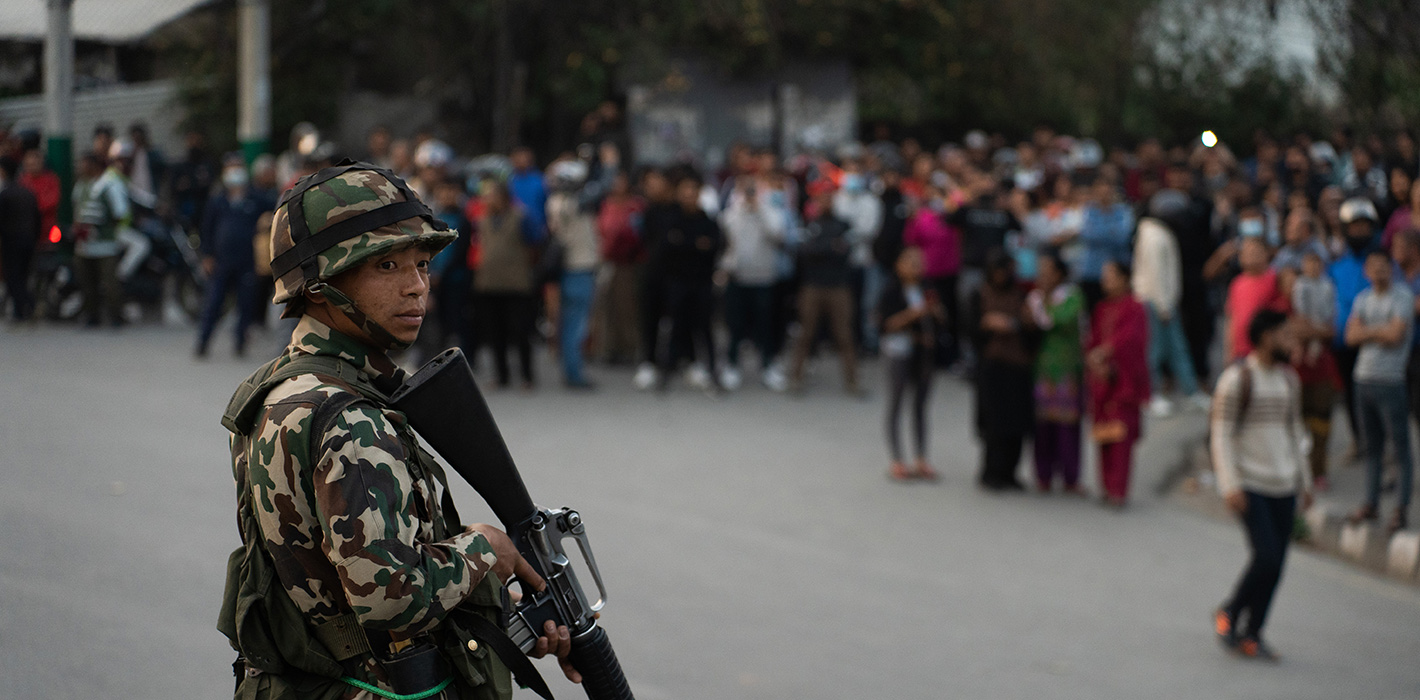
Source: Getty
Military rule is now a defining political factor in South Asia. Here’s how analysts can understand and account for it.
Over the past two decades, scholars and analysts have devoted much of their attention to democratic backsliding, illiberal democracy, and competitive authoritarianism—all processes through which elected leaders can threaten democracy by undermining democratic institutions and practices. Related to the rise of backsliding is the fact that military coups also declined sharply after the end of the Cold War. Many of the classical praetorian militaries of the Cold War era—those that seized power regularly or for long periods, whether in Brazil, Nigeria, Turkey, or Indonesia—were brought under civilian control. After the Cold War, the military coup seemed to have fallen out of favor; the key threats to democracy were from politicians, not generals.
In South Asia, concerns about democratic backsliding and competitive authoritarianism were often raised during the 2010s and 2020s in relation to the governments of Narendra Modi in India, Sheikh Hasina in Bangladesh, and Mahinda Rajapaksa and then Gotabaya Rajapaksa in Sri Lanka. Even though scholars and analysts often disagreed about how apt these labels were in particular cases, the “liberal democracy versus democratic backsliding” dichotomy came to dominate much of the debate about political trends in the region.
In 2026, however, this should no longer be the predominant analytical framework for assessing political change across South Asia. The Rajapaksas lost power after mass protests in 2022, and Sheikh Hasina’s government similarly collapsed in the face of spiraling protest in 2024. Even if these regimes were less resilient than expected—and the risks of democratic backsliding remain—the more striking lesson of these upheavals is how often militaries have emerged as pivotal political actors during moments of crisis. The same dynamic occurred in 2025 when street protests toppled the government of Nepal within forty-eight hours and the military stepped in to stabilize a transition to an interim government.
The more striking lesson of these upheavals is how often militaries have emerged as pivotal political actors during moments of crisis.
In South Asia today, militaries are taking on a renewed, often decisive, role in shaping political outcomes. Since 2021, military power has consolidated or expanded across several countries in the region, including in Pakistan’s and Myanmar’s military-dominated systems and Bangladesh’s and Nepal’s recent experiences with armies stepping in as decisionmakers amid political crises. In all these cases, the military has emerged either as a central political actor or as a force that could become decisive in the months and years to come.
In Myanmar, despite a sham election in 2025–2026, the military has directly ruled since its 2021 coup, when it arrested Aung San Suu Kyi and banned her National League for Democracy (NLD). It continues to dominate politics and wage brutal warfare against various insurgent armies. In Pakistan, after former prime minister Imran Khan lost the military’s backing and was removed from office, the military cracked down on his Pakistan Tehreek-e-Insaf (PTI) party and, under Field Marshal Asim Munir, further consolidated its institutional power within the state, using a May 2025 conflict with India as justification. In Bangladesh, the army played a pivotal role in Sheikh Hasina’s 2024 departure when it signaled it would not repress protests to keep her in power. Though it supported the interim government and reasonably free and fair elections in 2026, it remains a potential kingmaker. Even in Nepal, while the army supported an interim cabinet that held free and fair new elections, the events of 2025 may lead protesters and politicians alike to look to the army in future crises.
These militaries have shown their ability to sideline or abandon a range of elected leaders, from anti-establishment populists (such as Imran Khan in Pakistan) and aspiring competitive authoritarians (such as Sheikh Hasina in Bangladesh) to beleaguered and ineffectual political elites (such as leaders in Nepal)—and, more broadly, anyone else they view as obstacles to their interests (such as Aung San Suu Kyi in Myanmar). Looking to the future, there is latent potential for military intervention in Bangladesh, especially given the history of Bangladeshi military politics, and perhaps even in Nepal, despite its strong tradition of civilian rule. Successful elections this year in both countries are positive signs, but they offer no guarantees.
Taken together, these developments suggest that civil-military relations should be viewed as one of the most fundamental questions of contemporary South Asian politics. In some ways this is nothing new: Bangladesh, Pakistan, and Myanmar are historically no strangers to praetorian militaries, accompanied by political repression and human rights abuses. Nevertheless, the 2020s are not the same as the 1960s. Understanding the contemporary political role of militaries requires attention to several dynamics, including how militaries shape electoral politics, control economic resources, and navigate internal and external security challenges.
To a greater extent now than during the Cold War, elections still seem to be expected by both domestic and international audiences, even if the high-water mark of post–Cold War democratic influence has passed. These elections can create challenges for military-backed regimes so long as there is some degree of competitiveness and capacity for surprise. While Myanmar’s recent election was a pure exercise in authoritarianism, Pakistan’s 2024 general election showed unexpectedly strong backing for PTI-affiliated independent candidates despite sustained military repression of the party.
Military-influenced political systems thus often involve militaries and political parties engaging in complicated, shifting patterns of alignment, conflict, or mutual avoidance. The National League for Democracy’s massive election win in 2021 showed the Myanmar military’s failure to shape the electoral arena, and the PTI retains a serious base of support in Pakistan, even if it is currently latent. It remains to be seen what relations emerge over time between parties and militaries in Bangladesh and Nepal, but students of the region will need to carefully track how militaries attempt to undermine or support parties, or maintain strict neutrality, in the electoral arena.
Militaries are often central nodes in increasingly diverse resource flows, many of which are embedded in murky political economies and tied to private sector capital. For instance, analysts have tracked the Myanmar military’s links to opaque transnational business networks, and Pakistan’s military has helped manage economic and defense ties with China and wealthy Gulf states. Despite having substantial economic leverage, militaries’ ability to meet pressing domestic development and growth needs is limited. Military-owned corporations are generally poor vehicles for development, and the possibilities for corruption and patronage associated with military political power can undermine claims of good governance and stewardship.
Militaries often justify their power on the grounds that they can bring greater security to the country in times of trouble. However, in both Pakistan and Myanmar, military dominance has not produced greater security. Insurgent violence has been spiraling in Balochistan and Khyber Pakhtunkhwa, and attacks have now even begun to reach urban centers in Pakistan. The resurgence of the Tehrik-e-Taliban Pakistan as a powerful insurgent group—which Pakistan alleges receives sanctuary in Afghanistan—has led to a militarized conflict with the Taliban government in Afghanistan over this alleged support. At the same time, the historical alignment of New Delhi and Kabul against Islamabad may be returning. Pakistan’s obsequious approach toward U.S. President Donald Trump and its continued reliance on China and Middle Eastern states suggest that limits to Pakistani autonomy in international affairs remain under its military-dominated regime. (That said, it has successfully carved out a valuable mediator role in the U.S.-Iran war.)
Even more dramatically, Myanmar’s 2021 coup led to a sharp escalation in insurgent violence by a variety of armed groups based both in ethnic minority areas and among the Bamar ethnic majority that has become a major civil war. Proving remarkably counterproductive, the coup has produced a grim stalemate in which the military is battling on multiple fronts and has lost control of large swaths of the country. Myanmar is now more politically dependent on China than it was before.
Moving forward, analysts and scholars will need to build new—and revisit old—tools for studying these actors. Understanding political militaries is very different than making sense of political parties and elections, illiberal or not. Interviews with military personnel and those close to them, as well as impartial experts on the institution and other political actors, may be hugely valuable.
Due to limitations on meaningful access to militaries, however, creative uses of open-source data are essential. Data on senior personnel and promotions can help analysts identify factions, trace career pathways, and assess which rising officers might be gaining influence. Other sources of insight include contract tenders and budgets, records of military-linked corporate and financial activity, military publications and public statements, and casualty information and videos released by military public relations branches. New AI tools can facilitate the scraping and organizing of data in ways that allow analysts to discern patterns and gain insights into the complex workings of powerful, but often intentionally opaque, military institutions.
At present, much of South Asia is less threatened by the specter of illiberal democracy than by the shadow of the gun. Yet the hard power of armies cannot be separated from other facets of politics: Elections—even somewhat free and fair ones—can persist alongside praetorianism; militaries are crucial actors in navigating external affairs and managing (or exacerbating) internal security challenges; and economic development is intertwined with the financing of costly military apparatuses. Understanding how these factors interact—and when they can generate surprises, tensions, and genuinely novel possibilities—will be essential for scholars and policymakers trying to anticipate the region’s next political crises.

Nonresident Scholar, South Asia Program
Paul Staniland is a nonresident scholar in the South Asia Program at the Carnegie Endowment for International Peace.
Recent Work
Paul Staniland
Paul Staniland
Carnegie does not take institutional positions on public policy issues; the views represented herein are those of the author(s) and do not necessarily reflect the views of Carnegie, its staff, or its trustees.

The European far right might fail to steer EU policy in the direction Russia wants, but they will create enough chaos inside Europe to benefit the Kremlin.

Dimitar Bechev

With the growth in points of friction between the great powers, organizations like the SCO will continue to play a role in the strategic adaptation of the smaller powers caught between them.

Temur Umarov

Two divergent trends—Putin’s hardline vision of how to prosecute the war in Ukraine, and a growing desire for change in Russia—could tear the regime apart.

Tatiana Stanovaya

Andrey Melnichenko’s essay offers no answer to the fundamental question of how, under any kind of negotiated settlement, Europe can protect itself from the Russian ressentiment that is inevitable in all scenarios except for an outright victory for Putin.

Leonid Bershidsky
The recent damage inflicted by Ukrainian drones and missiles on Russia has made Belarus aware of its own vulnerabilities—and surprisingly amenable to Kyiv’s demands.

Artyom Shraibman