

Paper
To avoid irrelevance when they are needed most, experts and nonpartisan analysts must rethink not just their channels of communication but also their theory of influence.

iStock
To remain effective, organizations need to master new media and legitimacy markers to make a once-in-a-century shift.
The shifting nature of where Americans get their news, and whom they deem worthy to listen to, constitutes much more than just a change in communication. It also represents a change in how policy is made and who has a voice in that process. It challenges the operating system of the last century, on which most fact-based organizations have been built.
In the twentieth century, organizations seeking to shape policy and public opinion learned to communicate in a world of media gatekeepers. They became skilled in how to write and place an op-ed, book their organizational leaders on Sunday talk shows, and deliver sound bites for television audiences. By communicating directly to policymakers and to the educated public via traditional media, they could get issues on the agenda. Fact-based arguments offered by well-regarded institutions in respected media could convince politicians and policymakers of an ideas’ value. Those media channels and skills still matter—but they are no longer sufficient.
Today, most Americans get their information and form opinions through an ecosystem of social media platforms, podcasts, Substacks, and even messaging apps—a world in which most traditional institutions have only minimal engagement. The influence of new media personalities within this system is beginning to give them more entrée to politicians and policymakers than experts. Organizations that cannot communicate effectively across the full ecosystem will lose the ability to reach the people they exist to serve and, over time, the policymaking audience they exist to convince.
Organizations that cannot communicate effectively across the full ecosystem will lose the ability to reach the people they exist to serve and, over time, the policymaking audience they exist to convince.
Traditional media still matters; new media has not supplanted it. But it no longer holds the singular role it once did in shaping how people and policymakers encounter public issues. We refer to the platforms that are now powering the market for ideas as “new media” in this paper (see box 1), but the term is something of a misnomer: These formats have been around for years and are now the media for the majority of Americans. If any media now warrants a modifier, it is perhaps “traditional media,” reflecting its reduced centrality in the public conversation.
In 2025, two of us wrote about why a shift in institutional communication strategy is needed. This paper focuses on how to accomplish it. It is written for the leaders, boards of directors, and communications professionals within nonprofit organizations that seek to influence public opinion, and the philanthropists who fund them. Our premise is that for organizations to successfully navigate this shift, leadership—not just communications staff—must understand that engaging new media demands new strategies, different hiring, and informed thinking about different types of risks.

To avoid irrelevance when they are needed most, experts and nonpartisan analysts must rethink not just their channels of communication but also their theory of influence.
This paper opens with a short recap of our earlier research. The next two sections are for organizational leaders and their communications teams to discuss together. Section two lays out four foundational questions to help organizational leaders assess their goals, audiences, competitive landscapes, and approaches to content. Section three offers ten practical tips for organizations to improve their engagement with new media. The final section considers how philanthropists can fund and evaluate this work in light of their strategic objectives. Case studies throughout the paper ground abstract concepts in the concrete experiences of organizations and individuals that have tried to put them into practice. These vignettes are not endorsements of the organizations we profile. Rather, we draw on examples from across the ideological spectrum to illustrate trends and tactics.
The platforms that are often referred to as “new media” are not exactly new—Facebook launched over twenty years ago! But the term remains useful because it marks a real divide: between the broadcast world of television, radio, and print, where professional gatekeepers controlled what reached the public, and the ecosystem of social platforms, podcasts, and chat apps, where they do not. In this paper, we use “new media” to refer to that participatory, algorithmically mediated ecosystem.
Social media platforms are where much of the activity of “new media” lives. The largest platforms (Facebook, Instagram, TikTok, and X) reach the majority of American adults. Smaller, niche platforms serve regional or identity-based communities (for example, Truth Social).
The term “social media” obscures how far these platforms have diverged from their origins. In the early days of Facebook, Instagram, or Twitter, users followed friends, colleagues, experts, or celebrities, and algorithms surfaced the content those people posted.
That model has been displaced. TikTok’s “For You” feed, launched globally in 2018, pioneered the algorithmic recommendation of what platforms call “unconnected” content—posts (in TikTok’s case, videos) from accounts a user does not follow, proactively identified by the algorithm and ranked by predicted interest rather than by who users are connected to. Other major platforms followed suit.1 By 2026, Meta’s own data showed that 41 percent of posts on the average user’s Facebook Feed came from recommended content unconnected to people the user follows.2 A Meta court filing reported that in 2025 only 7 percent of time on Instagram was spent viewing posts by “friends.”3 This means that it is no longer enough to have followers; making content that appeals to an algorithm—not just a human audience—is a key component of achieving widespread reach.
Video-first platforms were particularly suited to ranking and recommending content because of the rich data an algorithm could mine: how long a person watches, for example. In 2024, about 85 percent of American adults used YouTube, and about a third of U.S. adults said they regularly got news from YouTube, according to Pew Research.4 Long-form YouTube videos and short vertical clips operate by different logics but are part of the same video economy: Clips drive discovery, while longer videos and podcasts can deepen engagement with a creator or topic.
But not all social media is video-first. Reddit, with its largely text-based message boards, plays a particularly strong role in creating knowledge repositories that AI and search engines regularly synthesize and cite. It has an algorithmically curated feed that suggests content to users, yet also is a place for hyper-specific, persistent community discussion among pseudonymous users.
Podcasts have grown from a niche audio format into a hybrid audio-video medium. As of 2025, just over half of U.S. adults had listened to or watched a podcast in the past year, and one-third claimed to get news from podcasts at least sometimes.5 Podcasts are now often filmed, long-form conversations distributed in video on YouTube as well as in audio-only formats on platforms like Spotify and Apple Podcasts, with highlights that are clipped for vertical video teasers or hot takes that are shared on other social media platforms.
Messaging or chat apps, such as WhatsApp and others, were originally created to allow users to speak with a small group of known contacts but have evolved to be used for large conversations sometimes spanning many hundreds of people. Discord servers prioritize larger groups and communities oriented around interests. Unlike the social media platforms above, content in WhatsApp groups and Discord servers is not algorithmically curated. Creators on social media gather their most dedicated fans into group chats to build community; platforms like Substack and Instagram have also incorporated chat features to meet this demand.
Newsletter and writing platforms exist in a space between traditional media and social platforms. Some, like Substack, still primarily show users content based on who they subscribe to—but have incorporated live video (which does algorithmically elevate some videos), chat features like communication apps, and recommendation algorithms. Creators often still use these platforms in ways that resemble traditional media—speaking from one to many—though they sometimes also use attached chat groups. Substack’s largest political newsletters count paid subscribers in the hundreds of thousands, which is smaller than the top creators on YouTube. However, their readers are often journalists, policymakers, and other elite influencers, and email enables sustained audience relationships. As opposed to traditional media, content is frequently more casual in tone and is often published without the professional editing, fact-checking, and other journalistic norms that were once assumed.
1 Alex Hern, “How TikTok’s Algorithm Made It a Success: ‘It Pushes the Boundaries’,” Guardian, October 24, 2022, https://www.theguardian.com/technology/2022/oct/23/tiktok-rise-algorithm-popularity.
2 “Widely Viewed Content Report: What People See on Facebook, Q4 2025 Report,” Meta, 2026, https://transparency.meta.com/reports/widely-viewed-content-report.
3 Lauren Feiner, “Meta's Opening Statement Slides,” The Verge, April 15, 2025, https://www.theverge.com/policy/648167/here-are-the-slides-meta-used-to-lay-out-its-defense.
4 Claire Dannenbaum, “5 Facts About Americans and YouTube,” Pew Research Center, February 28, 2025, https://www.pewresearch.org/short-reads/2025/02/28/5-facts-about-americans-and-youtube.
5 Elisa Shearer, Emily Tomasik, and Mary Randolph, “Podcasts and News Fact Sheet,” Pew Research Center, September 25, 2025, https://www.pewresearch.org/journalism/fact-sheet/podcasts-and-news-fact-sheet.
The latest in analysis and developments from Carnegie's Democracy, Conflict, and Governance Program.
New media is now the primary way Americans consume information. It can no longer be dismissed as secondary, frivolous, or a sideshow. Only 16 percent of Americans reported paying for news in 2025.1 Anyone publishing behind a paywall, from the Atlantic to the National Review, is increasingly speaking to a tiny, disproportionately affluent and educated slice of the country that often leans liberal. Everyone else is elsewhere.
Some organizations still devote enormous effort to placing a New York Times op-ed penned by every former joint chief of staff or securing Washington Post coverage of a letter signed by hundreds of health experts. Yet even when these efforts succeed, they often make little impression on the mass public. Most Americans never see them—and those who do may no longer give them as much credence as they once did.
The most significant shift in the new media ecosystem is from the written word to vertical video. Video is a major content format on nearly all of the platforms where Americans spend their time—even X. But a well-made short video does not simply convey less information than a written report; it conveys information differently. Body language and facial expression convey vastly more emotion than a sentence. Music, backgrounds, framing, and pacing transmit information through aesthetics. Producing video well is more expensive than repackaging a report into a Substack post or tweet, and it demands different competencies than writing a brief or sitting for a TV interview. Building organizational capacity in video takes time, money, and often different people than organizations currently employ.
Less obvious, but equally essential, is the psychological shift new media demands because it operates under a fundamentally different model of legitimacy. Over the past century, appearing in a well-regarded newspaper or on a television show backed by strong educational credentials, a well-known institutional affiliation, and a professional tone signaled that someone’s views were serious and worth listening to.
But in an era of collapsing trust in institutions, professional markers of dress, tone, and institutional affiliation can beget skepticism. Viewers are asking: Who pays for that organization’s views? When was the last time that organization did something for my community, something that we saw and heard about? The careful language and polished presentation of institutional communication—once meant to convey authority—can instead convey distance and insincerity. Credentials still carry weight with some Americans. But after years in which many people believe experts got major events badly wrong, from the 2007–2008 financial crisis to the COVID-19 pandemic, expertise rooted in credentials can no longer expect deference or even a fair hearing. Instead, it may trigger rejection, resentment, or anger.
In an era of collapsing trust in institutions, professional markers of dress, tone, and institutional affiliation can beget skepticism.
Some groups of Americans like to go deep on issues and follow policy. But most Americans are seeking out news less and less—in 2025, a Pew Research Center study found that only 36 percent claimed to read news regularly, a number that has declined significantly across every age group over the past decade.2 Instead, many Americans are coming across news ambiently. TikTok is now where one in five Americans sees news—and 43 percent of adults under thirty years old regularly get their news from TikTok.3
But this is not always “news” in the way that journalism schools would describe it.
That is because many Americans are placing their trust in creators and influencers whose content is ostensibly cultural and whose online personas are entertaining, engaging, and relatable: a personal trainer who offers weightlifting tips, a traditional mom sharing parenting advice, a young outdoorswoman posting travel adventures. These personalities engage their audiences as peers (or a slightly aspirational version of themselves). They wear similar clothes, speak from familiar-looking bedrooms, and walk and talk on the same streets. Their informality reads as authentic and thus credible. Whatever their paid engagements might be, their audiences perceive them as speaking from personal experience rather than from hidden institutional incentives. And so, alongside discussions of music, weather, protein powders, or parenting come opinions about social issues, bits of information about science or policy issues, and discussions of news and current events—all of which shape how their followers process cultural, social, and political issues.
Influencers also speak with their audiences rather than to them—including going live for conversations, responding to comments, and referencing specific commenters in videos. They display an interest in what their community thinks. Many people, lonely for real relationships, develop parasocial bonds with influencers, seeing them as almost friends. Audiences form communities around their favorite creators. Together, they coproduce knowledge and a shared sense of what is true, building trust in a version of reality validated within that community.
Institutions that simply repackage print media content into social media formats are often missing why audiences are on social media. If most Americans are seeking entertainment and community, not information, then even a well-produced institutional podcast is competing for attention under unfavorable terms. When an outside expert contradicts the shared reality of a creator’s community—for instance, providing factual information that vote-by-mail is fair when a particular community comes together around claims that it is mostly fraud—that creator is more likely to be dismissed than engaged. And in an ecosystem saturated with content, even a viral post buys only a moment of visibility and attention, not lasting influence.
New strategies can transform this challenge into opportunity.
Organizations often treat new media as a packaging problem (“turn the report into some Instagram Reels”) instead of a strategy problem. But new media demands new ways of thinking about how information leads to impact. Younger staff who have grown up code-switching between their online personal lives and their offline professional worlds often already understand this intuitively—as do professional communications staff who spend a lot of time online. The challenge is getting older or less-online leadership to the same place.
Organizations that want to engage new media effectively need to begin by asking themselves four foundational questions.
Communications staff see this new environment and want to adapt. But they cannot answer these questions alone because the answers will influence staffing, risk tolerance, partnerships, and metrics for success. These questions must be answered in close conversation with CEOs and boards, and their rationale must be communicated to and understood by groups that hold power or make implementation decisions within an organization. That might be senior researchers in think tanks, or program directors in advocacy organizations—people who will have to support and work with these program changes.
The audience an organization wants to reach should shape almost every other part of its new media strategy. Is an organization mainly trying to deepen engagement among people who already agree with it, expand its reach among the broadly like-minded, or convince people who do not seek out news or policy content at all?
Reaching an audience in new media requires a shift in thinking, from grouping people by demographics to categorizing audiences by what media they consume. Too many organizations are still treating demographic identity as predictive of people’s beliefs—but in fact, the beliefs and group identification of individuals are shifting rapidly.4 By identifying audiences via media consumption, organizations gain a much more empathetic understanding of how to speak to audiences in terms of their values.
To quote Andre Banks, founder of the media company NewWorld,
“If you were designing a . . . persuasion campaign targeting a single individual, which of these two audience descriptions would give you more to work with?
A: The [person] is a 45-year-old Black woman, Democrat, living in Texas
B: The [person] listened to 16 hours of Candace Owens last month
One gives you a demographic profile. The other gives you insight into their worldview.”5
This can be a hard shift for organizations to make—a group that believes that it needs to micro-target young Latino men now feels it has an extra step to take to search for which creators and podcasts that demographic may follow.
In fact, new media challenges the core demographic assumption. Organizations may NOT need to target young Latino men—or any other particular demographic. They instead need to target individuals who believe certain things or interact with the world in a particular way. Dividing people by values instead of demographics is not how organizations have traditionally operated, and it can be tough to figure out. In the democracy space, the Democracy Communications Collaborative and Harmony Labs have released a data-driven audience map that breaks audiences down by worldview, values, and media consumption.6 Other fields would benefit from a similar shared understanding, because as values-based targeting becomes second nature, the benefits become much more clear.
Very broadly, organizations are trying to reach three types of audiences.
Every organization has a core audience: people already on its email list, who share its frame of reference and are aligned with its mission. These are the easiest people to reach on new media, because they are already looking for you. For this audience, organizations can repackage existing products and use existing staff on institutional accounts in podcasts, videos, and other content.
But organizations should be clear-eyed about what this strategy does and does not accomplish. The people most likely to engage with an institution’s account are generally like-minded; this strategy is not about persuading new people. That is not necessarily a problem. But it is important to match goals with strategies.
Beyond your existing base lies a larger group of people who would likely support your mission, but have never encountered your organization—for a good reason. While they may share similar end goals, their frame of reference for how the world works and thus how they engage with the world are often quite different. Consider three people worried about global warming: One joins a mainstream NGO to try to solve the problem within existing institutions. One joins a radical organization that throws soup on famous paintings to gain attention. A third feels strongly but has little hope for change and does nothing. All three share similar environmental values, but the actions they see as effective based on how they understand the world differ, so their tone, cultural references, and thus the creators and sites they enjoy will differ. All three groups are reachable for an organization that works on climate change—but depending on the values and tone of the organization, only one group is likely to be reachable through the existing staff and online presence of the organization itself.
Working with aligned political or ideological creators can be an efficient way of expanding your audience and deepening the intensity of agreement among people who already share your values but will not be engaged by how your organization presents information. (We will discuss how to work with such creators in the next section.) Outreach to aligned creators can also raise the salience of your issues and help people discover, and potentially follow, your organization.
But organizations should be realistic about the limits of this strategy. Remember, most Americans are not seeking out news at all—online or in traditional media—so the ideological and news ecosystem is much smaller than the entertainment and culture ecosystem.7 Political and ideological creators are often speaking to audiences that are looking more for affirmation than persuasion.8 A bigger-megaphone strategy is useful for expanding and energizing a base, but less effective for reaching people who do not already share your assumptions or worldview.
This matters because too many organizations still assume their problem is mobilization, when it is increasingly persuasion. Consider an organization whose mission is to mobilize women in support of contraception. They might assume that most young women agree with them, and that their task is to intensify support. But in fact, a growing number of online “trad wife” creators preach that feminism is unfeminine or that hormonal contraception is dangerous to women’s health—beliefs that correlate not simply with partisanship or demographics but also with who young women follow and interact with online.9 The organization that thought it needed to simply inform now needs to persuade.
For many evidence-based organizations, the largest and hardest-to-reach audience are people who have different frames of reference for the world and do not share the organization’s values. People who are this different from an organization’s core audience but are persuadable often present an additional challenge. They may not be interested or informed enough to form a strong opinion, and are therefore avoiding policy and news content altogether.
If an organization’s mission requires persuasion or bridge-building, then the creators it partners with will almost always need to make arguments through different values, language, messengers, and stories than the organization would choose on its own. Take the earlier hypothetical organization working to shift behavior on climate change. It may focus its appeals on preserving the Earth or taking care of animal habitats—values that land with its staff and existing supporters. But a study by Harmony Labs found that an entirely different—and potentially larger—audience could be convinced to eat a plant-based diet that had less impact on the planet if good-looking lifestyle messengers framed the topic around entirely different values, like building a physique that was attractive to the opposite sex.10 That kind of messaging, which makes no mention of climate change at all, can feel controversial or uncomfortable for mission-driven organizations. Many only want people who are engaged for the “right” (meaning their own) reasons. But remaining confined to messages that resonate with people who work at the organization means limiting reach to people who already agree. At the same time, contorting yourself to speak in ways that feel inauthentic is easily seen-through and unpersuasive. That is why partnerships can be so valuable.
Building trust with adjacent influencers and understanding their audiences and value systems takes more time and care than pouring old wine into new bottles or building a bigger megaphone. Organizations—and funders—should recognize that persuasion strategies may require more experimentation and will not result in the quick rise in followers that other strategies might yield. They should balance hitting metrics appropriate to a persuasion goal with maintaining the patience to try new things. Table 1 outlines the strategies that target different audiences, and box 2 discusses a time when partnerships helped an organization successfully expand its audience.
Sarah Labowitz, an expert on climate disasters at the Carnegie Endowment for International Peace, wanted to break into new online spaces where her research could shape public understanding and policy. Drawing on her strengths in relationship building and storytelling, Sarah set out to experiment with two new strategies.
The first involved cocreating alongside a creator with an existing audience. Edgar ONeal is a storm chaser, with an audience of hundreds of thousands across platforms including TikTok and Instagram. His anecdotal survey found that most of his audience is male and fairly apolitical. As a creator trying to expand his audience share, Edgar was interested in partnering with an expert who could provide material for content during the months between storm seasons. Sarah had an interest in persuading more Americans—especially those with Edgar’s audience profile—that different means of disaster preparation and government support could make the difference between a community that was resilient to disasters and one that was devastated by them. After Edgar attended one of Carnegie’s virtual creator briefings, Sarah noticed the potential for collaboration. She invested in a relationship built on trust, meeting Edgar in person and gradually becoming a true collaborator with him in workshops and convenings.
Partnering with Edgar has yielded an immediate leap in audience: When Sarah wrote a piece on disasters in March 2026,1 it received less than 1,000 views on Carnegie’s website and got just under 2,500 views on Carnegie’s social media. But the following month, when Edgar posted one of her data visualizations to his Instagram and Facebook accounts,2 nearly 200,000 people saw it and over 1,000 engaged deeply, with Sarah and her team helping Edgar answer questions in real time.
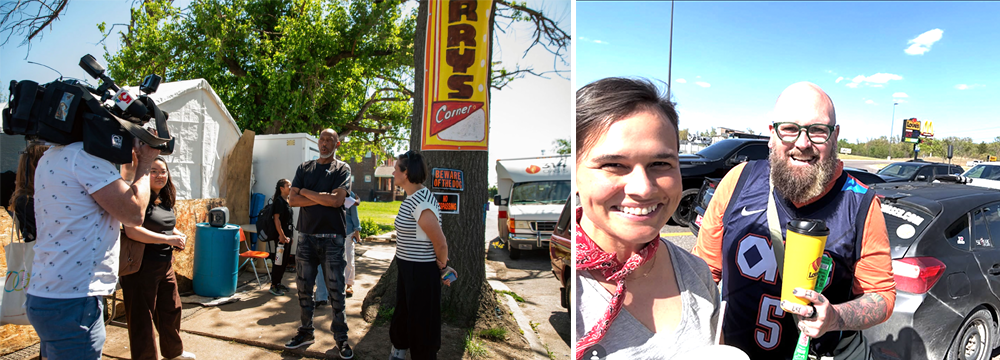
Left: Sarah Labowitz meets with local
community leaders to discuss impacts from
the May 2025 tornado that hit St. Louis,
Missouri. (Photo: Tyler Small)
Right: Sarah Labowitz with Edgar ONeal.
(Photo: Sarah Labowitz)
The second experiment centered on relationship building in locations key to her policy goals. Instead of spending $5,000 on a pay-to-play campaign to spread data about resilience and the May 2025 St. Louis tornado, for instance, Sarah spent a similar amount flying to St. Louis, Missouri, and hosting a dinner for creators, traditional media, and the local storm-affected community. A creator with a million followers reached out to work together, as did the local NPR affiliate and local news channel. After the trip, Sarah received nearly a dozen calls from St. Louis policymakers, creators, and local community leaders interested in further collaboration. Together, these experiments point to a different theory of how limited resources could be used in a new media space: Investing in relationships, shared interests, and trust yields ongoing opportunities to reach a wider audience and creates policy-relevant openings driven by momentum and organic growth.
1 Sarah Labowitz and Debbra Goh, “Can Mullin Revive FEMA?,” Carnegie Endowment for International Peace, March 24, 2026, https://carnegieendowment.org/emissary/2026/03/mullin-fema-disaster-recovery-funding.
2 Edgar ONeal, “Regardless of political affiliation everyone should be receiving equal help…”, Facebook, April 21, 2026, https://www.facebook.com/edgaroneal/photos/regardless-of-political-affiliation-everyone-should-be-receiving-equal-help-when/10164241881742760/.
Most institutional communications serve one of three missions: building an audience (expanding your “list” in terms of numbers or particular audience groups), raising the visibility of or educating the public about an issue, or mobilizing people to act. New media offers different potential strategies and tactics for each.
For organizations whose missions depend on mobilizing people at scale, the value of audience building is clear: It can help spur donations, calls, votes, or volunteering. Organizations previously connected with audiences through public events or field campaigns. But today, people have fewer real-world friends,11 join fewer organizations,12 and spend less time in shared public spaces.13 This is particularly true for young men,14 individuals who report low levels of trust in other people and in institutions,15 and those with less financial security or lower socioeconomic status.16 These audiences may not come to an in-person event, visit an institution’s online accounts, or see your op-eds.
Instead, they spend time in interest-based communities, group chats, podcasts, and algorithmic feeds where entertainment, identity, and belonging come first. Organizations need to go where people are—and that means showing up online. White nationalists who once recruited in record stores are now common on gaming platforms,17 because those spaces let them scale cheaply, expose gamers to their messages repeatedly, and build relationships over time. Prosocial organizations need to make the same conceptual leap.
Organizations need to go where people are—and that means showing up online.
Building a list is easiest if the goal is expanding reach among people who already agree with you. If your organization is trying to build engagement with audiences whose views and values diverge, the pace of your list growth and outreach strategy will necessarily differ—which is the topic of the next set of questions.
What to measure if list-building is your goal:
In the traditional media world, an issue became a shared societal reality via repeated, sustained coverage by media of record. Policy and advocacy organizations understood this. They learned to shape how an issue was framed and how salient it became by playing the media placement game strategically; no legislator could ignore an issue on the front page of a hometown paper.
That centralized information environment no longer exists. The media landscape has fragmented into algorithmically curated feeds in which no one knows what everyone else is seeing. Someone who clicks on a story about forest bathing may start seeing many more such stories in her feed without knowing whether anyone else is seeing them too—or in modern parlance, whether it is “a thing.” Because algorithmic amplification can also be strategically maximized, social platforms and advertisers can manufacture the appearance of a trend where none exists, creating the powerful impression that everyone is talking about an issue even when it remains fairly niche. Meanwhile, something real that is not being discussed online can sink into obscurity.
Still, some issues and trends do break through to broad swaths of the public: the current craze around increasing protein consumption, for example, or Formula 1 racing’s surge in popularity. What these tend to have in common is repetition both within and across networks—multiple creators and accounts in adjacent communities discuss, remix, and react to the same topic online, with reinforcement offline as well, until it becomes unavoidable. Amplification networks among creators produce compelling social cues of an active, important conversation in the way that front-page headlines do for traditional media consumers. That is why raising issue salience often requires reaching beyond your silo and into different networks.
For organizations, this changes what it means to “release” information. Publishing a report (or even a TikTok explainer of a report) is not the finish line. It is the raw material for the subsequent conversation in the internet’s video clipping and “content recycling machine.”18 The goal is to seed ideas that travel beyond your own channels so that they show up in other people’s language, in other people’s feeds, and in other people’s conversations. Doing that requires building relationships and distribution pathways beyond both traditional media and your existing base.
What to measure if issue salience is your goal:
If your goal is political or policy change, you need an engaged audience that you can call on to act. The size of that audience, who they are, and how credible you are with them shapes what kinds of change you can realistically make. A group that can help catalyze a million-person protest has a different mobilization capacity, and probably a different theory of change, than an organization that primarily operates by reaching fifteen senators on speed dial.
For organizations that rely on mass mobilization, whether they are simply seeking big numbers or are trying to mobilize distinct groups (such as veterans, mothers of young children, or people affected by a particular phenomenon), online activism should still follow a normal ladder of engagement that moves people from easy, simple actions to deeper and more intense participation. But in the current media environment, it should also generate belonging and visible social proof. For many highly online audiences, an action may not feel fully real until they see it reflected in the feeds of people around them. Offline action and online visibility therefore need to reinforce one another.
For those of us above a certain age, something was “real” if it happened in embodied life. For instance, in 2015 Renee was working on advocacy around a California public health bill. A small but highly organized group of anti-vaccine activists had mounted an aggressive opposition campaign.19 She tried to sound the alarm that anti-vaccine activists had far more reach and networked engagement than any pro-vaccine counterpart, but most of the institutional leaders of the public health community did not understand why “some people online” mattered. It took the COVID-19 pandemic to reveal to the healthcare field that the online world had real consequences offline. A highly networked, online anti-vaccine movement, it turned out, was well positioned to undermine trusted medical professionals, long-established institutions, and a century of public health progress.
Conversely, for people who are highly online, including generations who grew up sharing their lives on social media, actual activities done in the real world might not feel “real” until they see them posted on social media. Where once getting someone to sign a petition or attend a meeting was the first step on a ladder of engagement, now echoing that step online can help it feel more real, and thus lead to a second step. Offline events should be leveraged for online mobilization—and vice versa.
Offline events should be leveraged for online mobilization—and vice versa.
For organizations that see their audience as a small number of politicians or policymakers, mass mobilization—or any new media strategy at all—may seem like a waste of resources. If an organization already has access to and credibility with decisionmakers, why invest in the capacity to reach the broader public?
The answer is twofold. First, in some policy arenas, new media is clearly shaping public debate and influencing how elites respond. Consider how the Donald Trump administration has suddenly fast-tracked research on psychedelics for medical treatment, an issue that was pushed slowly but surely over the past two decades by a variety of mental health and other traditional advocacy groups but that has moved to the forefront of the administration’s policy agenda in large part due to the support of the creator Joe Rogan.20 Or consider the immense influence (which does not translate into factual accuracy) that online creators had on hastening the end of USAID.21
It is not just the Trump administration that is open to online influence: Advocacy organizations that understand the power of social media are using it to influence policy, as occurred with the successful creator-led campaign to get New York State to ban weight-loss and muscle-building supplements for minors.22 The genie is not going back in the bottle—the online space is a potent and essential space for influencing elite opinion, both directly and via constituents.
Second, for organizations with a more elite theory of influence, the ability to mobilize a public audience is increasingly a form of risk mitigation. At some point an institution may need to respond to an idea circulating online that upends their technocratic approach—or, sadly, a personal attack against the organization or an employee—and if that capacity does not already exist, then it will be too late to build it from scratch.
Politicians and policymakers still make policy decisions based on expertise and trusted relationships; keeping issues “under the radar” has been a time-honored technique for lobbyists and advocates. But public dynamics on new media can abruptly shift the behavior of politicians and policymakers. A topic going viral may mean that a once-obscure issue can quickly and unpredictably generate mass public outrage—particularly if opposition forces want to make this happen, or if creators frame it (accurately or not) in ways that catch the public’s attention. The public concern about the health effects of seed oils, for example, may have seemed to come on suddenly to many manufacturers and farmers. But the concern had been building online for years. Industry groups may have wished they had noticed it earlier and built an online constituency of their own that they could mobilize before the new nutritional pyramid was published or the farm bill passed. Issues such as foreign aid have similarly been plucked from technocratic obscurity into high-salience public debate. Once an issue becomes a topic of mass interest, policies long viewed as part of the technical realm may be catapulted into the world of politics, where a very different decisionmaking logic prevails. For an issue that is suddenly political, insider strategies alone will not suffice.
There is also occasionally the need to counter one of the serious negative externalities of social media: public vilification campaigns. Election workers, universities, charitable foundations, public health institutions, scholars, and a broad swath of nonprofits have all experienced sudden online pile-ons. Online smear campaigns intentionally erode trust in an institution or individual. Organizations and their employees find their goals questioned and their characters besmirched. Funders distance themselves, organizational leaders face incredible stress, and institutions may even need to suddenly address the physical security of their offices and staff.
A vilification campaign can destroy a reputation built over decades and upend an elite-driven, senators-on-speed-dial strategy of influence within days. Having a trusted public audience and validators who can respond quickly to counteract reputational harm is increasingly essential—even (and, maybe, especially) for policy-focused organizations that can now expect pushback to their policy ideas to come not only through genteel policy debate but also, too often, through online attempts at reputational destruction.
What to measure if mobilizing action is your goal:
In the 2004 movie Mean Girls, a teenager who spent her childhood being homeschooled in Africa has to enter an American high school and quickly figure out the social rules to fit in and eventually dominate the hierarchy—leading her to multiple flashbacks of primates in the wild. New media spaces operate much like high schools or the savannah. Every issue area has an existing ecosystem of creators, audiences, norms, and gatekeepers. An organization that charges in without understanding the terrain is likely to waste resources or provoke backlash.
Based on the audience an organization wants to reach and the goals it has with that audience, organizations might need to enter spaces where politics is largely absent or arenas where hostile gatekeepers actively police ideological boundaries. We identify four broad types of ecosystems, each of which demands a different strategic approach.
Many cultural content areas—such as fitness, cooking, parenting, fashion, gaming, and weather—are populated by creators with broad, cross-partisan audiences. Because they often rely on brand or business sponsorships to make a living, even creators who strongly agree personally with a cause may be cautious about alienating audiences or jeopardizing contracts. As Michael Jordan once demurred after being asked to support a Democratic candidate, “Republicans buy sneakers, too.”23
Breakthrough moments do occur: A wave of cultural creators expressed political messages after U.S. immigration officers’ killing of Alex Pretti in January 2026, for example.24 One study suggests that such creators may have more impact precisely because they speak up so rarely25—though research is too thin for definitive claims.
Organizations engaging with these creators must find ways of communicating ideas that resonate with a creator’s existing content and audience without triggering partisan identity. For instance, Americans for Family Values, a cross-issue advocacy organization, tapped into existing nonpartisan networks on college campuses to create the Butterfly Collective, which gives young college women the resources and trainings to create content that promotes freedom and feminist ideas and that draws aesthetically on a variety of forms of cultural content preferred by young women.26
Using curiosity rather than authority is often good practice for engaging apolitical audiences and getting them to think about a topic. For advocacy efforts, layering curiosity with emotional and aesthetic clues can push an audience’s thinking toward fear or comfort, or a sense of something being morally positive or negative. Consider how common this technique is in clickbait headlines, such as “are your cleaning products safe?” appearing in foreboding black lettering layered atop a picture of a dark broom closet in order to raise viewers’ emotional intensity and interest in what comes next while not-so-subtly shaping the directionality of emotion.
If your issue has not yet been coded as left or right, your best chance of building a large audience may be to keep it that way. Frame the issue around a shared individual concern, offer practical actions that regular people can take, and build broad cultural momentum before the issue hardens into overt partisan conflict. By the time opponents organize, a base of support is already in place. This was the strategy of the global movement against children’s smartphone use, which achieved remarkable policy change in under two years (see the Jonathan Haidt case study in box 3).
The anti-vaccine movement similarly focused on individual concerns, building grassroots momentum in parenting communities before leapfrogging into policy. By the time public health organizations recognized the threat, it was already powerful. The movement’s political valence has flipped over time; while early identifiers leaned left, it became increasingly linked to right-wing political identity beginning in 2015 as network-building efforts most successfully engaged right-leaning political activist communities.27
An issue that appears nonpartisan can become polarized quickly if partisan actors see value in claiming it, or if an organization’s own framing purposefully or inadvertently triggers ideological sorting. Organizations operating in non-polarized spaces should watch closely for early signs of politicization or capture of an issue by a partisan side and decide in advance how they will respond if it happens.
Organizations operating in non-polarized spaces should watch closely for early signs of politicization or capture of an issue.
Social psychologist Jonathan Haidt published several popular, scholarly books throughout his career. But his 2024 book The Anxious Generation, which argued that smartphones and social media harm kids, started a cultural moment. After its release, he was flooded with thousands of emails from parents, teachers, and others urgently looking for solutions. The book tapped into a widely felt, underaddressed cultural concern. But Haidt made deliberate choices that turned his idea into a social movement that created speedy political change worldwide. His experience not only illustrates how to operate in an undefined space but also offers broader lessons about content creation, audience building, and the relationship between cultural momentum and policy change, lessons that apply across the questions discussed in this section.
Decision 1: Provide solutions that empower regular people without engaging partisan identities.
Partisan actors had not staked out territory on the issues raised by The Anxious Generation. Entering this nonpolarized space, Haidt avoided framing the problem in ways that would implicate Democrats or Republicans. Instead, Haidt found a shared antagonist in the big social media companies such as Meta and TikTok, a message that resonated with both the left and right. His solutions avoided polarizing language and policy proposals. He focused instead on cultural shifts that could be enacted by parents and schools, not just elites or policymakers. He framed the response in four concrete, actionable ideas, each offering people who felt powerless a way they could act on the problems affecting their kids and communities.
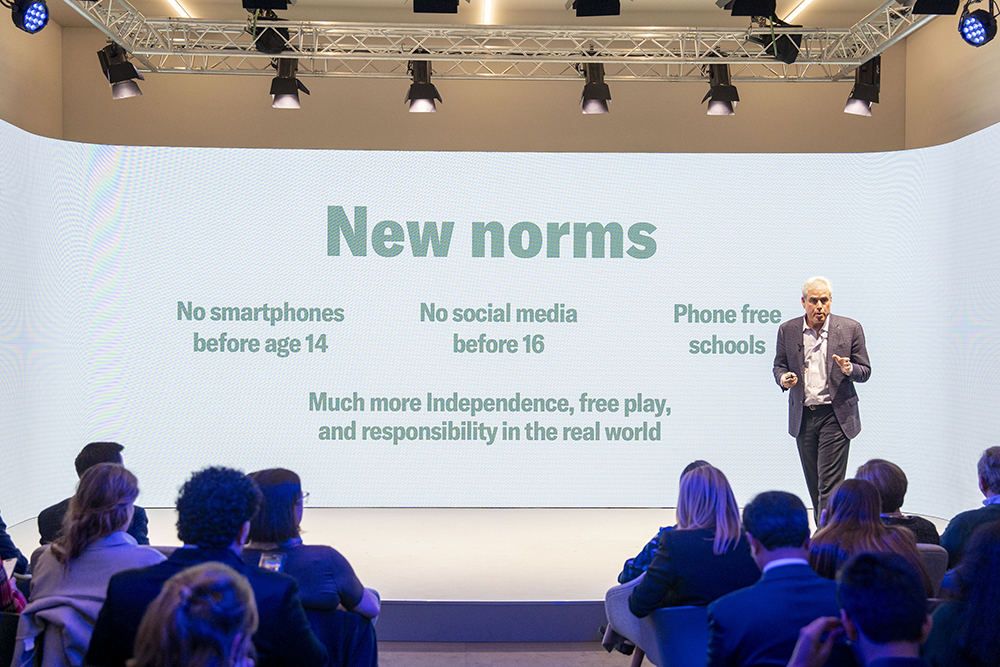
Jonathan Haidt speaking at the World Economic Forum Annual Meeting 2025 in Davos-Klosters, Switzerland. (Photo: World Economic Forum / Valeriano Di Domenico)
Decision 2: Invest in communication infrastructure that comes across as personal.
Ahead of the book’s release, Haidt invested his own money in a professional public relations firm, which helped him hire a chief of staff. Eventually, they built a small communications team to manage social media, email, and brand outreach. Haidt personally engaged with the new media space by appearing on podcasts and X and by launching a Substack a year before the book’s release. His team engaged on other platforms as if they were him, maintaining his voice: a tone that was accessible but expert. This allowed Haidt’s persona to be heavily present on social media in a way that appeared personal, not institutional, while he himself could maintain time for thought leadership.
Decision 3: Mix highbrow and popular communication, online and offline, to maximize reach.
Haidt’s media strategy combined highbrow platforms like The Atlantic (which published the article that garnered the single most attention) with popular venues like People magazine. Offline, his message spread through grassroots communities: book clubs, parent-teacher associations, mom groups, and faith groups. Haidt’s team fueled this organic momentum by carefully strategizing about speaking engagements, offering that Haidt would speak for free if a parent, school, or organization that reached out could gather a large enough group of leaders. For example, Haidt almost never spoke at an individual school, but he did many video calls and a few in-person events for dozens or hundreds of school principals or superintendents at a time. This strategy maximized Haidt’s time while turning supporters into organizers who further spread his ideas.
Decision 4: Prioritize authenticity over name recognition or paid promotion.
Haidt’s team has not paid for social media or celebrity endorsements. While the book benefited from organic engagement from celebrities such as Jessica Seinfeld, the team members felt that paid or celebrity campaigns could feel inauthentic and thus be counterproductive. They favored microinfluencers: engaged creators with more modest followings (around 20,000 followers) and personal passion for the issue. These invested creators gave their original spin to the movement’s ideas, even generating viral video trends.1 The team then amplified this “woman on the street” content, which had credibility and authenticity that Haidt’s expert voice could not convey.
Decision 5: Start with culture to generate policy momentum.
Haidt knew his ideas had hit the cultural mainstream when organizers and creators mentioned his ideas without referencing Haidt or his work. Partially because of The Anxious Generation, parents, teachers, and communities around the world formed collective action groups that pushed for their schools to limit phone use.2 They found support among crucial, organized constituencies that previously had been silent. Teachers in particular did not want to compete with phones for student attention. In less than two years, nineteen U.S. states, both red and blue,3 along with multiple countries,4 enacted phone-free school policies, while Australia led a wave of countries raising the age for creating social media accounts and putting the onus on companies to police the policy.5 Haidt and his team assisted these policy efforts when asked. But their choice to engage a cultural strategy built support for major policy change before opponents (such as tech companies, experts who disagreed with Haidt’s conclusions, internet freedom organizations, or the community of parents who feared having no access to their kids during the school day) could organize.6
1 For example, see Saltproject.co, “I Sent My 7yr Old Into Chick-Fil-A Alone . . . ”, post on Instagram, March 20, 2025, https://www.instagram.com/reel/DHcdp86RZz4.
2 “Aligned Organizations,” The Anxious Generation, accessed February 27, 2026, https://www.anxiousgeneration.com/aligned-orgs?type=Collective+Action+Org.
3 “State Policies,” The Anxious Generation, accessed Feb 27, 2026, https://www.anxiousgeneration.com/policy-state-map?topic=phone.
4 Katherine Martinko, “Several Countries Limit Digital Media for Kids,” The Analog Family, September 14, 2024, https://katherinemartinko.substack.com/p/several-countries-limit-digital-media.
5 “From Australia to Europe, Countries Move to Curb Children's Social Media Access,” Reuters, June 8, 2026, https://www.reuters.com/legal/government/australia-europe-countries-move-curb-childrens-social-media-access-2026-06-08.
6 Internet freedom organizations are concerned, for instance, that requiring ages on websites could lead to further information verification and are engaged in belated advocacy efforts, but the momentum of the issue was captured by Haidt. For more on these organizations’ concerns, see “Age Verification and Age Gating: Resource Hub,” Electronic Frontier Foundation, accessed June 24, 2026, https://www.eff.org/issues/age-verification.
Building an audience in an arena where your ideology is dominant poses its own challenges. A significant one is the scarcity mindset: Nonprofit organizations working in the same arena often jockey for funding instead of collaborating to boost a shared goal; creators and organizations in the same space may view newcomers as competition for a finite audience’s attention.
That impulse can limit the reach of the field as a whole. A better strategy is to look for ways you can mutually benefit the ecosystem. Cross-amplification can expand everyone’s reach. Making cross-posts or collaborative posts with organizations in adjacent issue areas can build new networks: An anti-corruption message piggybacking on the World Cup, for example, might break through to sports fans who know something about corruption’s effects on their game.
Spreading your message to adjoining communities has multiple benefits. It expands your organization’s audience. It also gives you a niche that might make it more interesting for bigger names in your own space to cross-pollinate with you. And the alternative perspectives gained from such collaborations can help guard against another very serious pitfall of operating in a space where your view is dominant: the echo chamber. An organization that assumes it holds ideological dominance can miss a flanking challenge from an unexpected quarter. For instance, in 2024 some organizations were targeting Black men with messages that assumed that their demographic identity made them Democratic Party voters. But these organizations missed a cultural shift building outside their field of vision: A growing percentage of Black men, particularly from immigrant communities, were leaning toward voting Republican.28 Reaching beyond an organization’s normal community is not just a growth strategy—it also can be a sentiment signaler and an early warning system.
If your organization is trying to present an alternative view in an area that is already polarized and occupied by an existing network of creators who know one another, those gatekeepers will be arrayed against you. This is not a neutral space where the best arguments win. Instead, it is more like a river of fast-flowing claims (some true, some not) sweeping followers into a politicized cultural arena on purpose. Any attempt to offer an alternative viewpoint is a direct challenge to the highly networked gatekeepers who maintain the current.
A single boat will not be able to row against such rapids alone. Trying to do so will provoke attack. The David French case study in box 4 illustrates what this looks like in practice: Respected leaders with decades of traditional credibility were vilified with online smear campaigns, their reputations were weaponized against them, and their audiences were poisoned before they could make their case.
The strategic implications are significant. Well-known personalities might be especially vulnerable: Years of public appearances, writing, and speeches provide a broad surface to mine for ammunition that can be used against them. Long-term thinking is needed. Organizations might consider building networks of fresh voices who can build trust from the start with a less polarized audience. While feminists could attack conservative activist Phyllis Schlafly in the 1980s by pointing out personal hypocrisy over her long career, hundreds of young women saying they are “just asking questions” on web forums and appealing to tradwife aesthetics on video platforms in the 2020s are much harder to discredit.
But long-term network building is not enough on its own. Organizations also need the capacity to respond when attacks come: to correct the record, mobilize validators, and draw support from adjacent networks and credible creators. Strategic partnerships with creators who have credibility in the hostile space, or adjacent to it, can provide crucial support during moments of attack. The institutional playbook for these situations remains largely unwritten, and engaging successfully requires more experimentation. (In the third section of this paper, tip 9 addresses response tactics in more detail.)
Funders should consider these realities when evaluating strategy. Contesting hostile spaces is expensive, slow, and uncertain. But the cost of leaving them uncontested is often also very high. Success in these environments should be measured over multiple years, not twelve-to-eighteen-month grant cycles.
Table 2 overviews the four types of social media spaces and what strategies succeed in each one.
David French and other highly regarded Christian commentators launched The After Party, a multimedia curriculum, aiming to build a Bible-based, pluralistic path for Christians to engage with the public sphere without falling into partisan divides. The creators found great success spreading the curriculum through traditional religious institutions and churches. Through these in-person and institutional venues they reached nearly 200,000 people, many of whom were religious leaders who served as force multipliers, spreading their curriculum even farther through their local congregations. But when the project’s leaders tried to use social media to spread their ideas to the evangelical public, far-right gatekeepers vilified French and his collaborators and blackballed the curriculum. Their experience offers important lessons for nonpartisan groups whose credibility rests on traditional forces of legitimacy and who are attempting to engage highly polarized debates and communities online.
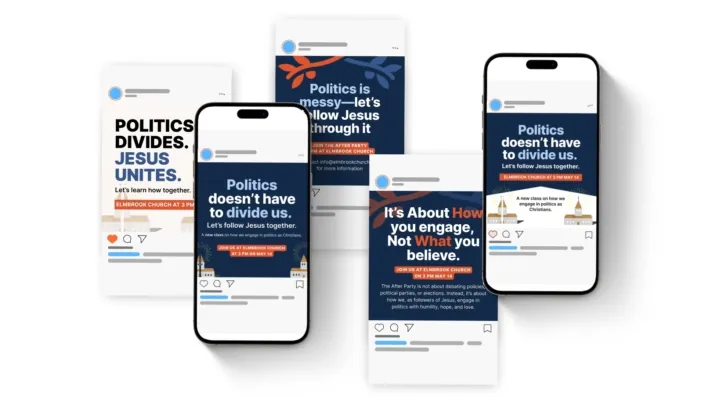
Good Faith provides a variety of resources to encourage groups to share The After Party course. (Photo: Good Faith)
Lesson 1: Hostile gatekeepers pursue character assassination to kill ideas.
French and his cocreators were among the most highly respected pastors and leaders of evangelical institutions. But online, a set of new networked gatekeepers with a far-right outlook had gained control over the evangelical conversation. They attacked The After Party, declaring that its attempts to avoid partisanship were stealth progressivism. They launched character assassinations against French, using his past writings to label him a heretic and a “wolf.”1 Many evangelicals trusted the judgment of these partisan gatekeepers, whose baseless accusations unleashed an online mob that further vilified the previously respected Christian leaders behind The After Party.
Reflecting on the experience, French suggested that a well-known and traditionally respected leader might be the opposite of what is needed when entering a highly polarized and partisan arena. Instead, it may be better to build new or depolarizing ideas with unknown personalities so that the content can speak for itself.
Lesson 2: Once attackers organize into a network and amplify one another’s views, it becomes significantly more challenging to persuade or win those audiences.
French initially thought it would be possible to rebut mischaracterizations by highlighting The After Party’s actual content. Knowing that many people engaged positively with the curriculum before they were told that it was heretical or stealth leftism, he reached out to the hostile influencers and tried to join them on their podcasts. The hosts, however, were uninterested in good faith conversation. They did not exist to educate or persuade, but to mobilize a base. Engaging directly with these partisan and polarized networks was a waste of time, French concluded.
Lesson 3: Altering polarized or partisan spaces cannot be done through singular programs or campaigns; it requires building a fresh network to “change the course of the cultural river.”2
The After Party was not entering a neutral space where the best ideas win. Instead, organizations with alternate views entering polarized spaces face an inevitable fight. They should enter armed to win: with their own online audiences, validation networks, and tactical plans to counter the inevitable battle that will follow.
1 Author interview with David French, Zoom, July 29, 2025.
2 Author interview with David French, Zoom, July 29, 2025.
Once you have identified your mission and analyzed the social media ecosystem shaping your target topics and audience, the final question is how to create and distribute content that reaches them. There are three broad methods: creating content within your organization, relinquishing control to creators who have no ties to your institution, or cocreating with existing influencers.
Each method has different implications for speed, cost, control, and audience reach. An organization focused on deepening engagement with its existing base may find that in-house content creation is sufficient, while one trying to persuade Americans who think differently in cultural spaces may decide to relinquish significant control to creators who understand those audiences. Sometimes, larger organizations will use a combination, while smaller organizations might start by experimenting with one approach. Organizational leaders can consider the relative risks and benefits of each for specific situations.
Most organizations start using new media by repackaging existing content into new formats and posting to institutional accounts. This is a useful first step: It expands distribution channels, gets staff comfortable with new formats, capitalizes on algorithms that reward active accounts, and creates a baseline social presence for people to find.
Building capacity in-house also yields benefits over time. It can help your organization stay on top of trends in format. It can also help an organization develop a sense of timing—releasing content when an issue is trending and being rewarded by the algorithm, for instance, rather than only when a new report happens to be finished and ready to go.
But creating content that reaches beyond your existing mailing list requires real investment. Creators spend significant amounts of time figuring out what does well and when. For an organization to engage in new media at any serious level, it likely needs to create designated new media jobs that can work with experienced creators, rather than expecting existing staff to perform a different profession on top of their existing jobs. An organization could hire consultants to advise on new media policy, have a content creator on staff, or have experienced staff manage partnerships with other creators.
These choices affect other roles in the organization: If a creator is brought on staff to make in-house content, that content will probably be institutionally branded, and thus needs some form of review. But content creation moves fast—who will be able to drop their work multiple times a day to approve outputs and ensure legal and tax rules are followed? Organizations will need to consider how to make their review processes speedy and efficient. Safeguards such as ensuring legal compliance are essential, but after that, organizations should prioritize striking the right balance between timeliness and authenticity over perfection.
Organizations also need to decide who, exactly, will be the face of their content. New media favors the personalities, charisma, and points of view of individuals; institutional accounts get far less traction. Many organizational CEOs will find it challenging to succeed as an organization’s front person in new media. They may struggle to come across as authentic and noninstitutional, unless they prioritize building familiarity and skills or are a new media native. Institutions may instead choose designated spokespeople, fellows, or staff members or invest in communications infrastructure that helps leaders and experts appear in a more personal voice across platforms (a tactic we describe in box 3 about Jonathan Haidt). These choices might impact the type of media training offered to staff.
The native tone of the internet is uncomfortable for most organizations. Content with profanity, memes, inside jokes, and sharper or edgier vibes frequently travels faster and further than the kinds of communications most institutions are willing to publish under their names. Relinquishing control is any strategy that involves providing information to creators and letting them run with it. Counterintuitively, this can reduce organizational brand risk; the institution is helping to inform the conversation but is not responsible for the content that emerges.
In practice, this can be as simple as inviting a group of creators to regular briefings, emailing them updates, or paying travel costs for them to attend events. It can also entail simply not getting involved.
In many ways, this model is similar to briefing or pitching traditional media. It is relatively low cost, because the main investments are relationship building, coordination, and trust. But it may also be low reward, as the organization builds no owned audience and has little control over the narrative. This strategy can help information reach the public, but it is not well suited to building an organizational brand or audience to activate when needed. While in most cases we caution against using the number of pieces of content created or the times a piece of content is viewed as primary metrics of success, they are relevant to this strategy. For instance, if an organization briefs a group of creators and can show that, in the following week, those creators discussed the issue more frequently than a comparable group that was not briefed, that can provide some evidence of impact.
Cocreating content offers the possibility of leveraging each side’s strengths—but if structured poorly, it can also deliver the worst of both worlds. Ideally, the organization brings subject-matter expertise, while content creators bring what is now a professional skill set in media production: knowledge of how algorithms boost content, instincts about posting cadence, thumbnails and pacing work, and experience operating across multiple platforms. They also—crucially—serve as endorsers, bringing the trust of existing communities that an organization can engage.
The first question in choosing what kind of creative partner you want to work with is: ideological or cultural? The Brennan Center for Justice, which works on a broad swath of civil rights issues, recently partnered with V Spehar, the creator from Under the Desk News who explains political and cultural developments to over 4 million followers across platforms. As a content creator ambassador, V’s content referencing the Brennan Center’s work and priorities on Instagram and TikTok will reach many more people than Brennan’s website would. By choosing an ideological partner instead of a cultural one, the Brennan Center is expanding its reach and spreading quality information. However, it is likely to be reaching a largely politically aligned audience and building a bigger megaphone, not persuading skeptics.
Recognizing the limits of solely working with political creators—which gave the Brennan Center depth with an already engaged base but little breadth into politically disengaged audiences—the center’s second cohort of ambassadors is more diverse. By expanding to include creators across a wider range of identities and interests, spanning health, lifestyle, history, culture, and comedy, the Brennan Center is trying to mobilize cultural influencers to better reach cross-partisan skeptics aged eighteen to thirty-five, a group notably underrepresented in their social media following, as well as audiences who have tuned out political content altogether.29
The second question is scale: Macroinfluencers with large followings can garner millions of views, but often less intimate connections with their audiences—as their audience sizes climb, they begin to function more like celebrities. The biggest whales, like MrBeast, have little need for partnerships; working with them is more like hiring a major speaker for a corporate conference where an organization pays for some level of interaction or access, but it will not develop into a deeper relationship. Microinfluencers vary greatly—some may just be less effective content creators with little reach. But research shows that others who have chosen to cultivate a close-knit, if smaller, community also enjoy deep relationships with their audiences.30 They may have smaller audiences but more persuasive potential. Influencers in the middle of the pack (like Edgar The Storm Chaser) may have more hunger to expand their audiences and be more open to discussing how a partnership can give them an edge.
Once you know the kind of creator you want to work with, there are several models for engaging.
Pay-to-play. One model is to work through agencies or nonprofits that act as intermediaries between organizations and creators. These firms aggregate groups of creators across political or cultural content areas (or both) and broker relationships. Creators are usually paid or are kept on retainer by the agency for producing content or boosting advocacy campaigns. The intermediary may simply pay creators by the piece of content or viewership of content alone, or it may provide its creators with production or amplification assistance. Sometimes the creator and the organization create the post together, with a negotiated number of rounds of back and forth around content production. In other cases, the organization offers a set of ideas to the intermediary, which might itself message test and then ask creators to publicize specific messages based on its findings.
Pay-to-play can be a fast and simple model for organizations to dip a toe into social media. It can be a useful way to spread a simple message (“vote on Tuesday!”) quickly across a broad audience. But it can also be expensive, labor intensive, and slow. Simply signing a contract can take weeks. For models where the content is approved by the contracting organization ahead of time, the rounds of back-and-forth content negotiations can take days. That is a problem for organizations that want to be responsive to current events and online trends that move in hours, and a source of frustration for creators who usually have a better sense of what an algorithm will reward than their client does. Some creators are also increasingly angry at the gap between what firms are paid and the tiny fraction that is passed on to creators. Perhaps most importantly, pay-to-play also builds no lasting equity: Once the contract ends, the organization may have only a limited growth in its own audience.
It is worth noting that in the political and advocacy realm, some payment models and messaging restrictions have generated controversy.31 Nonprofit organizations must be wary of the tax laws on political speech, particularly as the legal realities of this space are not clearly defined. For political campaigns that have disclosure rules, secrecy may itself be a problem. For their part, some creators quite reasonably fear that certain contract models that require more approval will result in a loss of authenticity, ownership over what they say, and trust with their audiences. Controversies have arisen across the political spectrum regarding influencer disclosure, from an instance where the House Oversight and Government Reform Committee subpoenaed one organization and some of its customers to a creator uproar regarding secrecy requirements in contract relationships.32 Transparency and disclosure are key for creator-organization relationships.
The pay-to-play model can be useful as a starting point for raising issue salience and for simple informational campaigns. It can be useful as an occasional supplement, such as by strategically leveraging the expansive ecosystem of accounts and services that exist to “clip,” repost, and amplify existing pieces of content at key moments for added distribution. But it is a weak default for organizations that want to build their own audience or mobilize supporters. It is expensive, slow, and builds no ongoing audience—as NewWorld CEO Andre Banks wrote, “rented reach doesn’t compound.”33 At its worst, it forces a trade-off between substance and effectiveness: Either the organization’s expertise gets flattened in translation, or the creator loses the freedom to make content that actually resonates with an audience and travels well online.
Fellowships, ambassador programs, and other contractual relationships. Organizations can build relationships by hiring creators or influencers directly themselves as ongoing partners, rather than for a single campaign. These relationships can take many forms. Short-term fellowships can help an organization gain knowledge of the personalities of different creators, learn best practices, benefit from the audiences and skill sets of multiple creators, and eventually engage more deeply with one or many. Ambassador programs or a variety of contractual relationships might involve long-term support in exchange for creators producing a certain amount of content each month (which may or may not be co-branded or collab posted). Long-term partnerships might involve the creation of a major piece of content such as a long-form YouTube video or podcast series.
These arrangements require more up-front work around payment, expectations, and oversight. But over time they reduce friction. Both sides learn how the other works, creators become more familiar with the issues, and content can move more quickly when a moment arises. These relationships can also generate secondary benefits such as organizational audience growth and amplification, because creators within a field often know one another and may help spread one another’s work organically.
Values-aligned creator labs. Labs may help organizations gain more of the benefits with fewer of the risks of cocreation. These are communities of values-aligned creators within a particular field—mom influencers, veterans, Christians, young women—that form amplification and collaboration networks. Organizations may host creator labs internally or work with outside creator labs through arrangements that resemble pay-to-play models but offer deeper values alignment, efforts to build community and amplification networks, and, ideally, clearer oversight of tax-law compliance.
In these models, creators typically retain message control while receiving fact sheets, production support, community, amplification, or stipends. The creator labs build real relationships with and among the creators and provide meaningful support, allowing creators to focus on the more fun parts of their profession, such as connecting with their audiences, and to spend less time on sourcing and cutting video. Sometimes creators join solely for the production benefits; in other cases, the lab may pay a stipend in exchange for a quota of content. This model shaped the ambassadors program of Turning Point USA (TPUSA) (see box 5), and is also being tried by groups such as Public Democracy, Americans for Family Values, and Valor Media Network.34
By putting creators in control and using their existing amplification networks, creator labs are more organic to new media work styles than pay-to-play contracts are. Creators can use their speed and knowledge of audiences and algorithms to make desirable content, while organizations share subject-matter expertise with aligned creators. Creator labs that have quotas often claim that their influencers regularly exceed these metrics because of intrinsic motivation and alignment with the values of the organizations they work with.
Turning Point USA (TPUSA) is the largest conservative youth activist organization in the United States. Founded in 2012, it made $85 million in revenue in 2024,1 when it had chapters on more than a thousand college campuses. TPUSA has content production arms in traditional and new media, an event production arm, and large operations as a political ground game in battleground states.2

Charlie Kirk speaks at the 2020 Student Action Summit hosted by Turning Point USA at the Palm Beach County Convention Center in West Palm Beach, Florida. (Photo: Gage Skidmore)
TPUSA illustrates how a single organization can combine audience strategies and content creation methods. It first chose to engage very like-minded people as its staff by developing a multimedia hub for its founder, Charlie Kirk. It then tried to organize more people who shared its politics by hiring right-wing political influencers with preexisting large followings. Finally, it moved to a persuasive cultural strategy, hiring athletes, musicians, comedians, and hobbyists who would infuse lifestyle content with a right-leaning slant. These strategies involved in-house hires and co-creation partnerships. But it also relinquished control by building an ambassadors program for hundreds of influencers who can spread their own content without oversight.
Decision 1: Focus on personality, not institutional affiliation.
Charlie Kirk, founder and CEO of TPUSA until his horrific murder in 2025, appeared frequently in traditional media, hosted a podcast and live radio show, and engaged 100 million people per month (according to TPUSA’s count).3 Kirk’s name was synonymous with Turning Point USA, and his expanding reach also built the organizational brand. But TPUSA chose to build an even bigger megaphone by hiring then–rising political influencer Candace Owens in 2017 and quickly promoting her to communications director.4 Though connected to TPUSA, she spoke as herself in media and grew her personal brand and platform, rather than subsuming herself within TPUSA’s institutional brand.
Decision 2: Wrap the political in the cultural; focus on content consumption, not demographics.
In 2019, TPUSA started its Influencer Media Program by hiring an array of full-time conservative talking heads to build a bigger politically inclined audience.5 The organization’s leaders hired political influencer Benny Johnson as the chief creative officer and explained that the influencer program was seeking “current and potential thought leaders and personalities” to “saturate social and traditional media markets” with their messages.6 The program was successful at meeting its goals: Benny Johnson and Candace Owens themselves became mega–political influencers.
But over the next few years, TPUSA shifted from hiring more political personalities to a persuasion strategy, using culture to reach new audiences. It offered stipends or salaries (up to six figures7) to a lineup of creators that included a female wellness influencer, a young woman athlete, a Black police officer, a comedian, a Jamaican Olympian, a Black Christian rapper, and an outdoors lifestyle influencer. Most of these lifestyle creators are good looking, have followings in the high five to low six figures, and foster strong connections with their audiences. By 2024, Kirk was telling the New York Times: “Win the culture, win the country.”8
Decision 3: Build influencers at a variety of follower levels and cross-pollinate to amplify.
In addition to hiring people to create content in-house, TPUSA also engaged in cocreation partnerships—such as a 2023 partnership with Candace Owens (after she left the staff) in which she merged her project focused on Black women into TPUSA’s branding and corporate structure to amplify both.
Perhaps most successfully, TPUSA relinquished control through an ambassador’s program (which it periodically rebrands) to build out a large new generation of influencers. Under this program, TPUSA identified high-potential college students and other microinfluencers with aligned ideology and offered them free trips to TPUSA conferences, speaking opportunities on college campuses, and collaborations with the TPUSA production team.9 TPUSA built these ambassadors into a networked community: They, along with the on-staff influencers, repost each other’s work and cross-pollinate on one another’s platforms. TPUSA’s public relations team also pitches them to television and radio shows and showcases them at TPUSA events, raising their profiles. This low-cost strategy—similar to a values-aligned creator lab, but built in-house—yielded high rewards: By 2021, TPUSA reported 275 unpaid brand ambassadors with a shared reach of 70 million social media users.10 As Kirk told the New York Times, “We made long-term investments in creators and in influential voices that we believe will be the opinion shapers of tomorrow.”11
Decision 4: Constantly produce new content.
In-person TPUSA events are also optimized for picture and video content online. Ambassadors are given stipends to attend these events, where they are trained and expected to pump out content without organizational oversight.12 Full-time influencers are on payroll five days a week to churn content to their followers. The organization produces thousands of videos ranging from one-minute clips to ten-minute pop culture analyses.
Decision 5: Build an attitude and an aesthetic—ideally one that is attractive and popular.
TPUSA leapfrogged existing organizations for young conservatives by focusing on attitude and tone. In contrast to conservative conferences like the Conservative Political Action Conference, TPUSA hosts high-production events with dry ice and pyrotechnics billed as multiday parties. These events, full of music, dancing, and entertainment, create a sense that TPUSA is not just “an army of like-minded peers across the nation”13 but a winning team and a fun place to spend a weekend. Far from the khaki-and-bow-tied young conservativism of the 1980s and 1990s, there is a strong focus on physical beauty, especially among the women—as wellness influencer Alex Clarke noted at TPUSA’s 2025 Young Women’s Leadership Summit, “Look around this room, let’s just be honest. It’s never been hotter to be a conservative.”14 Crazy after-parties, rumored hookups, and even a well-publicized fistfight offer a bad-boy, countercultural vibe that has spread throughout the conservative movement and is particularly attractive to young men.15 Frequent online spats between conservative factions generate a reality TV–style dynamic with emotion, characters, and a story that draws in a much broader audience than those just engaged ideologically.
In the new media world, aesthetics and attitude are not adjuncts to the organizational message. They are a core part of TPUSA’s institutional tone and how it spreads into new portions of the social media world that are reached first by a vibe of popularity, beauty, and the appeal of something countercultural and outside the mainstream. Ideology, partisanship, and policy follow in the wake of this culture-first audience engagement.
1 United States IRS, Turning Point USA Inc (Form 990), 2025, https://projects.propublica.org/nonprofits/organizations/800835023.
2 Kristen Holmes and Alayna Treene, “Donald Trump’s Ground Game Strategy: Rely on Help from Outside Organizations like Turning Point,” CNN, June 15, 2024, https://www.cnn.com/2024/06/15/politics/trump-campaign-turning-point-charlie-kirk.
3 “Press Kit: Turning Point USA,” Turning Point USA, May 2025, https://backend.tpusa.com/wp-content/uploads/2025/05/TPUSA-Media-Kit-2025.pdf.
4 Joesph Guinto, “Trump’s Man on Campus,” Politico Magazine, April 6, 2018, https://www.politico.com/magazine/story/2018/04/06/trump-young-conservatives-college-charlie-kirk-turning-point-usa-217829.
5 “Influencer Media,” TPUSA, archived November 15, 2020, https://web.archive.org/web/20201115114839/https://backend.tpusa.com/influencermedia.
6 Joe Concha, “Daily Caller Reporter Benny Johnson Joining Turning Point USA,” The Hill, February 6, 2019, https://thehill.com/homenews/media/428814-daily-caller-reporter-benny-johnson-joining-turning-point-usa; and “Influencer Media,” TPUSA, archived November 15, 2020, https://web.archive.org/web/20201115114839/https://backend.tpusa.com/influencermedia.
7 United States IRS, Turning Point USA Inc (Form 990).
8 Shane Goldmacher and Ken Bensinger, “Republicans Built an Ecosystem of Influencers. Some Democrats Want One, Too,” New York Times, November 28, 2024, https://www.nytimes.com/2024/11/28/us/politics/democratic-influencers.html.
9 Makena Kelly, “Turning Point Is Quietly Building the Next Generation of Conservative Influencers,” The Verge, January 5, 2022, https://www.theverge.com/2022/1/5/22868483/turning-point-charlie-kirk-republican-influencers-instagram-today-is-america.
10 “Winning America’s Culture War: 2021 Investor Prospectus,” Turning Point USA, 2021, https://www.documentcloud.org/documents/21091980-turning-point-usa-2021-investor-prospectus.
11 Goldmacher and Bensinger, “Republicans Built an Ecosystem of Influencers.”
12 Kelly, “Turning Point Is Quietly Building the Next Generation of Conservative Influencers.”.
13 “Press Kit: Turning Point USA,” 2025.
14 Meher Ahmad and Jessica Grose, “Why the Right Is Obsessed with Thinness,” New York Times, July 30, 2025, https://www.nytimes.com/2025/07/30/opinion/christian-influencers-diet-culture-women.html.
15 Will Sommer, “The Brawl Heard Round TPUSA,” The Bulwark, August 18, 2025, https://www.thebulwark.com/p/the-brawl-heard-round-tpusa-maga-melee-scrabble-gravel-fight; and Philip Wegmann, “Turning Point USA Struggles with Allegations of Student Sexual Assault, Harassment,” Washington Examiner, June 20, 2018, https://www.washingtonexaminer.com/opinion/2604060/turning-point-usa-struggles-with-allegations-of-student-sexual-assault-harassment.
Many communications professionals, particularly those native to new media, know what needs to be done organizationally—but have a hard time convincing managers trained in legacy media or organizational leaders and funders who are unused to this new landscape. The following ten rules of thumb can help bridge the gap between institutional communications habits and the demands of today’s information environment.
People want to follow people, not institutions—especially at a moment when trust in institutions is low and audiences often go to social media not just for information but also for community and belonging. Organizations that want to get their message across are therefore more likely to succeed by building some staff into recognizable online personalities or amplifying those who may have already begun informally creating content.
Institutions trying to build their reputation online can borrow from the logic of branding, seeking to be consistent and disciplined in their self-presentation to turn their institutional voice into a personality or brand—in the way that Subaru markets itself as outdoorsy. TPUSA used its events and its founders’ voices to build a brand that was countercultural, a little pugilistic, young, and physically attractive. An organization need not change its brand—it simply needs to be authentic to that brand. However, the personal will almost always outperform the institutional in new media. Organizations have to work within that reality rather than assume that they can beat the odds.
The personal will almost always outperform the institutional in new media.
Aesthetics and the emotions they evoke have always affected public communication. But as audiences for the printed word shrink and the online world becomes increasingly image- and video-driven, style and emotion carry more of the meaning of a message. Many fact-based organizations still spend enormous time choosing the right words while leaving visuals to a years-old style guide. Emotion and on-screen charisma are often afterthoughts. In a visual media environment built around scrolling and sharing, however, capturing attention and shaping a narrative depend not only on factual accuracy but also on tone, style, beauty, and feeling. Investing in staff who understand aesthetic design and the emotions it conveys is therefore not a nice-to-have. It is the visual-media equivalent of investing in strong editors in a print-driven world.
Organizations should ask explicitly: What emotion are we trying to evoke? TPUSA has invested heavily in building edgy countercultural aesthetics that make participation feel energetic, defiant, and attractive to many young people. By contrast, some prominent climate organizations have relied heavily on fear and doom, which can leave audiences overwhelmed by a problem that feels too large for individual action.35
A lot of punditry says that social media thrives on outrage. This is only partly true. What social media thrives on is engagement and attention. Outrage is one route to those outcomes, and some research shows that it is particularly effective at increasing virality on X and Facebook.36 But it is not the only path, and certainly not the healthiest for organizations or the public.
In box 6, we show how New York City Mayor Zohran Mamdani’s campaign spent a great deal of time considering how to build a feeling of joy into its campaign, through online and offline engagement. People wanted that feeling and joined in.
In the race for Mayor of New York City, Zohran Mamdani transformed from polling 1 percent in February 2025 to winning the Democratic primary in June 2025, in part due to strong engagement on social media that enabled him to create a superpowered base turnout strategy.1 The previously unknown Democratic Socialist New York State Assemblyman saw an alternate route to fundraising, communications, and volunteer mobilizing through the internet, a route that favored his cultural skills and could leapfrog party and organizational hierarchies. Nonpartisan organizations can learn from his campaign’s strategy, both about how to engage authentically and about the ease of disrupting their positionality.
Decision 1: Focus on emotions, and discount focus-grouped language and survey data.
Mamdani’s team members wanted to build an “emotional experience” and a central narrative, according to the campaign’s lead media strategist Morris Katz.2 Operating on the assumption that the paid media and political consulting ecosystem was out of date and broken, they refused to define the issues based on surveys or tie their rhetoric to focus-group-tested talking points. Instead, his team sculpted the campaign around a central narrative: “It’s a lie that life has to be this hard in New York . . . and it’s city government’s job to [make it better].”3

Zohran Mamdani’s campaign graphics. (Photo: zohrankmamdani on Instagram)
They sought to associate the candidate with feelings of hope—for instance, by purchasing expensive TV ads around the Knicks’ playoff games—and a sense of belonging that tied supporters to other sentiments central to the campaign: coolness and popularity. Cait Camelia, the organizer of the T-shirt campaign “Hot Girls 4 Zohran” (unaffiliated with the campaign officially) is a graphic designer by trade and said she concocted the project “like a brand strategy,” saying “the product is purpose and fulfillment.”4 To confirm resonance with New Yorkers, the campaign relied on conversations with voters at events and live message testing via social media audiences. “In the era of ad testing and overpolling, we’ve really lost the narrative structure,” said Katz.5
Decision 2: Let creatives lead to center aesthetics and online fluency.
Mamdani, who grew up and worked in the entertainment world, has a strong camera presence and a trained eye for video aesthetics and production. Mamdani’s videos drew on the tropes of social media using a variety of well-understood formats that were immediately accessible to a social media–literate audience, from man-on-the-street interviews to direct-to-camera talking.
The campaign valued aesthetics that spoke to people typically disengaged from politics, feeling, as Katz put it, that “no one likes political ads.”6 For the campaign’s own social media, Mamdani’s team hired Melted Solids, a video and social media production company that largely worked on entertainment (like the popular Subway Takes) and community activism rather than political campaigns. The team delegated significant authority to creative people on what might look, feel, and perform best, practicing the strategy of relinquishing control preached in part two of this paper. The structure was horizontal: Teams worked on ideas collaboratively without micromanaging and with wide latitude to experiment.
Decision 3: Engage seriously offline—but keep social media uses front of mind.
Mamdani’s campaign did not eschew traditional campaign tactics—the team rallied 30,000 canvassers to knock on over a million doors,7 had Mamdani speak at Black churches,8 and bought over $2 million in TV ads in May 2025 alone,9 for instance. But rather than simply engaging offline and then dropping clips of regular campaign events onto social media, Mamdani crafted traditional elements of his campaign with online content creation in mind. For example, when large crowds turned out to a campaign event, Mamdani often had supporters speak straight to the camera so that their comments could be cut together into persuasive videos. His primary campaign ended with a seven-hour walk across the length of Manhattan on a Friday night, capturing footage that was transformed into a highly polished video of Mamdani engaging with supporters by Monday.10
Decision 4: Trust your community to turn passive followers into fellow organizers with agency.
As the campaign spread online, creators, marketers, and artists unaffiliated with the campaign began to make videos and viral merchandise in support.11 The campaign directed some of this, prereleasing embargoed campaign ads to cultural influencers.12 But rather than trying to control this output by hiring influencers bound to the campaign’s messaging, the campaign encouraged organic spread. Through the grassroots coalition Creators for Zohran, interested influencers became organizers and volunteers, cultivating a sense of belonging and identity among the volunteers and creators.13 Mamdani collaborated with the influencer space in ways seen as risky by the traditional political establishment, such as going on the TikTok show Gaydar, where participants are asked about queer culture and classified as “gay, straight or a homophobe.”14 The Mamdani campaign reposted some content, incorporated some efforts into the campaign, and let some more edgy trends unfold separately from the campaign.
1 Joanna Insco, “How Zohran Mamdani Reached a Multilingual, Multicultural New York Online,” Al Jazeera, July 17, 2025, https://www.aljazeera.com/economy/2025/7/17/how-zohran-mamdani-reached-a-multilingual-multicultural-new-york.
2 Morris Katz, “Mamdani’s Media Man in Conversation with David Axelrod,” UChicago Institute of Politics, March 27, 2026, 33:15, https://www.youtube.com/watch?v=5ezJOoQHMA8.
3 Katz, “Mamdani’s Media Man,” 29:00. The paid advertisement the campaign put significant money behind was built on the phrase, ““It’s a lie that life has to be hard in New York.”
4 Cait Camelia, remarks at Very Fine People, a monthly influencer convening. Quotes provided by Aidan Walker, New York City, August 2, 2025.
5 Katz, “Mamdani’s Media Man,” 21:54.
6 Katz, “Mamdani’s Media Man,” 34:55.
7 Peter Sterne, “Here’s How Zohran Mamdani’s 50K-Strong Volunteer Army Pulled It Off,” City and State, July 1, 2025, https://www.cityandstateny.com/personality/2025/07/heres-how-zohran-mamdanis-50k-strong-volunteer-army-pulled-it/406464.
8 Zohran Mamdani (@ZohranKMamdani), “An honor to begin this Sunday,” X, June 22, 2025, https://x.com/ZohranKMamdani/status/1936843061092368743.
9 New York Campaign Finance Board, “Candidate Expenditures (filters: Election Cycle: 2025: Citywide Elections; Recipient Name: Mamdani, Zohran K; Transaction Type: Expenditure Payments; Expenditure Purpose: Television Ads,” Election Cycle 2025), accessed April 21, 2025, https://www.nyccfb.info/FTMSearch/Candidates/Expenditures?ec=2025&cand=2899&trans=F&purpose=TVADS%20.
10 Zohran Mamdani for NYC, “Why We Walked the Length of Manhattan,” YouTube, June 23, 2025, https://www.youtube.com/watch?v=Q5e6ihnji-M.
11 Heven Haile, “How Zohran Mamdani Used Free Merch to Power His Mayoral Campaign,” GQ, June 23, 2025, https://www.gq.com/story/zohran-mamdani-nyc-mayoral-campaign-merch.
12 Katz, “Mamdani’s Media Man,” 34:23.
13 Taylor Lorenz, “Zohran Hosted the First Ever Candidate Press Conference Exclusively for Content Creators,” Usermag (Substack), October 29, 2025, https://www.usermag.co/p/zohran-just-hosted-the-first-press; and Cassie Willson, “I Was the First Influencer to Make a Video with Zohran Mamdani,” Substack, October 29, 2025, https://cassiewillson.substack.com/p/i-was-the-first-influencer-to-make.
14 Dylan Wells and Tatum Hunter, “How Zohran Mamdani Used Social Media to Build a Movement,” The Washington Post, June 26, 2025, https://www.washingtonpost.com/politics/2025/06/26/zohran-mamdani-social-media-memes.
Personalities matter more than institutions—but personalities do not stand alone. Creators and influencers spread their messages most effectively when they are involved in networked communities in which members amplify one another. Sometimes this amplification takes the form of debates or even feuds (much like pro wrestlers putting each other down publicly to promote an upcoming match); negative publicity is still publicity. But more often, creator amplification is collaborative and supportive, serving as an endorsement of an unfamiliar person or piece of content, a role that is particularly important if the content’s new audience might be hesitant or skeptical. When an existing creator amplifies your organization’s content, they offer their credibility and thus speed the conveyance of trust to your organization’s voice. Look at the biggest personalities in any given new media niche and you will see that they cite each other, feature each other, and circulate the same guests and ideas across channels.
These networks often span adjacent subject areas while maintaining a shared sensibility. Popular podcaster Mel Robbins speaks about habits, relationships, and personal change, while Dr. Becky Kennedy focuses on parenting, particularly emotional regulation. Their subject matter is different, but both appeal to audiences drawn to psychologically informed, practical advice they can implement in their lives. When creators with that kind of overlap appear in one another’s orbit, they can expand their reach by introducing themselves to adjacent audiences that are already primed to listen.
Amplification is so important that it has generated its own infrastructure. Many highly influential accounts exist primarily to clip, repost, comment on, or otherwise aggregate content across networks and platforms. Some are organized on a decentralized basis by fans and collaborators who appreciate a creator’s content, or see an opportunity to make money themselves by reposting popular clips. Others are paid by media conglomerates or talent managers who want to build momentum across a portfolio of personalities. (Major media personalities, including controversial ones such as Hasan Piker on the far left and Nick Fuentes on the far right, are often experienced by mainstream audiences through clips.37) In less organic cases, there are bot amplifier accounts that game algorithms by commenting on content to create the appearance of broad engagement, helping to turn something into a trending topic and making it appear to be a salient issue.
Organizations do not need to imitate every aspect of this ecosystem, but they do need to understand that isolated content rarely travels as far as networked content. The same norms of reciprocity that exist in most human interactions are welcomed online—amplifying creators who make something good and relevant to an organization’s work brings that organization into community and signals shared interest in a common cause. Simply using creators to amplify your organization’s content creates no ongoing reciprocity or perception that you are a mutually contributing member of an online community.
Isolated content rarely travels as far as networked content.
Although this paper is about new media, some of the most effective strategies combine online and offline engagement. People are hungry for in-person encounters—which is why online creators often take their shows on the road, with podcasters hosting in-person events or Substack personalities meeting their audiences in theaters. Live events can build connections among an audience that primarily gathers online. Mamdani did this by creating a recognizable new media personality—and then building a multitude of gatherings into his campaign that helped followers build relationships not only with him, but with one another.38 Mixing online and offline engagement can turn an audience into a community. It deepens loyalty, creates stronger social bonds, and gives supporters an experience that can be documented and circulated online. For institutions, supporting an event or hosting a creator gathering can help showcase personalities while benefiting from some of the shine and trust that online personalities may draw.
In a democracy where many people feel frustrated and disempowered, giving them something meaningful to do is a way to build trust and connection. Better still is creating conditions in which supporters begin spreading mission-aligned messaging on their own. The best new media organizing finds ways to turn passive followers into organizers themselves.
Haidt did this by asking groups that wanted him to speak to organize larger audiences by drawing in allied organizations. That approach did more than fill rooms. It built denser networks among groups that shared an interest in the ideas. Many creators elevate posts from followers to their audiences, enabling any audience member to feel as if their engagement might become meaningful—and thus incentivizing further engagement. These things signal that participation matters and that audience members can help shape a project rather than simply receive a message.
Messages can fail or even backfire, and no organization wants to invest heavily in the wrong one. But the internet moves fast. The process of creating a few examples of content, testing them through well-known apps or a pay-to-play firm, getting feedback, and choosing the best one, at its absolute speediest, takes a day. In that twenty-four hours, the narrative might become set, or the moment may have passed. Content that arrives too late will fail to catch the algorithm’s trend line entirely. Compounding this, the testing environment often does not accurately reflect the real world, and the messages tested may reflect preexisting institutional biases or preferences—there may be better messages out there that traditional testing will not identify.
How can organizations be nimble without being reckless? This is where in-house teams and partnerships have an advantage over pay-to-play. Creators with long-term relationships with an organization can create quickly, skipping message testing to go with their gut knowledge of their audiences. Organizations with in-house new media capabilities can do the same or can rely on a rapid-response feedback group. For instance, the nonprofit BridgeUSA has a national network of student leaders that they have asked to serve as a rapid reaction force; when polled with a question, they have promised to respond within thirty minutes. After Charlie Kirk’s murder, BridgeUSA staff members quickly tapped this national network for feedback on how their campuses were feeling. They used that straw poll to create content that they could put out within hours to spread their depolarizing message in a way that met the mood of their target audience.39
The larger point is not to abandon testing, but to match the process to the speed of the medium. In new media, message testing often has to be iterative, lightweight, and embedded in real relationships rather than outsourced to a slower formal process.40 Internal content review should prioritize rapid response times and trust a staff member’s sense of digital authenticity. For many creators, the posts themselves are the message testing: If an angle in the morning’s video does not perform well or seems to be sparking unproductive conversations, the creator can experiment with a new angle in the evening’s video, working out in the open and adapting messaging to dynamic, real-world feedback rather than a frozen sample. Some content distribution platforms, like Instagram Reels, allow creators to post “trial” videos that the platform sends out to viewers who don’t follow them, allowing space to experiment.
It is hard to capture attention given the steady stream of new media content. Some creators fill that demand constantly, even live streaming large portions of their lives. Organizations that spend time polishing a single perfect piece may occasionally produce a breakout hit—but more frequently, they will simply spend a lot of time creating a single piece of content that is quickly washed away by the surrounding flood.
A better approach is to create more content—particularly video content—at a level of quality that fits your mission and risk tolerance. That does not mean lowering standards indiscriminately. It means recognizing that, in a crowded environment, frequency and consistency often matter more than polish alone. In practice, organizations usually gain more by developing a steady stream of good content than by investing everything in a few highly refined pieces.
Organizations are accustomed to publishing a report, video, or other piece of information once it is finished. If a news cycle later makes the issue relevant again, they might try to write an op-ed pointing at an older piece. But the internet is a recycling machine. Moments reappear in different guises, and memes get reused and repurposed. The biggest driver of internet recycling is algorithms, which notice that something is trending and then search for similar content to send to users.41 BridgeUSA, for example, had published a video of someone respectfully disagreeing with Charlie Kirk at a TPUSA event that had attracted very little attention at the time. But after Kirk’s murder, the same video attracted 50,000 views an hour, 42 finding an organic audience that, in that moment, was looking for content that showed respectful deliberation rather than conflict across difference.
Rather than publishing a piece when it is done, organizations should consider “banking” content: creating footage, clips, graphics, or explainers in advance and holding onto them until a moment arises when audiences and platforms are newly primed for that material. Or, they can publish the report, if needed, but then bank the clips and other forms of footage for the right moment. Edgar The Storm Chaser says he creates his content, then drops it at a moment when the algorithm will “give it wings.”43 If an organization has relevant information it can inject into the internet’s bloodstream at the right moment, it can take off, even if it is older. This changes what it means to build a content library. Archived material is not just institutional knowledge; it should be viewed instead as a strategic inventory.
A not-insignificant reason to build a new media audience is to give your organization the capacity to fight back when targeted by internet trolls, smear campaigns, or coordinated attacks. Many organizations still react as if they were dealing with traditional media: They stay silent in the hope that the controversy will pass, or issue formal statements that no one outside their existing base will read. In new media, silence does not make a story go away; it cedes the narrative to other people.
In our experience, responding is usually better than retreating if an online attack is getting traction. Letting internet bullies get away with their assaults has emboldened them, and they have only continued to harass a growing number of nonprofits.
In new media, silence does not make a story go away; it cedes the narrative to other people. . . . Responding is usually better than retreating.
But responding is easier when an organization has prepared in advance. Public-facing staff and leaders should think seriously about digital-security practices that reduce the risk of harassment spilling into their offline lives, such as hiring companies that help them scrub addresses, emails, phone numbers, and other personal information from the internet to ensure security. Doing so means that a new media troll attack may fill their X feed or generate a series of nasty notes, but will not interfere with their ability to work or live life. Organizations should also think ahead (or create predetermined decision trees) about who speaks for them, how quickly they can respond, and what kinds of attacks require rebuttal versus strategic nonengagement.
Where attacks involve clear falsehoods, organizations may also need a more formal legal response to serve as a stronger deterrent. The central principle, though, is broader than any legal tactic: If organizations want to survive in contested information environments, they need the ability to defend themselves in public, not just behind the scenes.
Some of us enjoy engaging with new media, and some detest it (a variance even among this paper’s authors). It has allowed for a broader and more democratic range of voices to emerge, and it often demands greater empathy for audiences whose values and habits differ from those of institutional professionals. It has also infused the public discourse with divisiveness, slop, and rage-bait, incentivized in large part by private profit incentives and the eccentricities of algorithms. The companies themselves are often noxious: Meta’s own internal projections estimated that 10 percent of its 2024 revenue stemmed from ads for sites that scam those who click on the link, or that promoted banned goods.44 When Taiwan required platforms to report fraud and verify advertisers, Taiwanese policymakers found that Meta simply redistributed scam content to other countries so that its revenues from scam sites remained the same.45
Organizations should therefore approach new media with both urgency and caution. They need to go where people are, and they should make the most of the opportunities these channels offer. But they should also weigh ethical considerations about where and how they engage. Wherever possible, they should try to move people toward healthier spaces and forms of community rather than simply feeding the worst incentives of the largest platforms.
Writing a guide to engaging in new media does not make us complacent about the sphere’s harms. It requires recognizing both realities at once: These crucial spaces do harm yet are now also unavoidable for democratic process to work. They can and should be used in ways that minimize damage rather than deepen it. Table 3 summarizes these new media strategies that organizations—both their leaders and communications professionals—should consider.
Organizations are unlikely to succeed in new media without investing significant new resources in doing so. Effective engagement requires new skills, new hires, new partnerships, and a greater tolerance for experimentation than many institutions are used to. It also requires resources to test approaches, learn quickly, and adjust strategy over time. When Rachel began working at the Carnegie Endowment for International Peace, it had an in-house book publishing capacity; now, many organizations need a similar investment in video production. Most institutions cannot build that capacity overnight, especially while sustaining the work they already do. And that traditional media work still matters: New media is additive, not a replacement for traditional media.
For many nonprofit organizations, building the necessary new capacities to succeed in new media will require new or additional philanthropic support. Philanthropists will find they are increasingly called upon by their grantees for help on new media work and therefore also need to up their game in this domain, by learning what kinds of support can be most effective. Properly designed philanthropic support can play a decisive role in helping nonprofits compete effectively in the new media space.
Busy institutional leaders may be tempted to delegate new media to a communications director. But this is not just a communications shift; it is a strategic one. For that reason, CEOs and senior leaders need to be directly engaged with senior communications staff at the strategic decisionmaking table.
Philanthropists can reinforce this by raising these questions during regular check-ins and by convening senior leaders to discuss the implications of the changing media environment. Conversely, they can ask who makes strategic communications decisions and encourage their early inclusion in high-level decisions. Funders are often in a position to signal that new media engagement is not a side project or optional undertaking, but part of an organization’s core strategy.
They can also help shape better evaluation methods from within organizations. Senior leaders, like philanthropists, may need help to understand which metrics matter. Philanthropists can encourage this by asking organizations to raise the harder strategic questions: Is the organization reaching the audience it actually needs? Is it building durable relationships? Is it gaining the ability to respond quickly, seed ideas into wider networks, or mobilize support when needed?
Venture capitalists often fund shared infrastructure to support their portfolios, enabling multiple companies to access media or marketing consultants and other forms of back-end support. Large philanthropic foundations can try something similar to accelerate grantees’ engagement with new media, especially video.
This could take the form of funding new media consultants to help many grantees. It could involve supporting some of the more expensive video production infrastructure that multiple grantees could use. It might mean building out data on the content consumption patterns of target audiences, like the Democracy Communications Collaborative and Harmony Lab’s audience map, or mapping the existing influencer niche ecosystem, so that every group is not doing the same research from scratch. For many organizations, the barrier to building a social media presence is not a lack of interest but a lack of affordable infrastructure. Shared support can lower that barrier and allow more organizations to experiment effectively.
For many organizations, the barrier to building a social media presence is not a lack of interest but a lack of affordable infrastructure.
This infrastructure should include measurement capacity as well as production capacity. If funders want grantees to learn from experimentation, grantees need the ability to track more than top-line outputs. Shared support for analytics, audience research, and basic content performance review can help organizations understand open rates, view time, repeat engagement, referral pathways, shares, saves, and other indicators of whether they are building real attention and relationships rather than generating momentary exposure.
Another form of shared infrastructure is access to values-aligned creators themselves. The most successful creators are usually people in the cultural realm who are not singularly focused on one issue—but who might talk over time about many priorities that a funder cares about.
A military veteran, music influencer, or Fortnite video game streamer might mention education, economic fairness, democracy, and health in the course of a day, while devoting only seconds to each. Microcreators with strong personal ties to their audiences might be particularly impactful when they tell stories that touch on such issues—but may be struggling to make a living and are often creating content in addition to holding other jobs. Given that only a small slice of the influencers’ work references any one topic, grantees may want to collaborate but find it hard to justify paying much for any partnership.
However, philanthropists might be able to support values-aligned creators by making grants to a nonprofit or investing in for-profit creator-labs that let influencers retain independent message control, authenticity, and trust, while offering a stipend, back-office support, fellowships, or prizes.
The fastest audience for an organization to grow will usually look very similar to its board, staff, donors, and existing database. Understanding which expanded, values-based audiences are actually reachable, persuading those new audiences, or investing in a cultural rather than political strategy will necessarily be slower at first. Philanthropists should convey clearly to grantees that they understand this trade-off, and they should beware of inadvertently incentivizing strategies that only preach to the choir or deepen an echo chamber by demanding high reach numbers or other metrics that are inappropriate to the audience and mission goals.
Organizations often understand that their broader mission is served when they amplify the work of others in their field. But competition for funding, attention, and organizational credit can discourage that behavior. As a result, grantees that should be reinforcing one another often operate in parallel instead.
Philanthropists are well positioned to align incentives for amplification and networking. Consider building community across grantees in the form of a messaging channel or occasionally group Zoom calls, enabling people to learn more about what others are working on and to form potential relationships and collaborations. Perhaps philanthropists could honor collaborative efforts online or otherwise support and recognize the work of experimentation together.
We have sprinkled ideas on metrics and evaluation throughout this paper but want to make a few key points here.
The easiest metrics to measure are usually direct outputs—how many people saw a piece of content is a commonly reported measure of reach and effectiveness. But philanthropists should be aware of which metrics matter; simple view and follower counts are not enough. It is easy to simply buy followers on many platforms—survey research recently estimated that 43 percent of Instagram influencers had bought followers, a number that grew to 58 percent for influencers with over a million followers.46 Paying a little can boost the spread of content. One recent estimate suggests that about a fifth of social media engagement comes from bots, with significant spikes in politically charged moments.47 But bots, and making it appear as if hundreds of thousands of people are seeing content, are not the same as having an impact on real people. Some algorithms even ignore such signals in content promotion.
Instead, the more useful metrics to collect are those that showcase complex engagement. How long do people spend on a page? How often is content commented on, shared, upvoted, or otherwise interacted with? For organizations trying to persuade, some engagement metrics might be counterintuitive. For instance, comments that indicate disagreement should be seen as a win—they mean that at least some of the audience does not already agree with the organization and may be open to hearing more or being persuaded.
If funders pressure organizations to produce large numbers quickly, they will steer them toward the fastest-growing and most-aligned audiences and the easiest-to-measure outputs, even when the real need is persuasion, relationship building, or the slower work of contesting a hostile information space. Philanthropic evaluation should reflect the organization’s actual strategy and the difficulty of the terrain.
Philanthropic evaluation should reflect the organization’s actual strategy and the difficulty of the terrain.
For base-building, follower growth or repeat engagement may matter a great deal. For persuasion, more telling signals may include longer dwell time from new audiences, shares across different communities, or even comments expressing disagreement, which can indicate that content is reaching people who do not already agree. For organizations trying to build community, repeat participation, saves, open rates, and signs of social clustering may matter more than raw reach. Organizations engaged in persuading hostile audiences will have smaller numbers and need more time than those engaged in base-building, and philanthropists should clarify that they are not comparing the two. Picking the right metrics is key.
Is the organization appearing on the pages of a range of influencers in different fields and cultural cross-sections? Is message creation staying with the organization—or has it taken on a life of its own, such that the message is bubbling up from audience members or others? Have members of an audience or other organizations taken up the message to make it part of their own missions? Is the framing beginning to travel independently of the organization that introduced it?
Strengthening a field’s connective tissue can be as important as strengthening any single organization. Is an idea appearing across a range of creators? Are influencers within a field networked and amplifying one another? Are new influencers taking up the message, or is the same small group simply putting out content?
While anecdotes are never a good way to measure effectiveness, stories can show that output led to outcomes. They can also provide important texture that can help shape methods of engagement in these early and changing days of a new information space. For these reasons, philanthropists should also embrace qualitative assessments.
Organizations built for a world of institutional gatekeepers are recognizing that the practices that once conferred reach, legitimacy, and influence have shifted. The challenge is not simply that audiences have moved to new media but also that trust, attention, and authority are now structured differently. Creators, networks, communities, and algorithmically mediated forms of distribution are shaping public opinion, and many traditional organizations are struggling to participate or compete.
That does not mean they should abandon their existing strengths. Expertise, credibility, and careful analysis still matter. But they are no longer enough on their own. To reach the publics they serve, organizations need to pair those strengths with new capacity. The good news is that developing this capacity does not require becoming a media company or imitating the worst habits of the internet. There are a variety of approaches that will offer meaningful opportunity for impact: seeding ideas through creators, cultivating new validators, building online community, and supporting networks that allow messages to travel further than one organization can achieve on its own.
There is no single blueprint for success, and there will be failures along the way. But inaction is now its own risk. The organizations that adapt will be those willing to test, learn from, and revise their strategies while keeping their mission and values intact. The task is not to chase every trend or to master every medium. It is to strategically build the capacity to communicate, organize, and earn trust in the media environment that now shapes public life.
The authors would like to thank the Ford Foundation for their generous support of Carnegie’s work to help fact-based organizations enter the new media realm. We would also like to thank early readers who provided important feedback, particularly Amanda Nelson, David Solimini, Aidan Walker, and Pinky Weitzman. All faults are our own; their insights were of great help in improving this piece. Finally, we would like to thank the institutions featured in the case studies and throughout the paper that allowed us to interview and deepen our understanding, as well as the many institutions and creators who have worked with us on our journey to learn about new media and share that learning with other institutions.
The Democracy, Conflict, and Governance Program is a leading source of independent policy research, writing, and outreach on global democracy, conflict, and governance. It analyzes and seeks to improve international efforts to reduce democratic backsliding, mitigate conflict and violence, overcome political polarization, promote gender equality, and advance pro-democratic uses of new technologies.
Renée DiResta
Associate Research Professor, Georgetown University McCourt School of Public Policy
Renée DiResta is an associate research professor at the Georgetown University McCourt School of Public Policy, where she focuses on influence and propaganda, user-centric infrastructure for trustworthy digital publics, and institutional resilience. She was formerly the research manager at the Stanford Internet Observatory, housed at Stanford’s Freeman Spogli Institute for International Studies.

Senior Fellow, Democracy, Conflict, and Governance Program
Rachel Kleinfeld is a senior fellow in Carnegie’s Democracy, Conflict, and Governance Program, where she focuses on issues of rule of law, security, and governance in democracies experiencing polarization, violence, and other governance problems.
Former Research and Communications Assistant, Democracy, Conflict and Governance Program
Margot Treadwell was a research and communications assistant in the Democracy, Conflict and Governance Program.
Carnegie does not take institutional positions on public policy issues; the views represented herein are those of the author(s) and do not necessarily reflect the views of Carnegie, its staff, or its trustees.
American democracy has been deeply damaged by a president’s refusal to concede power and his supporters’ use of violence and intimidation to pressure political officials—problems fueled by polarization and an antidemocratic faction of the Republican Party. Here’s where the fault lines come from—and how to begin patching them.
Rachel Kleinfeld
It is time to recognize the security threat that corruption overseas poses to U.S. interests and begin taking it seriously at the level of high politics.
Rachel Kleinfeld

Russia spent years building a “sovereign internet,” concentrating web infrastructure exclusively within Russian territory. Ukrainian drone attacks have shown how vulnerable that approach has left the Russian internet.

Maria Kolomychenko

Putin’s conservative staffing policies and search for ever greater control have cemented parliament’s transformation into a bureaucratic appendage of the executive branch.

Andrey Pertsev

Ex-president Gurbanguly Berdimuhamedov remains interested in politics, but his son Serdar, Turkmenistan’s current president, is becoming increasingly independent and willing to break with his father’s legacy. If their covert rivalry goes too far, both risk losing power.

Galiya Ibragimova