Europe’s Eastern Partnership is the clearest indication so far of its capability and willingness to project soft power into what Moscow regards as its sphere of influence.
Competing for PrivilegeSooner or later, it was bound to happen. While Russia was determined to create a center of power in the Commonwealth of Independent States, the enlarged European Union started paying more attention not only to the “new Eastern Europe” (Belarus, Moldova and Ukraine), but also to the South Caucasus and Central Asia — all areas of what is still being called, with decreasing validity, the former Soviet Union. Europe’s Eastern Partnership with Armenia, Azerbaijan, Belarus, Georgia, Moldova and Ukraine is the clearest statement so far of its capability and willingness to project its soft power onto what Moscow regards as its hereditary sphere of influence.
Few in Moscow were amused by the EU’s move, sponsored as it was by Stockholm and Warsaw and presented in Prague. The Kremlin sees the Eastern Partnership — under the guise of innocent-enough goals that few could oppose, such as increased trade and cooperation — as yet another geopolitical attempt by the West to wean these countries away from Moscow’s orbit. The tension was seen at the EU-Russia summit on Friday in Khabarovsk, despite the smiles and friendly protocol that was observed.
For some, the only solace is that Eastern Partnership may be too weak and unsustainable for a real breakthrough. With just a few hundred million euros in the bank and no prospect of EU membership for any of the six former Soviet republics in the foreseeable future, the initiative might as well fizzle out after the Swedish EU presidency in the second half of 2009. When it comes to relations with Russia, the EU is notoriously disunited.
Whether apprehensive or dismissive, Moscow sees the situation in terms of a geopolitical competition between itself (“defending its birthright”) and an assertive West (“expanding its influence.”) Some may even remember the mock warnings heard from some U.S. observers a decade ago: For Russia, NATO’s enlargement to the east will have very “light” consequences compared with the EU’s. To those Russians who at the time took the position of “anything but NATO,” they quoted the old Chinese curse, “be careful what you wish for.” Now, these warnings are being vindicated.
The Russians are right about increased competition in their neighborhood but wrong about its nature and its drivers. The name of the game is not dominance and allegiance but freedom and models of development. The new Eastern Europeans and nations of the South Caucasus are not a prize to be won or lost in a global geopolitical game. They decide for themselves who they want to align themselves with — the EU, Russia or perhaps some combination of the two.
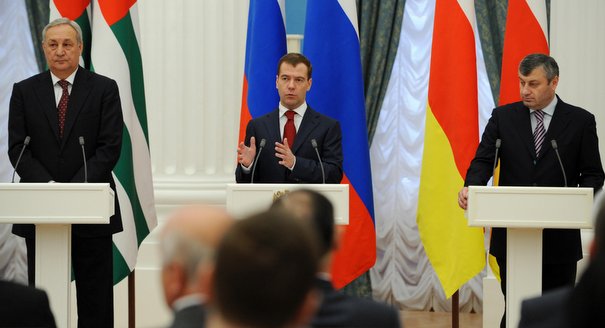
The choice is not a simple “switching of alliances.” For all the talk of a Brussels diktat, the six countries — just like the Central Europeans before them — feel much more comfortable dealing with a nonhegemonic EU than a heavy-handed Moscow. Europe may see the six nations as backward and requiring economic assistance, but it treats them as independent. Moscow, by contrast, unabashedly views the neighbors as its own “zone of interests” (or “privileged interests,” as President Dmitry Medvedev called it.) This creates apprehension in those countries that remember very well what it is like to spend decades under Moscow’s control. It is noteworthy that in the aftermath of the Georgia war last August, not a single Russian ally or integration partner followed Moscow in recognizing Abkhazia or South Ossetia. They all refused not out of any affection or sympathy for Georgia or President Mikheil Saakashvili. They were simply sending a Moscow a distinct message: We are independent states, not adjuncts of a former superpower.
The issue is not just money either. Although money is important, especially in a crisis, it is the opportunity that the world’s largest economy generates that motivates Russia’s neighbors. By contrast, Russia remains an economy largely built on energy and raw material resources, and once it phased out subsidies for its gas deliveries and started using economic sanctions for political ends, its power of attraction diminished greatly. Countries that seek paths to faster development and economic modernization look to the West, not to Moscow.
Whether the six Eastern Partnership countries succeed or fail makes a lot of difference to themselves, the EU and Russia. They need all the support and attention from Brussels and the EU member states that they can get. Ukraine, in particular, is crucial. Putting the divisive NATO issue to one side, Kiev and Brussels need to focus on the EU to help modernize the largest country in Eastern Europe. Moldova, one of the EU’s smallest and poorest new partners, requires urgent attention in Brussels to prevent a social and economic meltdown on Europe’s doorstep. In Moldova and the South Caucasus, the EU needs to become more present and effective as Russia’s partner in resolving the many conflicts. And as Europe diversifies its energy imports, it will need to become more seriously involved with the countries in the Caspian region. This calls for a long-term EU strategy and a coordinated foreign policy. This is a tall order, but if successful it will be a quantum leap for Europe.
Ironically, Russia is likely to benefit from Europe’s cohesion and its neighbors’ success. Moscow’s obsession with the 19th-century notions of geopolitics is a drag on its own post-imperial adjustment. Only when it is fully divested of these hang-ups will it be able to find a fitting place and a useful role for itself in the globalized environment.
In the long term, Russia will probably not follow its neighbors into the EU, although joining a pan-European economic area and a European-Atlantic security compact would make a lot of sense. Russia will stay as a separate unit, but it will recognize the EU not as its geopolitical rival, but as a regional leader and a rich source of modernization. The Kremlin will live to enjoy the proximity and learn to profit from the occasional friction. Finally, it will also learn the art of dealing with smaller neighbors through methods other than dominating, bullying or punishing them.
By 2030, United Europe for Russia may begin just beyond Belgorod and Bryansk. This will be a huge relief for a country whose standing in the world will be decided not by what occurs in Europe but by what happens in Asia.
Carnegie does not take institutional positions on public policy issues; the views represented herein are those of the author(s) and do not necessarily reflect the views of Carnegie, its staff, or its trustees.
U.S. unpredictability has allowed China to capitalize on its positioning as the “responsible great power”. Paradoxically, the more China wins the perception game, the more likely expectations will rise for Beijing to deliver not just words but to demonstrate with its deeds.
Hanoi and Beijing have long treated each other as distant cousins rather than comrades in arms. That might be changing as both sides draw closer to hedge against uncertainty and America’s erratic behavior.
Across Asia, China is better positioned to withstand energy shocks from the fallout of the Iran war. Its abundant coal capacity can ensure stability in the near term. Yet at the same time, the country’s energy transition away from coal will make it even less vulnerable during the next shock.
Malaysia’s chairmanship sought to fend off short-term challenges while laying the groundwork for minimizing ASEAN’s longer-term exposure to external stresses.