

Commentary
Dmitri Trenin
{
  "authors": [
    "Dmitri Trenin"
  ],
  "type": "legacyinthemedia",
  "centerAffiliationAll": "",
  "centers": [
    "Carnegie Endowment for International Peace",
    "Carnegie Russia Eurasia Center"
  ],
  "collections": [],
  "englishNewsletterAll": "",
  "nonEnglishNewsletterAll": "",
  "primaryCenter": "Carnegie Russia Eurasia Center",
  "programAffiliation": "",
  "programs": [],
  "projects": [],
  "regions": [
    "North America",
    "United States",
    "Middle East",
    "Iran",
    "South Asia",
    "Afghanistan",
    "East Asia",
    "China",
    "Central Asia",
    "Caucasus",
    "Russia",
    "Georgia",
    "Eastern Europe",
    "Ukraine",
    "Western Europe"
  ],
  "topics": [
    "Political Reform",
    "Security",
    "Foreign Policy"
  ]
}
Source: Getty
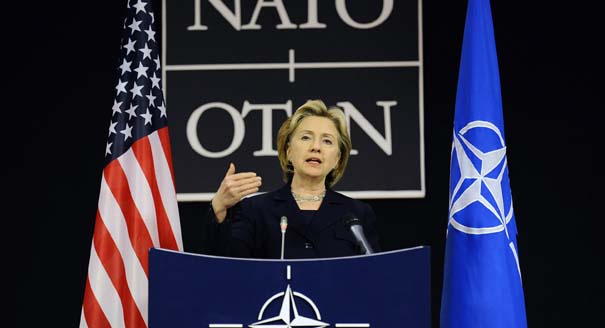
The West and Russia need to embark on a long and potentially rocky path toward creating a security community in Europe that would include both NATO members and nonmembers.
Source: Current History

Since the end of the Western-Soviet confrontation, NATO has not withered away—it has evolved, alongside the European Union, into a premier pillar of European security. The transatlantic link has withstood both the loss of a common adversary and divisions among the allies. The alliance has demonstrated, in the Balkans, a resolve for military action on its periphery and, with its involvement in Afghanistan, a capability to project power into the heart of another continent. Meanwhile, NATO membership has expanded to almost double its level at the end of the cold war.
Twenty years after the fall of the Berlin Wall, however, one major piece of unfinished post–cold war business remains: fitting the former Soviet lands into a pan-European security framework. The heart of the issue is Russia’s absence from the European and Euro-Atlantic security structures. Moscow’s one-time favorite among intergovernmental bodies, the Organization for Security and Cooperation in Europe (OSCE), has ceased to be an ongoing dialogue platform and has failed to live up to its title. This institutional deficiency affects not only Russia, but also its neighbors, such as Ukraine and Georgia. The brief war in the Caucasus in August 2008 and the tensions it produced in Crimea—which continue to linger and may produce another crisis in the future—point to the reality and potential severity of the problem.
There is no simple way to resolve this conundrum. Russia’s membership in the NATO alliance, sought by Moscow in the 1990s and again explored in the early part of this decade, is not a realistic proposition for the foreseeable future, if ever. Above all, it is not realistic at this stage to expect Russia to join a US-led alliance such as NATO is today, and it is even less realistic to anticipate some sort of NATO coleadership by the two nuclear superpowers. Even if one of these highly unlikely conditions were met, Russia’s hypothetical accession would needlessly exacerbate Russia’s own, and the West’s, relations with China, much to the detriment of global stability and security.
Thus, since no shortcut is possible, the West and Russia need to embark on a long, tortuous, and potentially rocky path toward creating a security community in Europe that would include both NATO members and nonmembers. Russian President Dmitri Medvedev’s idea of revamping European security, which he first announced before the Georgia war but has amplified since, is useful not so much because he calls for a new, legally binding treaty on security, but because it represents a de facto invitation to an ongoing dialogue. NATO needs to see the importance and urgency of the situation, seize the opportunity, and generate forward-looking ideas of its own.
Former Director, Carnegie Moscow Center
Trenin was director of the Carnegie Moscow Center from 2008 to early 2022.
Recent Work
Dmitri Trenin
Dmitri Trenin
Carnegie does not take institutional positions on public policy issues; the views represented herein are those of the author(s) and do not necessarily reflect the views of Carnegie, its staff, or its trustees.

The Plaza Accord was not an externally imposed punishment of Japan but part of a broader restructuring that Japanese economists and policymakers themselves recognized was necessary. Its effects were undermined, however, when Tokyo responded to the resulting slowdown with policies that exacerbated investment, credit expansion, and the very imbalances the adjustment was intended to resolve.

Michael Pettis

The nuclear relationship between China and the United States is increasingly shaped by widening perception gaps rather than deliberate strategic design.

Tong Zhao
China’s banking crisis in the 2000s was resolved by transferring the costs to households through financial repression—a decision that recapitalized the banks while exacerbating the structural imbalances that continue to shape the Chinese economy today.
Michael Pettis

Chinese biotech companies have been on the receiving end of U.S. economic coercion. Yet their responses have differed significantly because firm and state interests are not uniformly aligned. For Washington, treating all Chinese tech firms the same, irrespective of their actual interests, risks pushing them farther into Beijing’s corner.

Xue Gong

China’s latest energy plan explicitly calls for integrating data centers into the electricity system, particularly connecting them to green energy. It appears Beijing wants to use compute as a source of domestic demand to absorb renewables excess capacity.

Damien Ma