

Commentary
Thomas de Waal
{
  "authors": [
    "Thomas de Waal"
  ],
  "type": "legacyinthemedia",
  "centerAffiliationAll": "dc",
  "centers": [
    "Carnegie Endowment for International Peace",
    "Carnegie Europe"
  ],
  "collections": [],
  "englishNewsletterAll": "ctw",
  "nonEnglishNewsletterAll": "",
  "primaryCenter": "Carnegie Europe",
  "programAffiliation": "russia",
  "programs": [
    "Russia and Eurasia"
  ],
  "projects": [],
  "regions": [
    "Caucasus",
    "Azerbaijan",
    "Armenia"
  ],
  "topics": [
    "Political Reform",
    "Security"
  ]
}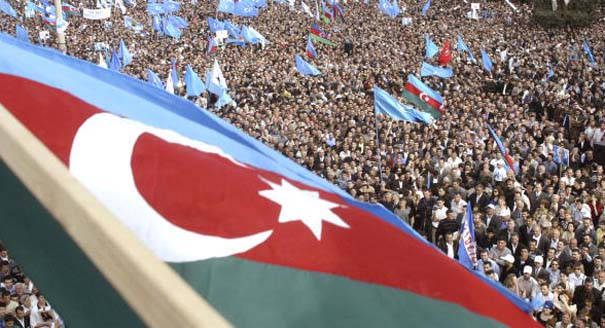
Source: Getty
The situation in the South Caucasus continues to be perilous as leaders of both Armenia and Azerbaijan find themselves increasingly boxed in by domestic political constraints.
Source: Voice of America
Speaking on Voice of America Armenian Service, Carnegie's Thomas de Waal explained that February has brought added tension to the South Caucasus as both Armenia and Azerbaijan continue to politicize the anniversaries of the Sumgait 1988 pogrom and the Khojali 1992 massacre, respectively. The two states have increasingly less room to maneuver as domestic political developments have constrained the leadership in Baku and Yerevan.
In Azerbaijan, he explained, an economic slowdown after years of strong growth has left the government feeling increasingly insecure even before a series of protests unfolded in January. In Armenia, although the hotly contested presidential election between Serzh Sargsyan and Raffi Hovannisian has been deemed satisfactory by most observers, president Sargsyan will have to deal with many potentially destabilizing domestic political trends.De Waal argued that if a planned direct air connection between Yerevan and Nagorny Karabakh goes ahead, it is likely to provoke an Azerbaijani response, with unpredictable consequences. Moreover, he added, the opposition presidential candidate, Raffi Hovannisian, continues to champion the idea of recognition of Nagorny Karabakh by Yerevan which, if it went ahead, would probably spell the end of the Minsk Peace Process.
Within this increasingly unpropitious climate, de Waal concluded, Akram Aylisli's novel which portrays Armenians in a sympathetic light, Stone Dreams, has unfortunately been the catalyst for recrimination in Azerbaijan rather than enhanced dialogue.
The interview was originally broadcast on Voice of America Armenian Service.

Senior Fellow, Carnegie Europe
Thomas de Waal is a senior fellow at Carnegie Europe, specializing in Eastern Europe and the Caucasus.
Recent Work
Thomas de Waal
Thomas de Waal
Carnegie does not take institutional positions on public policy issues; the views represented herein are those of the author(s) and do not necessarily reflect the views of Carnegie, its staff, or its trustees.

The Thai-Cambodian conflict highlights the limits to China's peacemaker ambition and the significance of this role on Southeast Asia’s balance of power.

Pongphisoot (Paul) Busbarat

Beijing believes that Washington is overestimating its own leverage and its ability to handle the trade war’s impacts.


Rick Waters, Sheena Chestnut Greitens

Tapping our network of China experts in the region, Carnegie China offers this latest “China Through a Southeast Asian Lens” report to offer preliminary assessments of whether the U.S. effort to reshape the global trading order will lead countries in the region to tilt toward Beijing.



Selina Ho, Khin Khin Kyaw Kyee, Joseph Ching Velasco, …
Because strategic, economic, and ideological perceptions of China contain multiple, sometimes contradictory facets in Southeast Asia, receptions of and responses to Beijing diverge across and within state lines.



Evan A. Feigenbaum, Chong Ja Ian, Elina Noor

Most Southeast Asian states behave as if the actions of their Northeast Asian neighbors and the Philippines will be sufficient to maintain a regional status quo from which they can benefit.
Chong Ja Ian