

Commentary
Dmitri Trenin
{
  "authors": [
    "Dmitri Trenin"
  ],
  "type": "legacyinthemedia",
  "centerAffiliationAll": "",
  "centers": [
    "Carnegie Endowment for International Peace",
    "Carnegie Russia Eurasia Center"
  ],
  "collections": [],
  "englishNewsletterAll": "",
  "nonEnglishNewsletterAll": "",
  "primaryCenter": "Carnegie Russia Eurasia Center",
  "programAffiliation": "",
  "programs": [],
  "projects": [
    "Eurasia in Transition"
  ],
  "regions": [
    "Russia"
  ],
  "topics": [
    "Foreign Policy"
  ]
}
Source: Getty
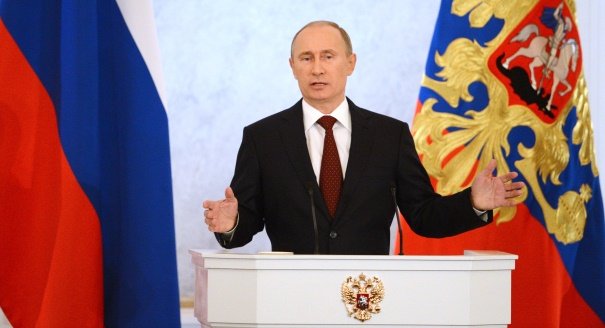
Putin’s new foreign policy doctrine has control as its true objective, sovereignty as its slogan, and nationalism as its soul.
Source: Security Times
Each presidential term since 2000, Vladimir Putin has had a new foreign policy doctrine. In the early 2000s, this was an alliance with the United States, coupled with the “European choice.” In the mid-2000s, it was replaced by a policy of defensive self-assertion, manifested in the Munich speech. Dmitri Medvedev’s presidency, which was de facto Putin’s third term, was marked by a reset with Washington and the quest for “modernization resources” in the West. Putin’s formal return to the Kremlin has ushered in yet another iteration of his foreign policy, which might be called sovereignization.
Above all else, Mr. Putin has moved to consolidate power at home, challenged by big city protesters in the winter of 2011/12. Seeing the protesters as pawns of the US State Department which did indeed finance some civil society and democracy building programs, Putin ordered the cancellation of USAID activities in Russia and the legal branding of Russian NGOs which accept funding from abroad as “foreign agents.” The Kremlin went even further when, in response to the US Magnitsky Act, which applied sanctions against Russian officials suspected of having caused death in detention of a corporate lawyer, it ended the practice of adoption of Russian children by US foster parents.
Actually, President Putin himself is introducing something like Magnitsky-in-reverse by legally restricting Russian officials from owning assets and property abroad. Evidently, Putin wants both to do away with the vestiges of Russia’s unequal status vis-à-vis the West rooted in the 1990s – foreign aid recipient, democracy class drop-out, orphans-for-adoption country – and to reduce the exposure of Russian officialdom to potential pressure from the outside – so that these same officials are better controlled by the Kremlin inside. Control is the true objective, sovereignty is the slogan and nationalism is the soul of this policy.In terms of foreign policy per se, Putin’s main project is Eurasian economic integration. The Customs Union of Belarus, Kazakhstan and Russia, in operation since 2009, is being upgraded to a single economic area of the three, with the goal of an economic union by 2015.
Putin has been working hard personally to expand the integration effort to include Kyrgyzstan and Tajikistan; and he has offered Customs Union membership to Ukraine, which is torn between the appeal of short-term gains in the east and its long-term aspirations to join the west.
Moscow has also been cultivating Tashkent hoping to engage Uzbekistan, a key country in Central Asia. This is not the beginning of a new Soviet Union, to be sure; and a degree of integration between Russia and some of its neighbors makes sense in economic terms. Putin, however, also seeks to enhance Russia’s geopolitical standing vis-à-vis its two biggest neighbors in Eurasia: the European Union to the west and China to the east.
Moscow’s approach toward the EU, meanwhile, has changed fundamentally. Europe is no longer regarded there as a mentor or even a model. Russia no longer seeks a relationship with it that would have, in Romano Prodi’s memorable phrase, “everything in common except the institutions.”
Instead, the relationship is getting more transactional, symbolized more by adding new pipelines and bickering over visas than by professing common values. Indeed, Moscow has not only accepted the values gap between itself and the EU, but has begun to proudly advertise its own more traditional values, such as national sovereignty, religious faith, and traditional family – in contrast to Europe’s unchecked freedoms which, in its view, erode society and eventually doom it.
Putin has also moved to re-reset relations with the United States. Eliminating elements of perceived inequality has been mentioned. Politico-military issues, including arms control, which featured prominently in the Medvedev interlude, have been assigned a back seat. Putin’s own priority is expanding trade and economic cooperation with Americans on the model of the 2011 Rosneft-ExxonMobil deal.
Over the years, the Russian President has come to prefer the company of Western CEOs to that of Western politicians. In a highly symbolic gesture, Putin missed not only the Chicago NATO summit, but also the G-8 meeting at Camp David – something no other world leader had done before. Having stopped pretending that Russia is affiliated, however loosely and indirectly, with the West, Putin felt free to take a more robust posture internationally.
The crisis in Syria has given him an opportunity to demonstrate that posture. Russia did not like US-led military interventions before, whether in the Balkans or in Iraq. It acquiesced in Libya, hoping to strengthen what Dmitri Medvedev called “modernization alliances” with the West, but was bitterly disappointed as the imposition of a no-fly zone morphed into regime change.
On Syria, Moscow is standing firm, giving no pretext for intervention to those who want to push or ease Bashar al-Assad out of power. Russia also continues to give Damascus material assistance and moral support.
In its view, an Islamist takeover of Syria must be prevented by all non-military means available. Nearly two years into the Syrian uprising, Assad is still holding out, and Washington is negotiating the future of Syria directly with Moscow – something not seen since the end of the Cold War.
Finally, Putin has also “pivoted” to Asia-Pacific. The Asia-Pacific Economic Cooperation (APEC) summit in Vladivostok was the most visible, but not the only sign of the east-west geopolitical rebalancing now taking place at the Kremlin. Moscow understands the importance of the rise of Asia, and of China in particular, and is seeking to find ways to develop its eastern provinces, which otherwise risk tilting, economically, toward the great neighbor across the river.
Thus, while taking great care to maintain good relations with Beijing, Moscow is reaching out to others in the region, from Tokyo and Seoul to Delhi and Hanoi, to expand trade and investment and develop political contacts. At some point, driven by the same logic, Russia may even discover the value of trans-Pacific ties with North America.
Dealing with Russia in the next few years will mean dealing directly with Vladimir Putin, and it will not be easy. There will be calls to opposing the Kremlin’s authoritarianism, and dire warnings against any return to realpolitik. Yet, opposing Russia, or simply ignoring it, will carry its own price. Russia is, and will continue to be, for the Russians themselves to fix.
Western values need to inform Western interests, not to replace them. The only possible solace will be that even though the relationship between Russia and the West may become more contentious than it was in Medvedev’s halcyon days, at least there will be no disillusionment in the end.
Former Director, Carnegie Moscow Center
Trenin was director of the Carnegie Moscow Center from 2008 to early 2022.
Recent Work
Dmitri Trenin
Dmitri Trenin
Carnegie does not take institutional positions on public policy issues; the views represented herein are those of the author(s) and do not necessarily reflect the views of Carnegie, its staff, or its trustees.

But their "principal to principal" model will only be as effective as the political strength of each leader back home.

Damien Ma

U.S. unpredictability has allowed China to capitalize on its positioning as the “responsible great power”. Paradoxically, the more China wins the perception game, the more likely expectations will rise for Beijing to deliver not just words but to demonstrate with its deeds.

Chong Ja Ian

Hanoi and Beijing have long treated each other as distant cousins rather than comrades in arms. That might be changing as both sides draw closer to hedge against uncertainty and America’s erratic behavior.

Nguyễn Khắc Giang

Across Asia, China is better positioned to withstand energy shocks from the fallout of the Iran war. Its abundant coal capacity can ensure stability in the near term. Yet at the same time, the country’s energy transition away from coal will make it even less vulnerable during the next shock.
Damien Ma

Malaysia’s chairmanship sought to fend off short-term challenges while laying the groundwork for minimizing ASEAN’s longer-term exposure to external stresses.

Elina Noor