

Paper
Paul Salem
{
  "authors": [
    "Paul Salem"
  ],
  "type": "legacyinthemedia",
  "centerAffiliationAll": "",
  "centers": [
    "Carnegie Endowment for International Peace",
    "Malcolm H. Kerr Carnegie Middle East Center"
  ],
  "collections": [],
  "englishNewsletterAll": "",
  "nonEnglishNewsletterAll": "",
  "primaryCenter": "Malcolm H. Kerr Carnegie Middle East Center",
  "programAffiliation": "",
  "programs": [],
  "projects": [],
  "regions": [
    "Levant",
    "Lebanon",
    "Syria",
    "Middle East"
  ],
  "topics": [
    "Political Reform",
    "Economy",
    "Security",
    "Foreign Policy"
  ]
}
Source: Getty
The best way for all to benefit from the east Mediterranean’s offshore resources is to forge a path toward peace in Syria and the region and to establish frameworks for economic and security cooperation in this sector.
Source: Al-Hayat
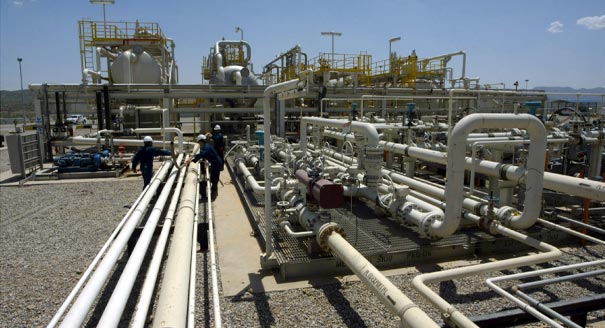
Despite the resignation of the Lebanese government of Najib Mikati on March 22, the Energy Minister Gibran Bassil of the now caretaker Cabinet announced in a news conference on March 28 that 52 international companies had asked to pre-qualify for the country’s first ever licensing round for the exploitation of its offshore gas and oil resources. Bassil sought to reassure companies and investors that despite political uncertainty, the licensing round would go forward. The energy resources of the eastern Mediterranean continue to be a major factor in the strategic calculations of regional and international players.
Of the 52 companies that sought to pre-qualify, 14 applied as operators—i.e. to undertake drilling and extraction activities—and the remaining 38 as non-operators—i.e. they share in the ownership and expense of drilling, development and extraction with operators, but are not responsible for operations. Major companies from the US, UK, Norway, France, Italy, Brazil, Russia, India, and China have applied, and the list includes ExxonMobil, Chevron, Total, Statoil Norway, ENI of Italy, Lukoil and Rosneft of Russia and the National Offshore Oil Company of China. Companies from Turkey, Iran, Kuwait and the UAE also applied, although interestingly, no companies from Saudi Arabia or Qatar submitted applications.
The Lebanese Petroleum Authority, which is a 6-person advisory technical committee, will review these applications and then announce the list of approved pre-qualified companies in the second half of this month. In order to proceed with the licensing round, which had been scheduled to start in May, the government must issue two decrees: one defining offshore blocks and another approving the model exploration and production sharing contract.A caretaker government normally lacks the authority to issue such decrees, so these decisions await the efforts of Mr. Tammam Salam to form a new Cabinet. If Salam’s efforts continue to flounder for an extended period of time, it is conceivable that a political consensus could emerge to allow the caretaker government to issue them. This has happened before, although rarely, in Lebanon’s political history. Bassil expressed confidence that the process would proceed quickly and that the licensing round would begin in the next two months and continue to the end of the year, with contracts being announced and awarded in the spring of 2014.
Companies that wish to bid for licenses are required to form coalitions made up of at least three companies and to present clear timetables for drilling and extraction. The government is interested in attracting a wide array of companies from influential regional and global players from the east and west to become stakeholders in Lebanon’s offshore energy sector; in this way, the government expects that regional and international players will have an interest in growing the sector and maintaining its security. Interestingly, the Russian company Rosneft has already announced that it has established a partnership with the US' ExxonMobil to bid for Lebanese resources.
If all goes according to plan, Lebanon hopes that gas extraction could begin as early as 2016. However, Lebanon's Parliament must also enact the law establishing a National Sovereign Wealth Fund, which is to receive the expected revenues from this extraction. If properly handled, gas extraction could dramatically reduce Lebanon’s electricity generation bill, create a boom in energy-related industries and jobs, and positively impact the country’s strained public finances and debt management challenges. Improperly managed, the energy sector could serve as an entryway into wider corruption.
Energy finds in the eastern Mediterranean continue to be a major factor on the geostrategic radar screen and with so many different interests involved, the sector could be a flashpoint for conflict. Lebanon and Israel disagree over their maritime border, as do also the Greek and Turkish parts of Cyprus. Hezbollah and the Israeli Defense Forces have exchanged barbed threats, and Turkish warships have cruised off the coast of Cyprus in a show of force.
Alternatively, the resources from this sector could spur enhanced cooperation and a de-escalation of conflict. The recent rapprochement between Israel and Turkey reduces one axis of tension, and the US has quietly brokered an understanding between Lebanon and Israel that neither will drill in their disputed maritime area for the immediate future.
But the sector is also part of a wider geostrategic struggle. Russia and Iran, relying on sympathy from China and India, wish to gain a strong influence in the sector; Russia, in order to maintain dominance of gas supplies to Europe, and China and India to ensure more direct cross-Asian access to energy supplies for their fast-growing economies. Iran is sponsoring a gas pipeline that would link Lebanon and Syria through Iraq to Iran, and has another pipeline project that would go through Pakistan to China and India. The US and Western Europe, on the other hand, along with Israel, want to steer these energy resources into Western hands.
The battle for Syria is partly a battle for control of this energy future. If Syria falls completely to the rebels, Turkish-Israeli cooperation with backing from Arab Gulf States would pull the new Syria into a Western orbit, and Iran and Russia would lose ground. If the Assad regime survives, or at least manages to survive along the north-western Syrian coast, the battle for influence in the eastern Mediterranean would be set to continue.
As the war in Syria drags on, and the political uncertainty in Lebanon grows, the world’s appetite for the eastern Mediterranean’s energy resources continues unabated. Both Lebanon and Syria need these newfound offshore resources to finance the sunken or future costs of post-war reconstruction. Lebanon has a chance to move forward quickly in exploiting these resources by forming a new government and launching its licensing round. Syria, unfortunately, is where Lebanon was thirty years ago, deep into a devastating civil war, with no political or military end in sight.
Wiser leaders in the international and regional community should realize that fuelling conflict in Syria not only devastates that country but threatens stability in Lebanon and the eastern Mediterranean in general; and that the best way for all to benefit from the east Mediterranean’s offshore resources is to forge a path toward peace in Syria and the region and to establish frameworks for economic and security cooperation in this sector.
Senior Fellow at the Middle East Institute
Paul Salem is a senior fellow at the Middle East Institute.
Recent Work
Paul Salem
Paul Salem
Carnegie does not take institutional positions on public policy issues; the views represented herein are those of the author(s) and do not necessarily reflect the views of Carnegie, its staff, or its trustees.

China’s banking crisis in the 2000s was resolved by transferring the costs to households through financial repression—a decision that recapitalized the banks while exacerbating the structural imbalances that continue to shape the Chinese economy today.

Michael Pettis

But their "principal to principal" model will only be as effective as the political strength of each leader back home.

Damien Ma

U.S. unpredictability has allowed China to capitalize on its positioning as the “responsible great power”. Paradoxically, the more China wins the perception game, the more likely expectations will rise for Beijing to deliver not just words but to demonstrate with its deeds.

Chong Ja Ian

Hanoi and Beijing have long treated each other as distant cousins rather than comrades in arms. That might be changing as both sides draw closer to hedge against uncertainty and America’s erratic behavior.

Nguyễn Khắc Giang

Across Asia, China is better positioned to withstand energy shocks from the fallout of the Iran war. Its abundant coal capacity can ensure stability in the near term. Yet at the same time, the country’s energy transition away from coal will make it even less vulnerable during the next shock.
Damien Ma