

In The Media
Lilia Shevtsova
{
  "authors": [
    "Lilia Shevtsova"
  ],
  "type": "legacyinthemedia",
  "centerAffiliationAll": "",
  "centers": [
    "Carnegie Endowment for International Peace",
    "Carnegie Russia Eurasia Center"
  ],
  "collections": [],
  "englishNewsletterAll": "",
  "nonEnglishNewsletterAll": "",
  "primaryCenter": "Carnegie Russia Eurasia Center",
  "programAffiliation": "",
  "programs": [],
  "projects": [],
  "regions": [
    "Russia",
    "Eastern Europe",
    "Ukraine"
  ],
  "topics": [
    "Political Reform",
    "Civil Society",
    "Foreign Policy"
  ]
}
Source: Getty
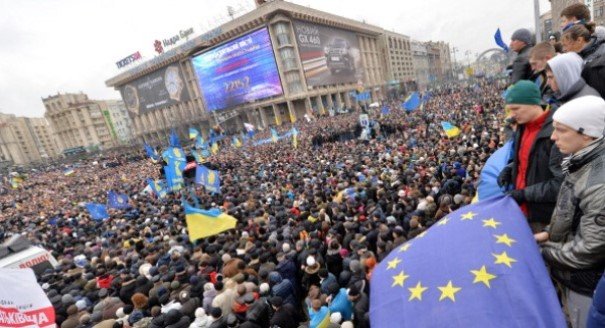
Victor Yanukovych has presented his nation as a gift to Vladimir Putin, but the Ukrainian people have gathered in Kiev’s Independence Square to resist this move. Violence is still possible, and more is at stake than just the political future of one country.
Source: American Interest
The Ukrainian Maidan is one the most remarkable events of the past year. In Kiev’s Independence Square, hundreds of thousands Ukrainians have gathered, and there they remain, demanding that the regime respect their dignity. Their actions have demonstrated more than just the courage and resilience of the Ukrainian people. They have allowed us to see the cowardice and treachery of the ruling regime. They have laid bare to the world Vladimir Putin’s new doctrine and his attempts to create a new version of the USSR—this time without Communist ideology. And they have showed us that the West’s leaders, whether out of naivety or indifference, have played right in to President Viktor Yanukovych’s game, thus facilitating his anti-Western turn.
The saga now underway in Ukraine has brought a troubling clarity to our perception of the situation. One cannot help but be disgusted and sickened to realize that the entire nation has become a bargaining chip in a game played by two authoritarian leaders intent on solving their personal problems of political survival, without a single developed democracy managing to stand up in opposition to this state of affairs. History repeats itself, apparently, because we are always in such a hurry to forget it.Meanwhile, in the past few days before Yanukovych presented Ukraine to the Kremlin, the Ukrainian regime’s choice became obvious to all but perhaps the most careless or indifferent observer. And that choice was not in Europe’s favor.
Yanukovych has demonstrated his lack of commitment to a genuine dialogue with the Maidan in a number of ways. His supporters were bussed into Kiev en masse. He refused to honor one of the Maidan’s central demands: dismissing the Azarov government. He remained unwilling to prosecute those responsible for the attacks on the protesters. Finally, there was the electoral fraud in Ukraine’s recent parliamentary elections (elections of the additional deputies to the Verchovna Rada), which testified to Yanukovych’s real intentions. Instead of talking to the Maidan, Yanukovych assembled his “popular” support intended to prop his regime and plans. Much like the Putin-organized Moscow rallies in 2012, the anti-Maidan, pro-Yanukovych rallies point to the leaders’ readiness to confront society rather than compromise.
True, Yanukovych continued to play his game with Brussels at the same time as he was doing all of these things. But as it turned out even his requests for financial aid from Brussels were simply a ploy to prolong the negotiations over the Association Agreement. These “negotiations”, which made absolutely no sense to the European negotiators, acted as a smokescreen allowing President Yanukovych to continue his bargaining marathon with Moscow without missing a beat. All of the promises Yanukovych made during his meetings with Western emissaries, we now know, were nothing but hot air! It was an imitation strategy calculated to secure a less humiliating conditional surrender to the Kremlin while placating and misleading the Maidan at the same time. The fact that European emissaries and many experts accepted his promises at face value reveals either their naivety or lack of understanding of the inner workings of personalized regimes—especially ones whose personifier wants to shirk responsibility for the mess he created. One can imagine Yanukovych deriding Europe’s leaders in secret as they tried to cajole him into signing the Association Agreement at the Vilnius summit. After all, his visit to Vilnius was just a decoy; he no longer cared about his standing with the likes of José Manuel Barroso, Angela Merkel, or the rest of those nice but simple-minded people. These people lived in a world that seems totally foreign to him, one which he holds in contempt. ...
Read the full text of this article in the American Interest.
Former Senior Associate, Russian Domestic Politics and Political Institutions Program, Moscow Center
Shevtsova chaired the Russian Domestic Politics and Political Institutions Program at the Carnegie Moscow Center, dividing her time between Carnegie’s offices in Washington, DC, and Moscow. She had been with Carnegie since 1995.
Recent Work
Lilia Shevtsova
Lilia Shevtsova
Carnegie does not take institutional positions on public policy issues; the views represented herein are those of the author(s) and do not necessarily reflect the views of Carnegie, its staff, or its trustees.

But their "principal to principal" model will only be as effective as the political strength of each leader back home.

Damien Ma

U.S. unpredictability has allowed China to capitalize on its positioning as the “responsible great power”. Paradoxically, the more China wins the perception game, the more likely expectations will rise for Beijing to deliver not just words but to demonstrate with its deeds.

Chong Ja Ian

Hanoi and Beijing have long treated each other as distant cousins rather than comrades in arms. That might be changing as both sides draw closer to hedge against uncertainty and America’s erratic behavior.

Nguyễn Khắc Giang

Across Asia, China is better positioned to withstand energy shocks from the fallout of the Iran war. Its abundant coal capacity can ensure stability in the near term. Yet at the same time, the country’s energy transition away from coal will make it even less vulnerable during the next shock.
Damien Ma

Malaysia’s chairmanship sought to fend off short-term challenges while laying the groundwork for minimizing ASEAN’s longer-term exposure to external stresses.

Elina Noor