

Commentary
Dmitri Trenin
{
  "authors": [
    "Dmitri Trenin"
  ],
  "type": "commentary",
  "centerAffiliationAll": "",
  "centers": [
    "Carnegie Endowment for International Peace",
    "Carnegie Russia Eurasia Center"
  ],
  "collections": [],
  "englishNewsletterAll": "",
  "nonEnglishNewsletterAll": "",
  "primaryCenter": "Carnegie Russia Eurasia Center",
  "programAffiliation": "",
  "programs": [],
  "projects": [],
  "regions": [
    "Russia",
    "Eastern Europe",
    "Ukraine"
  ],
  "topics": [
    "Security",
    "Foreign Policy"
  ]
}
Source: Getty
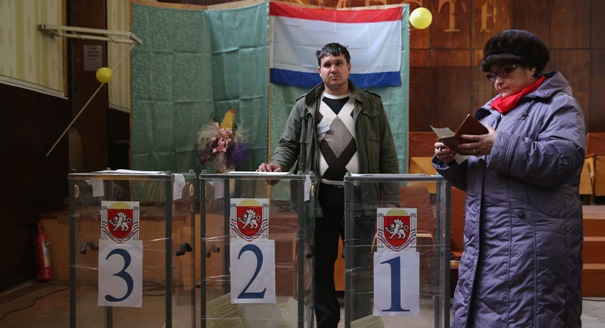
The Crimea referendum, in which the people of the region have massively voted to join Russia, marks a watershed in Russia’s foreign policy: Russia has stopped walking backward and has made a step forward. As for Ukraine, it will be for the foreseeable future a geopolitical battleground.
The Crimea referendum on March 16, 2014, has turned a page in the history of Eastern Europe. The people of the region have massively voted to join Russia. Whatever doubts one may have had about the legality of the plebiscite, its short-order fashion, or the role of Russia, it is hard to dispute the clear desire of the overwhelming majority of Crimean residents to leave Ukraine and "return to Russia." The actual process of Crimea's integration into the Russian Federation will take some time, but from now on this is a technicality.
Crimea's fate all but sealed, the focus of attention should now be on Ukraine. Dismissing the mass anti-Maidan rallies in the east of the country as the work of "thugs" sent from Moscow is self-delusion. The obvious ultra-nationalism of at least part of the victorious coalition in power in Kiev naturally invites a push-back in the regions with a different historical narrative. Ukraine has reached the point where its federalization may be the only means to hold the country in one piece, avoid a civil war, and give it a new chance at nation-building. The fact that Ukraine's federalization happens to be advocated by Moscow should not disqualify it. The alternatives may be worse.
Within a few weeks, Russian-Western relations have reached the level of an adversity typical of a Cold War. Some astute observers seem to believe the current tensions will soon subside, and Washington will seek an accommodation with Moscow. The Kremlin certainly does not relish in the prospect of a new confrontation with the West, but its terms of settlement may look pretty harsh to its partners-turned-opponents. Crimea should be recognized as part of Russia, following the will of its people; Ukraine should be reconstituted as a federation, de facto allowing its regions not only to decide the linguistic and cultural issues in their territory, and engage in economic relations with other countries, but weighing in on major foreign policy decisions. Which means, in plain Russian, no NATO membership, and no EU association for Ukraine.
It is unlikely that Kiev or the West will agree to that. Which means that, for the foreseeable future, Ukraine will be a geopolitical battleground. The outcome of the battle is unknowable, but it is likely to be a long and hard competition rather than a short campaign, with various Ukrainian forces joining different camps. The West has more power, but Russia has more at stake. The cheerful predictions that the "Russian aggression" in Crimea will accomplish the feat of consolidating all Ukrainians into a single nation are wishful thinking. The West needs to take a sober look at the landscape it finds itself in in Ukraine, and decide what its interests are and how much effort it is prepared to exert, and over what period of time.
As for Russia, Putin appears to have decided to play for high stakes in Ukraine. His popularity with the Russian people has topped 70 percent, a 10-percent jump in one month. In moving decisively on Crimea, Putin has also placed the Russian elites in front of a stark choice: to rally around the flag or risk being seen as a fifth column by the people, not just the authorities. Western sanctions would actually help the Kremlin in cleansing the elites. A number of critics, following the revolutionary Bolshevik tradition from World War I days, have predictably called for their government's defeat, but it appears that most will likely take the opposite view. After all, hasn't Putin managed to bring Crimea back without a shot being fired? Sanctions come and go. Sevastopol will stay.
Former Director, Carnegie Moscow Center
Trenin was director of the Carnegie Moscow Center from 2008 to early 2022.
Recent Work
Dmitri Trenin
Dmitri Trenin
Carnegie does not take institutional positions on public policy issues; the views represented herein are those of the author(s) and do not necessarily reflect the views of Carnegie, its staff, or its trustees.

But their "principal to principal" model will only be as effective as the political strength of each leader back home.

Damien Ma

U.S. unpredictability has allowed China to capitalize on its positioning as the “responsible great power”. Paradoxically, the more China wins the perception game, the more likely expectations will rise for Beijing to deliver not just words but to demonstrate with its deeds.

Chong Ja Ian

Hanoi and Beijing have long treated each other as distant cousins rather than comrades in arms. That might be changing as both sides draw closer to hedge against uncertainty and America’s erratic behavior.

Nguyễn Khắc Giang

Across Asia, China is better positioned to withstand energy shocks from the fallout of the Iran war. Its abundant coal capacity can ensure stability in the near term. Yet at the same time, the country’s energy transition away from coal will make it even less vulnerable during the next shock.
Damien Ma

Malaysia’s chairmanship sought to fend off short-term challenges while laying the groundwork for minimizing ASEAN’s longer-term exposure to external stresses.

Elina Noor