

Commentary
Dmitri Trenin
{
  "authors": [
    "Dmitri Trenin"
  ],
  "type": "commentary",
  "centerAffiliationAll": "",
  "centers": [
    "Carnegie Endowment for International Peace",
    "Carnegie Russia Eurasia Center"
  ],
  "collections": [],
  "englishNewsletterAll": "",
  "nonEnglishNewsletterAll": "",
  "primaryCenter": "Carnegie Russia Eurasia Center",
  "programAffiliation": "",
  "programs": [],
  "projects": [],
  "regions": [
    "North America",
    "United States",
    "Southeast Asia",
    "Russia",
    "Eastern Europe",
    "Ukraine",
    "Western Europe"
  ],
  "topics": [
    "Security",
    "Military",
    "Foreign Policy",
    "Global Governance"
  ]
}
Source: Getty
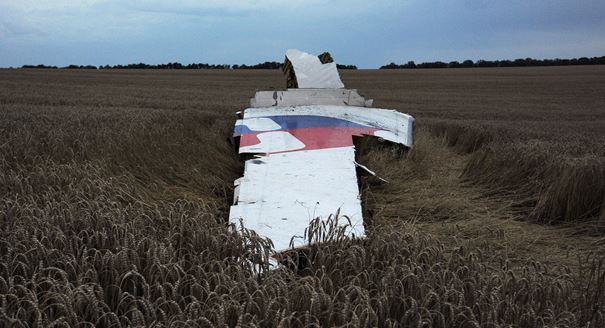
The downing of the Malaysia Airlines MH17 plane over Eastern Ukraine catapults the crisis there onto the global plane. The tragic and sudden loss of so many innocent lives should put a final point to the armed conflict—or it may put the international conflict over Ukraine on a much higher and more dangerous level.
The downing of the Malaysia Airlines MH17 plane on Thursday over Eastern Ukraine catapults the crisis there onto the global plane. Nationals of several countries, more than half of them Dutch, are among the victims. The UN Security Council will meet in New York. An international investigation has been called for. The story dominates television news all over the world.
Given the realities of continued fighting on the ground, and the very high political stakes involved, the investigation will not prove easy. Yet, even before it has started in earnest, accusations have been made. The most widely discussed scenario in the global media is the downing of the plane by the Donetsk insurgents.
Publicly, President Poroshenko has already blamed the Russia-supported separatists, and President Putin has put the blame on the Ukrainian government's resumption of the military operation in the east of the country. Actually, these statements may be less contradictory than they appear, but this is small comfort. Whatever the final result of the investigation, Russia is likely to face a major political and media campaign reminiscent of the 1983 shooting of the Korean Air Lines off Sakhalin island, which ushered in the most dangerous period of the Cold War after the Cuban missile crisis.
The coming UNSC debate is likely to be emotional, and acrimonious. The US Congress may press President Obama to ramp up the sanctions which he had only announced less than 24 hours before the MH17 tragedy. The daylight between the United States and the EU approaches to anti-Russian sanctions may narrow. Russia's outreach to Asia beyond China may be compromised. This will put Moscow in a difficult spot, and prompt a reaction on its part.
The only sensible step now would be to stop the fighting in Ukraine immediately and begin a political process, under the OSCE auspices and led by the Contact Group. The tragic and sudden loss of so many innocent lives should put a final point to the armed conflict. Or it may put the international conflict over Ukraine on a much higher and more dangerous level. The choice is still to be made, but the time is running out fast.
Former Director, Carnegie Moscow Center
Trenin was director of the Carnegie Moscow Center from 2008 to early 2022.
Recent Work
Dmitri Trenin
Dmitri Trenin
Carnegie does not take institutional positions on public policy issues; the views represented herein are those of the author(s) and do not necessarily reflect the views of Carnegie, its staff, or its trustees.

But their "principal to principal" model will only be as effective as the political strength of each leader back home.

Damien Ma

U.S. unpredictability has allowed China to capitalize on its positioning as the “responsible great power”. Paradoxically, the more China wins the perception game, the more likely expectations will rise for Beijing to deliver not just words but to demonstrate with its deeds.

Chong Ja Ian

Hanoi and Beijing have long treated each other as distant cousins rather than comrades in arms. That might be changing as both sides draw closer to hedge against uncertainty and America’s erratic behavior.

Nguyễn Khắc Giang

Across Asia, China is better positioned to withstand energy shocks from the fallout of the Iran war. Its abundant coal capacity can ensure stability in the near term. Yet at the same time, the country’s energy transition away from coal will make it even less vulnerable during the next shock.
Damien Ma

Malaysia’s chairmanship sought to fend off short-term challenges while laying the groundwork for minimizing ASEAN’s longer-term exposure to external stresses.

Elina Noor