

In The Media
Jessica Tuchman Mathews
{
  "authors": [
    "Jessica Tuchman Mathews"
  ],
  "type": "legacyinthemedia",
  "centerAffiliationAll": "",
  "centers": [
    "Carnegie Endowment for International Peace"
  ],
  "collections": [
    "Iranian Proliferation"
  ],
  "englishNewsletterAll": "",
  "nonEnglishNewsletterAll": "",
  "primaryCenter": "Carnegie Endowment for International Peace",
  "programAffiliation": "",
  "programs": [],
  "projects": [],
  "regions": [
    "North America",
    "United States",
    "Middle East",
    "Iran"
  ],
  "topics": [
    "Political Reform",
    "Security",
    "Foreign Policy",
    "Nuclear Policy"
  ]
}
Source: Getty
For every minute since the agreement went into force, Iran’s program has been under international surveillance, more extensively and more intensively than any nuclear program anywhere in the world has been before.
Source: New Hampshire Union Leader
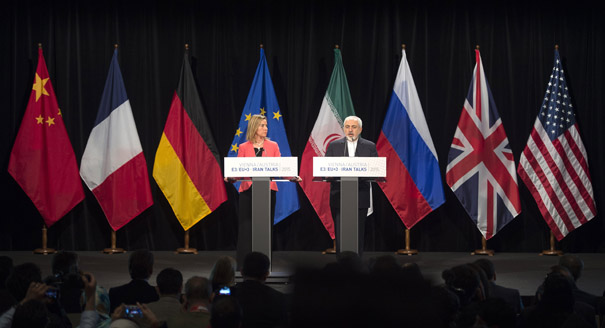
It has been a year and a half since agreement was reached on the nuclear deal between Iran and the U.S., Russia, China, France, Britain and Germany.
In that time, Iran has met its obligations to export, destroy or put in monitored storage the components of its nuclear program. It has kept very close to the allowed limits in a few cases — a typical form of Iranian brinksmanship — but where it has temporarily exceeded a limit it has been by a tiny and militarily meaningless amount of a non-nuclear material.
For every minute since the agreement went into force, Iran’s program has been under international surveillance, more extensively and more intensively than any nuclear program anywhere in the world has been before.
For all of its technical success, the deal teeters on a fragile political foundation. Hardliners in Iran, especially the Revolutionary Guard, opposed it during its negotiation and continue to work for its destruction. They oppose it for ideological reasons (dealing with the “Great Satan,”) for political ones (if it is successful in removing economic sanctions and ending Iran’s international isolation, it will strengthen the moderates who negotiated it), and for personal ones (sanctions created a black market from which members of the Revolutionary Guard and conservative clerics profited.)
There has been equally strong opposition in Washington and for some of the same reasons. There are many who oppose negotiating with Iran on ideological grounds. They prefer regime change to dealing with a government they despise. Or, they object to resolving “just” the nuclear threat while highly objectionable aspects of Iranian behavior continue.
Members of Congress, especially, opposed the deal for political reasons. If it succeeds in removing an imminent nuclear threat through economic pressure and negotiation, the deal will stand as a major achievement of the Obama presidency. Others object to the elements of compromise that are part of any negotiated settlement.
And, finally, there are many who don’t know what’s in the 160 page, technical document but are moved by opponents of the deal, particularly in Israel, Iran’s vulnerable neighbor and stated enemy.
Israeli Prime Minister Benjamin Netanyhau has been a passionate critic since before the deal was reached. Too few Americans have heard the judgment of Israel’s senior defense official, Chief of the General Staff Lt. General Gadi Eizenkot, who called the deal “a historic turning point.”
Iran will remain “high on our priority lists”, he explained, “but this is a real change… a strategic turning point.”
Ephraim Halevy, former chief of the Mossad, Israel’s CIA, agrees: “I believe this agreement closes the roads and blocks the road to Iranian nuclear military capabilities for at least a decade.’’
In weighing its options, the Trump administration will first have to recognize that the deal is not a two-party deal, but a six-party one which has broad (if not unanimous) international support. If the U.S. chooses to walk away from it without Iranian violations to justify doing so, it will walk alone.
That, in turn, means that there won’t be international support for re-imposing sanctions to drive Iran back to the negotiating table.
Instead, the U.S. could try to provoke Iran into walking away by imposing new sanctions or not doing things the deal requires us to do.
But Tehran is not dumb and is unlikely to let itself be seen as the violator. It would likely retaliate outside the deal, possibly in a way that would lead to tit-for-tat military escalation.
The nuclear deal is not perfect. But, when it was reached, Iran was three months away from having enough fuel for a nuclear weapon.
It is now at least a year away from that breakout point and the deal — if it survives — will keep it there for 15 years.
In the best of worlds, a broader deal encompassing Iranian support for Hezbollah and other terrorists, its antagonism towards Israel, its support of President Assad of Syria, and its domestic human rights violations could have been negotiated. Even to enumerate this list makes it clear how far we are from that enviable place.
But for now, President Trump is in the enviable position of being the first American President in decades who doesn’t have to worry about a growing nuclear threat from Iran. Why, one has to wonder, would he choose to undo that?
This article was originally published in the New Hampshire Union Leader.

Distinguished Fellow
Mathews is a distinguished fellow at the Carnegie Endowment for International Peace. She served as Carnegie’s president for 18 years.
Recent Work
Jessica Tuchman Mathews
Jessica Tuchman Mathews
Carnegie does not take institutional positions on public policy issues; the views represented herein are those of the author(s) and do not necessarily reflect the views of Carnegie, its staff, or its trustees.

The nuclear relationship between China and the United States is increasingly shaped by widening perception gaps rather than deliberate strategic design.

Tong Zhao

But their "principal to principal" model will only be as effective as the political strength of each leader back home.

Damien Ma

U.S. unpredictability has allowed China to capitalize on its positioning as the “responsible great power”. Paradoxically, the more China wins the perception game, the more likely expectations will rise for Beijing to deliver not just words but to demonstrate with its deeds.

Chong Ja Ian

Hanoi and Beijing have long treated each other as distant cousins rather than comrades in arms. That might be changing as both sides draw closer to hedge against uncertainty and America’s erratic behavior.

Nguyễn Khắc Giang

Across Asia, China is better positioned to withstand energy shocks from the fallout of the Iran war. Its abundant coal capacity can ensure stability in the near term. Yet at the same time, the country’s energy transition away from coal will make it even less vulnerable during the next shock.
Damien Ma