

Commentary
- +11
Cornelius Adebahr, Dan Baer, Rosa Balfour, …
{
  "authors": [
    "Erik Brattberg"
  ],
  "type": "other",
  "centerAffiliationAll": "dc",
  "centers": [
    "Carnegie Endowment for International Peace",
    "Carnegie Europe"
  ],
  "collections": [
    "Transatlantic Cooperation",
    "European Defense in a New Transatlantic Context"
  ],
  "englishNewsletterAll": "ctw",
  "nonEnglishNewsletterAll": "",
  "primaryCenter": "Carnegie Endowment for International Peace",
  "programAffiliation": "EP",
  "programs": [
    "Europe"
  ],
  "projects": [],
  "regions": [
    "Western Europe",
    "Europe",
    "North America",
    "Iran"
  ],
  "topics": [
    "Security",
    "Military",
    "Foreign Policy"
  ]
}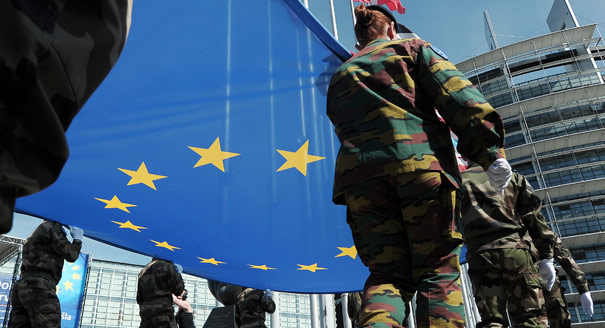
Source: Getty
Over the past year, European defense collaboration has arguably made more progress than in the past decade.
Source: German Marshall Fund
Over the past year, European defense collaboration has arguably made more progress than in the past decade. Significantly, unlike past attempts to deepen European defense, there seems to be both genuine political will and a sense of urgency this time around. Although many of the current initiatives date back several years, the election of Donald Trump has raised questions about the continued military reliance on the United States, and Britain’s exit from the EU means less internal opposition to ambitious EU defense proposals. Meanwhile, France’s new president Emanuel Macron has turned out to be a strong proponent of deeper EU defense collaboration. Even NATO seems to welcome a stronger European pillar. Gone are the age-old theological debates about EU versus NATO. Today, it is widely recognized that both organizations play crucial and complementary roles in providing for European security. Recent European defense initiatives, such as Permanent Structured Cooperation (PESCO) and the European Defence Fund (EDF), have the potential to make a distinct contribution to transatlantic security. But success also requires that they are correctly implemented and sufficiently integrated with NATO efforts to avoid duplication. As European capitals contemplate further steps to move forward on European defense collaboration, it is essential that they take into account viewpoints from the other side of the Atlantic.
This policy brief was originally published by the German Marshall Fund.
Former Director, Europe Program, Fellow
Erik Brattberg was director of the Europe Program and a fellow at the Carnegie Endowment for International Peace in Washington. He is an expert on European politics and security and transatlantic relations.
Recent Work



Cornelius Adebahr, Dan Baer, Rosa Balfour, …

Erik Brattberg, Philippe Le Corre, Paul Stronski, …
Carnegie does not take institutional positions on public policy issues; the views represented herein are those of the author(s) and do not necessarily reflect the views of Carnegie, its staff, or its trustees.

But their "principal to principal" model will only be as effective as the political strength of each leader back home.

Damien Ma

U.S. unpredictability has allowed China to capitalize on its positioning as the “responsible great power”. Paradoxically, the more China wins the perception game, the more likely expectations will rise for Beijing to deliver not just words but to demonstrate with its deeds.

Chong Ja Ian

Hanoi and Beijing have long treated each other as distant cousins rather than comrades in arms. That might be changing as both sides draw closer to hedge against uncertainty and America’s erratic behavior.

Nguyễn Khắc Giang

Across Asia, China is better positioned to withstand energy shocks from the fallout of the Iran war. Its abundant coal capacity can ensure stability in the near term. Yet at the same time, the country’s energy transition away from coal will make it even less vulnerable during the next shock.
Damien Ma

Malaysia’s chairmanship sought to fend off short-term challenges while laying the groundwork for minimizing ASEAN’s longer-term exposure to external stresses.

Elina Noor