

Commentary
Judy Dempsey
{
  "authors": [
    "Judy Dempsey"
  ],
  "type": "legacyinthemedia",
  "centerAffiliationAll": "dc",
  "centers": [
    "Carnegie Endowment for International Peace",
    "Carnegie Europe"
  ],
  "collections": [
    "Europe’s Eastern Neighborhood"
  ],
  "englishNewsletterAll": "ctw",
  "nonEnglishNewsletterAll": "",
  "primaryCenter": "Carnegie Europe",
  "programAffiliation": "EP",
  "programs": [
    "Europe"
  ],
  "projects": [],
  "regions": [
    "Europe",
    "Iran"
  ],
  "topics": [
    "Foreign Policy",
    "EU"
  ]
}
Source: Getty
The leaders of Serbia and Kosovo believe swapping territory will create stability in the western Balkans, but this proposal presents enormous risks for the broader region.
Source: Washington Post
The leaders of Serbia and Kosovo are planning to swap territory. They say it will ease ethnic tensions and contribute to stability in the western Balkans. Some commentators and politicians think it is a great idea.
Don’t bet on it. The proposals present enormous risks — not only for the countries themselves but also for the broader region. Indeed, they could set an ominous precedent for leaders who harbor separatist ambitions.
What Kosovo President Hashim Thaci refers to as a “border adjustment” could easily prompt nationalists in this part of Europe to demand similar changes. It could offer destructive inspiration to Croatia, Albania, Bosnia and Macedonia, where nationalist movements and some of the leaders yearn to have their own ethnically homogeneous countries.
German Chancellor Angela Merkel has come out strongly against the plan, citing the need to safeguard “the territorial integrity” of states in the region. She is right. As one of the few European leaders who has consistently taken a close interest in the Western Balkans, she knows stability is fragile.
Astonishingly, the United States disagrees with Merkel’s view. “The U.S. policy is that if the two parties can work it out between themselves and reach agreement, we don’t exclude territorial adjustments,” said national security adviser John Bolton. “We would not stand in the way, and I don’t think anybody in Europe would stand in the way if the two parties to the dispute reached a mutually satisfactory settlement,” he added.
Serbian President Aleksander Vucic has his own agenda behind the land swap. He has never recognized the independence of Kosovo, which it unilaterally declared in 2008. For many Serbs, Kosovo is still regarded as a cradle of Serb history and culture.
Several European Union member countries, notably Spain and Greece, do not recognize Kosovo’s independence. (Spain fears the implications for Catalonian demands for independence, and Greece is a long-standing supporter of Serbia.) But Vucic is also desperate for his country to join the E.U. He can do so only if Serbia recognizes Kosovo. But because he cannot afford to alienate his nationalist supporters, he believes he can square the circle by a border swap.
The current version of the plan would entail swapping the northern part of Mitrovica, which is a part of Kosovo where Serbs are in the majority, with Serbia’s Presevo Valley, where ethnic Albanians are in the majority. The ethnic Albanians in Mitrovica are already opposing the idea, as are ethnic Serbs in the Presevo Valley. It is far from clear what would happen to these ethnic minorities. The potential for conflict is huge, especially because neither Vucic nor Thaci have yet reached out to the Serb and ethnic Albanian communities to explain the practical implications of any land swap.
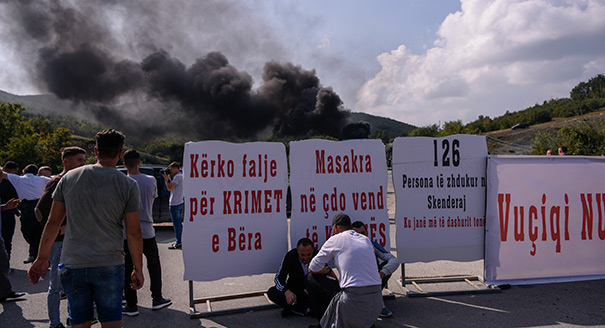
In Kosovo itself, it is simply not stable enough to undergo such a border swap. NATO, which intervened in 1999 to stop former Serbian strongman Slobodan Milosevic’s brutal policy of ethnic cleansing of the Albanians in Kosovo, ended the war in the former Yugoslavia. But the ethnic hatred between Serbs and Kosovars has continued. That’s why NATO still has more than 4,000 NATO troops deployed in the country: to keep the peace. When Vucic visited Kosovo earlier this month, he was prevented by ethnic Albanian war veterans from visiting a village dominated by Serbs. It showed the depth of the distrust of the proposed land swap.
Since 1999, the E.U. has poured a staggering $2.6 billion into Kosovo with the aim of building democratic institutions, the rule of law and a strong independent judiciary. Yet, the actual achievements have been dismal, thanks to Brussels’ failure to take effective measures to combat endemic corruption and end the politicization of the courts.
Beyond Kosovo and Serbia, the proposal to swap territory carries big risks.
Border adjustments — which rarely happen in times of peace — need strong and democratic institutions to allow them to happen peacefully. (The breakup of Czechoslovakia was a rare exception.) In the Western Balkans, however, such institutions are very weak, the economies are dominated by local oligarchs, corruption is rife, and civil society is under immense pressure from the political elites.
Take Bosnia. In the mid-1990s, the country was split into two autonomous regions — a federation of Muslim Bosniaks and Croats on the one hand and the Serb Republic on the other. The central government and administration remains weak and divided, while the E.U. has been too ineffective in overseeing the implementation of political and economic reforms. A Serb-Kosovo deal could hand the Croats and the Serbs in Bosnia a golden opportunity to bolt. Both could try to unite territorially with Croatia and Serbia.
As for Macedonia, its new, liberal leadership — which has negotiated with Greece to reach agreement over a new name — hopes it is now firmly on the path to the E.U. and NATO. But the territorial swap between Kosovo and Serbia could scupper such progress. It could play into the hands of nationalists who oppose the rapprochement with Greece and of ethnic Albanian nationalists in Macedonia who could campaign for their own autonomous region.
The risks, in short, cannot be downplayed. Europe is already engulfed in nationalist, anti-immigration and populist politics that home in on ethnic identity. And even if Serb and Kosovar leaders pledge that their plans for border changes would be exclusively for these two countries alone, there are no proposals about how that pledge would be guaranteed.
This article was originally published in the Washington Post.

Nonresident Senior Fellow, Carnegie Europe
Judy Dempsey is a nonresident senior fellow at Carnegie Europe
Recent Work
Judy Dempsey
Judy Dempsey
Carnegie does not take institutional positions on public policy issues; the views represented herein are those of the author(s) and do not necessarily reflect the views of Carnegie, its staff, or its trustees.

But their "principal to principal" model will only be as effective as the political strength of each leader back home.

Damien Ma

U.S. unpredictability has allowed China to capitalize on its positioning as the “responsible great power”. Paradoxically, the more China wins the perception game, the more likely expectations will rise for Beijing to deliver not just words but to demonstrate with its deeds.

Chong Ja Ian

Hanoi and Beijing have long treated each other as distant cousins rather than comrades in arms. That might be changing as both sides draw closer to hedge against uncertainty and America’s erratic behavior.

Nguyễn Khắc Giang

Across Asia, China is better positioned to withstand energy shocks from the fallout of the Iran war. Its abundant coal capacity can ensure stability in the near term. Yet at the same time, the country’s energy transition away from coal will make it even less vulnerable during the next shock.
Damien Ma

Malaysia’s chairmanship sought to fend off short-term challenges while laying the groundwork for minimizing ASEAN’s longer-term exposure to external stresses.

Elina Noor