

Commentary
- +11
Cornelius Adebahr, Dan Baer, Rosa Balfour, …
{
  "authors": [
    "Erik Brattberg"
  ],
  "type": "commentary",
  "centerAffiliationAll": "dc",
  "centers": [
    "Carnegie Endowment for International Peace"
  ],
  "collections": [],
  "englishNewsletterAll": "ctw",
  "nonEnglishNewsletterAll": "",
  "primaryCenter": "Carnegie Endowment for International Peace",
  "programAffiliation": "EP",
  "programs": [
    "Europe"
  ],
  "projects": [],
  "regions": [
    "North America",
    "United States",
    "Iran"
  ],
  "topics": [
    "Political Reform",
    "Foreign Policy"
  ]
}
Source: Getty
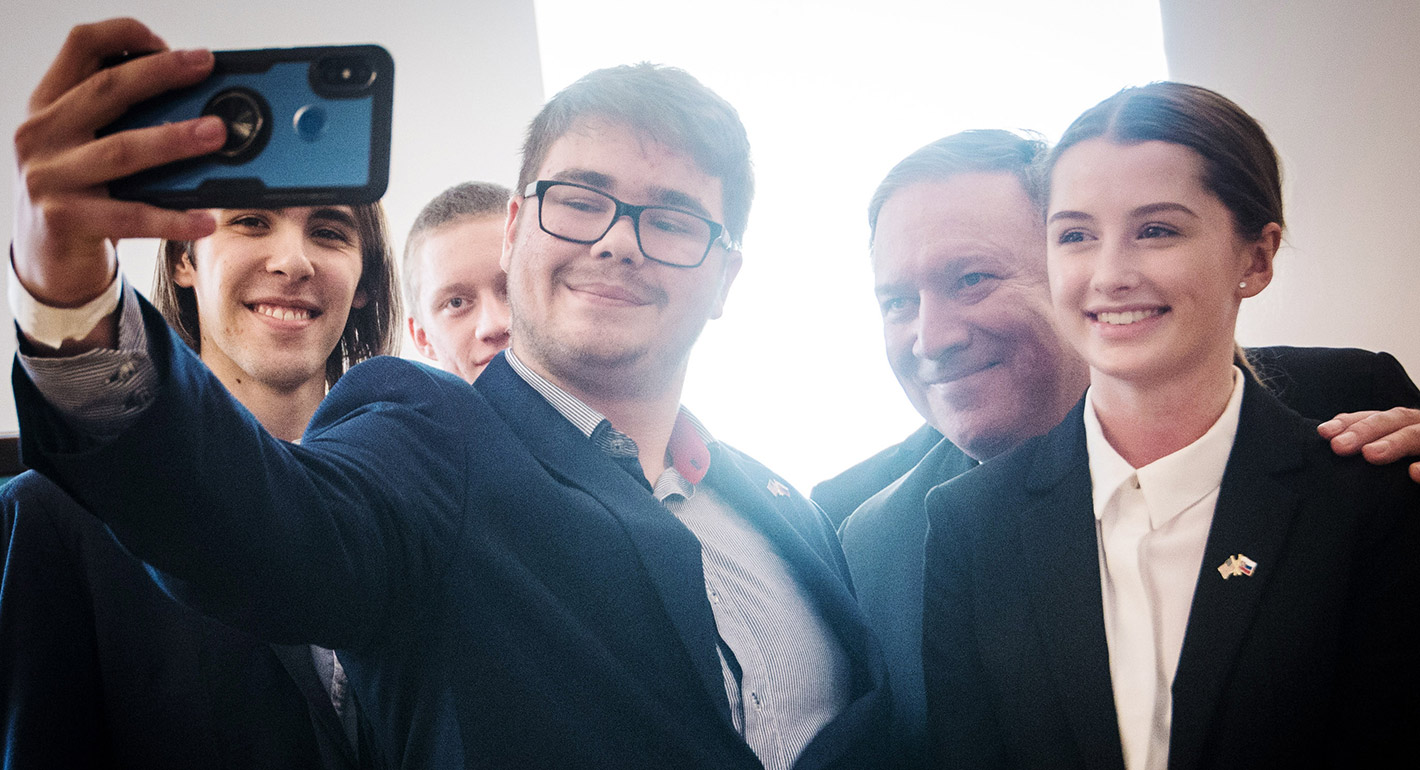
U.S. Secretary of State Mike Pompeo toured Central Europe this week. The United States needs these countries as a buffer against its competitors to the east. But ignoring their drift towards internal repression would be foolish.
When U.S. Secretary of State Mike Pompeo’s visited Europe this week, he stopped in Budapest, Bratislava, and Warsaw. The destinations were a window into the Trump administration’s strategy to reengage allies in Central Europe, who are confronting growing pressure from Russia and China.
Devoting more attention to Central Europe is sensible, given the need to keep vulnerable allies close amid rising geopolitical pressure from Russia and China.
But Washington must also use its influence to push back against illiberal trends and democratic backsliding in states such as Hungary and Poland. The Obama administration shunned nationalist, populist leaders like Hungary’s Viktor Orbán. By contrast, the Trump administration has concentrated on security relationships, while publicly downplaying the importance of democracy and the rule of law (although Pompeo, to his credit, did meet with Hungarian civil society and promised more U.S. support for independent journalism in Hungary).
The Trump administration views nationalist leaders in Central Europe as likeminded—for instance, when it comes to supporting tough immigration policies. Trump praised both Hungary and Poland in his speech before the UN General Assembly in September 2018, where he delivered a strong nationalist message. Trump’s visit to Warsaw in July 2017 was also interpreted by some in the Polish government as an endorsement of its policies, and a snub against the EU.
However, the swing towards repression in some countries in Central and Eastern Europe is a worrying internal threat to the transatlantic community and the values underpinning it. In Freedom House’s 2019 Freedom in the World rankings, Hungary dropped from “free” to “partly free,” as its independent judiciary, civil society, and media face growing pressures from Orbán’s government.
What’s more: Russia and China stand to benefit from these authoritarian tendencies. Hungary is already a proponent of stronger relations with Vladimir Putin and has sought to prevent EU sanctions against Russia and NATO’s engagement with Ukraine. Similarly, Hungary is openly inviting Chinese investments (including on 5G development) and has tried to block or weaken EU statements concerning China’s actions in the South China Sea, human rights violations, and the Belt and Road Initiative. Hungary’s inability to tackle corruption also provides opportunities for Russian and Chinese influence.
Isolating troublesome Central European allies like Hungary makes little sense. But if the United States only reengages with countries in Central and Eastern Europe on security—without explicitly addressing other concerns—it will damage U.S. interests in the region. To push back against Russia’s and China’s efforts to spread authoritarian influence in Europe, it is ultimately up to the U.S. and EU to show Central and Eastern European countries why Western democratic values and norms are more appealing than authoritarian-style politics and investment.
Former Director, Europe Program, Fellow
Erik Brattberg was director of the Europe Program and a fellow at the Carnegie Endowment for International Peace in Washington. He is an expert on European politics and security and transatlantic relations.
Recent Work


Cornelius Adebahr, Dan Baer, Rosa Balfour, …

Erik Brattberg, Philippe Le Corre, Paul Stronski, …
Carnegie does not take institutional positions on public policy issues; the views represented herein are those of the author(s) and do not necessarily reflect the views of Carnegie, its staff, or its trustees.

But their "principal to principal" model will only be as effective as the political strength of each leader back home.

Damien Ma

U.S. unpredictability has allowed China to capitalize on its positioning as the “responsible great power”. Paradoxically, the more China wins the perception game, the more likely expectations will rise for Beijing to deliver not just words but to demonstrate with its deeds.

Chong Ja Ian

Hanoi and Beijing have long treated each other as distant cousins rather than comrades in arms. That might be changing as both sides draw closer to hedge against uncertainty and America’s erratic behavior.

Nguyễn Khắc Giang

Across Asia, China is better positioned to withstand energy shocks from the fallout of the Iran war. Its abundant coal capacity can ensure stability in the near term. Yet at the same time, the country’s energy transition away from coal will make it even less vulnerable during the next shock.
Damien Ma

Malaysia’s chairmanship sought to fend off short-term challenges while laying the groundwork for minimizing ASEAN’s longer-term exposure to external stresses.

Elina Noor