

Commentary
Dmitri Trenin
{
  "authors": [
    "Dmitri Trenin"
  ],
  "type": "legacyinthemedia",
  "centerAffiliationAll": "",
  "centers": [
    "Carnegie Endowment for International Peace",
    "Carnegie Russia Eurasia Center"
  ],
  "collections": [
    "Pax Sinica"
  ],
  "englishNewsletterAll": "",
  "nonEnglishNewsletterAll": "",
  "primaryCenter": "Carnegie Russia Eurasia Center",
  "programAffiliation": "",
  "programs": [],
  "projects": [],
  "regions": [
    "North America",
    "United States",
    "East Asia",
    "China",
    "Russia"
  ],
  "topics": [
    "Foreign Policy"
  ]
}
Source: Getty
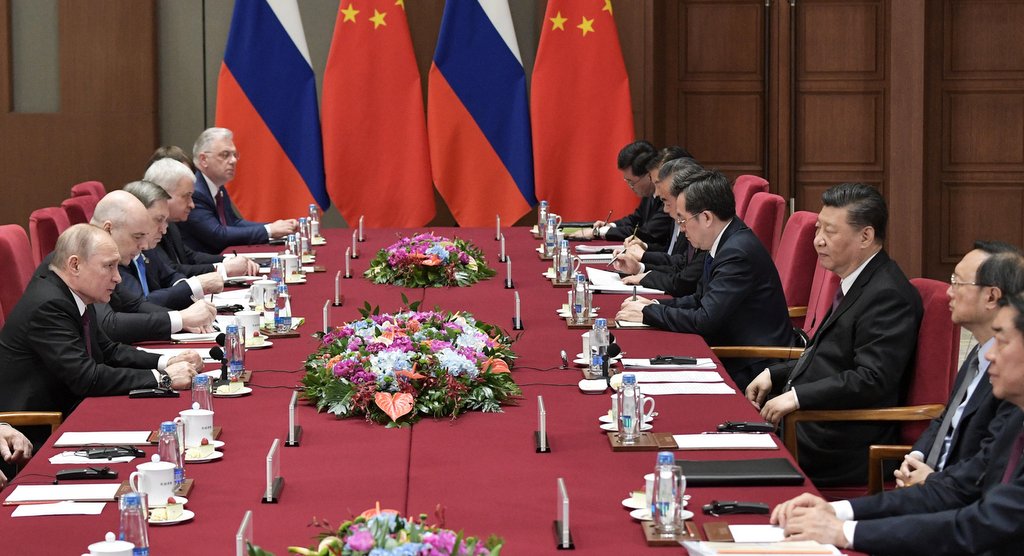
Moscow and Beijing will continue to have their differences, and they are not entirely free from reciprocal phobias, but the chances of a China–Russia collision over those differences are being minimised by the US policy of dual containment.
Source: East Asia Forum
The United States has recently entered a period of great-power rivalry with China and confrontation with Russia. The China–Russia rapprochement has simultaneously acquired the quality of an entente: a basic proximity of worldviews and close coordination of policies short of a formal alliance.
This realignment is due to the inability to construct an inclusive world order that accommodates all major players after the Cold War. It also demonstrates the limits of single-power dominance — the Pax Americana — that could only last as long as the United States remained willing to carry the burden and other main actors acquiesced to its hegemony. The historical norm of competition among great powers is back. US–China and US–Russia rivalries will probably grow in intensity until a new balance is established.
Both the rivalries and the entente are highly asymmetrical. The United States, China, and Russia have vastly different capabilities and resources. They belong in the same category in one sense only — they are the world’s three most powerful military and geopolitical players whose interactions massively impact the global strategic order. Each country has its own agenda, objectives, strategies and tactics. This is a new pattern of relations, different both from the Cold War era and the European rivalries of the 18th and 19th centuries.
The United States seeks to retain its global pre-eminence now that dominance is no longer sustainable. Washington sees Beijing as its prime rival, capable of overtaking it economically and potentially technologically, while it regards Moscow as essentially a spoiler with outsized ambitions. But the United States is just beginning an internal debate on its future world role and foreign policy goals. At this point one thing appears clear: to stay competitive, the United States will have to pay more attention to its domestic base, and will demand more from its allies.
China works to continue its global ascent, even as its prime focus continues to be on domestic development and, above all, maintaining political and social order. China’s global presence and influence is expanding, though Beijing is still restrained by insufficient experience in many regions, plus the fact that its armed forces are not battle-tested. China’s strategy probably aims at steadily enhancing Beijing’s weight in the international system, gradually displacing the United States from its leading positions. Relations with Russia serve China to assure it a stable geopolitical rear and a flow of resources, from energy to military technology.
Russia tries to consolidate its newly restored status as a great power, though on a much smaller scale compared to the Soviet and imperial periods. Moscow is not competing for global primacy with Washington, nor for continental predominance with Beijing. Rather, Russia seeks to maintain its geopolitical and security sovereignty vis-à-vis both the United States and China. For the foreseeable future, Moscow regards Washington as its principal adversary, and Beijing as its main partner. But it is careful not to become overly dependent on the latter.
The Trump Administration is following a highly unorthodox course of pressuring both China and Russia as the United States’ two major power rivals. This stance is unusual — in the past Washington avoided pushing Beijing and Moscow too close to each other.
The departure from traditional practices can be explained by general US disdain regarding Russia; a belief that China secretly shares that disdain; and by American calculus that China–Russia differences are too serious and deep to allow a solid anti-US bloc. In the end, the theory goes, Russia would abandon China either because most opportunities for its development lie in the west, or because over time an emboldened China will start treating Russia as a tributary state, which the Russians will resent.
This calculus is partly borne out by recent developments. After 2014, China balked at an opportunity to massively support Russia which found itself under US-led sanctions. Beijing was clearly mindful of its much bigger stake in economic relations with the United States, and probably also unsure of whether it would be able to successfully manage too close a relationship with Russia.
Bilateral ties grew stronger, with China extending credits to Russian energy companies in exchange for access to Russia’s energy deposits. The Chinese People’s Liberation Army also gained access to more advanced Russian military technology, and there is more joint military training and diplomatic coordination between the two countries. But the former Moscow–Beijing bloc has not been revived.
Yet Russia’s overall geopolitical posture has changed fundamentally over recent years. Russia’s attempted integration with the West is history. As part of the global non-West, Russia will not join China, but will not help the United States deal with China’s rise either. Moscow would probably benefit from Beijing continuing to chip away at Washington’s positions in various fields.
Russia will continue to collaborate with China in constructing a continental order in Greater Eurasia that pointedly excludes the United States. Of course, China and Russia have ample reason to cooperate even without the US factor, but Washington’s pressure brings them even closer together.
Moscow and Beijing will continue to have their differences, and they are not entirely free from reciprocal phobias, but the chances of a China–Russia collision over those differences are being minimised by the US policy of dual containment. This policy, ironically, also relieves both countries’ elites of lingering suspicions that the United States might build a bond with either China or Russia at the expense of the other.
Former Director, Carnegie Moscow Center
Trenin was director of the Carnegie Moscow Center from 2008 to early 2022.
Recent Work
Dmitri Trenin
Dmitri Trenin
Carnegie does not take institutional positions on public policy issues; the views represented herein are those of the author(s) and do not necessarily reflect the views of Carnegie, its staff, or its trustees.

China’s political future will be shaped between now and next October. As the Communist Party enters its intense “campaign season” to prepare for a major political transition in 2027, reading Beijing's actions and responses may become more difficult as domestic politics weigh on its behavior more than usual.

Damien Ma
China has showcased its engineering prowess with small modular reactor demonstration projects. But turning these technological achievements into commercial success will be a greater challenge.

Tong Zhao

The Plaza Accord was not an externally imposed punishment of Japan but part of a broader restructuring that Japanese economists and policymakers themselves recognized was necessary. Its effects were undermined, however, when Tokyo responded to the resulting slowdown with policies that exacerbated investment, credit expansion, and the very imbalances the adjustment was intended to resolve.

Michael Pettis

The nuclear relationship between China and the United States is increasingly shaped by widening perception gaps rather than deliberate strategic design.
Tong Zhao
China’s banking crisis in the 2000s was resolved by transferring the costs to households through financial repression—a decision that recapitalized the banks while exacerbating the structural imbalances that continue to shape the Chinese economy today.
Michael Pettis