

Research
- +6
Yasmine Farouk, Nathan J. Brown, Maysaa Shuja Al-Deen, …
{
  "authors": [
    "Michele Dunne"
  ],
  "type": "legacyinthemedia",
  "centerAffiliationAll": "dc",
  "centers": [
    "Carnegie Endowment for International Peace"
  ],
  "collections": [],
  "englishNewsletterAll": "menaTransitions",
  "nonEnglishNewsletterAll": "",
  "primaryCenter": "Carnegie Endowment for International Peace",
  "programAffiliation": "MEP",
  "programs": [
    "Middle East"
  ],
  "projects": [],
  "regions": [
    "North Africa",
    "Egypt"
  ],
  "topics": [
    "Political Reform",
    "Democracy",
    "Security",
    "Global Governance",
    "Foreign Policy"
  ]
}
Source: Getty
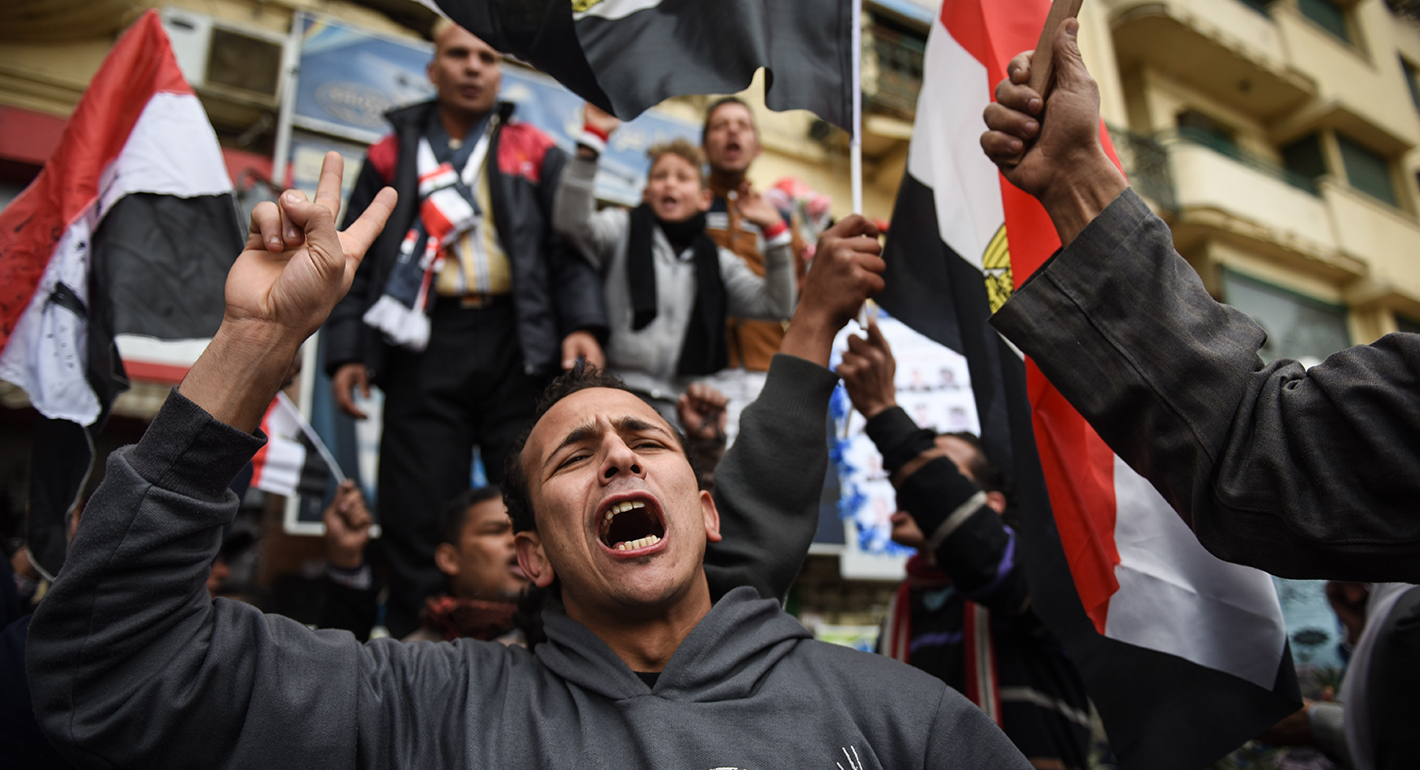
Nearly all political and social movements active before the coup have been crushed, leaving few leaders to formulate coherent protest demands or to negotiate with the military and security apparatus.
Source: Axios
Chaotic protests across Egypt this weekend — prompted by videos exposing corruption in President Abdel Fattah el-Sisi's military-backed government — underscore the population's weariness with economic hardship due in part to government austerity measures.
Why it matters: While Sisi markets Egypt as an island of stability in a turbulent region, popular dissatisfaction with his regime threatens that image. Whether the protests escalate or fizzle, the country remains a potential powder keg in a highly strategic location: straddling the Suez Canal, flanked by Israel and Libya, and across the Mediterranean from Europe.
Where it stands: Authorities have arrested several hundred protestors so far. Meanwhile, Sisi is in New York for the meeting of the UN General Assembly.
Background: Sisi has ruled with an iron fist, killing several thousand and imprisoning some 60,000.
Between the lines: While Sisi has sharply increased the military’s share of economic activity and political power, those benefits fall unequally, giving rise to internal power struggles.
The bottom line: While there is no clear path to peaceful change, Sisi’s continued rule promises to drive Egyptians into increasingly desperate circumstances, as well as to increase security headaches for Europe and the U.S., which funds Egypt’s military to the tune of $1.3 billion annually.

Former Nonresident Scholar, Middle East Program
Michele Dunne was a nonresident scholar in Carnegie’s Middle East Program, where her research focuses on political and economic change in Arab countries, particularly Egypt, as well as U.S. policy in the Middle East.
Recent Work



Yasmine Farouk, Nathan J. Brown, Maysaa Shuja Al-Deen, …
Robert Springborg, Emile Hokayem, Becca Wasser, …
Carnegie does not take institutional positions on public policy issues; the views represented herein are those of the author(s) and do not necessarily reflect the views of Carnegie, its staff, or its trustees.

But their "principal to principal" model will only be as effective as the political strength of each leader back home.

Damien Ma

U.S. unpredictability has allowed China to capitalize on its positioning as the “responsible great power”. Paradoxically, the more China wins the perception game, the more likely expectations will rise for Beijing to deliver not just words but to demonstrate with its deeds.

Chong Ja Ian

Hanoi and Beijing have long treated each other as distant cousins rather than comrades in arms. That might be changing as both sides draw closer to hedge against uncertainty and America’s erratic behavior.

Nguyễn Khắc Giang

Across Asia, China is better positioned to withstand energy shocks from the fallout of the Iran war. Its abundant coal capacity can ensure stability in the near term. Yet at the same time, the country’s energy transition away from coal will make it even less vulnerable during the next shock.
Damien Ma

Malaysia’s chairmanship sought to fend off short-term challenges while laying the groundwork for minimizing ASEAN’s longer-term exposure to external stresses.

Elina Noor