

Article
Frederic Wehrey, Charles H. Johnson
{
  "authors": [
    "Frederic Wehrey"
  ],
  "type": "legacyinthemedia",
  "centerAffiliationAll": "",
  "centers": [
    "Carnegie Endowment for International Peace",
    "Malcolm H. Kerr Carnegie Middle East Center"
  ],
  "collections": [],
  "englishNewsletterAll": "",
  "nonEnglishNewsletterAll": "",
  "primaryCenter": "Malcolm H. Kerr Carnegie Middle East Center",
  "programAffiliation": "",
  "programs": [],
  "projects": [],
  "regions": [
    "Middle East",
    "Türkiye",
    "North Africa",
    "Libya",
    "Syria",
    "Levant"
  ],
  "topics": [
    "Political Reform",
    "Security",
    "Foreign Policy"
  ]
}
Source: Getty
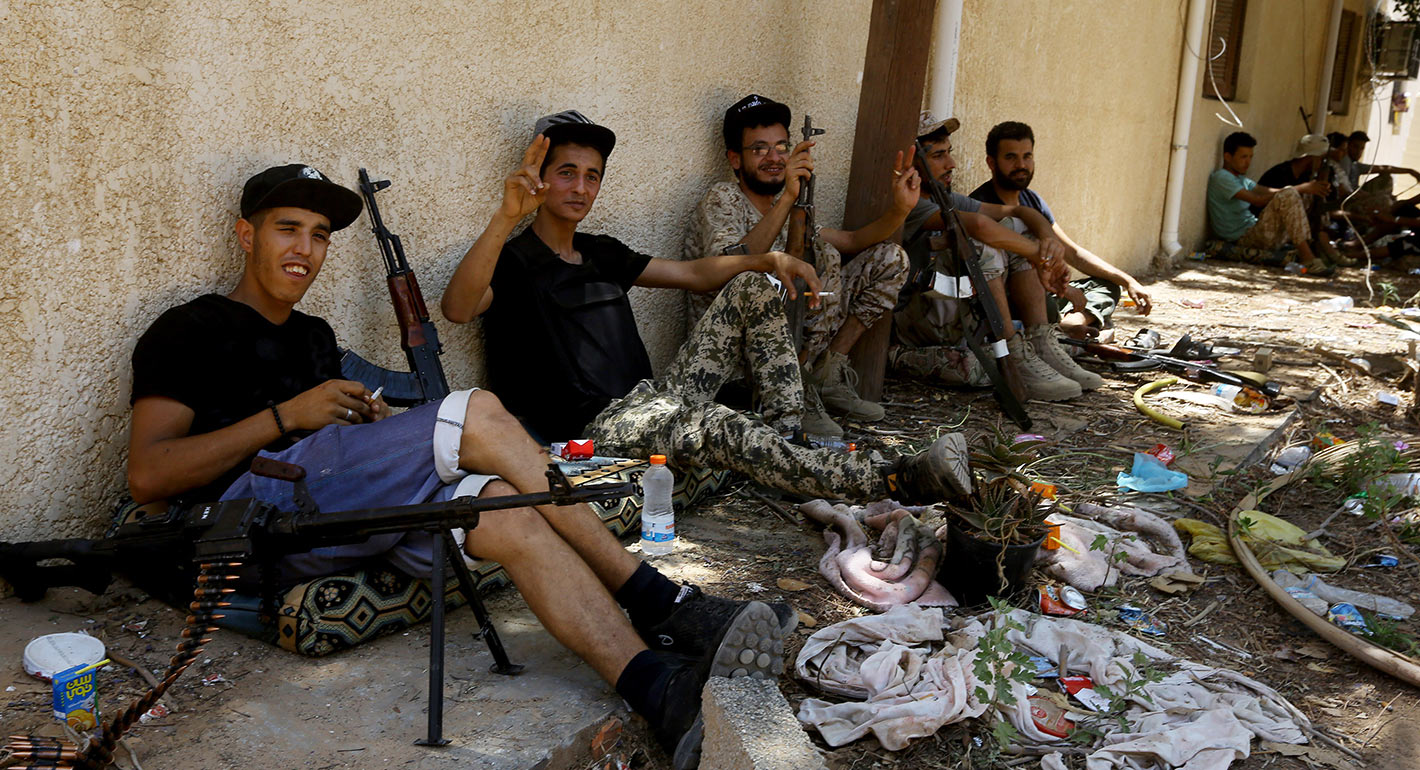
Turkey’s military intervention in Libya, involving the deployment of Syrian fighters, is the latest chess move in a long-running civil war that followed the 2011 revolution, the NATO-led intervention, and the overthrow of the dictator Muammar Qaddafi.
Source: New York Review of Books
Tripoli, Libya—At a mud-caked intersection this month, some hundred-and-fifty feet from the front line, a lanky militia fighter approached and then abruptly turned around when he saw me, a Westerner. I’ve been covering Libya’s conflicts for years and noticed some minor but distinctive details about his appearance: a do-rag tied around his head, an olive green tactical vest, and perhaps a certain military bearing. The Libyan commander I was with confirmed it, with a chuckle: “That’s not a Libyan look.”
Fifteen minutes later, I was inside a poured-concrete villa that served as the living quarters for a group of war-hardened Syrian fighters. Seated before me on a plush purple couch, behind a coffee table strewn with ash-trays and blown-glass decanters, was the Syrians’ leader, a thirty-four-year-old former Syrian military officer named Ahmed, and two other Syrian fighters. Numbering roughly five hundred on this section of the front, they told me they’d been in Libya several days and were part of a larger contingent of roughly two thousand Syrian militiamen that started arriving a month ago, along with Turkish military personnel. There are plans, they said, for an additional six thousand Syrian fighters.
Turkey’s military intervention in Libya, involving the deployment of Syrian fighters, is the latest chess move in a long-running civil war that followed the 2011 revolution, the NATO-led intervention, and the overthrow of the dictator Muammar Qaddafi. Since then, this oil-rich country has disintegrated into a patchwork of regions, towns, and militias sparring over power and wealth.
This article was originally published in the New York Review of Books.
Senior Fellow, Middle East Program
Frederic Wehrey is a senior fellow in the Middle East Program at the Carnegie Endowment for International Peace, where his research focuses on governance, conflict, and security in Libya, North Africa, and the Persian Gulf.
Recent Work
Frederic Wehrey, Charles H. Johnson
Frederic Wehrey, Charles H. Johnson
Carnegie does not take institutional positions on public policy issues; the views represented herein are those of the author(s) and do not necessarily reflect the views of Carnegie, its staff, or its trustees.

But their "principal to principal" model will only be as effective as the political strength of each leader back home.

Damien Ma

U.S. unpredictability has allowed China to capitalize on its positioning as the “responsible great power”. Paradoxically, the more China wins the perception game, the more likely expectations will rise for Beijing to deliver not just words but to demonstrate with its deeds.

Chong Ja Ian

Hanoi and Beijing have long treated each other as distant cousins rather than comrades in arms. That might be changing as both sides draw closer to hedge against uncertainty and America’s erratic behavior.

Nguyễn Khắc Giang

Across Asia, China is better positioned to withstand energy shocks from the fallout of the Iran war. Its abundant coal capacity can ensure stability in the near term. Yet at the same time, the country’s energy transition away from coal will make it even less vulnerable during the next shock.
Damien Ma

Malaysia’s chairmanship sought to fend off short-term challenges while laying the groundwork for minimizing ASEAN’s longer-term exposure to external stresses.

Elina Noor