
• Commentary
  • Research
  • Experts
  • Events
Carnegie China logoCarnegie lettermark logo
{
  "authors": [
    "Philippe Le Corre",
    "John Ferguson"
  ],
  "type": "legacyinthemedia",
  "centerAffiliationAll": "dc",
  "centers": [
    "Carnegie Endowment for International Peace"
  ],
  "collections": [],
  "englishNewsletterAll": "ctw",
  "nonEnglishNewsletterAll": "",
  "primaryCenter": "Carnegie Endowment for International Peace",
  "programAffiliation": "EP",
  "programs": [
    "Europe"
  ],
  "projects": [],
  "regions": [
    "East Asia",
    "China",
    "Western Europe",
    "France",
    "Germany",
    "Iran"
  ],
  "topics": [
    "Political Reform",
    "Foreign Policy"
  ]
}

Source: Getty

In The Media

China’s Diplomatic Duo Fails to Engineer a Successful Summit with Europe

The meeting—although depicted as a decisive diplomatic victory by Chinese state media—was especially disappointing to Chinese leadership considering they were trying to accomplish larger geostrategic goals. One was to prevent the creation of a united transatlantic front against China.

Link Copied
By Philippe Le Corre and John Ferguson
Published on Sep 21, 2020

Source: National Interest

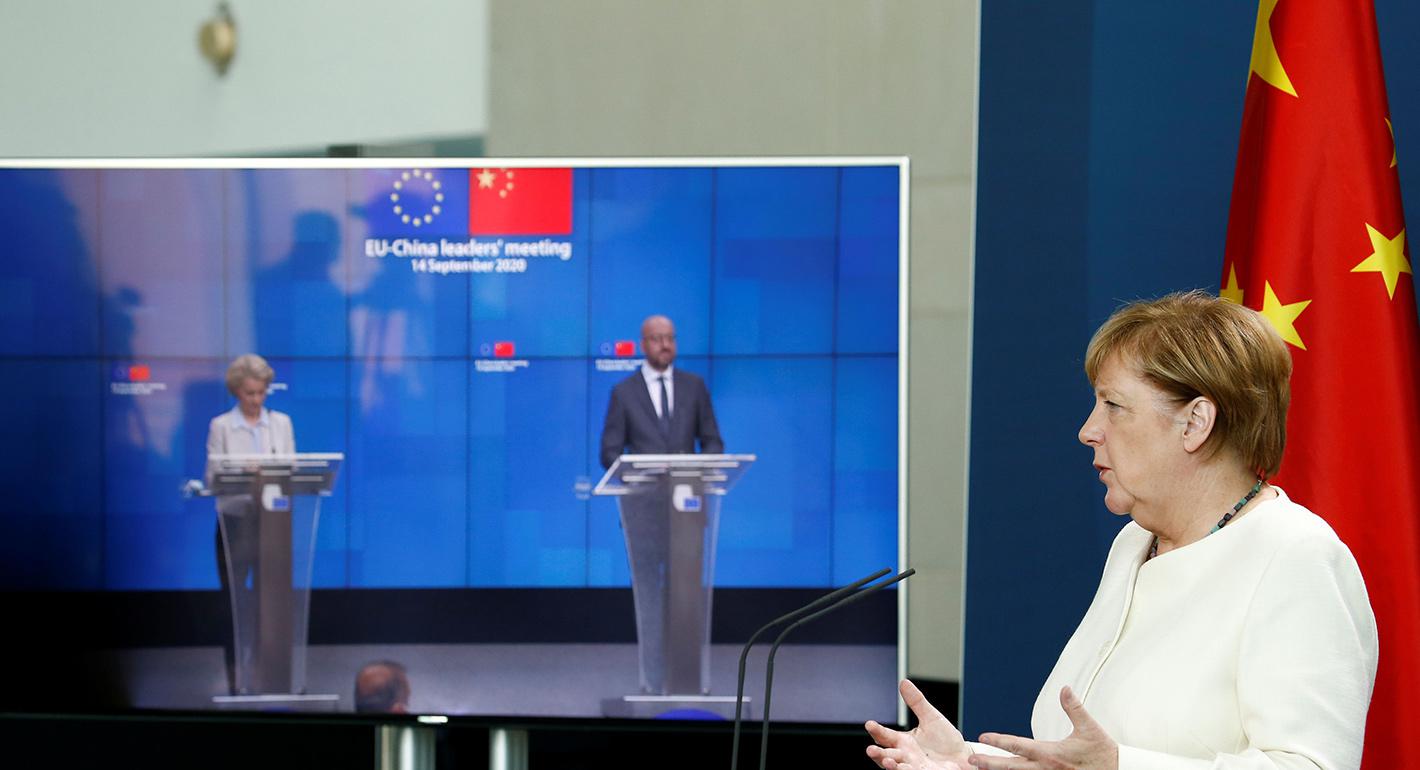
While China had declared 2020 a critical year for relations with Europe, the EU-China virtual summit which took place on September 14 between Chinese president Xi Jinping and EU leaders German Chancellor Angela Merkel, European Council head Charles Michel, and Commission President Ursula von der Leyen fell short of expectations. Some Europeans were optimistically hoping to conclude the negotiations on the long-awaited Common Agreement on Investment, which have now dragged into their seventh year. Others in Brussels were relieved that the summit didn’t take place in Leipzig in the presence of the twenty-eight leaders (twenty-seven EU countries and China) as was originally planned by Germany, the holder of the six-month rotating presidency. In the end, despite statements about what has been achieved in the meeting by European leaders—addressing Chinese state aid and addressing technology transfers from Europe to China—the actual outcome had little substance. In particular, China did not agree on economic reciprocity—the primary demand from the European side.

The meeting—although depicted as a decisive diplomatic victory by Chinese state media—was especially disappointing to Chinese leadership considering they were trying to accomplish larger geostrategic goals. One was to prevent the creation of a united transatlantic front against China, spurred on by recent visits to Western and Central Europe by U.S. Secretary of State Mike Pompeo and National Security Adviser Robert O’Brien. Rejecting any kind of strategic alignment either in the direction of the United States or China, President Charles Michel told reporters afterward “Europe is a player, not a playing field.” The second broad Chinese goal was to reassure Europeans after souring relations this year after coronavirus. Still reeling from the pandemic, the accompanying economic recession, and now—what many perceive to be an opportunistic expansion of Chinese aggression—Europe has recently channeled pain and anger into pushback on contentious foreign policy issues against China, mainly on Huawei (5G) and Hong Kong, but also on the treatment by the PRC of the Uighur minority in Xinjiang.

Read the Full Text

This article was originally published by the National Interest.

About the Authors

Philippe Le Corre

Former Nonresident Senior Fellow, Europe Program

Philippe Le Corre was a nonresident senior fellow in the Europe Program at the Carnegie Endowment for International Peace.

John Ferguson

John Ferguson is a research assistant at the Harvard Kennedy School’s M-RCBG.

Authors

Philippe Le Corre
Former Nonresident Senior Fellow, Europe Program
John Ferguson

John Ferguson is a research assistant at the Harvard Kennedy School’s M-RCBG.

Political ReformForeign PolicyEast AsiaChinaWestern EuropeFranceGermanyIran

Carnegie does not take institutional positions on public policy issues; the views represented herein are those of the author(s) and do not necessarily reflect the views of Carnegie, its staff, or its trustees.

More Work from Carnegie China

  • Commentary
    China’s Energy Security Doesn’t Run Through Hormuz but Through the Electrification of Everything

    Across Asia, China is better positioned to withstand energy shocks from the fallout of the Iran war. Its abundant coal capacity can ensure stability in the near term. Yet at the same time, the country’s energy transition away from coal will make it even less vulnerable during the next shock.


      • Damien Ma

      Damien Ma

  • Xi walking into a room with people standing and applauding around him
    Commentary
    Emissary
    The Xi Doctrine Zeros in on “High-Quality Development” for China’s Economic Future

    In the latest Five-Year Plan, the Chinese president cements the shift to an innovation-driven economy over a consumption-driven one.

      • Damien Ma

      Damien Ma

  • Commentary
    Malaysia’s Year as ASEAN Chair: Managing Disorder

    Malaysia’s chairmanship sought to fend off short-term challenges while laying the groundwork for minimizing ASEAN’s longer-term exposure to external stresses.

      Elina Noor

  • Commentary
    When It Comes to Superpower Geopolitics, Malaysia Is Staunchly Nonpartisan

    For Malaysia, the conjunction that works is “and” not “or” when it comes to the United States and China.

      Elina Noor

  • Commentary
    ASEAN-China Digital Cooperation: Deeper but Clear-Eyed Engagement

    ASEAN needs to determine how to balance perpetuating the benefits of technology cooperation with China while mitigating the risks of getting caught in the crosshairs of U.S.-China gamesmanship.

      Elina Noor

Get more news and analysis from
Carnegie China
Carnegie China logo, white
Keck Seng Tower133 Cecil Street #10-01ASingapore, 069535Phone: +65 9650 7648
  • Research
  • About
  • Experts
  • Events
  • Contact
  • Careers
  • Privacy
  • For Media
Get more news and analysis from
Carnegie China
© 2026 Carnegie Endowment for International Peace. All rights reserved.






