

Commentary
Alexey Malashenko
Source: Getty
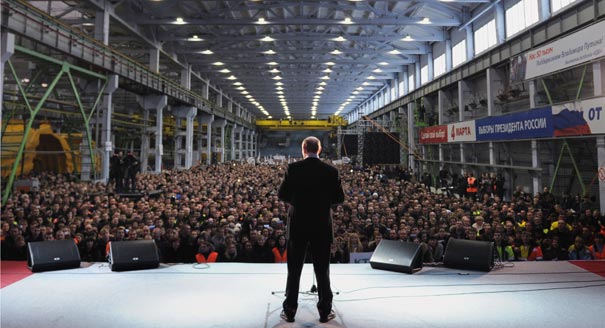
Vladimir Putin secured his return to power in Sunday’s Russian presidential election. Though that result came as no surprise, the issue of what will come next for Russia is still an open question.
Vladimir Putin secured his return to power in Sunday’s Russian presidential election. Though that result came as no surprise, the issue of what will come next for Russia is still an open question.
I would not exclude the possibility that victorious Putin might want to exact some kind of revenge and punish his opponents for all their criticism, protests, and general disobedience. The increased pressure on the Russian mass media, the search for terrorists plotting to eliminate the leading candidate on the eve of the election, and Putin’s statement on the opposition’s possible plans to assassinate some well-known politician in order to provoke unrest in the country all underscore the likelihood of this outcome.
A harsher response from the authorities to ongoing protests against fraud and violations in the presidential election is possible as well. Frightened by the thought of a second round of voting, the authorities pulled out all the stops over the weekend and many election violations were reported.The Kremlin will also continue to crack down on the Russian mass media, especially on electronic outlets—and it might even tighten its grip. Ninety-nine percent of all television programs will remain the official powers’ sanctuaries. The authorities will also continue their search for means by which to turn up the heat on Internet discussions. Studying China’s and Iran’s success in this area keeps Russian law-enforcement officials up at night.
If this proves to be the Russian authorities’ response to the recent events, it would appear that the state is having a “nervous breakdown” of sorts. There are certainly plenty nervous people in the Kremlin right now.
What should we expect in the more distant future?
All the political reforms announced by now-outgoing president Dmitri Medvedev—such as direct elections of regional governors and amendments to the election code—will commence. However, all these reforms are tactical rather than strategic. They reflect the ruling class’s overarching goal of preserving its power at all costs—even if that power has to be retouched a bit with vague democratic strokes.
The party system will be reformed, resulting in the disappearance of the unpopular, heavy-handed United Russia, which looks to have worn out its welcome. New political parties, including some liberal parties, will replace the outdated, outspent organizations, and the Communist Party will be partially reconstructed.
The issue of the Kremlin’s relations with the “informal opposition” will be resolved according to the opposition’s willingness to play by the Kremlin’s rules. If some of the opposition leaders abide by the rules, they will later be allowed into the State Duma. New starts and starlets will also appear on Russia’s political horizon.
I believe that the most important issue will be whether the current ruling class realizes that Russian society has gone through fundamental and possibly irreversible changes, that the old way of governing the state has become ineffective and largely useless. While Putin has returned as president of Russia, “Putinism” as a model of state governance, designed to serve one person whose authority was based on a small clan of close associates, is no more.
Former Scholar in Residence, Religion, Society, and Security Program
Malashenko is a former chair of the Carnegie Moscow Center’s Religion, Society, and Security Program.
Recent Work
Alexey Malashenko
Alexey Malashenko
Carnegie does not take institutional positions on public policy issues; the views represented herein are those of the author(s) and do not necessarily reflect the views of Carnegie, its staff, or its trustees.

But their "principal to principal" model will only be as effective as the political strength of each leader back home.

Damien Ma

U.S. unpredictability has allowed China to capitalize on its positioning as the “responsible great power”. Paradoxically, the more China wins the perception game, the more likely expectations will rise for Beijing to deliver not just words but to demonstrate with its deeds.

Chong Ja Ian

Hanoi and Beijing have long treated each other as distant cousins rather than comrades in arms. That might be changing as both sides draw closer to hedge against uncertainty and America’s erratic behavior.

Nguyễn Khắc Giang

Across Asia, China is better positioned to withstand energy shocks from the fallout of the Iran war. Its abundant coal capacity can ensure stability in the near term. Yet at the same time, the country’s energy transition away from coal will make it even less vulnerable during the next shock.
Damien Ma

In the latest Five-Year Plan, the Chinese president cements the shift to an innovation-driven economy over a consumption-driven one.
Damien Ma