

Commentary
But their "principal to principal" model will only be as effective as the political strength of each leader back home.
Damien Ma
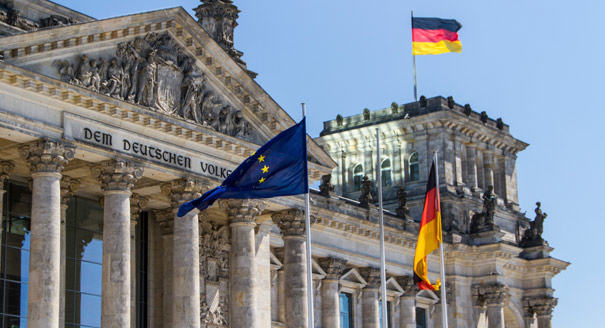
Source: Getty
Germany is a powerful nation, but that power is confined by a number of factors. Going forward, Germany must embrace its strength and become the confident leader that Europe needs.
Germany today is widely regarded as the most powerful country in Europe. But it is often reluctant to take the lead. This hesitance has much to do with the foundations of German power—Berlin has considerable resources but also faces considerable constraints. Most importantly, German power is embedded in the European Union, which both enhances and confines the country’s capability to be a foreign policy player.
And on security, Berlin depends on its Western allies, especially the United States. But as the United States is reducing its footprint in Europe, Germany needs to step up its game.
Germany has come through the global financial crisis in better shape than most European countries. It expects healthy economic growth in years to come, and the official GDP growth forecast for 2014 is 1.75 percent. With its solid manufacturing base and many “hidden champions”―globally successful small and medium-sized businesses―the German economy has drawn worldwide admiration, despite regular criticism of its strong emphasis on exports.
Geography also contributes to German power. Situated in the middle of Europe, the country lies at a crossroads of trans-European flows of goods and people, between Central Europe and Western Europe, between Scandinavia and the Mediterranean. Germany has strong economic, social, and political ties with all its neighbors. It is ideally placed to play a mediating role between the different political, social, and economic views and attitudes in Europe.
Because of its size―the result of a number of wars and a peaceful reunification in 1990―Germany is big enough to play in the European premier league. But at the same time, it is too small and too weak to dominate the continent. Germany’s power depends on its ability to get along with its European neighbors and to cooperate closely with them.
The European Union, shaped mainly by Germany and France, provides the mechanism through which Germany interacts with its neighbors and brings different interests and views together. As long as German power is embedded in the EU, it is acceptable to Berlin’s European partners. EU countries share the same basic norms, and officials from all member states work together with their counterparts from other countries. Member states are closely involved in issues that in the past were purely domestic affairs of others. A network of cooperation spans the continent, reducing the relevance of national borders and providing an abundance of the most important resource in international relations: mutual trust.
Being integrated into the EU protects Germany from the ever-present threat of geopolitical isolation―what former German chancellor Otto von Bismarck once described as the “nightmare of coalitions” directed against Germany. From German unification in 1871 until the middle of the twentieth century, European politics were characterized by increasing competition among great powers of roughly the same size, driven by an ambition to dominate others and a fear of being conquered. Germany was at the center of this geopolitical struggle and, in two world wars, tried to reshape the political order in Europe, with devastating results.
Today, the continent’s central power is a key anchor of geopolitical stability in Europe, thanks to the European integration project, developed under benign U.S. hegemony. Because German power now flows through the channels of review and revision by its European partners, this strength has lost its former threatening character.
The EU not only limits German power, it also enables it, providing an opportunity for Germany to play an important role in shaping European and global politics by multiplying its own weight. If Berlin can assert its position within the EU, that position receives the backing of a potentially powerful union of 28 states, among them two classical great powers, France and Britain. To effectively assert its position, Germany needs to use its weight smartly by integrating the interests of key partners early in the decisionmaking process and by winning allies for its own views.
German power is further confined by political mentalities: German society has a profound aversion to all things military. The deep-seated, popular view that the use of force is almost always wrong puts German leaders in a difficult position and places clear limits on Berlin’s foreign policy.
Although Germany participated in the NATO-led operation in Afghanistan that began in 2001, that intervention appears to have hardened, not softened, Germany’s pacifist outlook. In 2011, Berlin refused to take part in a military campaign in Libya, a move that looked like a rebuff of its key Western allies, the United States, France, and Britain. And while Paris and London were pushing for a harder EU line against the regime of Syrian President Bashar al-Assad, Berlin preferred to apply the brakes, apparently afraid of a process that might end in the use of force.
Ultimately, Germany depends on its Western allies for its security. But these allies expect the country to share some of the burden, including by participating in military operations abroad. Berlin cannot afford to frustrate Washington, London, and Paris too much, or else they might one day conclude that their security alliance is of little use and cut down on their investments. The way for Berlin to resolve this dilemma between internal and external demands is usually to support its allies in ways other than by participating in combat operations.
For traditional powers such as the United States, France, or Britain, the use of force remains a legitimate instrument in their foreign policy toolbox. Germany, by contrast, is not going to consider military intervention abroad in the foreseeable future as a means of achieving any of its foreign policy goals.
The country’s dependence on its allies on defense matters limits Berlin’s power in significant ways. As a consequence of its economic weight, Germany plays in the global political league. But at the same time, it is reliant—more so than most G8 members—on alliances with other Western powers, first and foremost through NATO.
This situation is not going to change anytime soon. According to the agreement between the parties of Germany’s current coalition government, the transatlantic alliance “is and remains the central foundation of our security and defense policy.” There is no desire in Germany to become more independent on military matters.
It follows that Germany’s actions, especially in global politics, are always checked against the risk of endangering this underlying security arrangement. In that regard, the Cold War relationship between the United States and Germany is still alive. What remains unclear is whether Washington will see this relationship as beneficial enough to justify continued investment in it in the future.
Unlike most classical or traditional powers, Germany has no national narrative to back up an active mission in the world. Germans neither see themselves as defenders of universal values or a civilizing mission nor have a sense of superiority that would justify dominance over others.
Since World War II, Germany has developed something quite different: the notion that it is an antipower. The country has built its political identity and its political system on the concept of being the opposite of the Nazi state. Germans today see the Nazi regime, among other things, as a radicalized form of classical power politics—something that they consider themselves lucky to have left behind.
Yet Germany’s rejection of traditional ideas of power should not prevent the country from taking the lead. The United States seems increasingly unwilling to invest in European security and carry out crisis management operations in Europe’s neighborhood. On a range of new challenges from the Syrian civil war to a new geopolitical competition with Russia in Europe’s East, Europeans need to find a new approach. It is clear that a large part of that approach needs to be developed in Berlin.
Without a strong and assertive Germany, there can be no strong and assertive EU in the world. And without a more self-confident EU, the liberal global order―built and underpinned for decades by the United States―might not be sustainable. Germany must start to invest more in an order from which it has benefited so much over the decades.
Ulrich Speck
Former Visiting Scholar, Carnegie Europe
Speck was a visiting scholar at Carnegie Europe in Brussels, where his research focuses on the European Union’s foreign policy and Europe’s strategic role in a changing global environment.
Carnegie does not take institutional positions on public policy issues; the views represented herein are those of the author(s) and do not necessarily reflect the views of Carnegie, its staff, or its trustees.

But their "principal to principal" model will only be as effective as the political strength of each leader back home.

Damien Ma

U.S. unpredictability has allowed China to capitalize on its positioning as the “responsible great power”. Paradoxically, the more China wins the perception game, the more likely expectations will rise for Beijing to deliver not just words but to demonstrate with its deeds.

Chong Ja Ian

Hanoi and Beijing have long treated each other as distant cousins rather than comrades in arms. That might be changing as both sides draw closer to hedge against uncertainty and America’s erratic behavior.

Nguyễn Khắc Giang

Across Asia, China is better positioned to withstand energy shocks from the fallout of the Iran war. Its abundant coal capacity can ensure stability in the near term. Yet at the same time, the country’s energy transition away from coal will make it even less vulnerable during the next shock.
Damien Ma

Malaysia’s chairmanship sought to fend off short-term challenges while laying the groundwork for minimizing ASEAN’s longer-term exposure to external stresses.

Elina Noor