

Commentary
Dmitri Trenin
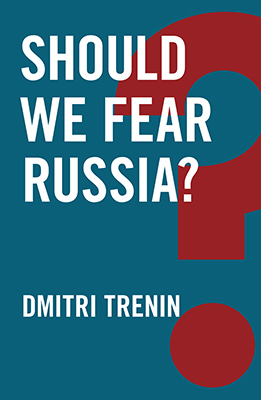
The Cold War analogy is misleading. Relations between the West and Russia are certainly bad and dangerous now but they are bad and dangerous in new ways.
Source: Polity
Since the outbreak of the Ukraine crisis, there has been much talk of a new Cold War between the West and Russia. Under Putin’s authoritarian leadership, Moscow is widely seen as volatile, belligerent and bent on using military force to get its way.
In this incisive analysis, top Russian foreign and security policy analyst Dmitri Trenin explains why the Cold War analogy is misleading. Relations between the West and Russia are certainly bad and dangerous but - he argues - they are bad and dangerous in new ways; crucial differences which make the current rivalry between Russia, the EU and the US all the more fluid and unpredictable. Unpacking the dynamics of this increasingly strained relationship, Trenin makes a compelling case for handling Russia with pragmatism and care rather than simply giving into fear.
“This rich and exceedingly well-written book considers whether the impasse in relations between Russia and the West is due to Putin’s ‘Realpolitik’ or whether it reflects Putin’s lack of realism about Russia’s true national interests. With Trenin we are in good hands. His lively analysis rewards its audience with a stimulating reading and learning experience.”
—Jack Snyder, Columbia University
“Dmitri Trenin is one of the most lucid analysts of Russia writing today. In this short but rich volume, he traces the recent history of misguided policy and conflicts of interest that have produced the current sharp deterioration in relations between Russia and the West. A ‘new normal’ has emerged, he argues. It is not a second Cold War but a period of new challenges and opportunities, in which seeing Russia clearly is critical to peace and security. To that end, there is no better place to start than this present essay.”
—Thomas Graham, Managing Director, Kissinger Associates; former Senior Director for Russia on the US National Security Council staff
Former Director, Carnegie Moscow Center
Trenin was director of the Carnegie Moscow Center from 2008 to early 2022.
Recent Work
Dmitri Trenin
Dmitri Trenin
Carnegie does not take institutional positions on public policy issues; the views represented herein are those of the author(s) and do not necessarily reflect the views of Carnegie, its staff, or its trustees.

But their "principal to principal" model will only be as effective as the political strength of each leader back home.

Damien Ma

U.S. unpredictability has allowed China to capitalize on its positioning as the “responsible great power”. Paradoxically, the more China wins the perception game, the more likely expectations will rise for Beijing to deliver not just words but to demonstrate with its deeds.

Chong Ja Ian

Hanoi and Beijing have long treated each other as distant cousins rather than comrades in arms. That might be changing as both sides draw closer to hedge against uncertainty and America’s erratic behavior.

Nguyễn Khắc Giang

Across Asia, China is better positioned to withstand energy shocks from the fallout of the Iran war. Its abundant coal capacity can ensure stability in the near term. Yet at the same time, the country’s energy transition away from coal will make it even less vulnerable during the next shock.
Damien Ma

Malaysia’s chairmanship sought to fend off short-term challenges while laying the groundwork for minimizing ASEAN’s longer-term exposure to external stresses.

Elina Noor