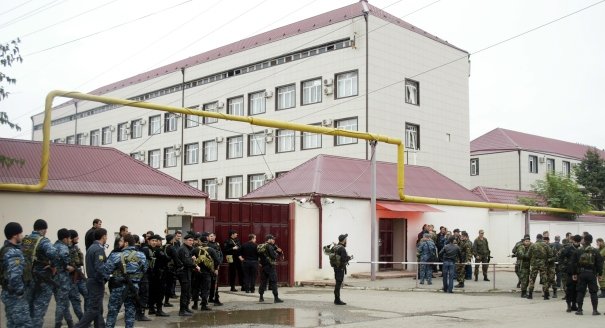
Given recent events in the North Caucasus, the October violence at the Chechen parliament—which left six people dead and 17 injured—is not surprising. It joins the list of other incidents such as the assassination attempt against Chechen leader Ramzan Kadyrov, the attack by gunmen on Kadyrov’s native village of Tsentoroi, the assassination attempt against President Arsen Kanokov of Kabardino-Balkaria, the explosions at the Baksan Hydroelectric Power Station, and the terrorist attacks in the Moscow metro. Unfortunately, rarely a day goes by in the North Caucasus without people being killed.
The incident in the Chechen parliament is just more evidence that the regional and federal authorities lack a real strategy for stabilizing the region and achieving an acceptable level of security. In spite of all the talk about stabilization and security, the militants have been more in 2010 than before. The increase in violence is their response to Moscow’s establishment of the new North Caucasus Federal District and its decision to bring in an outsider, successful manager Alexander Khloponin, to act as presidential envoy there.
It is hard to imagine how anyone can seriously tackle economic and social issues in a climate of constant instability and security threats. It is no surprise, then, that the hoped-for Russian and foreign investments in the North Caucasus have not been forthcoming.
The attack on the parliament has dealt a new blow to Kadyrov’s popularity in Chechen society and to his high standing in the eyes of the federal authorities. After all, he was viewed in Moscow as the most successful leader in the North Caucasus, able to ensure law and order and guarantee security. But it is becoming increasingly clear that Kadyrov is unable to fully control the situation in his republic, and his heavy-handed methods of suppressing opponents are no guarantee of success.
Some Russian law enforcement and security officials would say that the violence is Kadyrov’s own fault, the result of being too zealous in squeezing the federal security agencies out of Chechnya a couple of years ago, leaving him alone to face his opponents. Whatever the case, Kadyrov’s approach to ensuring stability has turned out to have its flaws.
However, Moscow is unlikely to take any decisive measures to shake up the Chechen leadership and replace Kadyrov. First, Russian Prime Minister Vladimir Putin continues to have confidence in his appointee, with whom he has a strong relationship. Second, it is hard to predict how the Chechen police force and other security forces would behave without their leader. Third, the political stage in Chechnya offers few choices after having been so thoroughly trampled out, and finding the right professional with charisma that is always in demand in the Caucasus would be a seemingly impossible task today.
Who was behind this provocative attack? No one has claimed responsibility yet. It could have been the work of Doku Umarov, head of the extremist Caucasus Emirate, or perhaps the work of his former associate Husein Gakayev, who is attempting to revive the separatist movement. But it could also have been organized by some other, still unknown, group, as has already been during the many years of the North Caucasus’ latent civil war.
Meanwhile it seems that Kadyrov will have to reconsider whether he has relied too heavily on the stick and whether it is time to start using the carrot again. After all, it was a sensible combination of both incentives and punishments under Putin that brought the end of the Chechen war and made Kadyrov’s father, Akhmad Kadyrov, the first president of Chechnya.