

Article
Frederic Grare
{
  "authors": [
    "Frederic Grare"
  ],
  "type": "legacyinthemedia",
  "centerAffiliationAll": "dc",
  "centers": [
    "Carnegie Endowment for International Peace"
  ],
  "collections": [],
  "englishNewsletterAll": "asia",
  "nonEnglishNewsletterAll": "",
  "primaryCenter": "Carnegie Endowment for International Peace",
  "programAffiliation": "AP",
  "programs": [
    "Asia"
  ],
  "projects": [],
  "regions": [
    "South Asia",
    "India",
    "Afghanistan"
  ],
  "topics": [
    "Security",
    "Foreign Policy"
  ]
}
Source: Getty
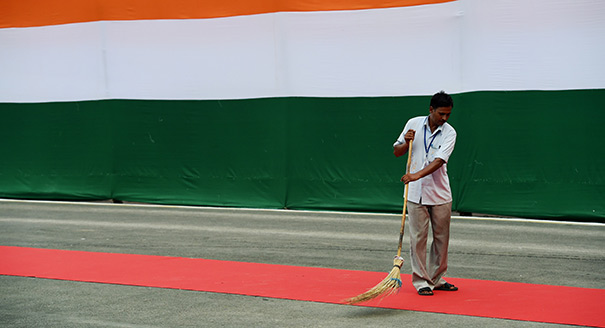
At best, India can be a useful ally to the Afghan government. It cannot—and does not pretend to— be a substitute for the United States.
Source: East Asia Forum
In an interview on 3 May 2017, former president of Afghanistan Hamid Karzai strongly attacked US policy in Afghanistan and, once again, asked India to do more in his country. In particular he requested India help to ‘enable the Afghan army to defend the country’ against ‘extremism and the violation of Afghanistan’s sovereignty from across the Durand Line’, referring to Afghanistan’s longstanding border dispute with Pakistan.
Karzai requested India do this based ‘on its own view of the region’ and for ‘its own interest’. Karzai was clearly asking for more hardware for the Afghan army and, in the process, also attacking the two entities he constantly fought during his own presidency. One was Pakistan, for the support it provided to the Taliban and its violations of Afghanistan’s sovereignty, and the other was the United States for its political and strategic inconsistency in the country’s affairs. Karzai was suggesting that India should, in essence, be a substitute for the United States, based on the assumption that the Afghan government could hold its own if it does receive sufficient support.
But Karzai’s suggestions lack any grounding in reality.
India cannot sustain a massive military presence in Afghanistan. It has only been able to operate in Afghanistan post 2001 because of the stability provided by US military presence. As the number of US troops on the ground diminished, so too did India’s ability to weigh in meaningfully, even on the economy of Afghanistan. While India did contribute to the training and (modestly) to equipment for the Afghan forces this cannot compete with Pakistan’s comparative geographical advantage.
Despite its uneasiness, India has been left with no other option but to support the Afghan government. This is still preferable to the chaos that would result if the Afghan government collapsed. The political crisis of August 2016, which saw a confrontation between Ashraf Ghani and his Chief Executive Officer Abdullah Abdullah, made the dysfunctional character of the so called ‘National Unity Government’ obvious to India but New Delhi has no serious alternative.
The diplomatic context in which India is operating today is also complex. Because of the uncertainty regarding the future US posture, all of Afghanistan’s neighbours are hedging their bets. Pakistan is seen as the regional problem as the country’s military is accused of aiding the Taliban but the growing presence of the so-called Islamic State (IS) in Afghanistan seems to be a game changer as it gives Pakistan the opportunity to rally its neighbours around its own line.
China’s willingness to assert its presence on the shores of the Indian Ocean is also causing havoc. While China tends to moderate Pakistan’s most extreme behavior, it is reluctant to intervene in Afghanistan for security matters so it delegates the management of the Afghan crisis to Pakistan, which in turn assists Pakistan’s position. On top of this, Russia — traditionally a partner of India but increasingly tight with China — seems to be getting closer to Pakistan. This move is part of Russia’s broader strategy of putting pressure on India and also because Russia is looking to use some of Pakistan’s arguments regarding the distinction between good and bad Taliban and the possibility to use the former against ISIS.
So can India be a game changer in Afghanistan?
India can certainly help the Afghan forces increase the Taliban’s military costs but it can’t really reverse the overall dynamic of the conflict. Similarly, while India is providing necessary support for Afghanistan’s economy, the return on this investment is increasingly doubtful. And politically, India can have a moderating influence on the main actors of the current Afghan government but is in no position to promote a government of its liking or even guarantee the present administration’s sustainability.
At best, India can be a useful ally to the Afghan government. It cannot — and does not pretend to — be a substitute for the United States. Its best chance for influencing Afghanistan’s trajectory lies in a close partnership with Washington in which the United States provides the military support necessary to ensure the survival of the Afghan government and eventually brings the insurgency to the negotiating table. But in the broader picture, New Delhi’s margins of manoeuvre are slowly but surely diminishing. Karzai needs to take realities into account when he next makes political calculations.

Former Nonresident Senior Fellow, South Asia Program
Frédéric Grare was a nonresident senior fellow at the Carnegie Endowment for International Peace, where his research focuses on Indo-Pacific dynamics, the search for a security architecture, and South Asia Security issues.
Recent Work
Frederic Grare
Frederic Grare
Carnegie does not take institutional positions on public policy issues; the views represented herein are those of the author(s) and do not necessarily reflect the views of Carnegie, its staff, or its trustees.
Arms supplies from Russia to Iran will not only continue, but could grow significantly if Russia gets the opportunity.

Nikita Smagin
Putin is stalling, waiting for a breakthrough on the front lines or a grand bargain in which Trump will give him something more than Ukraine in exchange for concessions on Ukraine. And if that doesn’t happen, the conflict could be expanded beyond Ukraine.

Alexander Baunov
Disillusioned with the West over Gaza, Arab countries are not only trading more with Russia; they are also more willing to criticize Kyiv.

Ruslan Suleymanov

With the blocking of Starlink terminals and restriction of access to Telegram, Russian troops in Ukraine have suffered a double technological blow. But neither service is irreplaceable.

Maria Kolomychenko
The main source of Russian aggression is a profound mistrust of the West and the firm belief that it intends to inflict a “strategic defeat” on Russia. As long as this fear persists, the war will not end.

Tatiana Stanovaya