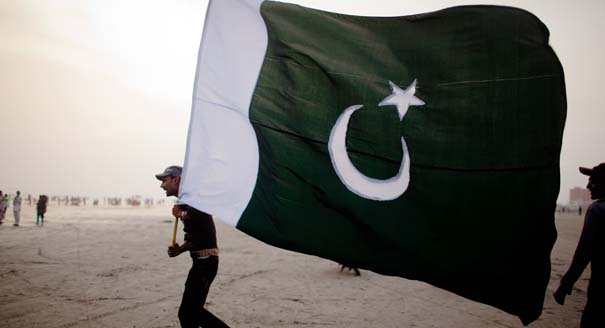
U.S. Secretary of State Clinton must make a case for China to play a greater role in stabilizing Afghanistan and Pakistan. This is an opportunity for China to prove it is a responsible stakeholder.
Link Copied
By Kevin Slaten
Published on Feb 12, 2009
Source: South China Morning Post
China's Bigger Role in Pakistan, AfghanistanNext week, Secretary of State Clinton makes her first trip to Beijing. She must make a case for China – a regional stakeholder – to play a greater role in stabilizing Afghanistan and Pakistan.
Currently, the Obama Administration is undertaking a major review of the war in Afghanistan. The president has already indicated that the US will probably scale back its objective there from installing a democracy to stabilizing the country and ridding it of terrorist elements.
There are two major impediments to achieving stability in Afghanistan. The first is resources. Despite plans to send 30,000 US troops to Afghanistan, the total allied forces will not be able to cover the vast expanses of the country. Further manpower seems unlikely to materialize: Iraq is not going to simply go away and NATO is resisting deeper involvement.
The second challenge is Pakistan. The tribal regions of the country’s northwest has given space for Al-Qaeda and the Taliban to plan attacks on allied forces in Afghanistan. These militants are hard to reach due to a lack of central rule from Islamabad as well as adamant Pashtun resistance against any foreign presence. For eight months, the US has tried to fight inaccessible militants with drone attacks, but this tactic has only served to exacerbate tensions with Pakistani politicians and anger local tribes.
China could assist in both “Af-Pak” challenges.
The People’s Republic has strategic energy and economic interests in maintaining stability in both nations. Pakistan and China share a free trade agreement and did over $6 billion in bilateral trade last year. The “All Weather” allies are aiming for $15 billion in the coming years.
Beijing also considers Pakistan critical to energy security. The Gwadar port – 400km from the Straight of Hormuz – along with a network of rail and roads through Pakistan assures the convenient transport of Middle Eastern oil and gas to China through Xinjiang Province.
In Afghanistan, China has deep interests in acquiring natural resources. In 2007, after President Karzai opened up his country to foreign investment of natural resources, China Metallurgical Group won the rights to develop the world’s largest undeveloped copper field in Anyak for $3.5 billion. China’s state-owned companies are also likely to pursue Afghanistan’s untapped oil, gas, and iron resources.
Beyond these motivations, the circumstance in Af-Pak is an opportunity for China to take another next step toward its stated goal of becoming a responsible regional power and major world player. Beijing can allay concerns in the international community over its growing influence if it shows – through action – that it is ready to contribute to stability in trouble areas in its own neighborhood.
China can help in two primary ways: aid and troops. In Pakistan, China has been providing military aid for decades. This funding should increase to support Pakistani forces in rooting out violent militants in FATA. (Of course, the funding will not do any good without a successful effort by Special Representative Richard Holbrooke to convince Pakistani troops to fight.) Developmental aid will also be needed to encourage tribes to reject Al-Qaeda and the Taliban.
China can help tackle the most urgent problem in Afghanistan – a lack of manpower – by lending some of its 1.7 million ground forces to the mission. Not only will this bring the stability necessary for economic development, but Pakistan would be much more comfortable with a large build-up of Chinese troops in Afghanistan rather than US forces.
Here too, China must commit aid – not just business investment. Without sufficient infrastructure, Afghanistan will continue to see its resources extracted with minimal gain to its people, therefore remaining vulnerable to militants who might offer an alternative.
Some would doubt the ability of Chinese and US or NATO forces to work together, citing underdeveloped military relations. But this is a chance to boost military cooperation. There is no more convenient time for building trust than when both sides want the same outcome: a stable Afghanistan.
Another complaint might be that China, as a one-party state, does not share the values of NATO, which was founded around democracy, and the mission to leave a viable democracy in Afghanistan. Yet this is irrelevant for two reasons. First, as mentioned earlier, the Obama administration has become more focused on the objective of stability than democracy. Second, given that security is the paramount objective, the pragmatic choice would be to leave ideology at home and obtain the manpower necessary to achieve stability.
China could be a critical part to success in Af-Pak. And given so many common challenges, this could be the first of numerous problems that China and the US tackle together.
Carnegie does not take institutional positions on public policy issues; the views represented herein are those of the author(s) and do not necessarily reflect the views of Carnegie, its staff, or its trustees.
The EU can impose sanctions but struggles to enforce them without the United States. With Washington increasingly disinterested in backing European interests, the bloc must now fend for itself.
Russia is testing the waters of NATO’s mutual defense clause. What do strikes in Romanian territorial waters mean for the alliance’s posture toward Moscow?
With its public finances in shambles, the far right polling at 35 percent ahead of the 2027 presidential election, and a growing protest movement, is France’s crisis a threat to the EU’s geopolitical awakening?
Ahead of a tough winter for Ukraine, Donald Trump’s swing back toward Russia bodes ill. But instead of panicking, Kyiv’s European allies are focusing on action.
Funding Ukraine remains a priority for European leaders. As Russia’s war of aggression heads into another winter, two feasible options to mobilize support for Kyiv should be fast-tracked.