

Commentary
Nikolay Petrov
{
  "authors": [
    "Nikolay Petrov"
  ],
  "type": "legacyinthemedia",
  "centerAffiliationAll": "",
  "centers": [
    "Carnegie Endowment for International Peace",
    "Carnegie Europe",
    "Carnegie Russia Eurasia Center"
  ],
  "collections": [],
  "englishNewsletterAll": "",
  "nonEnglishNewsletterAll": "",
  "primaryCenter": "Carnegie Russia Eurasia Center",
  "programAffiliation": "",
  "programs": [],
  "projects": [],
  "regions": [
    "Caucasus",
    "Russia"
  ],
  "topics": [
    "Political Reform"
  ]
}
Source: Getty
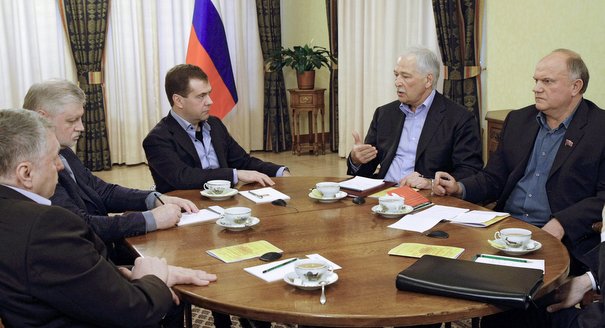
United Russia is preparing for the October regional elections, its first serious test run prior to the State Duma elections in 2011, and the result of these preparations may see the party changed for the better.
Source: The Moscow Times

In addition to the parliamentary elections in the Tuva republic and the Belgorod, Kostroma, Magadan and Novosibirsk regions, elections will also be held for 40,000 seats in municipal governmental bodies. The October elections will be the first serious test run prior to the State Duma elections in 2011.
United Russia is focusing its campaign preparations on renewing staff, regrouping its forces and changing tactics. The process of replacing United Russia party secretaries in the regions continues. A couple of days ago, six more party secretaries were replaced not only in regions where United Russia did poorly, but also where protests have been strong over the past year. This includes the Vladimir, Kaluga, Smolensk, Sverdlovsk and Khabarovsk regions and the Udmurtia republic.
A major staffing change is also expected in the office of regional affairs at the party’s headquarters. The emphasis will be on bringing in younger workers from the regions who are motivated to gain a foothold in Moscow.
There is another important political innovation: As of January 2011, to be eligible for appointment into the Federation Council, all senators must have been elected by popular vote in a municipal or a regional election at the time of their appointment.
What this means in practice is that United Russia will continue developing its so-called “locomotive” party tickets — those that are headed by celebrity candidates who have no intention of ever becoming deputies. Their only job is to push through lesser-known party members into their respective legislative assemblies. The votes these “locomotives” earn will be counted toward the formation of the party list for federal elections in 2011. Priority in those elections will be given to lawmakers who receive the highest voter support during these earlier stages.
Perhaps most important of all, Prime Minister Vladimir Putin plans to appoint his own person who will take day-to-day control of United Russia from his office in the White House. Up until now, this was done exclusively by Kremlin first deputy chief of staff Vladislav Surkov, who answers to President Dmitry Medvedev. Putin had always been content leaving these duties to Surkov only because the elections did not concern him all that much, or he assumed that United Russia’s results were going according to plan. But as Duma and presidential elections are approaching and after the poor results and allegations of fraud in the October vote, Putin was forced to take more direct control of the party.
This means that there will be two centers of power controlling United Russia — Putin’s representative from the White House and Surkov from the Kremlin. In a worst case scenario, this could turn into a management disaster with two competing power centers eating each other alive. In the best case, however, it could improve the party’s effectiveness by introducing some competition within the United Russia structure. If successful, United Russia could be transformed from its traditional status as a party of androids into being a real political party — or something to close to it.
Former Scholar-in-Residence, Society and Regions Program, Moscow Center
Nikolay Petrov was the chair of the Carnegie Moscow Center’s Society and Regions Program. Until 2006, he also worked at the Institute of Geography at the Russian Academy of Sciences, where he started to work in 1982.
Recent Work
Nikolay Petrov
Nikolay Petrov
Carnegie does not take institutional positions on public policy issues; the views represented herein are those of the author(s) and do not necessarily reflect the views of Carnegie, its staff, or its trustees.

Europe is facing rising populism internally as well as external pressures from Russia, China, Turkey, and the United States.

Dimitar Bechev

A notable degree of participative democracy has firmly arrived in Europe. But to have more far-reaching impact, democratic deliberation needs to move into a radically new phase.

Richard Youngs

Before the next wave of EU enlargement takes place, the union needs to grapple with thorny questions of how power is distributed among its members.


Emil Sondaj Hansen, Ditte Brasso Sørensen

A summer of escalation in the Black Sea has hurt Ukraine economically and is exacerbating world food security. A truce is needed—as is a broader reframing of Europe’s Ukraine strategy.

Thomas de Waal

European Commission President Ursula von der Leyen is about to give her annual address on the state of the EU. Here’s what she won’t—but should—say.

Rym Momtaz