

Article
Uri Dadush, Vera Eidelman, Taiya M. Smith
{
  "authors": [
    "Taiya M. Smith"
  ],
  "type": "other",
  "centerAffiliationAll": "dc",
  "centers": [
    "Carnegie Endowment for International Peace",
    "Carnegie Europe"
  ],
  "collections": [],
  "englishNewsletterAll": "asia",
  "nonEnglishNewsletterAll": "",
  "primaryCenter": "Carnegie Endowment for International Peace",
  "programAffiliation": "AP",
  "programs": [
    "Asia"
  ],
  "projects": [],
  "regions": [
    "North America",
    "United States",
    "East Asia",
    "China",
    "Asia"
  ],
  "topics": [
    "Foreign Policy"
  ]
}
Source: Getty
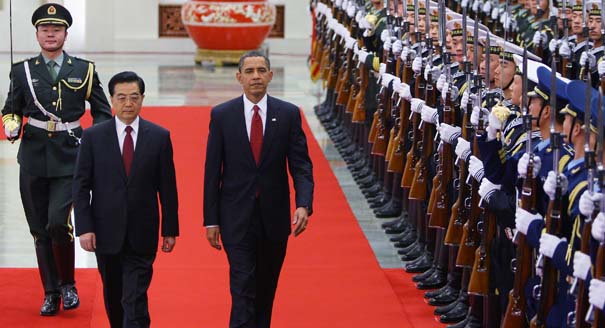
While the United States and China—the world’s two largest economies—are becoming increasingly interdependent, there is a growing risk of misunderstanding or even clashes. The two powers need a dialogue to provide strategic vision to their relationship.
While the United States and China—the world’s two largest economies—are becoming increasingly interdependent, there is a growing risk of misunderstanding or even clashes. In a new paper, Taiya Smith says the two powers need a dialogue to provide strategic vision to their relationship.
Smith, who led the U.S.-China Strategic Economic Dialogue for Treasury Secretary Paulson, draws on examples from her experience to analyze the recent history of strategic dialogues and recommends steps for Washington and Beijing to take to improve the broader bilateral relationship.
“What the U.S.-China relationship needs is a truly strategic discussion to steer a critically important, yet increasingly complex, bilateral relationship while still managing the time-sensitive issues of the day,” writes Smith.

Former Senior Associate, Energy and Climate Program, Asia Program
Smith has spent the last decade working in international negotiations. Most recently, she served as a member of Secretary Hank Paulson’s senior management team from 2006 to 2009 as the deputy chief of staff and executive secretary for the U.S. Department of the Treasury.
Recent Work

Uri Dadush, Vera Eidelman, Taiya M. Smith
William Chandler, Taiya M. Smith
Carnegie does not take institutional positions on public policy issues; the views represented herein are those of the author(s) and do not necessarily reflect the views of Carnegie, its staff, or its trustees.

Funding Ukraine remains a priority for European leaders. As Russia’s war of aggression heads into another winter, two feasible options to mobilize support for Kyiv should be fast-tracked.


Vladyslav Rashkovan, Gregory P. Wilson

While the EU and European governments are embracing the much-lauded middle-power moment, this entails three difficult conundrums.

Richard Youngs

Europe is facing rising populism internally as well as external pressures from Russia, China, Turkey, and the United States.

Dimitar Bechev

Much has been said of the changes Brussels is trying to make to the EU enlargement process. Here’s why gradual integration might—or might not—be the answer.
Dimitar Bechev

The European Commissioner for Trade is headed to China. But after President Xi’s bridge-building visit to Washington, can a more isolated EU overcome Beijing’s stranglehold on critical raw materials? Who will blink first?

Rym Momtaz, ed.