

Commentary
Marc Pierini
{
  "authors": [
    "Marc Pierini"
  ],
  "type": "commentary",
  "centerAffiliationAll": "",
  "centers": [
    "Carnegie Endowment for International Peace",
    "Carnegie Europe"
  ],
  "englishNewsletterAll": "",
  "nonEnglishNewsletterAll": "",
  "primaryCenter": "Carnegie Europe",
  "programAffiliation": "",
  "regions": [
    "Europe",
    "Türkiye"
  ],
  "topics": [
    "EU",
    "Foreign Policy",
    "Security",
    "NATO"
  ]
}
Source: Carnegie Europe
Debate is heating up on how Turkey could be integrated into a common European defense framework. Commercial and industrial deals offer a better chance at alignment than sweeping political efforts.
Europe’s relationship with Turkey has always been immensely complex, but it has been made even more difficult by the 2022 Russian invasion of Ukraine, the Israel-Gaza war, and the ongoing Israeli-U.S. war on Iran. A flurry of recent official statements, publications, and social media posts have obscured some of the fundamental realities. For Europe and Ankara, the door to progress remains open, but the room for maneuver is very narrow.
The EU is currently confronted by an accumulation of challenges from many directions. Four moments in recent years stand out.
First, Russia embarked on a long-term military and ideological battle against Ukraine while openly questioning the integrity of the Baltic states, the EU, and NATO.
Second, Israel reacted to Hamas’s 2023 attacks on its territory by engaging in a war of attrition against the Palestinians, disturbing relations within the entire Middle East—a region in which European countries have long seen their historical influence dwindle.
Third, the United States, through its 2025 National Security Strategy, launched its own ideological assault on the EU. Washington clearly stated its intention to fight the EU’s political and economic architecture while expressing doubts about the usefulness of NATO. This move upended eighty years of unity within the transatlantic alliance, a severe jolt for all European countries.
Fourth, Iran and its proxies launched powerful attacks against Israel, while Israel and the United States unleashed massive offensives on Iranian territory. The main consequences for Europe are being felt in terms of constrained energy and fertilizer supplies from the Gulf region.
Because of its internal divergences and decisionmaking procedures, the EU often proved incapable of defending itself against these adverse developments or playing a peacemaking role. The EU has, however, supported Ukraine militarily and economically and launched a time-consuming rearmament program to counter Washington’s intended withdrawal from the defense of the European continent.
The historic change for European leaders came in January 2025, when Donald Trump returned to the White House. A new U.S. foreign policy, fundamentally hostile to the EU and Ukraine, coincided with the president’s close alignment with the Kremlin. As a result, Europe is suddenly facing political hostility from both the United States and Russia, a novelty in the eighty years since World War II.
In this complex environment, Turkey has its own challenges and has tried to implement a policy of equidistance between the two opposing sides, despite the many contradictions of doing so. For example, Ankara has participated in NATO’s plans to secure the alliance’s Eastern flank and will host a NATO summit on July 7–8 in what is a prestigious achievement for Turkey, although the meeting itself will be fraught with Trump’s proclaimed hostility toward the alliance. In parallel, however, Ankara’s earlier purchase of Russian S-400 anti-aircraft missile systems triggered U.S. sanctions in December 2020 under the first Trump administration.
Meanwhile, Ankara has multiplied the agreements between its fast-growing, innovative defense industry and European firms as well as its exports of defense equipment, including armored personnel carriers, corvettes, and drones to Romania and drones and defense systems to Poland.
The most recent agreements constitute major achievements for Turkey’s defense sector and will be followed by several others.
A June 2025 accord between Turkey’s drone manufacturer Baykar and Italy’s aerospace company Leonardo resulted in the creation of a fifty-fifty joint venture, LBA Systems, dedicated to the development of unmanned technologies. Under a deal reached in October 2025, the UK will sell Turkey twenty Eurofighter Typhoon aircraft, while a March 2026 agreement includes accompanying training and support to the Turkish Air Force. And in Spain, an April 2026 agreement between Airbus and Turkish Aerospace Industries provided for exports of Turkish-made Hürjet training aircraft, their customization to Spanish standards, and their inclusion in a new integrated combat training system.
Another bilateral success is the Strategic Partnership Framework signed on April 23 by Turkey and the UK, aimed at “increasing co-operation and co-ordination within NATO, including strengthening the European pillar, enhancing defence capability and industry co operation [sic].” This new agreement will be far more strategic in nature and more meaningful than the existing strategic partnership between Turkey and Hungary under outgoing Prime Minister Viktor Orbán.
On the policy side, not only Turkey’s leadership but also analysts frequently describe the country as the essential ingredient of Europe’s security. In April 2026, Carnegie’s Sinan Ülgen wrote, “As a NATO ally, Turkey is also an indispensable security actor. Its growing defense industrial base can help to address European aspirations to reduce dependence on the United States.”
In many ways, the recent industrial deals with Turkey do just that. Yet, the politics of an ambitious strategic agreement between Europe and Turkey do not work.
Given the international geopolitical context, Turkey’s geographic position and strong defense industry, and Europe’s need to become more autonomous in the security sector, it would seem natural for Turkey and European countries to team up in a tight security partnership.
The core question is whether European nations or the EU should entrust their security to a formal partnership with Turkey. Seen from Brussels, the argument is that while this happens through individual sales and joint projects, it does not and cannot happen in a more structured way under current political circumstances. There are five reasons for this, and they should come as no surprise.
The first is that Turkey is keen to play a central role in NATO but has considerably weakened the alliance’s missile-defense architecture by buying and taking delivery in 2019 of the Russian S-400 systems. The disruption of that decision was such that Ankara lost not only the order it had placed for 120 Lockheed Martin F-35 stealth fighters but also a multi-billion-dollar industrial contract for the construction of the aircraft.
A second aspect is that Turkey has a record of providing massive financial support to Iran despite international sanctions. Between 2010 and 2015, Ankara channeled approximately $20 billion to Iran in what became known as the Reza Zarrab case (after an Iranian-born businessman based in Turkey), which involved Halkbank, a Turkish public bank. A settlement was reached between the U.S. and Turkish governments in March 2026, but the political stain remains.
The core question is whether European nations or the EU should entrust their security to a formal partnership with Turkey.
The third element is that Turkey has offered uninterrupted support to Russia’s military operations against Ukraine by running a channel for Moscow’s global exports of oil and natural gas, feeding the Kremlin’s war chest. Russian crude oil is delivered to Turkish refineries and reexported as Turkish oil products to circumvent international sanctions against Russia. Such schemes go far beyond Ankara’s claim of a policy balance between Moscow and the West and drastically erode Turkey’s credibility.
A fourth dimension is that Turkey’s leadership has repeatedly offered to play a mediation role in several conflicts, such as those in Ukraine, Gaza, and Iran, but has been unable to achieve any groundbreaking progress beyond prisoner swaps between Russia and Ukraine. Ankara is currently not seen as an efficient go-between.
Finally, Turkey’s leadership has consistently degraded the country’s rule-of-law architecture through a 2017 constitutional reform, attacks on politicians and political parties, control of the judiciary and the media, and harassment of civil society. In so doing, Ankara has long ceased to meet the EU’s political criteria for membership, as demonstrated by regular reports of the EU institutions and by some Turkish analysts. As a result, EU accession negotiations with Turkey, which started in 2005, came to a halt several years ago.
In short, Turkey has become an ambivalent partner for European leaders. The country is clearly a powerful defense actor. Its president, Recep Tayyip Erdoğan, claimed last year that “European security without Türkiye will not be possible,” adding on May 4, “Our hope is that the decisionmakers in Europe will finally abandon their political and historical prejudices and focus on developing sincere, genuine, and eye-to-eye relations with Turkey.” But at the same time, Turkey’s past and present affinities with Iran, Russia, and the United States contradict such statements. And Turkey has put in place a governance system squarely at odds with the EU’s democratic requirements, while still pretending to keep EU accession at the top of its foreign policy priorities.
The end result of these contradictions is a genuine lack of trust from Europe in Turkey’s leadership in an era of major geopolitical upheaval and direct threats to the European continent. In this context, it is arguable that an EU security and political alliance with Turkey would be too unsettling to be worth the risks.
Why would European leaders entrust part of their future security to Turkey? Or, for example, give Turkey access to the EU’s taxpayer-funded Security Action for Europe (SAFE) program, a financial instrument to support European defense-industrial investment? Today, such a strategic alliance with Turkey is largely perceived by EU leaders as a no-go.
Despite the parlous state of the relationship, a visit of Turkey’s Foreign Minister Hakan Fidan to Vienna on April 30 sent an interesting signal. While blaming the EU-Turkey deadlock on former French president Nicolas Sarkozy, who, as of his 2007 election, was a vocal opponent of Ankara’s EU entry, the minister implied that if the EU made a move forward, Turkey would reciprocate and accession negotiations could be revived in a sort of give-and-take bargain.
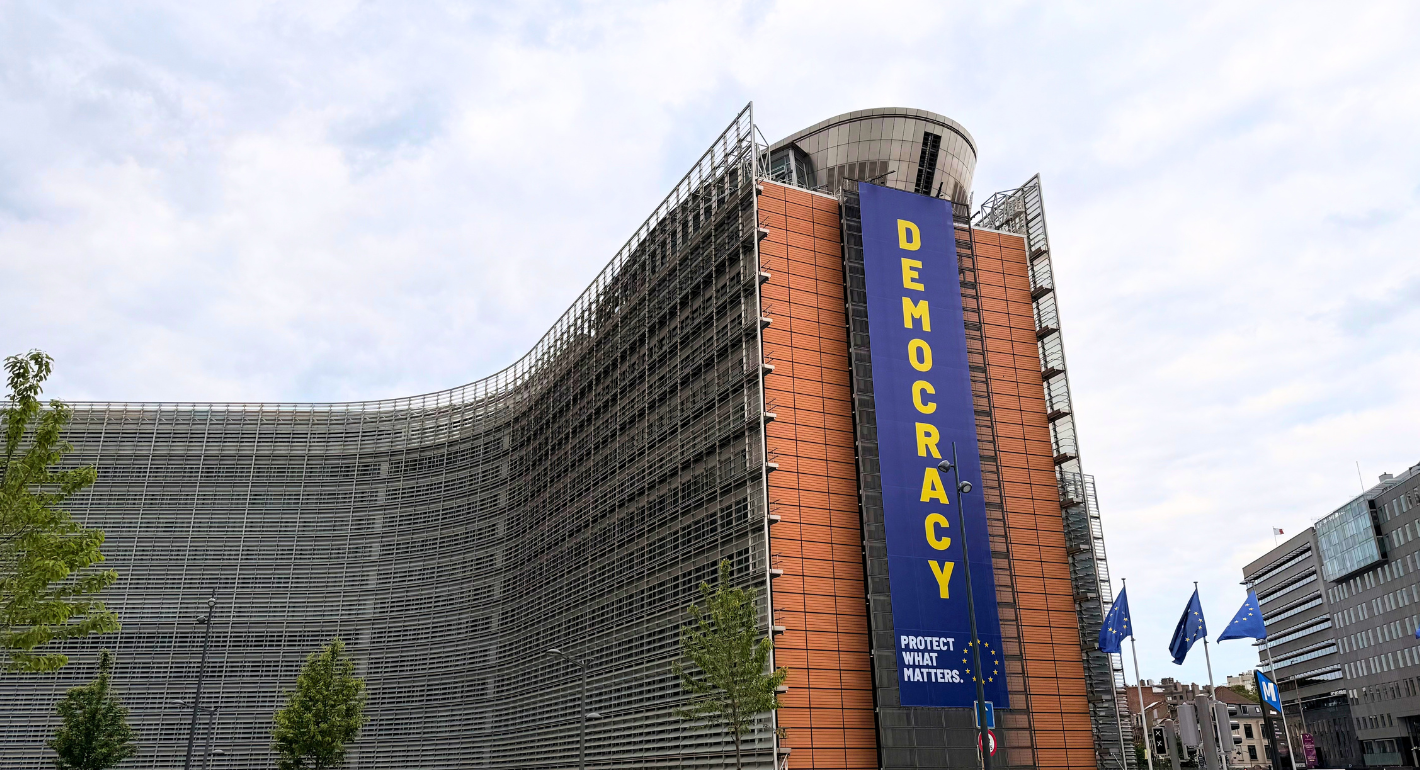
Yet, for Turkey to fulfill the EU’s membership conditions would mean dismantling Ankara’s carefully crafted autocratic architecture. Turkish leaders would see no reason to sap their own political predominance without any chance of amending the EU’s political criteria. Likewise, EU leaders would have no benefit in weakening their governance architecture while under pressure from Moscow and Washington. After all, the EU’s rule-of-law principles formed the background of Orbán’s brutal exit from power in Hungary’s April 2026 election. A ten-story-high banner currently on display on the European Commission’s emblematic Berlaymont building in Brussels says it all: “Democracy: Protect What Matters.”
Meanwhile, amid the turmoil from multiple conflicts—the wars in Ukraine, Gaza, and Iran as well as retaliatory attacks on a military base in Cyprus—European leaders have reinforced their military posture in the Eastern Mediterranean, especially by providing political and military backing to Cyprus, while France has reaffirmed its support for Greece. At an informal European Council meeting in Cyprus on April 23–24, EU leaders also reinforced their mutual-defense clause. Europe is acting according to its interests.
The current geopolitical turmoil carries an existential risk for Western Europe and the EU: Giving up their fundamental values in the face of Russian and U.S. pressure would not only endanger their economies and security, it would jeopardize their very existence. In this context, seen from most EU capitals, Turkey is not a dependable partner.
If Ankara is to participate in Western European efforts to beef up Europe’s defense, it will likely be through more bilateral commercial and industrial agreements, not as part of a political grand bargain.
A monthly newsletter from Carnegie Europe

Senior Fellow, Carnegie Europe
Marc Pierini is a senior fellow at Carnegie Europe, where his research focuses on developments in the Middle East and Turkey from a European perspective.
Recent Work
Marc Pierini
Marc Pierini

While the EU and European governments are embracing the much-lauded middle-power moment, this entails three difficult conundrums.

Richard Youngs

Europe is facing rising populism internally as well as external pressures from Russia, China, Turkey, and the United States.

Dimitar Bechev

A notable degree of participative democracy has firmly arrived in Europe. But to have more far-reaching impact, democratic deliberation needs to move into a radically new phase.
Richard Youngs

Much has been said of the changes Brussels is trying to make to the EU enlargement process. Here’s why gradual integration might—or might not—be the answer.
Dimitar Bechev

The European Commissioner for Trade is headed to China. But after President Xi’s bridge-building visit to Washington, can a more isolated EU overcome Beijing’s stranglehold on critical raw materials? Who will blink first?

Rym Momtaz, ed.