

Commentary
Michael Pettis
{
  "authors": [
    "Michael Pettis"
  ],
  "type": "legacyinthemedia",
  "centerAffiliationAll": "dc",
  "centers": [
    "Carnegie Endowment for International Peace"
  ],
  "collections": [],
  "englishNewsletterAll": "asia",
  "nonEnglishNewsletterAll": "",
  "primaryCenter": "Carnegie Endowment for International Peace",
  "programAffiliation": "AP",
  "programs": [
    "Asia"
  ],
  "projects": [],
  "regions": [
    "North America",
    "United States",
    "East Asia",
    "China"
  ],
  "topics": [
    "Economy",
    "Trade"
  ]
}
Source: Getty
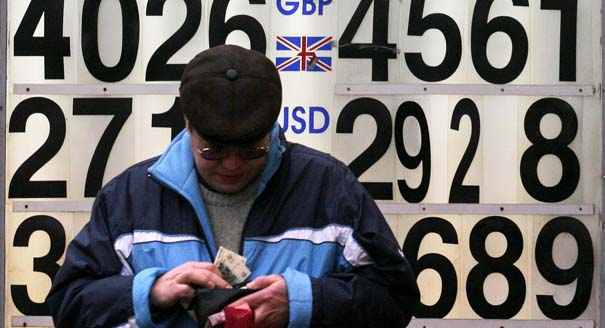
If countries with large trade surpluses weaken their currency, countries with large trade deficits are likely to retaliate through reciprocal currency manipulation or trade tariffs.
Source: The Economist

And we know how that game ends. In 1930, following France’s very successful 1928 devaluation and Britain’s tightening of trade conditions within the Commonwealth, the world’s leading trade-surplus nation passed the Smoot-Hawley tariffs in a transparent attempt to gain a greater share of dwindling global demand. This would have been a great strategy for the US had no one noticed or retaliated, but of course the rest of world certainly noticed, and all Smoot-Hawley did was accelerate a collapse in global trade which, not surprisingly, hurt trade surplus countries like the US most.
We seem to be following the same path, and in a beggar-thy-neighbor world any country that does not participate in retaliatory policies will suffer. The only question is which retaliatory policy. I suspect that countries that can intervene in the currency and manipulate domestic interest rates will select those polices as the most efficient way of intervening in trade. Countries that cannot will almost certainly resort to trade tariffs. And it is probably too late for global policy coordination to make much of a difference. It would be very difficult for policy coordination to limit all the many ways countries can and do cheat, and in the end the trade-deficit countries will probably find it easier to retaliate openly and directly. And why not? Diversified countries with large trade-deficits have most of the best cards in any trade dispute. Simple game theory suggests that a sub-optimal result is almost inevitable absent a policeman to bully participants into good behaviour.

Nonresident Senior Fellow, Carnegie China
Michael Pettis is a nonresident senior fellow at the Carnegie Endowment for International Peace. An expert on China’s economy, Pettis is professor of finance at Peking University’s Guanghua School of Management, where he specializes in Chinese financial markets.
Recent Work
Michael Pettis
Michael Pettis
Carnegie does not take institutional positions on public policy issues; the views represented herein are those of the author(s) and do not necessarily reflect the views of Carnegie, its staff, or its trustees.

The European Commissioner for Trade is headed to China. But after President Xi’s bridge-building visit to Washington, can a more isolated EU overcome Beijing’s stranglehold on critical raw materials? Who will blink first?

Rym Momtaz, ed.

European NATO countries are wrestling with the possibility of U.S. disengagement from the alliance. With the continent’s security increasingly uncertain, governments must restore the credibility of their collective defense.



Hans-Dieter Lucas, Adam Thomson, Pierre Vimont

The domestic impacts of how long it is taking to end the war in Ukraine have pushed the French electorate to the political extremes and compromised the country’s diplomatic capacity.
Rym Momtaz

The new U.S.–Denmark–Greenland agreement will help Washington exert political, economic, and financial dominance under the guise of security. Yet, it acknowledged Copenhagen’s and Nuuk’s sovereignty on the island.

Marc Pierini

A summer of escalation in the Black Sea has hurt Ukraine economically and is exacerbating world food security. A truce is needed—as is a broader reframing of Europe’s Ukraine strategy.

Thomas de Waal