
European reactions to the war in Iran have lost sight of wider political dynamics. The EU must position itself for the next phase of the crisis without giving up on its principles.
Richard Youngs
{
"authors": [],
"type": "other",
"centerAffiliationAll": "",
"centers": [
"Carnegie Endowment for International Peace",
"Malcolm H. Kerr Carnegie Middle East Center"
],
"collections": [
"Arab Awakening"
],
"englishNewsletterAll": "",
"nonEnglishNewsletterAll": "",
"primaryCenter": "Carnegie Endowment for International Peace",
"programAffiliation": "",
"programs": [],
"projects": [],
"regions": [
"North Africa",
"Egypt"
],
"topics": [
"Political Reform"
]
}Source: Getty
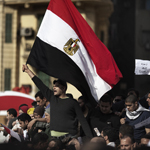
A committee of pro-democracy activists involved in negotiating with the Egyptian authorities suggest a way to move from the present confrontation to a peaceful transition.
Source: February 3

In view of the high level of interest in the events in Egypt, the Carnegie Endowment for International Peace offers its readers this unofficial translation of the statements issued by the committee, which have not appeared in English so far. The Carnegie Endowment does not endorse the statements but believes they are of sufficient interest to be shared.
Full text of statement (translated from Arabic by the Carnegie Endowment for International Peace)
The current regime, represented by the president of the republic, has agreed to a limited number of the popular demands that have been clearly expressed. The people who have come out in the millions in Cairo and all Egyptian cities still insist on the following legitimate demands:
The signatories released a second statement stating:
The group, which addressed its message to the President, his deputy and the military proposed a way out of the grave crisis that has plagued the country and its citizens. The group reiterates its call for the military to ensure the security and safety of the Egyptian youth that is protesting peacefully in Tahrir Square and other streets in Egyptian cities, and to protect them from the risk of prosecution, persecution, and violation of their rights. The violence occurring on Egyptian streets will only contribute to more political tensions and create obstacles to mitigating the current crisis. We are hoping once again that the Egyptian military will help the nation and the people to emerge from this crisis and save the lives of the Egyptian youth.
Signatories:
Ahmed Kamal Aboul Magd
Naguib Sawiris
Nabil al-Arabi
Salama Ahmed Salama
Ibrahim El Moallem
Waheed Abd El-Majeed
Abdel Aziz El-Shafei
Amr Hamzawy
Amr El Shobaki
Gamil Matar
Safwat Thabet
Nabil Fahmy
Mervat el-Talawi
Ali Mosharrafa
Adel el-Moalem
Yahya al-Jamal
Anis Aclimandos
Amin Mahdy
Ahmed Fouad
Sami Mahmoud Zein el-Din
Amani Al Khayat
Nasser Amin
Fathi al-Shawadfi
Carnegie does not take institutional positions on public policy issues; the views represented herein are those of the author(s) and do not necessarily reflect the views of Carnegie, its staff, or its trustees.
European reactions to the war in Iran have lost sight of wider political dynamics. The EU must position itself for the next phase of the crisis without giving up on its principles.
Richard Youngs
Europe’s interests in Syria extend beyond migration management, yet the EU trails behind other players in the country’s post-Assad reconstruction. To boost its influence in Damascus, the union must upgrade its commitment to ensuring regional stability.
Bianka Speidl, Hanga Horváth-Sántha
A prophetic Romanian novel about a town at the mouth of the Danube carries a warning: Europe decays when it stops looking outward. In a world of increasing insularity, the EU should heed its warning.
Thomas de Waal
2026 has started in crisis, as the actions of unpredictable leaders shape an increasingly volatile global environment. To shift from crisis response to strategic foresight, what under-the-radar issues should the EU prepare for in the coming year?
Thomas de Waal
Despite the strategic importance of relations between the EU and the African Union, deep divisions remain between the blocs. At their upcoming summit, both partners should strive to build a mutually beneficial cooperation.
Marta Martinelli