

In The Media
Minxin Pei
{
  "authors": [
    "Minxin Pei"
  ],
  "type": "legacyinthemedia",
  "centerAffiliationAll": "dc",
  "centers": [
    "Carnegie Endowment for International Peace"
  ],
  "collections": [],
  "englishNewsletterAll": "asia",
  "nonEnglishNewsletterAll": "",
  "primaryCenter": "Carnegie Endowment for International Peace",
  "programAffiliation": "AP",
  "programs": [
    "Asia"
  ],
  "projects": [],
  "regions": [
    "East Asia",
    "China"
  ],
  "topics": [
    "Political Reform",
    "Economy"
  ]
}
Source: Getty
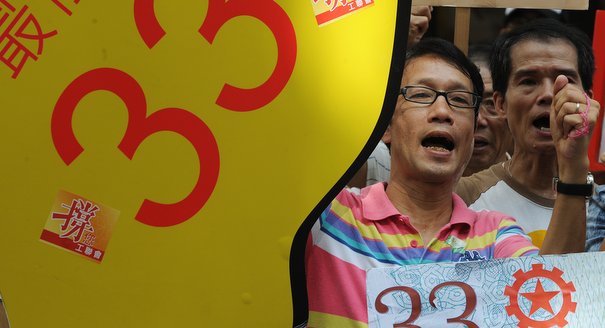
When popular protests occur in China, Beijing’s official response is shaped by a number of factors, including the level of organization of the protesters, the media coverage the protests receive, the demands the protesters make, and the location of the protests.
Source: Diplomat

The outcome of this incident couldn’t be more different from another recent event: the arrest of Ai Weiwei, one of China’s most prominent political activists. Ai has repeatedly defied the ruling Communist Party and, despite his international stature, Beijing decided to put him behind bars, ignoring widespread international condemnation.
The contrast between these two incidents raises an intriguing question: why does Beijing tolerate certain forms of protest, but represses others?
One obvious reason is that it depends on the nature of the protest. As a rule, a frontal challenge to the authority of the Chinese Communist Party, as Ai’s activities embodied, practically guarantees a harsh response from the government. But protest inspired by specific economic grievances, such as truckers’ ire over excessive fees, seems to fare better. In the eyes of the ruling party, the former constitutes an existential threat and so no concessions are seen as able to appease political activists rejecting the very legitimacy of the regime.
In contrast, the discontent generated by well-defined economic grievances can be treated with specific concessions. One quote, allegedly from a sitting senior Politburo member, says it all: ‘What are the contradictions among the people?’ the Politburo member supposedly asked. ‘(These contradictions) can all be solved by using renminbi.’
But things are a little more complicated than this. The reality is that even when dealing with protests or riots fuelled by specific socioeconomic grievances, the behavior of the Chinese authorities isn’t always consistent. Sometimes, government officials pacify protesters through the use of the renminbi, while other times they mercilessly crush such protest.
So how do we make sense of such apparent inconsistencies?
It seems that the type of response to social protest—harsh or soft—depends on a complex mix of factors such as who the protesters are, the resources and organizational capacity at their disposal, the economic sectors in which they are located, and the social repercussions of their protest. Generally speaking, highly organized protesters (such as truck drivers, discharged soldiers and officers of the People’s Liberation Army, and taxi drivers) tend to fare better. They also possess resources that can be easily and effectively deployed. Taxi and truck drivers, for example, can use their vehicles to paralyze traffic and produce instantaneous and widespread social and economic disruptions.
Former PLA servicemen, meanwhile, have a strong institutional identity and are well-connected with each other through ties forged during their military service. Research conducted by Chinese scholars shows that protests organized by former PLA servicemen tend to get the most attention—and the softest treatment—from the government. In contrast, protests by peasants are handled more harshly as they are less organized, possess few strategic assets, and have little impact beyond their villages.
Another important factor is the political calculations of local officials. Despite the popular image of the Chinese state as a hierarchical, top-down system, there’s no uniform national manual for handling protests. This leaves a great deal of discretion at the hands of local officials, but it also places them in a political quandary. Whenever a mass protest erupts, local officials have to think and react fast, but deploying riot police and using force against protesters isn’t necessarily the preferred modus operandi since this could prompt an escalation in violence. Local officials who mishandle mass protests risk demotion or even dismissal, so they must calculate how to end such demonstrations peacefully and quickly, while ensuring that their actions won’t also encourage future protests. It’s a difficult balancing act.
So what influences the political calculations of local officials?
As I’ve said, it’s in large part the nature of the protest, the strength of the protesters, and the likely effects of the protest—all are critical variables. Local officials usually avoid using violence against protests inspired by economic discontent and organized by workers in strategic sectors (transportation and energy, for example). Another factor at play is simply the amount of renminbi available to local officials for buying off the protesters. In the case of striking truckers, the Shanghai municipal government, the wealthiest local jurisdiction in China, has plenty of money. But in poorer areas, the renminbi option just doesn’t exist.
Another factor is media glare—the more media coverage (particularly international media coverage), the more constraints on local officials’ use of force. Last, the location of the protest is key. When such protests happen in remote villages or towns, they are quickly and ruthlessly crushed. But when they occur in urban centres, the government (usually) responds more cautiously and gently.
All this means that the happy ending for the striking truckers in Shanghai shouldn’t be taken as an encouraging precedent for workers in other sectors who might think the government will back down in the face of economic demands—however justifiable they might be.
Former Adjunct Senior Associate, Asia Program
Pei is Tom and Margot Pritzker ‘72 Professor of Government and the director of the Keck Center for International and Strategic Studies at Claremont McKenna College.
Recent Work
Minxin Pei
Minxin Pei
Carnegie does not take institutional positions on public policy issues; the views represented herein are those of the author(s) and do not necessarily reflect the views of Carnegie, its staff, or its trustees.

With its public finances in shambles, the far right polling at 35 percent ahead of the 2027 presidential election, and a growing protest movement, is France’s crisis a threat to the EU’s geopolitical awakening?

Rym Momtaz, ed.

While the EU and European governments are embracing the much-lauded middle-power moment, this entails three difficult conundrums.

Richard Youngs

Europe is facing rising populism internally as well as external pressures from Russia, China, Turkey, and the United States.

Dimitar Bechev

A notable degree of participative democracy has firmly arrived in Europe. But to have more far-reaching impact, democratic deliberation needs to move into a radically new phase.
Richard Youngs

The European Commissioner for Trade is headed to China. But after President Xi’s bridge-building visit to Washington, can a more isolated EU overcome Beijing’s stranglehold on critical raw materials? Who will blink first?
Rym Momtaz, ed.