• Research
  • Strategic Europe
  • About
  • Experts
Carnegie Europe logoCarnegie lettermark logo
EUDemocracy
  • Donate
{
  "authors": [
    "Marina Ottaway"
  ],
  "type": "legacyinthemedia",
  "centerAffiliationAll": "dc",
  "centers": [
    "Carnegie Endowment for International Peace",
    "Malcolm H. Kerr Carnegie Middle East Center"
  ],
  "collections": [
    "Arab Awakening"
  ],
  "englishNewsletterAll": "menaTransitions",
  "nonEnglishNewsletterAll": "",
  "primaryCenter": "Carnegie Endowment for International Peace",
  "programAffiliation": "MEP",
  "programs": [
    "Middle East"
  ],
  "projects": [],
  "regions": [
    "Middle East",
    "North Africa",
    "Egypt",
    "Gulf",
    "Levant",
    "Maghreb"
  ],
  "topics": [
    "Political Reform",
    "Foreign Policy"
  ]
}
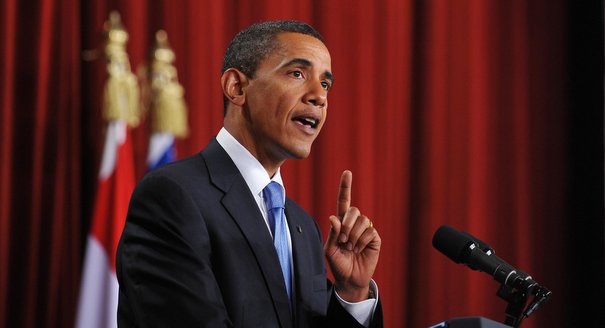
Source: Getty

In The Media

Did Obama Lay Out a Cohesive Middle East Policy?

President Obama’s speech in response to the Arab Spring did not establish a clear foreign policy for the region, but rather outlined a vision of a democratic and prosperous Middle East.

Link Copied
By Marina Ottaway
Published on May 19, 2011

Source: Politico

Did Obama Lay Out a Cohesive Middle East Policy?President Obama’s speech will disappoint audiences in the Middle East. It does not outline a policy, but a vision — that of a democratic and prosperous Middle East — which of course is not new. In the region, this will be seen as another rhetorical statement rather than as a policy.

The amount of economic assistance he offered to countries that have started a transition, Egypt in particular, will undoubtedly disappoint. It will also probably be ridiculed as totally insufficient: up to $ 1 billion in debt relief to Egypt, helpful in the long run but not in the short run. And $2 billion in investment guarantees through the Overseas Private Investment Corporation is unlikely to encourage U.S. companies to invest in an unstable country.
 
Nor did he set out a new policy for the Israeli-Palestinian problem. He repeated well-known U.S. positions, which Arabs will criticize as being pro-Israel, even as Israeli Prime Minister Benjamin Netanyahu reacted strongly to Obama’s statements that the borders of a Palestinian state should be those of 1967, with negotiated modification.
 
The speech was not a winner.

About the Author

Marina Ottaway

Former Senior Associate, Middle East Program

Before joining the Endowment, Ottaway carried out research in Africa and in the Middle East for many years and taught at the University of Addis Ababa, the University of Zambia, the American University in Cairo, and the University of the Witwatersrand in South Africa.

    Recent Work

  • Article
    Reactions to the Syrian National Initiative

      Marina Ottaway, Omar Hossino

  • Article
    Slow Return to Normal Politics in Egypt

      Marina Ottaway

Marina Ottaway
Former Senior Associate, Middle East Program
Marina Ottaway
Political ReformForeign PolicyMiddle EastNorth AfricaEgyptGulfLevantMaghreb

Carnegie does not take institutional positions on public policy issues; the views represented herein are those of the author(s) and do not necessarily reflect the views of Carnegie, its staff, or its trustees.

More Work from Carnegie Europe

  • Commentary
    Strategic Europe
    Letter from the Editor: Europe Takes Two Steps Forward But One Step Back

    As we close out another season of Strategic Europe, it is worth taking stock of the deep shifts underway.

      • Rym Momtaz

      Rym Momtaz

  • Commentary
    Strategic Europe
    Taking the Pulse: Are the EU’s Watered-Down Russia Sanctions Better than None?

    The EU had to compromise to adopt a twenty-first sanctions package against Russia, exposing growing cracks in the union’s resolve. Is this latest, weaker round worth it to keep pressure on Moscow?

      • Rym Momtaz

      Rym Momtaz, ed.

  • Commentary
    Strategic Europe
    Why Europe Must Take Charge of its Russia Diplomacy Now

    Trump is distracted and Ukraine wants Europe to step up. The continent’s leaders must find their voice and assert it in talks with Russia.

      Alissa de Carbonnel

  • Commentary
    Strategic Europe
    Why Russia Could Escalate Hybrid Warfare Against Europe

    Mounting economic strain and battlefield losses will not necessarily make the Kremlin less dangerous. They could instead push Moscow toward a more aggressive hybrid campaign designed to test NATO’s Eastern flank, exploit allied hesitation, and fracture European resolve.

      Maksym Beznosiuk

  • Commentary
    Strategic Europe
    Taking the Pulse: Enough with the Annual NATO Summits, Already?

    Over the past ten years, NATO has held almost as many summits as it did during the entirety of the Cold War. Are they still useful, or is it time to stop holding annual meetings?

      • Rym Momtaz

      Rym Momtaz, ed.

Get more news and analysis from
Carnegie Europe
Carnegie Europe logo, white
Rue du Congrès, 151000 Brussels, Belgium
  • Research
  • Strategic Europe
  • About
  • Experts
  • Projects
  • Events
  • Contact
  • Careers
  • Privacy
  • For Media
  • Gender Equality Plan
Get more news and analysis from
Carnegie Europe
© 2026 Carnegie Endowment for International Peace. All rights reserved.