

Paper
Maria Fantappie
{
  "authors": [
    "Maria Fantappie"
  ],
  "type": "legacyinthemedia",
  "centerAffiliationAll": "",
  "centers": [
    "Carnegie Endowment for International Peace",
    "Malcolm H. Kerr Carnegie Middle East Center"
  ],
  "collections": [],
  "englishNewsletterAll": "",
  "nonEnglishNewsletterAll": "",
  "primaryCenter": "Malcolm H. Kerr Carnegie Middle East Center",
  "programAffiliation": "",
  "programs": [],
  "projects": [],
  "regions": [
    "Gulf"
  ],
  "topics": [
    "Political Reform"
  ]
}
Source: Getty
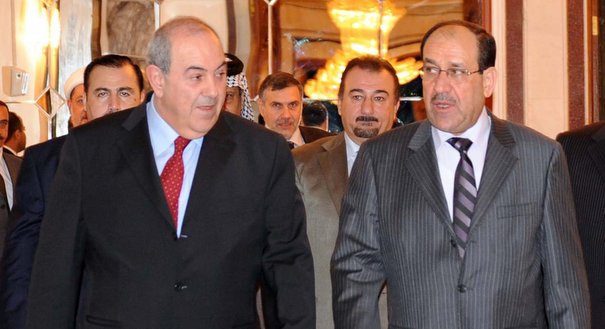
Iraqi Prime Minster Nouri Maliki is using the deteriorating security situation in the provinces and the political stalemate between Iraq's top political leaders to tilt the political balance in his favor.
Source: Los Angeles Times

In the country’s south, Maliki is attempting to defend his base from the growing popularity of the Sadrist Trend. Meanwhile, in Iraqiya’s northern strongholds of Anbar, Ninewa, Salaheddine, and Diyala, the prime minister is mounting an ambitious campaign to consolidate his hold over Iraq. By attempting to break the link between provincial leaders and the Iraqiya coalition — his main parliamentary rival — Maliki is seeking to bind the governorates to Baghdad.
Already, public demonstrations and a deteriorating security situation in these governorates have challenged the credibility of local political leaders, who came to power following the 2009 provincial election. Governors, deputy governors and heads of provincial councils in all four northern governorates have been repeatedly confronted by protesters calling for service improvements. Recent attacks targeting provincial offices in Salaheddine and Diyala have called into question the competence of police and local security officials.
The Maliki-run central government now has an opening to play a greater role in provincial affairs.
In Ninewa, central government emissaries have ridden the wave of popular discontent to call for the resignation of local authorities. The army-run Ninewa Operations Command (NOC) has openly supported protests against the incumbent governor, Atheel Nujaifi.
Similarly, in Diyala, government-backed Operations Command is threatening to replace the local police in handling security files, and, in Salaheddine, investigations of recent attacks have been transferred from the provinces to Baghdad. In some cases, OC has also imposed curfews, and a series of arrests has targeted members of the provincial councils, judges and tribal and religious leaders.
Although to different extents, the political establishment in all of the governorates has been shaken. Alliances forged during the last electoral cycle between political forces and tribal leaders are now splintering and reshaping. For instance, Al Hadba List, which won a majority of votes in Ninewa in 2009, has been dividing into two factions. The leader of the al-Shammar tribes and a Maliki proponent, Fawaz Al Jarba, is now demanding Nujaifi’s resignation, while members of the al-Jubur tribes continue to support him.
Provoked by this government intrusion, some local leaders have gone so far as to call for the organization of individual autonomous regions. But confronted with a lack of funding and heightened security challenges, provincial authorities may find they have no choice but to negotiate directly with Maliki, ceding power to the central government in the process.
Provincial authorities could become increasingly reliant on Baghdad to reestablish their credibility in the eyes of their constituents through improvements to services and security. In Ninewa’s Hamadaniya district, for example, construction projects still await federal funding, as the governorate is still not fiscally autonomous despite provisions outlined in the 2009 Provincial Powers Act. In Diyala, a recent attack on the provincial council building was anticipated — but still could not be prevented— probably due to a lack of cooperation between the army and local police forces.
The recent uproar has also isolated local leaders from Iraqiya, revealing its vulnerability as an aggregate of political leaders rather than a cohesive coalition. Increasing instability in the north has only resulted in calls for better management of security and official visits by Vice President Tariq al Haschemi in Salaheddine. The bloc is also showing weakness in Baghdad — where it is failing to make any gains in recent cabinet negotiations, and struggling to hold on to its deputies, some of whom have defected to the breakaway faction “White Iraqiya.”
Local leaders are growing skeptical of Iraqiya’s potential to represent them, protect their interests, and defend their legitimacy in Baghdad’s national parliament. This has resulted in Iraqiya being bypassed altogether. For instance, Anbar’s provincial leaders have already held direct talks with Maliki over the army’s withdrawal from Ramadi.
Much is at stake if Iraqiya fails to reestablish its authority in the provinces, as well as in the national parliament. If Maliki succeeds in dismantling Iraqiya at the provincial level, not only will Iraq’s political balance shift in his favor, but more importantly, it may impact Iraq’s federal structure, bringing these provinces into a close-knit and dependent relationship with Baghdad.
In the coming months, the alignment of political and security authorities in the governorates could be remodeled under terms decided by Baghdad. If they are prepared to accept these terms, provincial leaders are likely to receive increased funding for services — which they desperately need — and police forces could receive support from the army to maintain security. But this will come at the cost of making the governorates more dependent on Baghdad.
If, on the other hand, the governorates fail to reach an agreement with the prime minister, local authorities may find themselves faced with little funding, delayed federal approval for infrastructure and industry projects, and more security breaches due to the lack of collaboration between the army and the local police.
Recent developments reveal Iraq’s search for a formula that may strengthen the central government without cultivating authoritarianism, and empower the governorates without fostering separatism. With the U.S. troop withdrawal looming, the shorter route to stability that favors Maliki is likely to be preferred.

Former Visiting Scholar, Carnegie Middle East Center
Maria Luisa Fantappie is Head of the Mediterranean, Middle East and Africa Programme at IAI. She served as Special Adviser at the Centre for Humanitarian Dialogue in Geneva (2020-2023) and at the International Crisis Group (2012-2020), engaging at the highest level of policy in Europe, the United States and across MENA (Iraq, Jordan, Saudi Arabia, Iran, Qatar, Oman and United Arab Emirates).
Recent Work
Maria Fantappie
Maria Fantappie
Carnegie does not take institutional positions on public policy issues; the views represented herein are those of the author(s) and do not necessarily reflect the views of Carnegie, its staff, or its trustees.

Before the next wave of EU enlargement takes place, the union needs to grapple with thorny questions of how power is distributed among its members.


Emil Sondaj Hansen, Ditte Brasso Sørensen

As the EU confronts profound challenges, several leaders have called for fundamental reform to the union’s model—but only modest, superficial changes have resulted. What if Europe really could be reimagined from zero today: What should such a redesigned European order look like?

Richard Youngs, ed.
When the U.S.-Iran memorandum of understanding was announced, the UK, France, Germany, and Italy declared their readiness to help demine the Strait of Hormuz and lift nuclear sanctions on Tehran. But does Europe need new tools to recover a diplomatic role?

Rym Momtaz, ed.
Preparing candidate countries for EU membership is no longer enough. As the enlargement process becomes a reality, the union must also prepare its own societies.

Iliriana Gjoni
Countries face several hurdles in joining the EU, including the final stage of ratifying their accession treaties. Procedural reforms and substantive adjustments could help move the process forward.

Stefan Lehne