

Commentary
Muhammad Faour
{
  "authors": [
    "Muhammad Faour"
  ],
  "type": "legacyinthemedia",
  "centerAffiliationAll": "",
  "centers": [
    "Carnegie Endowment for International Peace",
    "Malcolm H. Kerr Carnegie Middle East Center"
  ],
  "collections": [
    "Arab Awakening"
  ],
  "englishNewsletterAll": "",
  "nonEnglishNewsletterAll": "",
  "primaryCenter": "Malcolm H. Kerr Carnegie Middle East Center",
  "programAffiliation": "",
  "programs": [],
  "projects": [],
  "regions": [
    "Egypt",
    "Gulf",
    "Levant",
    "Maghreb",
    "Tunisia",
    "North Africa"
  ],
  "topics": [
    "Political Reform",
    "Education",
    "Democracy"
  ]
}
Source: Getty
While reforming education in the emerging democracies of the Middle East may prove more challenging than political democratization, without it, the future of democracy will remain tenuous at best.
Source: Foreign Policy

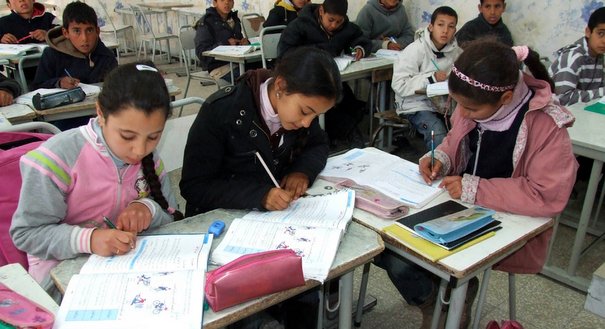
Revamping course content and methods of teaching are among the most significant steps the Arab world can take now. In this context, the education system should underscore the importance of a citizen's role in society. Students should be educated and prepared to be active citizens -- an approach that develops critical thinking and problem-solving skills for the 21st century while promoting equality, freedom, and respect for human rights.
Authoritarian Arab governments have long used education as a tool to curry public loyalty to the regime. This loyalty is transmitted through civic education at schools, thus reflecting the state's non-democratic ideology and laws. Curricula also include ethics that emphasize moral and religious values. Instruction in humanities and social sciences continue to drill obedience and submission to the regime rather than encourage freedom of thought.
The only participatory activity available to students in Tunisian public schools under the former regime, for example, was limited to cultural associations and sports clubs. Students were allowed to neither engage in policy-related debates nor bank on receiving tolerance or respect when their opinions differed from their teachers. Samia, a Tunisian student interviewed by the author about this state of affairs, elaborated further: "Young teachers are more understanding, as well as women, and are more willing to respect the student, while the older [teachers] say to you 'But what do you know?'. Young people have no right to stand up to their elders."
Teaching in most Arab states -- Tunisia and Egypt included -- continues to be far too didactic and teacher-directed rather than student-centered, and are adverse to environments that foster critical thinking, creativity, and problem-solving capacities. Communication in classrooms is one-sided; teachers talk at students and see textbooks as the only source of indisputable knowledge. As noted in international tests, notably the Trends in International Mathematics and Science Study (TIMSS), student learning relies on memorization of definitions, facts, and concepts rather than the ability to think critically. For example, about 70 percent of fourth graders in Tunisia and Egypt practice memorization of formulas and procedures in math, as compared to 18 percent in Ontario, Canada, and 27 percent in the state of Massachusetts in the United States.
The failure of the former dictators in Egypt and Tunisia to establish credible institutions of learning is evident. Tunisia's ousted President Zine el-Abidine Ben Ali introduced a series of changes to the education system in 2000, 2002, and 2004 that produced few positive outcomes, such as better facilities and higher student enrolment. However, the results of the TIMSS and Programme for International Student Assessment (PISA) -- international tests that compare students around the world -- reveal that Tunisian fourth and eighth graders consistently performed poorly compared with counterparts from some 60 countries in every continent around the world from 1995 to 2007. Fourth graders scored worse in 2007 than in 2003 in the TIMSS mathematics test, with the average score dropping from 339 to 327, a score significantly lower score than the global average of 500.
Even the most proficient Tunisian fourth graders performed poorly, failing to match even the average proficiency level of students from the top five performing countries. Fourth and eighth graders in Tunisia didn't fare much better on science exams. They continued to score well below the global average in the TIMSS test. In the PISA international test in mathematics, science, reading, and problem solving, Tunisian students again scored significantly below the average.
The Mubarak regime in Egypt also had a dismal record in education quality. There was no improvement as a result of the national reform plans in 1997 and 2003. Eighth graders who participated in the TIMSS international tests in mathematics and science scored poorly in both 2003 and 2007, falling significantly below the average of 500. Performance was unsatisfactory even among the brightest, most capable students.
In Egypt, the teachers, curricula, activities, and administration in public schools also failed to promote or support democratic values and practices. This is most clearly seen in the gap between the concept of citizenship espoused by the Ministry of Education and the content of social studies textbooks. Basic concepts in citizenship education, such as rule of law, social justice, and political participation, are rarely mentioned. And citizens' dependence on the government for provision of goods and services is exaggerated. The word "authority" prevails in the social studies textbooks compared to use of the word "citizen" (81 percent versus 47 percent, respectively), a clear indicator of state dominance over citizens and its efforts to create an education that perpetuates the system.
Past education reform in both Tunisia and Egypt failed to improve student learning or to equip students with skills that are required for success in the job market. The outgoing regimes created and perpetuated educational systems that produced dependent and submissive students that were not likely to challenge their rule. As Middle Eastern nations such as Egypt and Tunisia seek to democratize, however, the degree of active engagement by citizens in public life will ultimately determine the strength of their democratic consolidation. This requires a revolution in education systems that aims to empower students with 21st century skills which include citizenship capacities. Although there is no model that can fit to each case, countries such as Portugal, Romania, and Chile that transformed from dictatorships to democracies may provide useful experiences from which Arab states can draw. The experience of democratic Turkey as a predominantly Muslim country is also relevant.
A new initiative in education for citizenship should encompass a set of core learning outcomes (e.g., reflection on one's multiple identities, individual rights and responsibilities, equity, social justice), skills (e.g., creative thinking, effective communication), and values and dispositions (e.g., human dignity, freedom, respect for diversity) -- all of which promote democracy. Effective citizenship programs in established democracies combine learning at school with civic participation inside the school and in the community as well. But the first step would be to form a committee of education reformers who would lead this challenging task by involving various stakeholders: principals, teachers, students, politicians, NGOs, and community members. This daunting task also needs technical support and professional advice from agencies such as UNESCO, the International Association for the Evaluation of Educational Achievement (IEA), and the U.S. National Center for Learning and Citizenship (NCLC). Reforming education in emerging democracies of the Middle East may be more challenging than political democratization, but without it, the future of democracy will remain tenuous at best.
Former Senior Associate , Middle East Center
Faour was a senior associate at the Carnegie Middle East Center, where his research focused on education reform in Arab countries with an emphasis on citizenship education.
Recent Work
Muhammad Faour
Muhammad Faour
Carnegie does not take institutional positions on public policy issues; the views represented herein are those of the author(s) and do not necessarily reflect the views of Carnegie, its staff, or its trustees.

Radical-right parties are expected to do well in upcoming elections in four of the EU's biggest member states. If successful, they could prevent the union from addressing key challenges ahead.

Stefan Lehne

An overwhelming victory by a far-right-wing party in a small state in eastern Germany will have major repercussions for Chancellor Friedrich Merz’s coalition.

Judy Dempsey

In supporting Europe’s far-right, MAGA and Russia both want the same thing: a weaker EU. Europe must defend itself without abandoning the openness these forces exploit.

Armida van Rij

The hybrid warfare landscape is evolving rapidly, leaving policymakers without clear strategies. To better inform their work in addressing emerging challenges, governments must dig deeper into the underlying dynamics at play.


Raluca Csernatoni, Alicia Wanless

As the EU confronts profound challenges, several leaders have called for fundamental reform to the union’s model—but only modest, superficial changes have resulted. What if Europe really could be reimagined from zero today: What should such a redesigned European order look like?

Richard Youngs, ed.