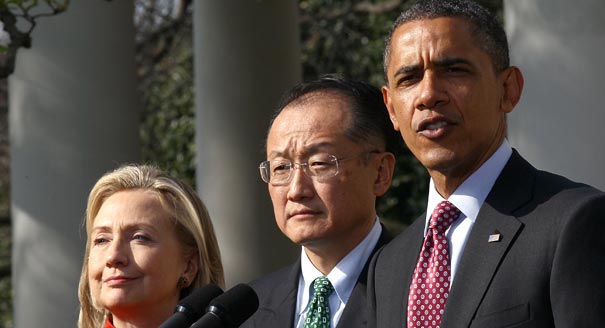
While Jim Yong Kim is a strong nominee for president of the World Bank, it is interesting to imagine how a more desirable and honest nomination process could unfold.
Economic growth or income redistribution? To alleviate poverty, which of the two should be given priority? Should governments invest in expanding the electricity grid to power new, job-producing private companies or use the money to subsidize health and education for the poor? It is an old, sterile, and ideologically charged debate -- one too often immune to evidence.
But it is now clear that a country can grow handsomely without either its poor or middle class having much to show for it -- and you don't need to look far for an example as the United States has exhibited these trends since 1980. Conversely, providing extensive safety nets, health, and education while deemphasizing growth can leave the poor poorer and cripple the economy. Just look to Cuba.
The lesson is that, in the hard art of development, both growth policies and social policies matter.
This means getting a currency's exchange rate and children's vaccine campaigns broadly right, managing schools and hospitals reasonably well, attracting investments by multinational corporations, establishing a viable microcredit facility, boosting agricultural production, and ensuring that urban slums have access to clean water. And so on. Development means getting at least some of these growth and social policies mostly right over a sustained period of time.
The paradox is that all of the above is as obvious as it is frequently ignored -- even by some of the smartest and well-meaning newcomers to these debates. Like Jim Yong Kim, the U.S. nominee to head the World Bank. According to the Financial Times, Kim is coming under fire over a book he co-authored that criticizes "neoliberalism" and "corporate-led economic growth" for making the middle classes and the poor in developing countries worse off in many cases.
We heavily discount what the book, a collection of co-edited essays published in 2000, tells us about what Kim thinks today. Nevertheless, the fact that this book is attracting so much attention illustrates some of the many underwater mines that the new president of the World Bank will have to navigate. Consider three big ones.
The first will be the very fact that Kim will be in the job. Despite the appearance of a contested selection process with other extremely worthy candidates like Ngozi Okonjo-Iweala, the Nigerian finance minister and former World Bank managing director, and despite all the protests that the process will be competitive, it is almost certain that Kim will be the next president of the World Bank. He only needed one vote, that of President Obama, and he got it last Friday.
As we have written, the process is a lamentable charade where everyone directly involved makes the effort to pretend that the selection process is fair, transparent, and based on merit. Through no fault of his own, this process will undermine Kim's legitimacy and authority from day one.
The second submerged water mine relates to the Bank's priorities. Kim will have only a few weeks of on-the-job training to be able to critically evaluate and guide the Bank's broad development approach. This is one decision he cannot delegate, yet it will require a grasp of the importance of about 20 broad sectors of Bank activity -- from financial deepening to trade and logistics to gender policies -- of which health delivery, Kim's specialty, is just one.
Among the people he will have to convince of the wisdom of his choices are his senior management, leaders of developing countries, the Bank's Executive Board, and the Bank Governors, who are typically finance ministers. Unlike Kim, most of these stakeholders will have decades of broad development strategy and economic policy experience behind them.
The third submerged water mine relates to the Bank's internal management. The World Bank is not just a huge store of knowledge and source of big development ideas; it really is a bank with an outstanding loan portfolio of nearly $200 billion. It directly or indirectly employs tens of thousands of people.
Banks must be managed properly. We know what happens when they are not. Kim's three-year tenure as president of Dartmouth College has given him some exposure to management, but the World Bank will feel like moving from skippering a coast guard cutter to commanding an aircraft carrier battle group.
The United States has put its best foot forward by nominating the impressive Jim Yong Kim as World Bank president. Yet, despite our belief that this is a done deal, it is surely interesting to imagine how a more desirable and honest scenario could unfold. Imagine, for example, that the United States could muster the will to step back (and ask other countries to do so as well) and let the process evolve unencumbered by political pressure and horse trading. Kim might actually prevail -- or he may not. But if he did, he would have the world behind him, and the wind in his sails.
Moisés Naím is a distinguished fellow at the Carnegie Endowment for International Peace, a best-selling author, and an internationally syndicated columnist.
Former Senior Associate, International Economics Program
Dadush was a senior associate at the Carnegie Endowment for International Peace. He focuses on trends in the global economy and is currently tracking developments in the eurozone crisis.
Carnegie does not take institutional positions on public policy issues; the views represented herein are those of the author(s) and do not necessarily reflect the views of Carnegie, its staff, or its trustees.
Amid uncertainty caused by the Iran war, the global drive for nonproliferation has stalled. With Europe diplomatically marginalized and countries reassessing their nuclear options, efforts to curb the spread of nuclear weapons risk becoming irrelevant.
Between the United States’ market-driven approach and China's state-led industrial strategy, Europe is reckoning with how it can remain competitive in the global economy. But is Europe in danger of becoming a U.S. or China colony?
The full list of humiliations Europe has endured since Donald Trump returned to the White House makes for grim reading. But Washington’s adversarial approach to its allies undermines its own power base.
After spending much of 2025 trying to placate Donald Trump, some European leaders are starting to change posture. But is even a hostile Washington still so important to Europe that the U.S. president’s outbursts are worth putting up with?
European leaders have now not only lost faith in Donald Trump’s U.S. presidency, but also in America’s hegemony as a whole. But short-term challenges make an immediate divorce unwise.