• Research
  • Strategic Europe
  • About
  • Experts
Carnegie Europe logoCarnegie lettermark logo
EUUkraine
  • Donate
{
  "authors": [
    "Judy Dempsey"
  ],
  "type": "legacyinthemedia",
  "centerAffiliationAll": "",
  "centers": [
    "Carnegie Endowment for International Peace",
    "Carnegie Europe"
  ],
  "collections": [],
  "englishNewsletterAll": "",
  "nonEnglishNewsletterAll": "",
  "primaryCenter": "Carnegie Europe",
  "programAffiliation": "",
  "programs": [],
  "projects": [],
  "regions": [
    "Europe"
  ],
  "topics": []
}
Source: Getty

In The Media
Carnegie Europe

Germany Making Jews Feel Unwelcome

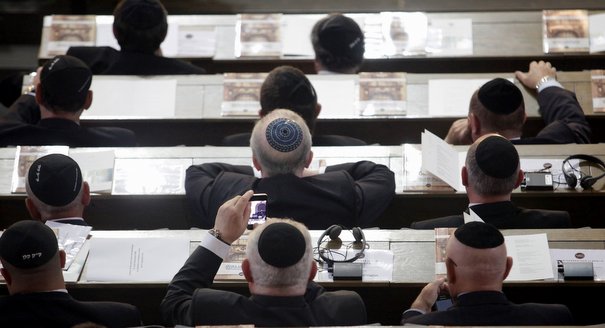
Following a regional court ruling that circumcision amounts to bodily injury, Germany's Jewish and Muslim communities are in uproar, seeing the court’s decision as an attack on their religious and cultural identity.

Link Copied
By Judy Dempsey
Published on Sep 17, 2012

Source: New York Times

A Jewish friend once told me something that I recalled when writing this week’s Letter from Europe about Germany and circumcision.

He said that there were three classes of Jews.
 
The first consisted of those who lived in Israel. The second were those who lived in the United States and other countries. And the third, and lowest, were those who lived in Germany.
 
Israeli leaders and the media vilified those Jews who decided to remain in Germany after 1945 or who had chosen to return to Germany if they had survived the Holocaust. They were considered traitors.
 
It must have been a very lonely time for those who made that extraordinary decision to live in Germany.
 
Today, Berlin is a different place. It is home to tens of thousands of Jews who have a bustling, lively community. They can worship in several synagogues, send their children to Jewish schools, have kosher shops and sign up for classes to learn Hebrew.
 
Berlin is hip, too. Each year, young Israelis throng to the German capital. The German authorities have made every effort to commemorate and show what Jewish life was before the Holocaust and how it is being slowly rebuilt.
 
What a change from the dark years of the 1950s, when West Germany’s total Jewish population was estimated at 10,000 to 15,000. More than 220,000 now live in Germany because many chose to settle here rather than move to Israel after the Soviet Union collapsed over two decades ago.
 
Indeed, Germany is now home to the fastest growing Jewish communities in Europe, as successive governments have made enormous efforts to make the Jews feel welcome, safe and free to practice their religion.
 
And that includes circumcision. Circumcision has become a controversial issue after a regional court in Cologne last June ruled that it amounted to bodily injury.
 
Since then doctors across Germany have stopped performing them, fearing prosecution. The Jewish and Muslim communities are in uproar, seeing the court’s decision as an attack on their religious and cultural identity. The German government is now rushing through a new law that would spell out that male circumcision is legal.
 
Of all countries, Germany is the one that can least afford to look inhospitable to Jews. Yet, ironically, it was here that a court first challenged the ritual. Now, all over Europe there is a growing debate about whether the practice should be continued.
 
This article originally appeared in the New York Times.

About the Author

Judy Dempsey

Nonresident Senior Fellow, Carnegie Europe

Dempsey is a nonresident senior fellow at Carnegie Europe

    Recent Work

  • Commentary
    Europe Needs to Hear What America is Saying

      Judy Dempsey

  • Commentary
    Babiš’s Victory in Czechia Is Not a Turning Point for European Populists

      Judy Dempsey

Judy Dempsey
Nonresident Senior Fellow, Carnegie Europe
Judy Dempsey
Europe

Carnegie does not take institutional positions on public policy issues; the views represented herein are those of the author(s) and do not necessarily reflect the views of Carnegie, its staff, or its trustees.

More Work from Carnegie Europe

  • Commentary
    Strategic Europe
    Taking the Pulse: Is France’s New Nuclear Doctrine Ambitious Enough?

    French President Emmanuel Macron has unveiled his country’s new nuclear doctrine. Are the changes he has made enough to reassure France’s European partners in the current geopolitical context?

      • Rym Momtaz

      Rym Momtaz, ed.

  • Commentary
    The Iran War’s Dangerous Fallout for Europe

    The drone strike on the British air base in Akrotiri brings Europe’s proximity to the conflict in Iran into sharp relief. In the fog of war, old tensions in the Eastern Mediterranean risk being reignited, and regional stakeholders must avoid escalation.

      Marc Pierini

  • Commentary
    Strategic Europe
    The EU Needs a Third Way in Iran

    European reactions to the war in Iran have lost sight of wider political dynamics. The EU must position itself for the next phase of the crisis without giving up on its principles.

      Richard Youngs

  • Trump United Nations multilateralism institutions 2236462680
    Article
    Resetting Cyber Relations with the United States

    For years, the United States anchored global cyber diplomacy. As Washington rethinks its leadership role, the launch of the UN’s Cyber Global Mechanism may test how allies adjust their engagement.

      • Christopher Painter

      Patryk Pawlak, Chris Painter

  • Commentary
    Strategic Europe
    Global Instability Makes Europe More Attractive, Not Less

    Europe isn’t as weak in the new geopolitics of power as many would believe. But to leverage its assets and claim a sphere of influence, Brussels must stop undercutting itself.

      Dimitar Bechev

Get more news and analysis from
Carnegie Europe
Carnegie Europe logo, white
Rue du Congrès, 151000 Brussels, Belgium
  • Research
  • Strategic Europe
  • About
  • Experts
  • Projects
  • Events
  • Contact
  • Careers
  • Privacy
  • For Media
  • Gender Equality Plan
Get more news and analysis from
Carnegie Europe
© 2026 Carnegie Endowment for International Peace. All rights reserved.







