

In The Media
David Rothkopf
{
  "authors": [
    "David Rothkopf"
  ],
  "type": "legacyinthemedia",
  "centerAffiliationAll": "",
  "centers": [
    "Carnegie Endowment for International Peace"
  ],
  "collections": [],
  "englishNewsletterAll": "",
  "nonEnglishNewsletterAll": "",
  "primaryCenter": "Carnegie Endowment for International Peace",
  "programAffiliation": "",
  "programs": [],
  "projects": [],
  "regions": [
    "North America",
    "United States"
  ],
  "topics": [
    "Political Reform",
    "Foreign Policy"
  ]
}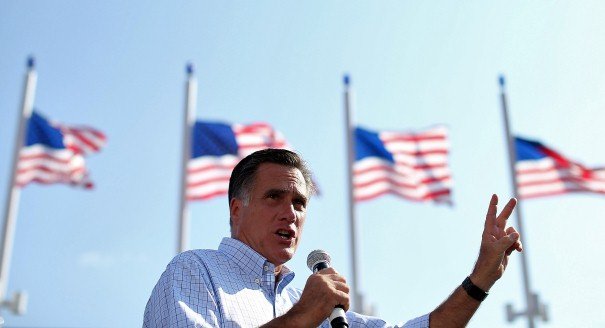
Source: Getty
Americans should shift their attention from the headlines about the non-stories of this pre-election month to the issues that really matter.
Source: Foreign Policy

Poof. What was that fellow's name again?
This is a surprise because the United States remains a deeply divided country politically. Opposition to the president remains strong, and his record remains spotty at best. It is a surprise because the past few weeks have seen bad news on the economic front and the unraveling of the story that Barack Obama is a foreign-policy master.
The race should be closer. By some reasoning, Romney should even be ahead. Heck, if Romney had gone on vacation to Lake Winnipesaukee for the past three weeks, he might be. But every time events have turned against the president -- from weak job numbers to bad manufacturing results, from the debacle in Libya to the rapid deterioration in Iraq, Afghanistan, Syria, and U.S.-Israel relations -- Romney has come to Obama's rescue with a boneheaded statement or some distracting gaffe of his own.
So now the swing-state polls suggest it is highly unlikely that the Republican candidate can orchestrate a victory. Behind by 9 percentage points in the latest Columbus Dispatch poll in the state he must win, Ohio, and trailing in eight of the nine Florida polls tracked by RealClearPolitics, Mitt has no clear path to 270 electoral votes. The media will spin this election up and down between now and Nov. 6 to try to create the illusion of drama, but stick a fork in it: The Romney goose is cooked.
Although this might be a letdown for political junkies, it is a relief for normal people who can tune out the incessant, mind-numbing, serially prevaricating television spots for the candidates and get on with their lives. Better to look ahead instead and start doing the planning for 2013 that the Obama White House, senior-level sources tell me, is not really doing right now. They're caught up in the election, and as a result they are letting a lot of big issues slide.
The result is that next year could be momentous on many fronts and even destabilizing on some. Let's give ourselves a head start and begin to consider just five of the most important challenges with international implications that Obama will face in the wake of his reelection victory:
Rebuilding his team: Out the door go Secretary of State Hillary Clinton, Treasury Secretary Timothy Geithner, and, if Defense Secretary Leon Panetta can push aside those trying to get him to stay on a little while into the new term, he will join them. So too will leave many other less visible members of an Obama team who are burned out, ready to make money, and/or disaffected. One senior official told me, "If Obama had his way, he'd probably do without having a cabinet altogether." He was referring to this White House's renowned neglect of its team, its tendency to micromanage or simply shut down initiatives from its cabinet departments, and the fact that a handful of people around the president think they can do it all themselves. (While everyone was stewing over why U.N. Ambassador Susan Rice offered an assessment of the Libya situation that was inconsistent with readily apparent reality, isn't it more offensive that this past weekend the White House thought it appropriate to have one of its political operatives, David Plouffe, serving as its spokesperson on sensitive foreign-policy issues … again?) Getting new talent in will be almost as tough as getting folks confirmed by a still deeply fractured Senate. Yet, much of Obama's legacy will depend on whether he finally becomes the leader of a strong Team of Rivals or whether he will opt for a Team of Staffers -- bland, back-bench choices who won't make waves and will require the president to do all the heavy lifting.
The fiscal cliff and beyond: The coming combination of required tax hikes and budget cuts will likely give the world a scare come year's end, but the president and Congress will probably paper together a deal that effectively does what they have done best for the past few years: Push off hard decisions into the future. If the markets tolerate this behavior, shame on them. But, because they like a good time as much as anyone (more, actually, because good times allow them to line their pockets now as insurance against the day when the fiscal chickens come home to roost), they probably will. And then the president and the Republicans will face the great litmus test of their collective legacies: Will they use the time they have bought themselves to fix problems, or will they continue to blame each other and leave it to their successors to clean up their mess?
The Middle East's worst year ever: It is hard to remember a time when the Middle East has not been fraught with tension. But it is impossible to remember a moment more dangerous than the one that looms ahead next year. Not only will the decision of whether to hit Iran before the country achieves nuclear weapons capability probably come due, but it will do so in the midst of a region caught up in an increasingly tense proxy war between, on one side, Iran and its Syrian and Hezbollah allies (and Russian enablers) and, on the other side, the Arab states that would seek to bring down Assad and contain Iran. Egypt and Libya are home to fragile reform efforts, and countries like Jordan, Bahrain, and Yemen are nervously studying their examples. The failure of the Palestinian leadership to lead and the failure of Israeli Prime Minister Benjamin Netanyahu's administration to be of any help exacerbate these problems. So too does the alarmingly rapid devolution of Iraq and the signs that the situation in Afghanistan is only going to get worse. Any one of these could trigger a regionwide conflict bigger and with greater global consequences than previous Middle Eastern crises -- and that's saying a lot, especially given that right now the United States has no strategy to deal with the situation and no inclination to get more deeply involved.
Europe will continue to struggle: As Obama seeks to harness modest U.S. growth and real comparative advantages such as cheap energy, good universities, strong intellectual property and legal regimes, deep wells of capital, and stability that other big economies could only dream of, the worst thing that could happen would be another big economic shock. Every time European leaders "solve" their problems, they forget to tell the people in the street who have to live with the austerity. That means political backlash is always a threat to Europe's recovery and therefore to America's fragile climb back.
China's new leadership will not have it easy: The incoming leaders of the world's most populous country are facing a soft-ish economy, confrontations with their neighbors in the South China Sea, incomplete political and economic reforms at home that have caused real tensions, scandal, and political infighting, and an America increasingly serious about getting tougher on trade and containing a rising China.
And there are other areas where potential problems could flare up. It was not much noticed, for example, that during his September trip to Asia, Defense Secretary Panetta made pointed references to the cyberthreat from China. But within the Obama administration, Panetta's decision to raise the profile of this growing problem was seen as significant -- "the tip of the iceberg," as one official put it to me. Given the possibility for constant, low-grade, nearly invisible, hard-to-trace, and hard-to-retaliate conflict between cyber-rivals, that could greatly make this tough relationship more difficult.
The rest of the world could pose its own problems. Increasingly, for example, Russia is behaving as an adversary, if not quite America's No. 1 geopolitical foe. Africa is going to be a growing source of concern due to extremist violence and greater U.S. economic interest in the region. The international financial system is not being appropriately overseen or regulated, and there are a number of vulnerable big financial institutions that will remain a cause for concern for years to come.
The stakes are enormous. They will affect Obama's legacy -- but more importantly, they could shape our lives for better or worse for decades to come. So better we should shift our attention from the screaming headlines about the non-stories of this pre-election month and raise our gaze over the horizon to the issues that really matter.
Former Visiting Scholar
David Rothkopf was a visiting scholar at the Carnegie Endowment as well as the former CEO and editor in chief of the FP Group.
Recent Work
David Rothkopf
David Rothkopf
Carnegie does not take institutional positions on public policy issues; the views represented herein are those of the author(s) and do not necessarily reflect the views of Carnegie, its staff, or its trustees.

Before the next wave of EU enlargement takes place, the union needs to grapple with thorny questions of how power is distributed among its members.


Emil Sondaj Hansen, Ditte Brasso Sørensen

The new U.S.–Denmark–Greenland agreement will help Washington exert political, economic, and financial dominance under the guise of security. Yet, it acknowledged Copenhagen’s and Nuuk’s sovereignty on the island.

Marc Pierini

A summer of escalation in the Black Sea has hurt Ukraine economically and is exacerbating world food security. A truce is needed—as is a broader reframing of Europe’s Ukraine strategy.

Thomas de Waal

Are Germany’s economic, industrial, and political struggles becoming a liability for the EU’s ability to rise to the geopolitical moment?

Rym Momtaz, ed.

European Commission President Ursula von der Leyen is about to give her annual address on the state of the EU. Here’s what she won’t—but should—say.
Rym Momtaz