

Research
- +10
Rosa Balfour, Frances Z. Brown, Yasmine Farouk, …
{
  "authors": [
    "Moisés Naím"
  ],
  "type": "legacyinthemedia",
  "centerAffiliationAll": "",
  "centers": [
    "Carnegie Endowment for International Peace"
  ],
  "collections": [],
  "englishNewsletterAll": "",
  "nonEnglishNewsletterAll": "",
  "primaryCenter": "Carnegie Endowment for International Peace",
  "programAffiliation": "",
  "programs": [],
  "projects": [],
  "regions": [
    "South Asia",
    "Pakistan",
    "Western Europe",
    "North America"
  ],
  "topics": [
    "Political Reform"
  ]
}
Source: Getty
The tragic stories of Malala Yousafzai and Savita Halappanavar illustrate how some modern societies still seek to prevent the spread of knowledge.
Source: El País

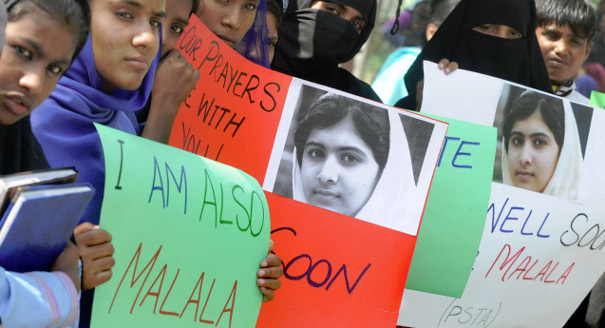
Ehsanullah Ehsan, spokesman for the Pakistani Taliban, claiming their responsibility for the attack, explained that Malala “is the symbol of the infidels, and of obscenity,” adding that, if she survives, they will try again to kill her. And also her father, Ziauddin, whom they blame for having brainwashed her. The first evidence of this brainwashing appeared when, Malala, then 12, at the urging of a BBC journalist, began to write a blog about aspects of her life under the Taliban, who at that time (2009) controlled the Swat Valley, where she lives in Mingora, the largest city there. This control meant that for girls going to school became dangerous or simply impossible as some schools for girls were shut down and others burned. Once the Pakistani army retook control of Swat, Malala became a public, lucid and highly articulate voice for the urgent need for Pakistan's government and society to do more to educate girls. For the Taliban, the preaching of such ideas carries a death sentence.
The attack on Malala produced international indignation and, what is more important, generated an indispensable debate within Pakistan.
Savita Halappanavar, is a 31-year-old dentist with Hindu origins who lived in Dublin. In principle, Ireland would seem to be a less dangerous place for women than the Swat Valley. However, an obscurantism not unlike that which almost killed Malala did kill Savita in Dublin. As she began her 17th week of pregnancy, she did not feel well, prompting her husband to take her to Galway’s university hospital. The diagnosis was as obvious as the necessary treatment. But medical logic clashed against the law; a clash that killed Savita. The doctors concluded that the fetus was not viable, and could not survive. Savita, despondent at the loss, finally resigned herself to it and, with her husband, requested an abortion. We can’t, the doctors explained. The law only allows it when the fetus’ heart ceases to beat. We must wait. And despite the couple’s protests and desperation, so it was. They were forced to wait. The fetus’ heart stopped on a Wednesday. Savita’s, the following Saturday.
The autopsy revealed that the cause of her death was septicemia, a generalized infection. Praveen Halappanavar, the husband, told the BBC: “It was our first baby, and she was on top of the world… She was so happy and everything was going well. There is no doubt that Savita would be alive today had we been able to terminate the pregnancy that finally killed her.”
Why is it that the protection of a fetus that is clearly not viable and has no hope of life is more important than the protection of a young mother of 31 in perfect health? You know the answer.
Malala’s failed murder and Savita’s death “for legal reasons” produced a wave of indignation around the world. Though global revulsion is far from sufficient to change things radically in Pakistan or Ireland, the two tragedies have produced some hopeful effects. Irish politicians have been forced to promise reforms to the laws that prevented doctors from saving Savita’s life, and in Pakistan it has become somewhat more difficult to defend the idea that girls don’t really need to go to school.
These changes are obviously not sufficient, and much remains to be done. But at least the stories of Malala and Savita have reminded the world that obscurantism is not a thing of the Middle Ages. It is here with us, in the 21st century. And is still claiming lives.

Distinguished Fellow
Moisés Naím is a distinguished fellow at the Carnegie Endowment for International Peace, a best-selling author, and an internationally syndicated columnist.
Recent Work



Rosa Balfour, Frances Z. Brown, Yasmine Farouk, …
Moisés Naím
Carnegie does not take institutional positions on public policy issues; the views represented herein are those of the author(s) and do not necessarily reflect the views of Carnegie, its staff, or its trustees.

Before the next wave of EU enlargement takes place, the union needs to grapple with thorny questions of how power is distributed among its members.


Emil Sondaj Hansen, Ditte Brasso Sørensen

Are Germany’s economic, industrial, and political struggles becoming a liability for the EU’s ability to rise to the geopolitical moment?

Rym Momtaz, ed.

In supporting Europe’s far-right, MAGA and Russia both want the same thing: a weaker EU. Europe must defend itself without abandoning the openness these forces exploit.

Armida van Rij

As we close out another season of Strategic Europe, it is worth taking stock of the deep shifts underway.
Rym Momtaz

As the EU confronts profound challenges, several leaders have called for fundamental reform to the union’s model—but only modest, superficial changes have resulted. What if Europe really could be reimagined from zero today: What should such a redesigned European order look like?

Richard Youngs, ed.