

Commentary
Sarah Chayes
{
  "authors": [
    "Sarah Chayes"
  ],
  "type": "legacyinthemedia",
  "centerAffiliationAll": "dc",
  "centers": [
    "Carnegie Endowment for International Peace"
  ],
  "collections": [],
  "englishNewsletterAll": "ctw",
  "nonEnglishNewsletterAll": "",
  "primaryCenter": "Carnegie Endowment for International Peace",
  "programAffiliation": "SAP",
  "programs": [
    "South Asia"
  ],
  "projects": [],
  "regions": [
    "North America",
    "United States"
  ],
  "topics": [
    "Military"
  ]
}
Source: Getty
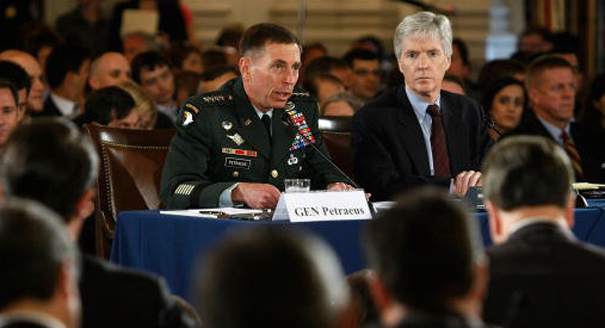
The scandal that toppled former CIA director David Petraeus had a real effect on hundreds of serving and former members of the military, on the standards underpinning the institution, on U.S. national security decision-making, and public integrity.
Source: Foreign Policy

Plenty of people were pleased to consider themselves acquaintances of Dave Petraeus. I have known him for about four years; we corresponded frequently about Afghanistan, and I served in his Kabul headquarters on loan from the Joint Staff during his transition into command in the summer of 2010. While real affection clearly infused some of these relationships, most were also transactional. People made professional mileage on their links to Petraeus; he used them to get his views out. They served him in one way or another; he rewarded them with positions, connections, or implicit endorsements.
Many of the same people consider themselves part of the national security community -- they make careers on their avowed expertise. But membership in such groups, with the stature and privileges it confers, entails responsibilities.In the e-mail chain from her PR advisors (left intact beneath her plea) is a remark about "the ‘sickeningly sexist' coverage" she has suffered to date. Broadwell would do better not to play that card. For she was the one who -- often arrayed in inappropriate clothes -- exploited her gender to gain an entree to people and venues that her credentials could not have secured.
Sadly, it worked.
Organizations that would never have given her a glance had she not been connected to Petraeus welcomed her once she was. Only her access allowed her to command the generous book advance she received -- for something she was unable to write herself. Invitations cascaded in: to a high-level panel at the very Kennedy School that had thrown her out a few years before, to the prestigious Aspen Security Forum, to the annual dinner honoring the forerunner of the CIA, or to a "major conference" on Afghan women and children. "Many members of the UNGA and int'l community, including former POTUSes, PMs, heads of state, and current foreign ministers will be present in the audience," she enthused in a September e-mail, which highlighted her membership on the executive board of such establishments as Women in International Security.
What exactly qualified Broadwell to travel in such circles? What motivation prompted so many of us to fawn over her this way? Why did serious reporters and think-tankers so easily set aside their critical analysis? These are questions the national security community might well ask as we consider the significance of this event.
Not that Petraeus was an innocent bystander. He promoted her into this environment -- and personally ushered her into an inner circle that was increasingly adulatory and resistant to critical views. He, no less than the rest of us, should weigh the quality of the character judgment such a lapse implies. Senior leaders like Petraeus appoint subordinates; they engage in hair-trigger interactions with hard-to-read counterparts. Character judgment matters.
Moreover, the suggestion that this was a purely private affair is inaccurate. Petraeus allowed it to spill over into his professional time and space, and to absorb resources that belonged in the fight. In Kabul, for example, Broadwell went along on so many "battlefield circulations" -- Petraeus's trips to visit subordinate commands aboard helicopters where seats were scarce -- that one staff member asked her if she could stay behind just occasionally, to leave room for officers who were actually working the issues to be discussed. "The general wants me along," the officer told me she replied.
When people are caught in an extramarital affair, and the imaginary world they have been avidly constructing abruptly implodes, leaving them flailing to right themselves amid the sharp-edged rubble, their first instinct is often to try to salvage something, anything. So perhaps Petraeus's energetic spinning in the days following his exposure was to be expected -- especially given his trademark practice of working aggressively to control messages that reflected on him. In this case, the effort was particularly transparent, since quotes from various friends and former staff members kept featuring the same vocabulary.
What was most disappointing was the absence in these statements by surrogates of any expression of remorse for the impact the pair's actions had on the institution that made them: the U.S. military. While a jolt of schadenfreude may have traversed some at news of the scandal, for others it has been deeply troubling. Troops -- whose bravery both Petraeus and Broadwell have often applauded -- are in the line of fire right now, many with their worldview badly dented. Two senior officers I know have spoken of their conversations with rattled company and battalion commanders. Many looked up to Petraeus as the ultimate role model. Others have seen their careers wrecked for much smaller lapses. Damage may be particularly great at the pair's alma mater, West Point. There and in our other military academies, young cadets or midshipmen are struggling, with perhaps more difficulty than before, to absorb lessons on the responsibility that goes with public service.
Repair after a personal crisis of these dimensions can lead to profound growth, but it requires a realization of what went wrong. For the moment, I don't see that either Petraeus or Broadwell, or members of the community that cosseted them, have made that realization. None has yet quite understood that this drama is not all about them.
Former Senior Fellow, Democracy, Conflict, and Governance Program
Sarah Chayes is internationally recognized for her innovative thinking on corruption and its implications. Her work explores how severe corruption can help prompt such crises as terrorism, revolutions and their violent aftermaths, and environmental degradation.
Recent Work
Sarah Chayes
Carnegie does not take institutional positions on public policy issues; the views represented herein are those of the author(s) and do not necessarily reflect the views of Carnegie, its staff, or its trustees.

Ahead of a tough winter for Ukraine, Donald Trump’s swing back toward Russia bodes ill. But instead of panicking, Kyiv’s European allies are focusing on action.

Rym Momtaz

While the EU and European governments are embracing the much-lauded middle-power moment, this entails three difficult conundrums.

Richard Youngs

Europe is facing rising populism internally as well as external pressures from Russia, China, Turkey, and the United States.

Dimitar Bechev

European NATO countries are wrestling with the possibility of U.S. disengagement from the alliance. With the continent’s security increasingly uncertain, governments must restore the credibility of their collective defense.



Hans-Dieter Lucas, Adam Thomson, Pierre Vimont

The new U.S.–Denmark–Greenland agreement will help Washington exert political, economic, and financial dominance under the guise of security. Yet, it acknowledged Copenhagen’s and Nuuk’s sovereignty on the island.

Marc Pierini