

Article
- +1
Toby Dalton, Mark Hibbs, Nicole Grajewski, …
{
  "authors": [
    "Mark Hibbs"
  ],
  "type": "legacyinthemedia",
  "centerAffiliationAll": "dc",
  "centers": [
    "Carnegie Endowment for International Peace"
  ],
  "collections": [
    "Japan's Nuclear Crisis"
  ],
  "englishNewsletterAll": "ctw",
  "nonEnglishNewsletterAll": "",
  "primaryCenter": "Carnegie Endowment for International Peace",
  "programAffiliation": "NPP",
  "programs": [
    "Nuclear Policy"
  ],
  "projects": [],
  "regions": [
    "Southeast Asia"
  ],
  "topics": [
    "Political Reform",
    "Climate Change",
    "Nuclear Policy",
    "Nuclear Energy"
  ]
}
Source: Getty
Nuclear power should not go forward in newcomer countries until they are prepared to master a number of technological, political, economic, and logistical challenges.
Source: Diplomat
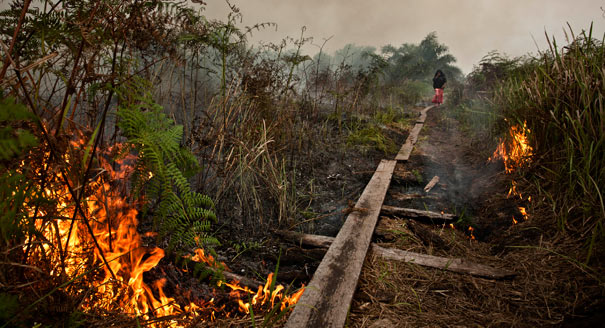
After forest fires raged across the island of Sumatra for a week, swaddling Singapore and parts of Malaysia in dense, toxic haze, Indonesian President Susilo Bambang Yudhoyono on June 24 was contrite. “I, as the president, apologize and seek the understanding of our brothers and sisters in Singapore and Malaysia,” Mr. Yudhoyono said. “Indonesia had no intention to cause this.”
But Indonesia has long failed to effectively manage this threat. For Indonesians, but also others in the region, the fires should be a wake-up call because their governments want to build nuclear power plants to generate carbon-free electricity their economies will need.
Beginning half a century ago, Indonesia has been putting laws and regulations on the books that assign responsibility to landowners and government regulators for responsible resource management. The record however suggests that Indonesia is not strictly implementing these rules. That’s bad news for Indonesia’s forests and for Asians who want to breathe clean air.In the case of a severe nuclear accident, the technological, political, economic and logistical challenges would be far greater than what’s involved in preventing or extinguishing fires. Nuclear power should not go forward in newcomer countries until they are prepared to master these challenges. That some politicians this month blamed foreign investors for the fires and blamed Indonesia’s neighbors for overreacting is not a sign that Indonesia is ready for nuclear power’s risks.
Two years ago, three power reactors melted down in Japan, one of the world’s most advanced, technology-driven nations. The accident happened despite Japan’s decades-long experience of designing, building, and operating over 50 of these units. It happened ultimately because leaders of Japan’s utility industry never really believed that a severe nuclear accident would occur, and because the central government failed to implement and enforce firm safety regulations. After the accident—just as Indonesia’s president did after the fires raged this month—Prime Minister Naoto Kan accepted personal responsibility. “As the person who was in charge of the country at the time of the accident, I sincerely apologize for my failure to stop it,” Kan said.
But Kan, who made his remarks last May in testimony to the Japanese parliament, also said words that Indonesians and others in the region should heed: “The biggest portion of the blame lies with the state.”
Indonesia in 1960 passed a law empowering the government to protect the environment. Since then it has not prevented runaway fires. For three months in 1997, burning Indonesian forests spewed toxic ash across a large swath of the region from Thailand to the Philippines. The total economic loss was over US $4 billion. Over 100 million people were exposed to acute health risks by an atmosphere laden with gases, dust, and particulates including carcinogens and mutagens.
The Indonesian state responded to this disaster in 1999 by promulgating forestry protection legislation that banned the burning of forests by landowners. Another government regulation in 2001 provided for specific fire protection measures. A 2007 act was passed to tighten regulation over licenses for palm oil plantations where many fires are started. Finally, in 2009 Indonesia’s parliament passed a national law on environmental protection.
None of this paperwork prevented this month’s devastation. Indonesia has vowed to investigate. A handful of farmers have been arrested for setting illegal fires. But critics fear that Indonesia lacks the political will to implement and enforce its environmental rules. The country is the world’s leading producer of palm oil, and its industry is influential. Forests have been decimated by burning to favor logging and agriculture. Much of the work is carried out by subcontractors. And this brings us back to Japan, which suffered a severe nuclear accident because regulators were not empowered to challenge that country’s powerful nuclear sector.
Indonesia has long harbored plans for nuclear power, and for good reasons. It needs energy sources that don’t emit carbon and will help cover fast-growing demand. Malaysia and Vietnam are making similar plans following the same logic. And Vietnam will go first, having agreed to import nuclear power plants from Russia.
Foreign governments whose nuclear industries are offering to help these countries are urging them to enact legislation to set up safety bodies and assign liability to plant owners. Establishing oversight bodies, passing laws, and joining international covenants are very important, crucial in fact. But as we saw in Japan in 2011, this doesn’t go far enough.
The lessons from Fukushima and Indonesia are the same: governments must do two things. First, they must ensure that infrastructure is in place to prevent and to cope with events which can cause severe domestic and extraterritorial environmental and human health damage. That requires capital investment in education and facilities. And second, they must empower regulators to stand up to powerful vested interests—whether utility companies in Japan’s megacities or agribusiness operations in Sumatra and Kalimantan.

Nonresident Senior Fellow, Nuclear Policy Program
Hibbs is a Germany-based nonresident senior fellow in Carnegie’s Nuclear Policy Program. His areas of expertise are nuclear verification and safeguards, multilateral nuclear trade policy, international nuclear cooperation, and nonproliferation arrangements.
Recent Work


Toby Dalton, Mark Hibbs, Nicole Grajewski, …
Mark Hibbs
Carnegie does not take institutional positions on public policy issues; the views represented herein are those of the author(s) and do not necessarily reflect the views of Carnegie, its staff, or its trustees.
The U.S.-Iran war has crossed a dangerous threshold: water infrastructure in the Gulf is now a target. Ecological statecraft is no longer peripheral to security, it's part of its foundations.


Olivia Lazard, Ali Bin Shahid
The closure of the Strait of Hormuz has triggered a global energy crisis, but Europe is stuck in reaction mode. Without more strategic foresight, the EU will remain dependent on fossil fuels and will never be truly secure.


Milo McBride, Pauline Gerard
Countries face several hurdles in joining the EU, including the final stage of ratifying their accession treaties. Procedural reforms and substantive adjustments could help move the process forward.

Stefan Lehne
Europe has an interest in supporting Armenian leader Nikol Pashinyan as he tries to make peace with neighbors and loosen ties with Russia. But it is depersonalized support in the long term, not quickfire flash, that will win the day.

Thomas de Waal
Montenegro and Albania are frontrunners for EU enlargement in the Western Balkans, but they can’t just sit back and wait. To meet their 2030 accession ambitions, they must make a strong positive case.


Dimitar Bechev, Iliriana Gjoni