


Article
- +1
Toby Dalton, Mark Hibbs, Nicole Grajewski, …
{
  "authors": [
    "Mark Hibbs"
  ],
  "type": "legacyinthemedia",
  "centerAffiliationAll": "dc",
  "centers": [
    "Carnegie Endowment for International Peace"
  ],
  "collections": [
    "U.S. Nuclear Policy"
  ],
  "englishNewsletterAll": "ctw",
  "nonEnglishNewsletterAll": "",
  "primaryCenter": "Carnegie Endowment for International Peace",
  "programAffiliation": "NPP",
  "programs": [
    "Nuclear Policy"
  ],
  "projects": [],
  "regions": [
    "North America",
    "United States",
    "Middle East",
    "Iran"
  ],
  "topics": [
    "Nuclear Policy",
    "Arms Control"
  ]
}
Source: Getty
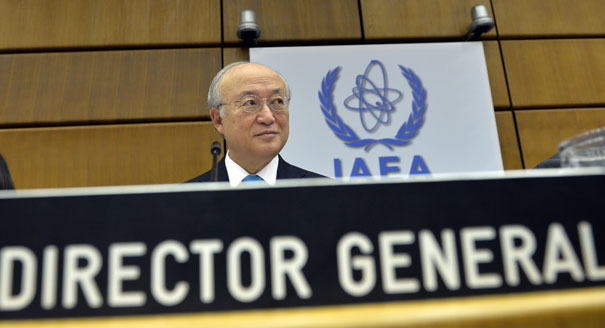
Transparency doesn’t factor into the IAEA’s routine work in Iran, which is mostly about monitoring and verifying the accounting of declared materials and activities. Instead, it’s a battleground in the IAEA’s efforts to arrive at a holistic picture of Iran’s nuclear history.
Source: Arms Control Wonk
Transparency is an elusive commodity in international nuclear affairs. Routinely cited as a universal virtue and not without a certain sanctimoniousness, this aspiration is sacrificed time and time again on the altar of political expediency.
Transparency doesn’t factor into the IAEA’s routine work in Iran, which is mostly about monitoring and verifying the accounting of declared materials and activities. Instead, it’s a battleground in the IAEA’s efforts to arrive at a holistic picture of Iran’s nuclear history, including things that Iran, so far, has not seen fit to declare. That includes what the IAEA calls “possible military dimensions” (PMD) of Iran’s nuclear program.
In this context, the use of the T-Word has been breathtaking. As pressure gradually builds toward the July 20 expiration date of the Joint Plan of Action’s “first step,” we have been told variously that there is a transparency deficit in Iran, that more transparency is on the way, that Iran is being more transparent in its relationship with the IAEA, and, conversely, that it isn’t.There is also the separate but related issue of how transparent should be the process by which the IAEA, the powers, and ultimately the Board of Governors conclude that enough is known about Iran’s past and perhaps current activities to warrant lifting sanctions and returning to routine verification.
Complete transparency would imply that the roles of the IAEA and the powers would be absolutely separate: The IAEA and Iran would confer in a different box from Iran’s negotiations with the powers, along the lines of the Framework for Cooperation which Iran and the IAEA concluded last November just before the powers and Iran followed up with the JPOA. When both tracks are finished the IAEA Secretariat, fully autonomously, would inform the Board of Governors about what it knows.
The real world is not so cut-and-dried. It might be useful to think of the state of play like a Venn diagram where the circles represent the interests and views of individual member states (including Iran and each of the six powers) plus the IAEA Secretariat; decisions emerge in the space where these sets intersect. Left to itself, that space might be quite opaque.
On paper, decisions might happen either in the IAEA General Conference, where all 162 member states convene, or in the 35-member Board of Governors. In fact, no significant decision in the Iran crisis has ever been taken at a General Conference, and the Board is too big, too indiscreet, too prone to division, and meets too infrequently to serve as the locus for sensitive discussions about Iran’s ongoing relationship with the IAEA as negotiations continue. Instead something like an iterative process takes place in bilateral meetings between the Secretariat and key member states and in small colloquia involving the six powers, Iran, and the IAEA. U.S. negotiators have acknowledged that the powers have been getting briefed by the IAEA on its progress with Iran on a monthly basis. It would be fair to assume that this discussion in fact takes place in something closer to real time.
It would certainly be a mistake to conclude, based on the pains taken in some quarters to underline that the Iran-powers track and the Iran-IAEA track are separate, that the IAEA and the powers will wait until the end of the negotiation of the “final step” to find out whether Iran is disclosing to the IAEA what the IAEA needs to know
It is in that light that we should consider this item published a few days ago by the Foreign Policy Research Institute, a mini-think tank which has no track record of having a strong interest in the details of how the IAEA, Iran, and the powers are handling PMD.
FPRI stops just short of asserting that the U.S. has pressed the IAEA to accept what it calls “limited disclosure” of PMD activities to facilitate making a deal with Iran. It documents that, since negotiations with Iran have accelerated after the election of President Hassan Rouhani, personalities involved in how the powers frame the PMD issue have departed from the view that Iran must “come clean” or “confess” that it had a nuclear weapons program. The author, Gary Gambill, pits in this debate David Albright and Bruno Tertrais, Gary Samore, and Emily Landau, Shimon Stein, and Ephraim Asculai against Jon Wolfsthal, Jofi Joseph, and Bob Einhorn.
Wendy Sherman, now negotiating with Iran on behalf of the U.S. State Department, is singled out by Gambill for having told Congress in 2011 that the U.S. “rallied the P5+1 to co-sponsor” an IAEA Board of Governors resolution “urging Iran to come clean about PMD,” while, in February 2014, she was vague about how the PMD issue would be put to rest.
Over the last half-year, I have asked officials from countries negotiating with Iran about the apparent shift on this issue. There are long answers (some of which are couched in legalese about what people think the IAEA’s legal mandate is and isn’t) but the exceedingly short answer is something like “That was then, and this is now,” because in 2014 Iran is at the table and in 2011 it wasn’t.
That brings us full circle to the T-Word. If the powers, the IAEA, and Iran all agree at the end of the day that they aim to retire the PMD conundrum, what will they say and on what basis will they decide? One conclusion by FPRI’s author might suggest that they will want to disclose as little as possible: “Insisting on full transparency may well jeopardize the progress of the negotiations.”
Nonresident Senior Fellow, Nuclear Policy Program
Hibbs is a Germany-based nonresident senior fellow in Carnegie’s Nuclear Policy Program. His areas of expertise are nuclear verification and safeguards, multilateral nuclear trade policy, international nuclear cooperation, and nonproliferation arrangements.
Recent Work


Toby Dalton, Mark Hibbs, Nicole Grajewski, …
Mark Hibbs
Carnegie does not take institutional positions on public policy issues; the views represented herein are those of the author(s) and do not necessarily reflect the views of Carnegie, its staff, or its trustees.

European NATO countries are wrestling with the possibility of U.S. disengagement from the alliance. With the continent’s security increasingly uncertain, governments must restore the credibility of their collective defense.



Hans-Dieter Lucas, Adam Thomson, Pierre Vimont

The new U.S.–Denmark–Greenland agreement will help Washington exert political, economic, and financial dominance under the guise of security. Yet, it acknowledged Copenhagen’s and Nuuk’s sovereignty on the island.

Marc Pierini

European Commission President Ursula von der Leyen is about to give her annual address on the state of the EU. Here’s what she won’t—but should—say.

Rym Momtaz

Radical-right parties are expected to do well in upcoming elections in four of the EU's biggest member states. If successful, they could prevent the union from addressing key challenges ahead.

Stefan Lehne

Canadian Prime Minister Mark Carney has twice inspired praise for standing up to U.S. President Donald Trump: at the 2026 World Economic Forum in Davos and on Canada-U.S. trade negotiations. Is Carney showing a third way better than the EU has in dealing with the Trump administration?
Rym Momtaz, ed.