

Commentary
As we close out another season of Strategic Europe, it is worth taking stock of the deep shifts underway.
Rym Momtaz
{
  "authors": [
    "Yuval Weber"
  ],
  "type": "commentary",
  "centerAffiliationAll": "",
  "centers": [
    "Carnegie Endowment for International Peace",
    "Carnegie Russia Eurasia Center"
  ],
  "collections": [],
  "englishNewsletterAll": "",
  "nonEnglishNewsletterAll": "",
  "primaryCenter": "Carnegie Endowment for International Peace",
  "programAffiliation": "",
  "programs": [],
  "projects": [],
  "regions": [
    "Eastern Europe",
    "Ukraine"
  ],
  "topics": [
    "Political Reform",
    "Civil Society"
  ]
}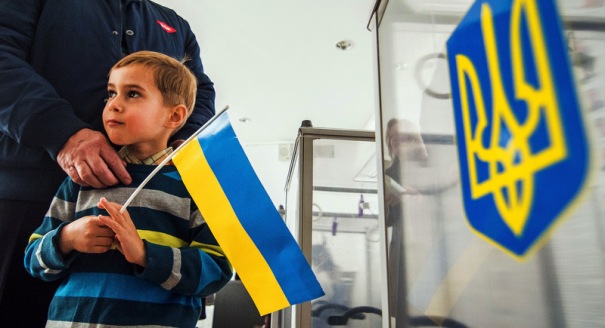
Source: Getty
The Ukrainian government retains the prerogative to exclude violators of public trust from further government service while new political and economic institutions are built. It remains to be seen how lustration and anti-corruption laws will be implemented.
Sunday’s parliamentary elections in Ukraine confirmed the electorate’s preference for a pro-European government promising to address the immediate economic and security challenges the country faces. The success of President Petro Poroshenko’s eponymous bloc and other pro-Western parties hinges not only on delivering peace and economic security, but, perhaps more crucially, on implementing institutional reforms to stamp out the corruption that has bedeviled the economy and exacerbated political polarization since the earliest days of independence.
Public anger over an opaque political system that rewards corrupt insiders at the expense of the public good has been at the heart of large-scale political protests in Ukraine since the Orange Revolution in 2004. Recent pre-election opinion polls put the struggle against corruption and concerns over the economy as the first and second most important issues affecting Ukrainian citizens across all age groups and nearly all regions.
Accordingly, Euromaidan protestors and subsequently the Ukrainian electorate demanded the lustration of officials connected to the Yanukovych regime and an end to the corruption responsible for Ukraine’s anemic post-Soviet economic performance. The previous Verkhovna Rada responded by passing a lustration law on September 17 (signed into law by President Poroshenko on October 9) that creates an audit mechanism to screen people with dubious histories and loyalties. On October 23, Poroshenko signed into law a bill creating a National Anti-Corruption Bureau to address endemic corruption. With support for the current lustration bill hovering at around 57 percent and general support for lustration of some kind at nearly 80 percent, passing such laws in the run-up to an election was smart electoral politics.
Yet the failure to implement lustration and anti-corruption measures transparently and evenhandedly could easily torpedo the current government and plunge Ukraine back into political struggle. Lustration is a social process in which a new political administration identifies officials who actively participated in violations of human rights during previous regimes and potentially bars them from participation in public affairs. When pursued to achieve truth and reconciliation, as across Latin America and Sub-Saharan Africa after the fall of military regimes, or to expose the corrosion of public trust through secret police forces in Communist regimes in Central Europe, lustration aims to identify what was wrong in the past, punish those who benefited, and then draw a line between the past and the present to rebuild political and social institutions.
The consequences of having overly broad lustration processes can be seen in the de-Ba’athification that occurred in Iraq after the ouster of Saddam Hussein. As part of the dismantling of that regime, the entire Ba’ath Party was outlawed, its members expelled from public service, and the Iraqi Army, secret police, and paramilitary units disbanded. Though it is true that those “power ministries” were responsible for grievous human rights abuses, de-Ba’athification largely disenfranchised the Sunni community and placed the population at risk for revenge from those they had previously brutalized. Without formal ways to defend themselves and without opportunities for participation in post-Hussein Iraq, the disbanded military and purged political community became the Sunni insurgency that plagues Iraq and the larger Middle East (ISIS) to this day.
The lustration process in Ukraine cuts deep into the ranks of those who served in the previous Yanukovych regime, affecting anyone associated with pacification of the Maidan protests, as well as Soviet-era political officials. The law as designed has “lopsided regional effects” and fails to provide a procedure to allow a person who knows he has violated the public trust to apologize, come clean, and apply for reinstatement even if he or she wants to contribute positively to a new political system. Lustration in its current iteration does not provide an incentive for moderate officials who served under Yanukovych in the east of the country to place their allegiance with the Ukrainian state, which would weaken support for the rebels—essentially a group of individuals who feared revenge and disenfranchisement—and potentially bring an end to the civil war.
The Ukrainian government retains the prerogative and responsibility to exclude violators of public trust from further government service while new political and economic institutions are built. It remains to be seen how lustration and anti-corruption laws will be implemented. It is unclear that endemic corruption resulted merely from the personal characteristics of individuals and not from a perverse incentive structure. Transparency, public participation, and some mechanism to prevent lustration from degenerating into “score-settling” would serve the Ukrainian government and public best in their long-term goals.
Yuval Weber, PhD, is an Associate Professor in the National Research University—Higher School of Economics.
Yuval Weber
Carnegie does not take institutional positions on public policy issues; the views represented herein are those of the author(s) and do not necessarily reflect the views of Carnegie, its staff, or its trustees.
As we close out another season of Strategic Europe, it is worth taking stock of the deep shifts underway.

Rym Momtaz
The EU had to compromise to adopt a twenty-first sanctions package against Russia, exposing growing cracks in the union’s resolve. Is this latest, weaker round worth it to keep pressure on Moscow?
Rym Momtaz, ed.

Trump is distracted and Ukraine wants Europe to step up. The continent’s leaders must find their voice and assert it in talks with Russia.

Alissa de Carbonnel

Mounting economic strain and battlefield losses will not necessarily make the Kremlin less dangerous. They could instead push Moscow toward a more aggressive hybrid campaign designed to test NATO’s Eastern flank, exploit allied hesitation, and fracture European resolve.

Maksym Beznosiuk

Over the past ten years, NATO has held almost as many summits as it did during the entirety of the Cold War. Are they still useful, or is it time to stop holding annual meetings?
Rym Momtaz, ed.