

Commentary
Thomas de Waal
{
  "authors": [
    "Thomas de Waal"
  ],
  "type": "commentary",
  "centerAffiliationAll": "",
  "centers": [
    "Carnegie Endowment for International Peace",
    "Carnegie Europe",
    "Carnegie Russia Eurasia Center"
  ],
  "collections": [],
  "englishNewsletterAll": "",
  "nonEnglishNewsletterAll": "",
  "primaryCenter": "Carnegie Europe",
  "programAffiliation": "",
  "programs": [],
  "projects": [],
  "regions": [
    "Caucasus",
    "Georgia"
  ],
  "topics": [
    "Political Reform"
  ]
}
Source: Getty
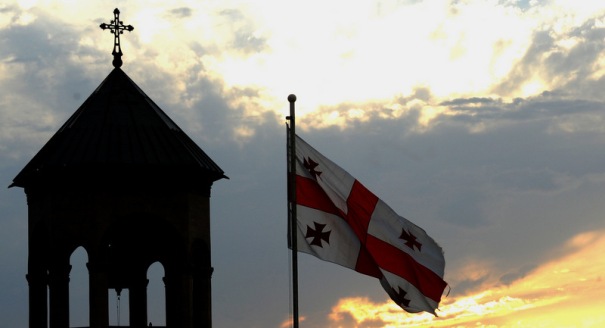
The unity of the Georgian Dream coalition has ended and the next election has already begun, only two years after the previous one. A break-up of this big coalition was inevitable; the only surprise is that it has happened so soon.
Georgia’s governing Georgian Dream coalition was always a marriage of convenience, held together more by opposition to the previous administration of Mikheil Saakashvili than a common political agenda.
But the working assumption was that it would hold together until the next elections in 2016, that a diverse group had more to gain by hanging together than by fighting with each other.
That assumption came crashing down on Tuesday. Defense Minister Irakli Alasania was sacked by Prime Minister Irakli Garibashvili. The crisis kicked off last week when one former and four current defense minister officials came under criminal investigation for an alleged crooked procurement contract. Alasania, who was in Germany at the time, denounced the charges as politically motivated and an “attack on Georgia’s Euro-Atlantic choice.” Garibashvili then dismissed Alasania for disobedience.
Both Washington and Brussels have sent out warning signals in recent months over criminal prosecutions against members of the former government. There was not much fuss raised over the prosecution of Saakashvili’s two main enforcers and hard men, Bacho Akhalaia and Vano Merabishvili. But there was anger that, despite repeated warnings, Saakashvili himself, now in exile in New York, was prosecuted and even more so when David Bakradze, the most moderate member of the previous government who had worked effectively with Georgian Dream in parliament, came under investigation.
The big question is whether Alasania’s departure will bring down the government. Long unhappy behind the scenes, he has no reason to want to prolong its life. Already one fellow minister from his Free Democrats party, European Integration Minister Alexi Petriashvili has stepped down too. The two high-profile women in the cabinet, Foreign Minister Maia Panjikidze (who also happens to be Alasania’s sister-in-law) and Justice Minister Tea Tsulukiani, may follow suit.
The ten parliamentary deputies of the Free Democrats will now leave the majority group in the parliament. That poses a big dilemma for the Republicans, the other main Western-leaning Georgian party, and for speaker of parliament and former Republican Party leader, David Usupashvili. Usupashvili commands at least another nine votes in parliament. His political sympathies are undoubtedly close to Alasania’s but he will be reluctant to break the government he helped create.
These two parties are the most organized in Georgian Dream which is otherwise a rather ramshackle coalition of celebrities, Orthodox nationalists and secular liberals. Even if a few other deputies peel away from the parliamentary majority, the surest mathematical route to defeating the government for the Free Democrats involves a tricky decision: whether or not to ally with the 51 votes of a party they despise, Saakashvili’s United National Movement, now the opposition minority.
According to the new version of the Georgian constitution, it needs half of the 150 parliamentarians to support a no-confidence vote in the government. If the president vetoes the resolution, it can be overturned by 90 votes.
A constitutional crisis would suddenly give Margvelashvili, whose powers are otherwise quite limited, a lot of leverage.Tweet This
Observers of the Georgian political scene will immediately notice that the President Giorgi Margvelashvili has clashed repeatedly with the prime minister in recent months, although the two were seen to make up recently. Speaking in Vienna, the president made a pointed remark about former Prime Minister Bidzina Ivanishvili apparently still pulling the strings. Margvelashvili said, "The country should be ruled with strong institutions and not from the backstage."
A constitutional crisis would suddenly give Margvelashvili, whose powers are otherwise quite limited, a lot of leverage.
Prime Minister Garibashvili may postpone a showdown for now. But the unity of the Georgian Dream coalition has ended and the next election has already begun, only two years after the previous one. A break-up of this big coalition was inevitable. The only surprise is that it has happened so soon.

Senior Fellow, Carnegie Europe
Thomas de Waal is a senior fellow at Carnegie Europe, specializing in Eastern Europe and the Caucasus.
Recent Work
Thomas de Waal
Thomas de Waal
Carnegie does not take institutional positions on public policy issues; the views represented herein are those of the author(s) and do not necessarily reflect the views of Carnegie, its staff, or its trustees.

A notable degree of participative democracy has firmly arrived in Europe. But to have more far-reaching impact, democratic deliberation needs to move into a radically new phase.

Richard Youngs

Much has been said of the changes Brussels is trying to make to the EU enlargement process. Here’s why gradual integration might—or might not—be the answer.

Dimitar Bechev

Before the next wave of EU enlargement takes place, the union needs to grapple with thorny questions of how power is distributed among its members.


Emil Sondaj Hansen, Ditte Brasso Sørensen

As the EU confronts profound challenges, several leaders have called for fundamental reform to the union’s model—but only modest, superficial changes have resulted. What if Europe really could be reimagined from zero today: What should such a redesigned European order look like?
Richard Youngs, ed.
Preparing candidate countries for EU membership is no longer enough. As the enlargement process becomes a reality, the union must also prepare its own societies.

Iliriana Gjoni