

Commentary
Alexander Baunov
{
  "authors": [
    "Alexander Baunov"
  ],
  "type": "commentary",
  "centerAffiliationAll": "",
  "centers": [
    "Carnegie Endowment for International Peace",
    "Carnegie Russia Eurasia Center"
  ],
  "collections": [
    "Inside Russia"
  ],
  "englishNewsletterAll": "",
  "nonEnglishNewsletterAll": "",
  "primaryCenter": "Carnegie Endowment for International Peace",
  "programAffiliation": "",
  "programs": [],
  "projects": [],
  "regions": [
    "Caucasus",
    "Russia"
  ],
  "topics": [
    "Political Reform",
    "Security"
  ]
}
Source: Getty
The perpetrators of violence have staked their claim to power, or at least a more active role in formulating the regime’s identity and methods. If we are to assume that the president is not directly linked to Nemtsov’s murder, it seems that someone else wants to push Putin in a more decisive and punitive direction.
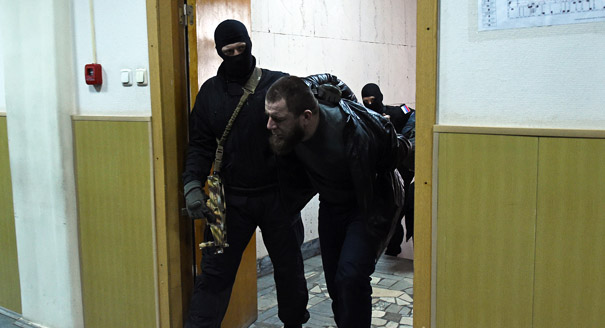
The world is at once pleased and disappointed. Slain liberal dissident Boris Nemtsov’s accused killers were rounded up much sooner than expected. Yet no satisfactory explanations for their actions have emerged. We are told that Zaur Dadayev, the main suspect, has confessed so we “we shouldn’t expect any high-profile profile exposures or arrests.” It’s all very straightforward: “there is no mastermind behind the crime; [the murderers] came up with it on their own.”
It has become fashionable to be offended by religious intolerance and zealotry. On the surface, the narrative of Nemtsov’s murder taps into this trend. Yet Nemtsov’s allegedly strident comments on the Charlie Hebdo attack weren’t terribly drastic by international or even Russian standards. On the contrary, they were quite subdued: for example, “The centuries will pass; Islam will mature, and the terrorism will become a piece of history…” If he had actually said something extreme, it would’ve been discussed long before his murder, not after. Besides Nemtsov, hundreds of politicians, journalists, and bloggers lashed out at Islamic extremists far more harshly, defending the cartoonists far more energetically. Even Sergey Lavrov took up the mantra of free speech, serving as the most prominent Russian participant in the Paris rally after the Charlie Hebdo killings.
But perhaps we shouldn’t over-rationalize the killers’ choice of victim. Maybe they don’t engage in historical or linguistic research to determine which politicians and journalists most deserve to be punished. Maybe they don’t conduct comparative studies and tally up the number of “strong” and “not-so-strong” statements to determine the enemies of the Prophet or Russia. They have a far more straightforward approach: here’s an enemy; let’s annihilate him.The question is: how exactly did the victim appear on the killer’s radar?
“Everyone who knows Zaur says that he is a deeply religious man and that he, like all Muslims, was shocked by Charlie’s actions and the comments in support of printing the cartoons,” Chechen leader Ramzan Kadyrov wrote on Instagram. So he was shocked by the cartoons and decided to kill Nemtsov? How, exactly, are these dots connected? Mustn’t someone have connected these dots in the killer’s mind?
Regardless of how readily people are offended and look for an offender, it is hard to imagine that Dadayev or any of his accomplices arrested over the weekend have been closely following the politics of the Russian opposition. It is hard to imagine they read political blogs or listen to talk radio.
To test this theory out, we could ask the suspects to name other enemies of their faith and of the homeland; they might be hard-pressed to utter even a few names or identify their transgressions. Most likely, in the lead-up to Nemtsov’s murder, they had only a vague idea of who these enemies of the Prophet, Russia, and Chechnya were. Somebody had to point the villains out to them: really, why should they themselves look when there are people who know better?
Alternatively, someone could have paid them to kill the enemy. The fee would have offset the risks that such men of honor subjected themselves to. The choice of victim was unlikely inspired by simply watching TV; someone must have dropped a hint or even offered a monetary benefit.
On the other hand, predatory instincts may have helped the killers identify a victim: the best prey is weak and unprotected. Sharpening distinctions between friends and enemies or patriots and traitors make it easier to believe that the legal protections don’t apply to enemies. One may think that you can even get away with eliminating an enemy. No one will grieve; in fact, the killer will be praised. If he is actually punished, the punishment may be less severe than if one of their own had been killed.
The chain along which the instructions to kill the enemy traveled may have been short or long. Or it could have been even longer than in some money laundering cases. But this chain has one distinct characteristic. For the West—as well as for some Russians—Vladimir Putin surely was the first link. And until the murderers were found and paraded in front of the cameras, Western public opinion breathlessly portrayed Putin as a rival of the murder victim. If the killers were told that no one would be upset about the death of an enemy and that no one would go after them, they were surely deceived.
Putin didn’t want to bear sole responsibility for Nemtsov’s murder, especially if he wasn’t the one who actually ordered the killing. Assuming this is actually the case, he should be rather frightened by the murder. It would suggest that the killing broke the Russian regime’s (or, more specifically, the Kremlin’s) monopoly on controlling dissent and punishing dissenters—especially by such extreme means. The Kremlin clearly does not want government and law enforcement officials, let alone concerned citizens, to start punishing enemies at their own discretion and leaving the ruling elite holding the bag. It’s one thing when there’s political violence at the local level. But killing Boris Nemtsov, an internationally famous opposition leader, is a whole different matter entirely.
If the Kremlin didn’t order the murder, then a speedy investigation and high-visibility arrests are the next best thing. They are the ruling class’s defiant attempt to regain the monopoly on violence. After all, it’s one thing to identify enemies as a warning sign to the opposition, to consolidate power, or to keep them handy for future purposes. It is quite another thing is to discover that the future has arrived on its own. The perpetrators of violence have thus staked their claim to power, or at least a more active role in formulating the regime’s identity and methods. In other words, someone is reshaping the regime by using the instruments it previously set aside for itself.
From the ruling class’s perspective, it is witnessing the rage of the machines—the uprising of hammers, chisels, and saws. But in this uprising, the tools think that their owner is not who he once was. He can’t do the job. He can’t manage anymore.
If we are to assume that the president is not directly linked to Nemtsov’s murder, it seems that someone else wants to push Putin in a more decisive and punitive direction. Besides, burdened by the Nemtsov affair, Putin becomes an even weaker figure on the international stage, where he is already not terribly welcome. He practically can’t visit Western countries. Therefore, both the agenda he is advancing and any agreements guaranteed by his words or deeds carry less weight. Take, for example, the Minsk peace agreements, which many dislike. Some believe that Russia opted for peace too soon. Others question his commitment to a capitalist economy, believing that economy should serve the state and its interests more actively. And since the West runs the capitalist world now, it is impossible to oppose such a system while remaining in it. It is time to leave.
All these explanations are part of a search for deeper meaning. But there are quite a few people up at the highest echelon of the regime who simply live life according to the maxim: “Cross me, and you will be punished. Otherwise, no one will respect me anymore.”
But while restoring its monopoly on political violence, the regime is not ready to openly elevate in the chain of command some former Chechen police officers operating in the guise of “true patriots.”
The West’s Dostoyevskian “you have killed” letter to Putin will likely move Russia and the West even farther apart. After all, from the Russian perspective, did the avengers of Islam do something truly wrong? In this country, two women have already served time for desecrating a place of worship, the parliament wants to jail a theater director for a blasphemous play, and a so-called million-man march condemning those murdered in the Paris attack was held in a key regional capital? At most, the killers merely overstepped their bounds.
That’s what Kadyrov’s surprised Instagram post is actually about. Perhaps the accused actually did commit a crime. But they weren’t wrong. They just went ahead without the regime’s approval.
Behind the accused Islamists who got a chance to say that they “love the Prophet,” we can catch the glimpses of the Grozny march, the Novosibirsk bishop with a criminal case against the play, and the throngs of believers who are being urged from the very top to more actively assert their values. This looks a lot like the Kremlin, just seen from a slightly different perspective.

Senior Fellow, Editor-in-Chief, Carnegie Russia Eurasia Center
Baunov is a senior fellow and editor-in-chief at the Carnegie Russia Eurasia Center.
Recent Work
Alexander Baunov
Alexander Baunov
Carnegie does not take institutional positions on public policy issues; the views represented herein are those of the author(s) and do not necessarily reflect the views of Carnegie, its staff, or its trustees.

Are Germany’s economic, industrial, and political struggles becoming a liability for the EU’s ability to rise to the geopolitical moment?

Rym Momtaz, ed.

European Commission President Ursula von der Leyen is about to give her annual address on the state of the EU. Here’s what she won’t—but should—say.
Rym Momtaz

The EU’s responses to two recent incidents expose the gulf between European perceptions and capabilities. Unless the union can bridge that gap, it will never become a real geostrategic power.
Rym Momtaz

European states control several Overseas Countries and Territories around the world that carry strategic, economic, and environmental weight. As great powers challenge the rules-based order, defending them is a geopolitical imperative for Europe.

Marc Pierini

In supporting Europe’s far-right, MAGA and Russia both want the same thing: a weaker EU. Europe must defend itself without abandoning the openness these forces exploit.

Armida van Rij