

Paper
Renad Mansour, Faleh A. Jabar
{
  "authors": [
    "Renad Mansour"
  ],
  "type": "legacyinthemedia",
  "centerAffiliationAll": "dc",
  "centers": [
    "Carnegie Endowment for International Peace",
    "Malcolm H. Kerr Carnegie Middle East Center"
  ],
  "collections": [],
  "englishNewsletterAll": "menaTransitions",
  "nonEnglishNewsletterAll": "",
  "primaryCenter": "Malcolm H. Kerr Carnegie Middle East Center",
  "programAffiliation": "MEP",
  "programs": [
    "Middle East"
  ],
  "projects": [],
  "regions": [
    "Gulf",
    "Iraq",
    "Middle East"
  ],
  "topics": [
    "Political Reform",
    "Security"
  ]
}
Source: Getty
Retaking Tikrit from the Islamic State is a symbolic step in the much larger campaign of regaining Sunni trust in Iraq.
Source: El País
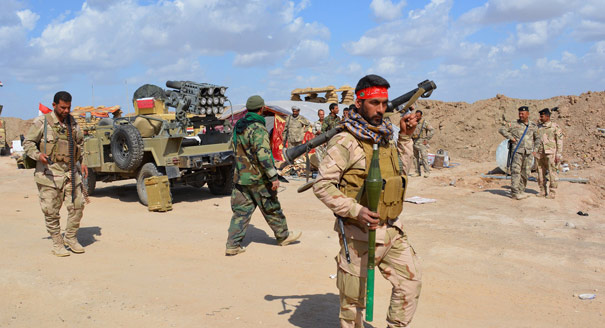
On Sunday, Iraqi Prime Minister Haider al-Abadi declared a new offensive to liberate Tikrit from the self-proclaimed Islamic State. From this order, the Iraqi Security Force (ISF) and the powerful Popular Mobilization Force, which consists of thousands of Shia militiamen, swiftly advanced on the city from five different sides.
In the fight against IS, the battle for Tikrit is highly symbolic. Since June 2014, IS has controlled the city, only 180 kilometers from Baghdad. There have been several failed attempts to retake the city. According to Abadi, this time is “the last chance” for the local Sunni tribal fighters to realign themselves with pro-government forces and flush IS out of Iraq. This is also perceived to be one of Abadi’s last chances to prove his leadership ability as Commander in Chief.Tikrit holds historical significance. Its village of Ouija was former Iraqi President Saddam Hussein’s hometown. During his reign, the people of Tikrit were privileged. This was overturned in 2003, when the long-favored Sunni group began to feel it was an oppressed minority in a Shia-led and Iranian-backed country. Former Prime Minister Nouri al-Maliki’s centralization policies further disenfranchised the Sunni tribes in Tikrit. The Islamic State’s leadership, realizing this resentment, moved into Tikrit, where it was welcomed by some Sunni tribal elements.
This honeymoon phase is now long over. The group’s inability to provide basic services, such as electricity and water, has not boded well for the city’s residents, who are now seeking alternatives.
Retaking Tikrit is an important step in the Iraqi government’s attempt to reclaim sovereignty. So close to Baghdad, its occupation by IS and Iraqi Sunni fighters, such as the Naqshbandia Order, a group filled with former Ba’athists, threatens Iraq’s security and symbolizes Baghdad’s institutional weakness.
Retaking Tikrit from the Islamic State is a symbolic step to the much larger campaign of regaining Sunni trust in Iraq. This is the political solution necessary for driving IS out. The Sunni tribes from all over Iraq are carefully watching the conduct of the Shia militias, which they despise. Many of the Shia fighters, traumatized by the massacre at Camp Speicher where IS executed some 1500 Shia ISF air cadets, may be seeking revenge. Yet, an important trust-building sign in the battle for Tikrit will be for the ISF and Shia fighters to drive IS out and restore autonomy to the local groups, without targeting Iraqi Sunnis extra-legally in acts of revenge. Abadi’s pardon to IS collaborators is an important step.
Finally, if trust is regained in a successful offensive on Tikrit, the much anticipated and greater battle for Mosul will become easier, and will happen sooner rather than later.
This article was originally published in Spanish by El País.

Former El-Erian Fellow, Middle East Center
Mansour was an El-Erian fellow at the Carnegie Middle East Center, where his research focuses on Iraq, Iran, and Kurdish affairs.
Recent Work
Renad Mansour, Faleh A. Jabar
Renad Mansour
Carnegie does not take institutional positions on public policy issues; the views represented herein are those of the author(s) and do not necessarily reflect the views of Carnegie, its staff, or its trustees.

Russia is testing the waters of NATO’s mutual defense clause. What do strikes in Romanian territorial waters mean for the alliance’s posture toward Moscow?

Dimitar Bechev

With its public finances in shambles, the far right polling at 35 percent ahead of the 2027 presidential election, and a growing protest movement, is France’s crisis a threat to the EU’s geopolitical awakening?

Rym Momtaz, ed.

Europe is facing rising populism internally as well as external pressures from Russia, China, Turkey, and the United States.
Dimitar Bechev

A notable degree of participative democracy has firmly arrived in Europe. But to have more far-reaching impact, democratic deliberation needs to move into a radically new phase.

Richard Youngs

Before the next wave of EU enlargement takes place, the union needs to grapple with thorny questions of how power is distributed among its members.


Emil Sondaj Hansen, Ditte Brasso Sørensen