

Article
Frederic Grare
{
  "authors": [
    "Frederic Grare"
  ],
  "type": "legacyinthemedia",
  "centerAffiliationAll": "dc",
  "centers": [
    "Carnegie Endowment for International Peace"
  ],
  "collections": [],
  "englishNewsletterAll": "ctw",
  "nonEnglishNewsletterAll": "",
  "primaryCenter": "Carnegie Endowment for International Peace",
  "programAffiliation": "SAP",
  "programs": [
    "South Asia"
  ],
  "projects": [],
  "regions": [
    "United States",
    "South Asia",
    "Afghanistan",
    "Pakistan"
  ],
  "topics": [
    "Security",
    "Military"
  ]
}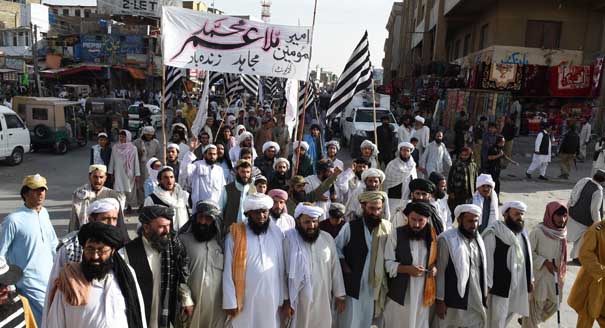
Source: Getty
Confirmation of the death of Taliban’s last unifying figure could set back the peace process in Afghanistan.
Source: Indian Express
Ever since the announcement of the death of Mullah Omar, the Taliban amir al-mu’minin (commander of the faithful), by the Afghan authorities, experts have been pondering the future of the so-called “reconciliation” process in Afghanistan. Talks had taken place in Murree, Pakistan, on July 7, sponsored by Pakistan, China and the United States. Following the announcement of Mullah Omar’s death, a second meeting scheduled for July 31 was cancelled.
Concluding that this move has killed the reconciliation process in Afghanistan would, however, be an exaggeration, if for no other reason than because such a process had barely started. Reconciliation is by definition a long-term endeavour, likely to take months, if not years, and fragile until its very end, as it can be jeopardised at any stage by developments on the ground.
Moreover, the conditions for an early and successful completion of a peace process were not met. The insurgency, on the offensive in various parts of the country, currently has no incentive to negotiate as, despite a few setbacks here and there, it believes it can still expect a military victory once the foreign troops leave Afghanistan.The announcement of Mullah Omar’s death will nevertheless have several important consequences, the importance of which is still difficult to assess.
“Reconciliation” has always been a divisive issue within the Taliban. Its office in Doha had initially declared that the July 7 meeting in Pakistan was invalid because the Taliban office in Qatar, officially in charge of negotiations, was not represented. Yet, the authority of Mullah Omar, who, on the occasion of Eid ul-Fitr, had supposedly issued a statement endorsing the negotiations to end the conflict, was sufficient to temporarily smooth over the differences.
The announcement of his death, therefore, also means the disappearance of the last unifying figure of the Taliban movement.
How this will play out in Afghanistan is unclear. Conflicted legitimacy has been the story of the country ever since the Saur revolution in 1978, and has only been made more complicated over the years by the elimination of layer after layer of existing elites. In a sense, the emergence of the Taliban in 1994 was a response to this problem. Mullah Omar, a respected veteran leader of the anti-Soviet jihad and self-proclaimed commander of the faithful, incarnated a form of religious legitimacy that was so far uncontested, even though differences existed over strategy. With the announcement of his death, the legitimacy issue is now also haunting the Taliban movement.
The Quetta Shura has moved quickly to ensure the succession of Mullah Omar and named Mullah Akhtar Mansour, its deputy chief, as the successor. However, the leadership question is far from settled as the mistrust, an inevitable result of more than two years of lies — if Afghan officials are to be believed, Mullah Omar died in April 2013 in a Karachi hospital — will further complicate the matter. Mullah Yacoub, the 26-year-old son of Mullah Omar, is said to claim to be his father’s successor and is likely to be followed by other hardliners.
This could lead to more Taliban field commanders joining the Islamic State, which, so far in Afghanistan, is no more than the rebranding of disgruntled Taliban factions. The decisive factor in this regard will most likely be the outcome of the fighting season. Should the Taliban make significant gains on the ground, the need for the movement to negotiate will further diminish and so will de facto cease to be a divisive issue, possibly consolidating the new leadership. Should, on the contrary, the Afghan security forces manage to successfully contain the summer offensives, the likelihood of many commanders joining the IS will increase. The way the succession struggle will affect military operations remains to be seen.
Pakistan is another victim of the ongoing process. For years, Islamabad has had a dual discourse. It did say, on the one hand, that it has much more limited outreach in Afghanistan than usually thought, including within the Taliban movement, which Murree proved to be true. But, at the same time, it pretended to be indispensable for the resolution of the conflict. The two propositions were compatible as long as Islamabad’s objective was to spoil Western efforts in Afghanistan while keeping the US engaged. The control over part of the Taliban was sufficient given their convergence of interests with the larger insurgency. Engineering a peace agreement is, however, a different kind of endeavour, for which differences between the various Taliban factions will be an impediment. Even if an agreement is signed under the aegis of Pakistan, large parts of the Taliban movement will remain suspicious. This is even more true for the Afghan population, for whom Pakistan is by definition behind everything negative in the country.
Afghan President Ashraf Ghani is another collateral victim. True, a potential fragmentation of the insurgency would defeat its hope to seize power in the foreseeable future, but it would also deprive the Afghan president of interlocutors in future negotiations. The apparent weakening of Pakistan’s position, even if temporary, is also a blow to his own strategy. Ghani has invested a considerable amount of political capital in a rapprochement with Islamabad, based on the assumption that only peace with Pakistan can bring peace to Afghanistan. Not only may his efforts not be rewarded due to Islamabad’s incapacity or inability to deliver, but they may prove to be counterproductive as illustrated by the recent fiasco of the cooperation agreement signed by the intelligence agencies of Pakistan and Afghanistan.
Ultimately, the announcement of Mullah Omar’s death is also a setback for the US administration. It did not change the ground situation but years of patient effort to build the narrative of a “mission accomplished”, authorising the US withdrawal despite residual problems, has been reduced to nil. What remains is the very real risk of a return to the pre-2001 situation. The conditions for a peace process have, for the time being, disappeared.
Former Nonresident Senior Fellow, South Asia Program
Frédéric Grare was a nonresident senior fellow at the Carnegie Endowment for International Peace, where his research focuses on Indo-Pacific dynamics, the search for a security architecture, and South Asia Security issues.
Recent Work
Frederic Grare
Frederic Grare
Carnegie does not take institutional positions on public policy issues; the views represented herein are those of the author(s) and do not necessarily reflect the views of Carnegie, its staff, or its trustees.

Are Germany’s economic, industrial, and political struggles becoming a liability for the EU’s ability to rise to the geopolitical moment?

Rym Momtaz, ed.

European Commission President Ursula von der Leyen is about to give her annual address on the state of the EU. Here’s what she won’t—but should—say.
Rym Momtaz

Radical-right parties are expected to do well in upcoming elections in four of the EU's biggest member states. If successful, they could prevent the union from addressing key challenges ahead.

Stefan Lehne

Canadian Prime Minister Mark Carney has twice inspired praise for standing up to U.S. President Donald Trump: at the 2026 World Economic Forum in Davos and on Canada-U.S. trade negotiations. Is Carney showing a third way better than the EU has in dealing with the Trump administration?
Rym Momtaz, ed.

European states control several Overseas Countries and Territories around the world that carry strategic, economic, and environmental weight. As great powers challenge the rules-based order, defending them is a geopolitical imperative for Europe.

Marc Pierini