

Commentary
Balázs Jarábik
{
  "authors": [
    "Balázs Jarábik"
  ],
  "type": "other",
  "centerAffiliationAll": "dc",
  "centers": [
    "Carnegie Endowment for International Peace"
  ],
  "collections": [],
  "englishNewsletterAll": "ctw",
  "nonEnglishNewsletterAll": "",
  "primaryCenter": "Carnegie Endowment for International Peace",
  "programAffiliation": "russia",
  "programs": [
    "Russia and Eurasia"
  ],
  "projects": [
    "Reforming Ukraine"
  ],
  "regions": [
    "Eastern Europe",
    "Ukraine"
  ],
  "topics": []
}
Source: Getty
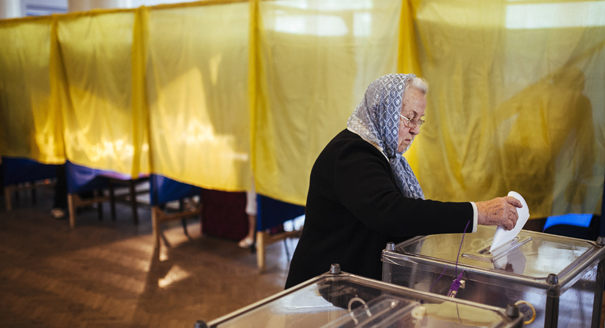
Ukrainians will go to the polls on October 25 to choose their mayors and local council deputies.
Ukrainians will go to the polls on October 25 to choose their mayors and local council deputies. The vote will take place throughout the country, with the exception of Russian-occupied Crimea, rebel-controlled Donbas, and a handful of municipalities adjacent to the conflict zone where Kyiv has deemed it unsafe to hold elections.
These elections will be important as the first gauge of the government’s performance since the parliamentary elections of October 2014, and will empower a new cohort of local politicians who will be responsible for the implementation of the decentralization reforms currently being debated in the Rada.
The results will also likely determine the next moves for the ruling coalition, namely whether President Petro Poroshenko will feel the need to reshuffle the government or schedule another parliamentary election.
Although recent public opinion surveys show high public interest in the elections—71 percent of respondents in a recent IFES survey said they were likely to vote—past experience suggests that the turnout may in fact be below 50 percent. The IFES poll shows that 12.8 percent of very likely voters support Poroshenko’s and Kyiv Mayor Vitali Klitschko’s Solidarity bloc; 10.5 percent favor former prime minister Yulia Tymoshenko’s Batkivshchyna party; 8 percent support Lviv Mayor Andriy Sadovyi’s Samopomich party; 6.4 percent support the Radical Party; 4.1 percent—the Opposition Bloc; 3.1 percent—Right Sector; and 11 percent—other parties. Thirty-six percent of voters are undecided. Only Solidarity has support across the entire country; other parties rely largely on regional strongholds.
The dirty campaigning of the pre-Maidan era is alive and well. Over 130 blocs and parties have fielded candidates. A number of the so-called “technical candidates” reportedly have been entered in the race with the apparent sole purpose of undermining the competition and confusing voters. Several new parties are reportedly being funded by Party of Regions’ affiliated businessmen, as well as oligarch Ihor Kolomoysky who has conducted a vigorous anti-Poroshenko campaign since being dismissed from his post as governor of Dnepropetrovsk in March. These new parties include the new patriotic party Ukrop and several local parties. Some of them have measurable support thanks to massive billboard and television advertising campaigns.
Public opinion surveys also indicate a general decline in public confidence in political leaders. According to IFES, Poroshenko’s confidence rating is down to 32 percent, from 69 percent a year ago. Prime Minister Arseniy Yatsenyuk is faring even worse: his confidence rating is down from 60 percent to 20 percent. His People’s Front party has not even registered candidates in this election. Tymoshenko, whose confidence rating has risen to 25 percent from 17 percent last year, is the only key figure whose approval has gone up. A strong showing by Tymoshenko and her Batkivshchyna party in the October 25 election could enable her to force Poroshenko’s hand into calling an early parliamentary election. Tymoshenko appears likely to emerge as Poroshenko’s biggest rival as a result, thus possibly leaving him little choice but to seek an alliance with the Opposition Bloc.
Poroshenko’s goal appears to be to ensure his party’s dominant position at the local level. To achieve that, he reportedly has made concessions to local strongmen in key cities like Kharkiv and Odessa. Poroshenko will probably want to avoid early parliamentary elections and will try to sustain the current ruling coalition.
Although local elections are not supposed to impact the implementation of the Minsk accords, which is in the hands of the central government in Kyiv, a strong showing by the Opposition Bloc and Tymoshenko’s Batkivshchyna could weaken Poroshenko’s hand.
Poroshenko will need to muster 300 votes in the Rada to pass the decentralization legislation. In order to do that, he will need the support of the nationalist-patriotic-leaning parties and the Opposition Bloc. Poroshenko will need a major concession from Russia in order to get their votes, which appears unlikely. The prospect of Tymoshenko’s strong showing in the election makes the likelihood of the decentralization package passing the Rada even smaller, and as a result raises new doubts about the implementation of the Minsk accords.

Political analyst, former Slovak diplomat, and consultant specializing in Eastern Europe
Recent Work
Balázs Jarábik
Balázs Jarábik
Carnegie does not take institutional positions on public policy issues; the views represented herein are those of the author(s) and do not necessarily reflect the views of Carnegie, its staff, or its trustees.

Much has been said of the changes Brussels is trying to make to the EU enlargement process. Here’s why gradual integration might—or might not—be the answer.

Dimitar Bechev

The domestic impacts of how long it is taking to end the war in Ukraine have pushed the French electorate to the political extremes and compromised the country’s diplomatic capacity.

Rym Momtaz

Before the next wave of EU enlargement takes place, the union needs to grapple with thorny questions of how power is distributed among its members.


Emil Sondaj Hansen, Ditte Brasso Sørensen

A summer of escalation in the Black Sea has hurt Ukraine economically and is exacerbating world food security. A truce is needed—as is a broader reframing of Europe’s Ukraine strategy.

Thomas de Waal

European Commission President Ursula von der Leyen is about to give her annual address on the state of the EU. Here’s what she won’t—but should—say.
Rym Momtaz